Startup India (DPIIT) Registration in Delhi NCR – 2026 Rules

In a Nutshell: Startup India (DPIIT) Registration in 2026

Startup India registration is official recognition by DPIIT that your entity is an eligible startup. Since 4 February 2026 the rules are set by notification G.S.R. 108(E), which doubled the turnover ceiling and added a Deep Tech category. Recognition is free, is applied for on the National Single Window System (NSWS), and unlocks the startup tax holiday, IPR rebates, tender relaxations and funding schemes. Startup Advisory handles DPIIT recognition and the tax-holiday application end-to-end from Saket, New Delhi.

  • Who qualifies: Pvt Ltd (including OPC), LLP, registered partnership or cooperative society; up to 10 years old; turnover up to ₹200 crore in every year; innovative or scalable model.
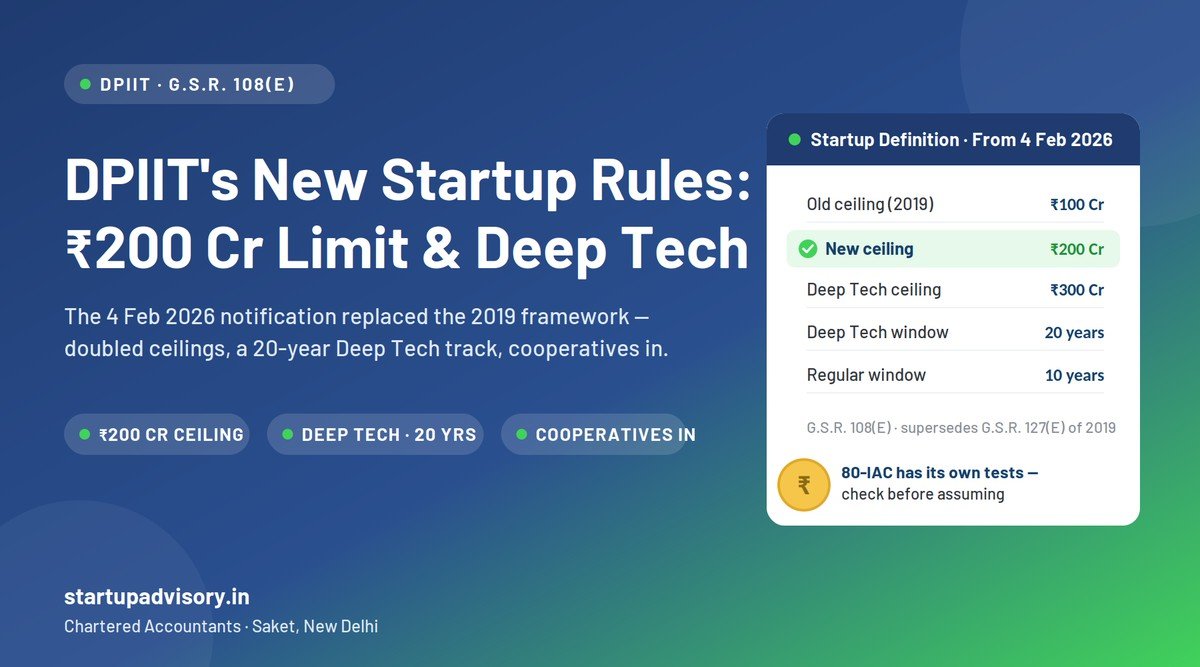
  • Deep Tech Startups: recognition for up to 20 years with a ₹300 crore turnover ceiling.
  • Tax holiday: 100% deduction for 3 consecutive years out of 10 — Section 140 of the Income-tax Act, 2025 (old Section 80-IAC), for companies and LLPs incorporated by 31 March 2030; turnover limit raised to ₹300 crore from Tax Year 2026-27; needs a separate IMB certificate.
  • Fee: ₹0 government fee; typical recognition time a few working days to two weeks for a complete application.
  • Coverage: Delhi, Gurugram (Gurgaon), Noida, Greater Noida, Ghaziabad & Faridabad — 100% online. Call 9311972982.

Updated 16 September 2026 to reflect G.S.R. 108(E) (4 Feb 2026), the Finance Act, 2026 and the Income-tax Act, 2025.

Reviewed by CA Neeraj Rohilla, FCA — Chartered Accountant, Startup Advisory, Saket, New Delhi.

Get DPIIT Recognised Under the 2026 Rules

Share a few details and our CA-led team in Saket will call you back to check your eligibility and start your Startup India application.

Call now: 9311972982

Startup Advisory provides end-to-end Startup India (DPIIT) registration in Delhi NCR – for startups in Delhi, Gurugram (Gurgaon), Noida, Greater Noida, Ghaziabad and Faridabad. Get DPIIT recognition under the 2026 rules, the Section 140 (old 80-IAC) tax holiday and funding eligibility, handled 100% online by our CA-led team in Saket, South Delhi. Call 9311972982. New to the process? Whether you're looking to register a startup for the first time or add DPIIT recognition to an existing company, start with our step-by-step guide on how to register a startup in Delhi.

Empower Your Startup Journey with DPIIT Recognition

Launch your venture with confidence. Get Startup India recognition and access tax benefits, government tenders, funding, and more. Our experts guide you through the entire DPIIT registration process seamlessly.
Book a Free Consultation

What Changed for Startups in 2026

  • New startup definition (4 February 2026): DPIIT notification G.S.R. 108(E) replaced G.S.R. 127(E) of 2019. The turnover ceiling for regular startups rose from ₹100 crore to ₹200 crore; a Deep Tech Startup category gets 20 years and ₹300 crore; cooperative societies became eligible; and a negative list restricts how recognised startups use their funds. Read the full analysis.
  • Tax holiday renumbered and widened: from 1 April 2026 the Section 80-IAC deduction lives in Section 140 of the Income-tax Act, 2025. The Finance Act, 2026 raised its turnover limit from ₹100 crore to ₹300 crore from Tax Year 2026-27. The incorporation window still runs to 31 March 2030.
  • Applications through NSWS: recognition is applied for on the National Single Window System, still with no government fee.
  • Funding: the Union Cabinet approved a ₹10,000 crore Fund of Funds for Startups 2.0 on 14 February 2026; the Credit Guarantee Scheme for Startups covers loans up to ₹20 crore per borrower; the Startup India Seed Fund Scheme closed to new startup applications in 2026.

DPIIT Startup Eligibility in 2026 (G.S.R. 108(E))

ConditionStartupDeep Tech Startup
Eligible entitiesPrivate Limited Company (including OPC), LLP, registered partnership firm, multi-state or State/UT cooperative society — incorporated or registered in India. Sole proprietorships are not eligible.
Age limitUp to 10 years from incorporationUp to 20 years from incorporation
Turnover ceiling₹200 crore in every financial year since incorporation₹300 crore in every financial year since incorporation
Business testInnovation, development or improvement of products, processes or services, or a scalable model with high potential for employment or wealth creationBusiness based on new scientific or engineering knowledge, significant R&D spend, and novel IP being created or owned with a plan to commercialise it
ExcludedEntities formed by splitting up or reconstructing an existing business
Use of fundsNegative list: no investment in non-core real estate, luxury assets or speculative instruments; breach can cost recognition and benefits

Recognition and the tax holiday are two different tests. A partnership firm or cooperative can be DPIIT-recognised, but only a company or LLP can claim the Section 140 deduction — and the tax holiday has its own ₹300 crore turnover limit and needs an Inter-Ministerial Board certificate. See DPIIT recognition in 2026 for worked examples.

How to Get DPIIT Recognition: Step-by-Step

  1. Incorporate the right entity. Choose a Pvt Ltd or LLP if you want the tax holiday or equity investors — we register it for you in 5–7 working days.
  2. Check eligibility. Age, turnover history, whether the business is new (not a reconstruction), and whether a Deep Tech classification is realistic.
  3. Prepare the innovation write-up. The decisive part — what is new or scalable, backed by evidence such as a working product, users, IP filings or R&D spend.
  4. Apply on NSWS. Create an NSWS account, add the central approval "Registration as a Startup", fill the entity, founder and business details and upload the documents. No government fee.
  5. Respond to queries and receive the certificate. DPIIT issues a recognition number and certificate, typically within a few working days to two weeks.
  6. Apply for the tax holiday. File the Inter-Ministerial Board application for Section 140 (old 80-IAC) once you are recognised — why IMB applications get rejected.
Startup India DPIIT recognition benefits for Delhi NCR startups

Benefits of DPIIT Recognition in 2026

1. 100% tax holiday for 3 years — Section 140 (old Section 80-IAC)
An IMB-certified Private Limited Company or LLP can deduct 100% of the profits of its eligible business for any 3 consecutive years out of its first 10. Conditions: incorporated between 1 April 2016 and 31 March 2030, DPIIT-recognised, and turnover within ₹300 crore from Tax Year 2026-27 (₹100 crore for years under the old Section 80-IAC). MAT/AMT and the choice of tax regime still need planning. Tax holiday guide.
Why it matters: zero income tax on profits during three growth years.
2. No angel tax, and protected losses
Section 56(2)(viib) (angel tax) does not apply from AY 2025-26 and has no equivalent in the Income-tax Act, 2025. IMB-certified startups can also carry forward losses of their first ten years despite a change in shareholding, provided the original shareholders continue to hold their shares (old Section 79, now Section 119). Angel tax explained.
Why it matters: fund-raising above fair value no longer triggers tax, and early losses survive new investment rounds.
3. Funding and credit access
Recognition makes you eligible for capital from AIFs backed by the Fund of Funds for Startups (including the ₹10,000 crore Fund of Funds 2.0 approved in February 2026), collateral-free loans under the Credit Guarantee Scheme for Startups (up to ₹20 crore per borrower), the RDI scheme for deep-tech ventures, and state startup policies. The Seed Fund Scheme is closed to new applicants. What is actually open in 2026.
Why it matters: DPIIT recognition is the entry ticket for most government-linked startup capital.
4. Cheaper, faster IP protection
An 80% rebate on patent filing fees, a 50% rebate on trademark fees and expedited examination of patent applications.
Why it matters: protects your core innovation at a fraction of the normal cost.
5. Public procurement relaxations
Relaxation of prior-experience, prior-turnover and earnest money deposit conditions in many central government tenders, subject to meeting quality and technical specifications, plus access to government buyers on GeM.
Why it matters: lets a young company bid for contracts it would otherwise be screened out of.
6. Lighter compliance and an easier exit
Self-certification under specified labour and environmental laws for a limited period after incorporation (with the four Labour Codes in force since 21 November 2025, confirm the current list on the Startup India portal before relying on it), and access to the fast-track insolvency route under the Insolvency and Bankruptcy Code.
Why it matters: fewer inspections while you build, and a quicker route out if the venture does not work.

More in Startup India benefits beyond tax and our government funding support service.

Cost of Startup India (DPIIT) Registration

Good news: DPIIT recognition itself is free. The Government of India charges no fee for Startup India recognition on the official portal – you only pay a professional fee if you want an expert to prepare your application, innovation write-up and Section 140 (old 80-IAC) tax-holiday filing correctly the first time. Most rejections happen because the innovation/scalability note is weak or the documents are incomplete, which is exactly what our CA team handles.

What's free vs. what you pay for:
  • Government / DPIIT fee: ₹0 – there is no official charge for recognition.
  • Professional fee (optional): a one-time fee for end-to-end application, innovation write-up and follow-up – quoted upfront, with no hidden charges.
  • Prerequisite: you must already have a registered Pvt Ltd, LLP, partnership firm or cooperative society – we can register that for you first if needed.

Want the exact professional fee for your startup? Call 9311972982 for a transparent quote, or read more in our guide on DPIIT startup recognition.

Documents Required for Startup India Registration

  • Certificate of Incorporation / LLP agreement / partnership deed / cooperative registration certificate

  • PAN of the entity

  • Details of directors, partners or members and authorised representative

  • Innovation / scalability write-up (what is new, the problem solved, the revenue model)

  • Website, product link or pitch deck (recommended)

  • Evidence such as patents or trademarks filed, awards, users or R&D spend (strengthens the case; essential for Deep Tech)


Documents checklist for DPIIT startup recognition

Why Choose Startup-Advisory for Your Startup India Registration?

  • Complete Documentation & Filing Support

  • Inter-Ministerial Board Application for the Section 140 (old 80-IAC) Tax Holiday

  • Patent & Trademark Filing at Startup Fee Rebates

  • Timely Follow-ups on NSWS and with DPIIT

  • Post-recognition Business Support for Tenders & Funding

Ready to Unlock Government Startup Benefits?

Get DPIIT Recognition with Startup Advisory — usually within two weeks of a complete application

Call Now: 9311972982 Email: hello@startupadvisory.in
100% Online Process Across India
Book a Free Consultation Now

Frequently Asked Questions (FAQs)

Startup India registration is official recognition of an eligible entity as a startup by DPIIT (Department for Promotion of Industry and Internal Trade). Since 4 February 2026 it is governed by notification G.S.R. 108(E). Recognition is free and is the gateway to the startup tax holiday (Section 80-IAC, now Section 140 of the Income-tax Act, 2025), IPR fee rebates, public-procurement relaxations and government funding schemes. Startup Advisory handles the application end-to-end for founders across Delhi NCR.

Under G.S.R. 108(E) dated 4 February 2026, an entity qualifies if it is a Private Limited Company (including an OPC), an LLP, a registered partnership firm or a cooperative society; is not more than 10 years old; has had turnover of not more than ₹200 crore in every year since incorporation; works on innovation or a scalable business model; and was not formed by splitting up or reconstructing an existing business. A Deep Tech Startup can stay recognised for up to 20 years with a ₹300 crore turnover ceiling.

G.S.R. 108(E) replaced the 2019 framework (G.S.R. 127(E)). The turnover ceiling for regular startups doubled from ₹100 crore to ₹200 crore, a new Deep Tech Startup category was created (20 years, ₹300 crore), cooperative societies became eligible, and a negative list now bars recognised startups from putting funds into non-core real estate, luxury assets or speculative investments. Recognition obtained on false information can be revoked with retrospective effect. Already-recognised startups did not need to re-apply.

A Deep Tech Startup is a recognised startup whose business is built on new scientific or engineering knowledge, that spends substantially on research and development, and that owns or is creating novel intellectual property with a plan to commercialise it. It can hold recognition for up to 20 years from incorporation with turnover up to ₹300 crore. Classification is not automatic – the application must make the case.

Applications are made online through the National Single Window System (NSWS) – add the approval "Registration as a Startup" under central approvals – with entity details, incorporation proof, PAN, directors or partners and a write-up explaining the innovation or scalability of the business. There is no government fee. Recognition typically comes through in a few working days to two weeks for a complete, well-argued application.

Yes. The Government of India charges no fee for DPIIT recognition. You pay only an optional professional fee if you want a CA team to check eligibility, prepare the innovation write-up and file the application and the separate tax-holiday application correctly the first time.

Certificate of Incorporation or registration (or the LLP agreement / partnership deed / cooperative registration), PAN of the entity, details of directors, partners or members, and a clear description of what is innovative or scalable about the product, process or service. A website, pitch deck, patent or trademark filings, awards or traction data strengthen the application but are not all mandatory.

It is a 100% income-tax deduction on profits of the eligible business for any 3 consecutive years out of the first 10 years from incorporation. Up to Tax Year 2025-26 it was Section 80-IAC of the Income-tax Act, 1961; from Tax Year 2026-27 it is Section 140 of the Income-tax Act, 2025. It is open only to DPIIT-recognised Private Limited Companies and LLPs incorporated between 1 April 2016 and 31 March 2030, and needs a separate certificate from the Inter-Ministerial Board (IMB).

The Finance Act, 2026 raised the turnover limit in Section 140 of the Income-tax Act, 2025 from ₹100 crore to ₹300 crore, applicable from Tax Year 2026-27. For earlier years claimed under Section 80-IAC of the 1961 Act, the ₹100 crore limit applies. The tax-holiday limit is separate from the ₹200 crore DPIIT recognition ceiling.

No. Recognition is only the first step. The tax holiday requires a separate application for an Inter-Ministerial Board certificate, and the Board looks for genuine innovation, not just a new company. Partnership firms and cooperative societies can hold DPIIT recognition but cannot claim the Section 140 / 80-IAC deduction.

The incorporation window runs from 1 April 2016 to 31 March 2030, following the extension made by the Finance Act, 2025. A company or LLP incorporated on or after 1 April 2030 will not qualify unless the window is extended again.

Yes. Section 56(2)(viib) of the Income-tax Act, 1961 does not apply from Assessment Year 2025-26 for all classes of investors, and the Income-tax Act, 2025 carries no equivalent. Note that the recipient-side rule on receiving shares or property below fair market value continues in the new Act, and FEMA pricing rules still apply to foreign investment.

Yes, with conditions. An IMB-certified startup can carry forward losses of its first ten years even if more than 49% of the shareholding changes, provided all the shareholders who held voting power in the loss year continue to hold those shares. The rule was Section 79 of the 1961 Act and continues as Section 119 of the Income-tax Act, 2025.

Yes. An OPC is a private company under the Companies Act, 2013, so it can be recognised if it meets the age, turnover and innovation tests. If the tax holiday and outside investment matter to your plan, compare the structures first – see our Pvt Ltd vs LLP vs OPC guide.

Yes, from 4 February 2026. G.S.R. 108(E) added multi-state cooperative societies and cooperative societies registered under State or Union Territory laws as eligible entities, subject to the same age, turnover and innovation conditions. They cannot, however, claim the Section 140 tax holiday, which is limited to companies and LLPs.

The main routes are the Fund of Funds for Startups through SEBI-registered AIFs (a further ₹10,000 crore Fund of Funds 2.0 was approved by the Union Cabinet on 14 February 2026), the Credit Guarantee Scheme for Startups (cover for loans up to ₹20 crore per borrower), the ₹1 lakh crore Research, Development and Innovation (RDI) scheme for deep-tech ventures through its fund managers, and state startup policies. The Startup India Seed Fund Scheme closed to new startup applications in 2026.

No. The Startup India Seed Fund Scheme (SISFS) closed to new startup applications in mid-2026, and no successor scheme had been announced as of September 2026. Early-stage founders should look at incubator programmes, state seed funds, angel and AIF capital, and the Credit Guarantee Scheme for Startups instead.

An 80% rebate on patent filing fees and a 50% rebate on trademark fees with expedited patent examination; relaxation of prior-experience, prior-turnover and earnest money deposit conditions in many public tenders and access to GeM; self-certification under specified labour and environmental laws for a limited period; and the fast-track insolvency route under the Insolvency and Bankruptcy Code.

There is no annual renewal. Recognition stays valid until the entity completes 10 years from incorporation (20 years for a Deep Tech Startup), crosses the turnover ceiling (₹200 crore, or ₹300 crore for Deep Tech) in any year, or breaches the conditions of the notification, including the negative list on use of funds.

Most rejections come from a weak, generic or copied innovation write-up, an entity formed by reconstructing an existing business, mismatched incorporation details, or missing supporting documents. A specific explanation of what is new or scalable – with evidence such as a working product, users, IP filings or R&D spend – is what gets applications approved.

Yes. Recognition does not replace normal compliance. A recognised company still maintains books, gets its accounts audited, files its income-tax return, TDS and GST returns, and completes its annual ROC filings (AOC-4 and MGT-7/7A). We handle this ongoing compliance for startups across Delhi NCR.

Yes. We check eligibility, incorporate the entity if needed, prepare the innovation write-up and file the DPIIT application on NSWS, and then prepare the Inter-Ministerial Board application for the Section 140 (old 80-IAC) tax holiday with the financials and evidence the Board expects. Call 9311972982 to get started.

Sources: DPIIT notification G.S.R. 108(E) dated 4 February 2026; Income-tax Act, 2025 (Section 140) as amended by the Finance Act, 2026; Finance Act, 2025; PIB releases of 14 February 2026 (Fund of Funds 2.0) and 9 May 2025 (Credit Guarantee Scheme for Startups); startupindia.gov.in. Reviewed 16 September 2026. General information, not tax or legal advice.

Talk to an Expert Now

Our Testimonials

Our Clients

View all clients →

Latest Updates

Fresh guides on tax, GST and startup compliance from our CA team.

View All Articles

Get a Free Consultation

Share your details — our experts call you back. We use these details only to respond to you. See our Privacy Policy.