

Company Registration / Company Law
Minimum Capital for a Private Limited Company in India (2026): Authorised vs Paid-Up Explained
Reviewed by CA Neeraj Rohilla, FCA — Chartered Accountant, Startup Advisory, Saket, New Delhi.
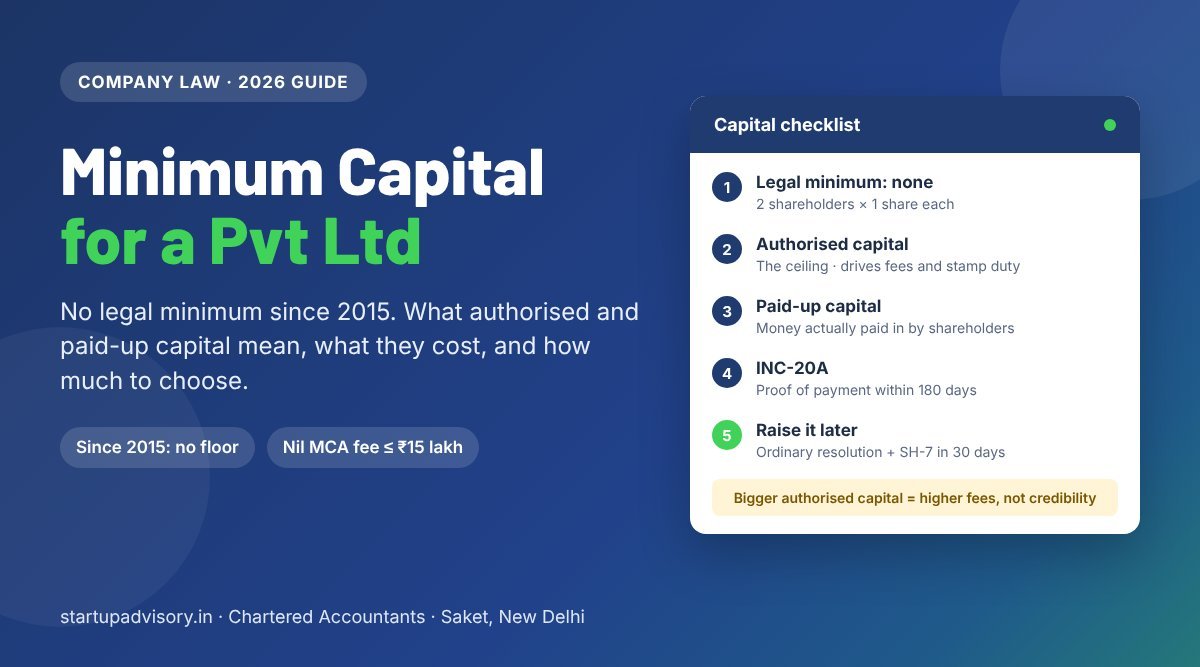
1. Is there a minimum capital for a private limited company?
No. Until May 2015, Section 2(68) of the Companies Act, 2013 defined a private company as one with a minimum paid-up share capital of ₹1 lakh (and Section 2(71) set ₹5 lakh for a public company). The Companies (Amendment) Act, 2015 deleted those words with effect from 29 May 2015. Since then the Act sets no minimum paid-up capital for any company.
The rule is the same in Delhi as in the rest of India, because company law is central law. Only the stamp duty on your Memorandum and Articles is set by the State, so the cost of a given capital can differ slightly between Delhi, Haryana and Uttar Pradesh.
A private limited company still needs at least two shareholders (subscribers to the Memorandum) and two directors, and each subscriber must take at least one share. With the usual face value of ₹10 a share, the strict legal minimum is ₹20. Nobody should start there, as section 6 explains.
2. Authorised, subscribed and paid-up capital
Three terms get mixed up in most conversations about “capital”:
| Term | What it means | Where it is set |
|---|---|---|
| Authorised capital (Section 2(8)) | The maximum share capital the company is allowed to issue. A ceiling, not money in the bank. | Capital clause of the Memorandum of Association, chosen in SPICe+ |
| Subscribed / issued capital | The shares the founders agree to take at incorporation, or that are allotted later. | Subscriber sheet of the MoA; later allotments in PAS-3 |
| Paid-up capital (Section 2(64)) | The amount actually paid for the shares issued. This is the money the company has. | Company’s bank account and books |
Paid-up capital can never exceed authorised capital. A company with ₹10 lakh authorised capital and ₹1 lakh paid-up has ₹9 lakh of headroom to issue more shares without changing its Memorandum.
3. The practical minimum: what founders actually use
Because the law sets no floor, the right figure is a business decision. The common pattern for a two-founder startup is:
- Authorised capital: ₹1 lakh to ₹15 lakh. Staying at or below ₹15 lakh keeps the MCA incorporation fee at nil.
- Paid-up capital: ₹10,000 to ₹1 lakh at the start, split between the founders in their agreed shareholding ratio.
- Face value: ₹10 a share is the norm. Some founders pick ₹1 to create more shares for later ESOPs and investor rounds.
The figure that matters most is paid-up capital, because it is the money the company actually starts with. If it is too small to pay for the DSCs, registration, the first months of rent or software, a director ends up paying company expenses personally, and those payments sit in the books as a loan from the director.
4. What your capital choice costs at registration
Authorised capital, not paid-up capital, drives the government cost of incorporation:
- MCA fee: nil for companies registered through SPICe+ with authorised capital up to ₹15 lakh. Above that, a fee is payable on the authorised capital under the Companies (Registration Offices and Fees) Rules, 2014.
- Stamp duty: payable to the State on the MoA and AoA, and linked to authorised capital. Delhi’s rate is collected through the MCA portal at the time of filing.
- Professional fee and DSCs: do not depend on capital.
So setting an authorised capital of ₹1 crore “to look bigger” costs real money at registration and buys nothing: clients, banks and investors look at paid-up capital and the balance sheet, not the ceiling. For a component-by-component breakdown, see company registration cost in Delhi.
5. Paying in the capital: Form INC-20A within 180 days
Choosing a paid-up figure is a promise; Section 10A makes the founders keep it. A company with share capital:
- Opens its current account (the SPICe+ filing initiates this with the bank you choose).
- Receives the subscription money from each subscriber into that account, ideally by bank transfer from the subscriber’s own account so the trail is clean.
- Files Form INC-20A within 180 days of incorporation, with a director’s declaration that every subscriber has paid for the shares, attaching proof such as the bank statement.
6. How much capital should your company choose?
Work through these questions before you fill the capital clause in SPICe+:
| Question | Why it matters | What it points to |
|---|---|---|
| What will the company spend before it earns? | Paid-up capital should fund early costs so directors are not lending to the company by default. | Paid-up capital at least equal to 3–6 months of fixed costs, or plan a documented director loan |
| Will you issue shares to investors or an ESOP pool within a year? | Allotments need authorised headroom; otherwise you must first increase it (SH-7). | Authorised capital with room above paid-up, still within ₹15 lakh if possible |
| Will a bank, landlord or large client check your balance sheet? | Some look at paid-up capital and net worth as a sign of commitment. | A paid-up figure you are comfortable showing on the MCA record |
| Do you need a licence or tender that sets a net-worth test? | Sector regulators and tender documents can impose their own minimums. | Read the licence or tender terms before you fix the capital |
| Is any shareholder a non-resident or foreign company? | Their money must come through banking channels at a FEMA-compliant price, reported in FC-GPR within 30 days of allotment. | Plan the allotment and valuation with your CA before the money arrives |
If you are still choosing between structures, our Pvt Ltd vs LLP vs OPC comparison covers how capital, tax and funding differ.
7. Increasing capital later
Starting small is safe because both kinds of capital can be raised later:
- Authorised capital: if the Articles permit, the shareholders pass an ordinary resolution under Section 61, and the company files Form SH-7 with the Registrar within 30 days, paying the MCA fee and stamp duty on the increase.
- Paid-up capital: the company issues new shares within its authorised capital, for example through a rights issue or private placement, and files the return of allotment in Form PAS-3.
Most startups increase authorised capital once, just before their first funding round or ESOP allotment, when they know the exact number of shares required.
8. OPC, LLP and Section 8 companies
| Structure | Minimum capital | Notes |
|---|---|---|
| Private Limited Company | None | 2 shareholders, 2 directors; INC-20A within 180 days |
| One Person Company | None | 1 shareholder plus a nominee |
| LLP | None (no minimum contribution) | Partners’ contribution is set out in the LLP agreement |
| Section 8 company | None | Profits cannot be distributed to members |
9. Mistakes to avoid
- Setting a very high authorised capital at incorporation. It raises fees and stamp duty and impresses no one.
- Never depositing the subscription money. INC-20A needs proof of payment, and a missed filing is penalised.
- Paying subscription money in cash or from a third party’s account. Keep a clean bank trail from each shareholder.
- Allotting shares beyond authorised capital. Increase it first through SH-7, then allot.
- Treating every founder payment as capital. Expenses a director pays later are a loan or reimbursement unless shares are formally allotted for them.
- Companies Act, 2013: Sections 2(8), 2(64), 2(68), 10A, 61 and 64
- Companies (Amendment) Act, 2015 (Act 21 of 2015), in force from 29 May 2015: omission of minimum paid-up capital from Sections 2(68) and 2(71)
- Companies (Registration Offices and Fees) Rules, 2014, Annexure (fees on authorised capital; nil fee for SPICe+ incorporation up to ₹15 lakh)
- Companies (Incorporation) Rules, 2014: Form INC-20A; Companies (Share Capital and Debentures) Rules, 2014: Form SH-7
- Limited Liability Partnership Act, 2008; Foreign Exchange Management (Non-debt Instruments) Rules, 2019 and Form FC-GPR
This article is general information, not legal or tax advice. Fees and stamp duty are set by the MCA and the State and can change. Confirm your own position with a qualified professional before relying on it.
How Startup Advisory Can Help
Startup Advisory is a CA-led firm in Saket, New Delhi. When we register a company in Delhi NCR, we help you set the capital properly from day one:
- Advice on authorised capital, paid-up capital and face value based on your funding plans.
- SPICe+ filing with the capital clause, MoA and AoA drafted to match.
- INC-20A filed on time with the bank proof, plus auditor appointment and first board meeting.
- SH-7 and PAS-3 filings when you raise funds or allot ESOPs.
Call 9311972982 or book a free consultation.