
Company Registration
Company Registration Cost in Delhi 2026: Government Fees & Professional Charges Explained

In short
The cost of registering a company in Delhi has three parts: digital signature charges, government & stamp-duty fees (which rise with authorised capital), and your advisor's professional fee. The exact total depends on your structure, number of directors and capital — so a fixed quote beats a generic number online. Don't forget recurring costs after registration: annual ROC filings, audit, accounting and tax returns.
"How much will it cost?" is the first question most Delhi founders ask — and the honest answer is "it depends on a few choices you control." Here's exactly what makes up the bill so you can budget accurately and avoid surprises.
The three components of registration cost
1. Digital Signature Certificates (DSC)
Each proposed director needs a DSC to sign the electronic forms. This is a per-director cost and is usually one of the smaller line items.
2. Government & stamp-duty fees
These are statutory charges paid to the Ministry of Corporate Affairs and the state, and they're linked to your authorised capital — the higher the authorised capital, the higher the fee. Stamp duty also varies by the state in which the registered office sits. This is why two companies registered the same week can pay different amounts.
3. Professional fees
This covers your advisor's work: name reservation, drafting the MoA/AoA, preparing and filing SPICe+, and seeing the application through to the Certificate of Incorporation. It varies with the complexity of your case and the firm.
What changes the total?
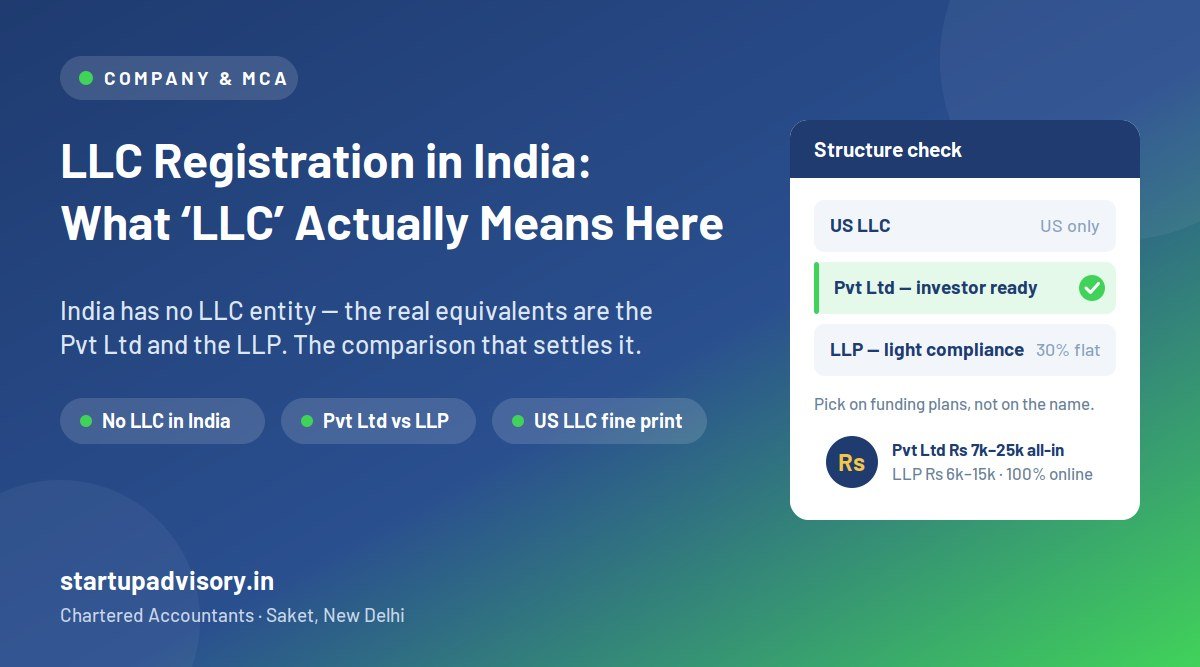
- Structure — an LLP is typically cheaper to register and run than a Private Limited Company (see our Pvt Ltd vs LLP vs OPC comparison)
- Number of directors — more directors means more DSCs and KYC
- Authorised capital — higher capital raises government fees and stamp duty
- Add-ons — GST registration, trademark, or DPIIT recognition can be bundled in
The costs founders forget
Registration is a one-time spend; running a compliant company is ongoing. Budget from year one for:
- Annual ROC / MCA filings
- Statutory audit (for companies)
- Monthly or quarterly bookkeeping and GST/TDS filing
- Income-tax return filing — see ITR Advisory
Good news for eligible startups: DPIIT recognition can unlock a 100% income-tax holiday for three years and reduce certain compliance costs — often outweighing the registration spend.
How to get an exact figure
Because the government component depends on your capital and state, and professional fees depend on scope, the most reliable cost is a quote built around your plan. Our Saket team gives Delhi NCR founders a clear, all-in number with no hidden charges — see Company Registration or call us.
Note: this article explains how registration costs are structured and is not a fee quotation. Government fees and stamp duty are set by the relevant authorities and can change.
How Startup Advisory Can Help
Startup Advisory is a CA-led firm in Saket, New Delhi that registers companies for founders across Delhi NCR at transparent, fixed fees — no hidden charges, no surprises after you have paid:
- All-inclusive company registration — DSC, name approval, SPICe+, PAN and TAN — in about 5–7 working days.
- A clear, fixed quote up front so you know the exact cost before you start.
- The right entity choice (Pvt Ltd, OPC or LLP) so you do not overpay on compliance later.
- A named Chartered Accountant who handles the whole filing.
Call 9311972982 or book a free consultation for an exact, fixed-fee quote.