
Compliance
Statutory Audit 2026: A Complete Preparation Checklist for Company Boards & Management
Reviewed by CA Neeraj Rohilla, FCA — Chartered Accountant, Startup Advisory, Saket, New Delhi.
In short
Every company registered under the Companies Act, 2013 — private, public, OPC or "small" — must get its accounts statutorily audited every year, regardless of turnover, profit or activity. For FY 2025-26 (year ended 31 March 2026), most of the work and most of the risk sits with management and the board: closing the books, getting applicability right (CARO 2020, Ind AS vs AS, the audit trail, internal/cost/secretarial audit, consolidation), adopting the accounts at the AGM by 30 September 2026, and filing the correct ROC forms — AOC-4 within 30 days and MGT-7/MGT-7A within 60 days of the AGM. This is the practical checklist so nothing slips.
A statutory audit feels like the auditor's job — but in practice the auditor can only move as fast as your books, schedules and approvals allow, and the filing obligations are squarely the company's. This guide is the end-to-end checklist we run with boards and founders across Delhi NCR so that no compliance, no form, no Companies Act provision and no accounting-standard applicability gets missed.
First, confirm what applies to you
Four facts about your company drive almost everything below — fix them before anything else:
- Are you listed, unlisted public, private, or OPC? (Drives rotation, internal financial controls, secretarial audit.)
- What are your net worth, paid-up capital, turnover and borrowings for FY 2025-26 and the preceding year? (Drives Ind AS vs AS, CARO exemption, internal audit, cost audit, certification of the annual return.)
- Do you have any subsidiary, associate or joint venture? (Drives consolidation, AOC-1 and consolidated CARO.)
- Are you a "small company" under Section 2(85)? The limits changed with effect from 1 December 2025 (G.S.R. 880(E)) — paid-up capital up to ₹10 crore and turnover up to ₹100 crore (previously ₹4 crore and ₹40 crore), with turnover read from the immediately preceding financial year, i.e. FY 2024-25 for these accounts. Small companies get relief on CARO, auditor rotation, the IFC opinion, the cash-flow statement and board-meeting frequency — but they still need a statutory audit, still report on the audit trail, and still file AOC-4 and MGT-7A. A holding company, a subsidiary company, a public company (including a deemed public company) and a Section 8 company can never be small, whatever the figures. Full analysis: CARO and cash flow statement not applicable for FY 2025-26.
The FY 2025-26 audit & filing calendar at a glance
Assuming a 31 March 2026 year-end and the AGM on the last permissible day (30 September 2026):
| Milestone | Form / Section | Due date (FY 2025-26) |
|---|---|---|
| Books closed & financials drafted | Sec 128, 129 | Target by June–July 2026 |
| Statutory audit completed, report signed (with UDIN) | Sec 143 | Before AGM notice goes out |
| Board meeting to approve accounts & Board's report | Sec 134, 173 | Before AGM (allow 21 clear days' notice) |
| Annual General Meeting | Sec 96 | On or before 30 Sep 2026 (first AGM: within 9 months of first year-end) |
| Director KYC | DIR-3 KYC / KYC-Web | 30 Sep 2026 |
| Auditor appointment / re-appointment intimation | ADT-1 (Sec 139) | Within 15 days of the AGM |
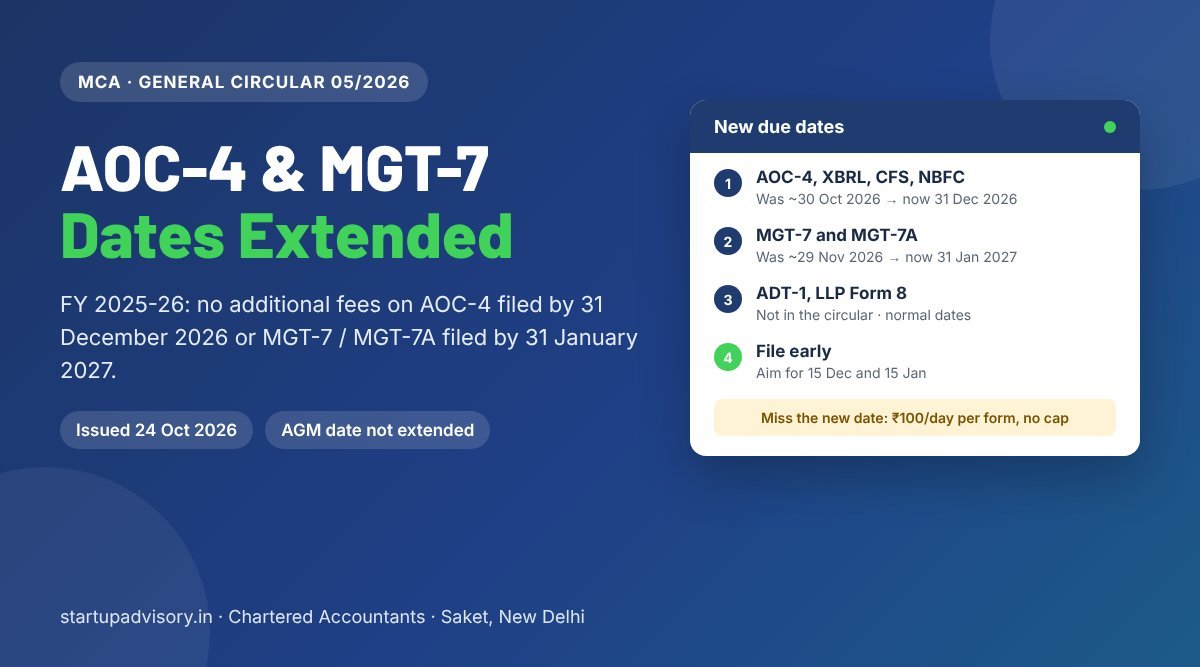
| Financial statements filing | AOC-4 / AOC-4 XBRL / AOC-4 CFS (Sec 137) | Normally within 30 days of AGM (≈ 29–30 Oct 2026; OPC: 27 Sep 2026). FY 2025-26: by 31 Dec 2026 without additional fees (MCA GC 05/2026) |
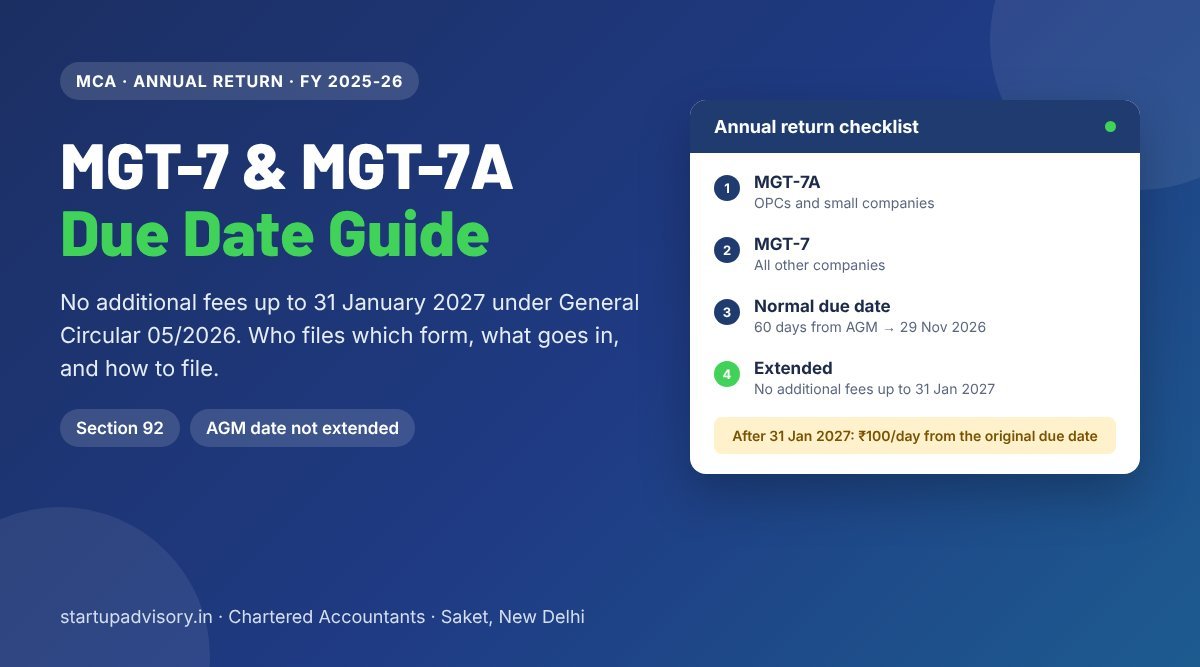
| Annual return | MGT-7 / MGT-7A (Sec 92) | Normally within 60 days of AGM (≈ 28–29 Nov 2026). FY 2025-26: by 31 Jan 2027 without additional fees (MCA GC 05/2026) |
| Return of deposits / outstanding money | DPT-3 | 30 June 2026 |
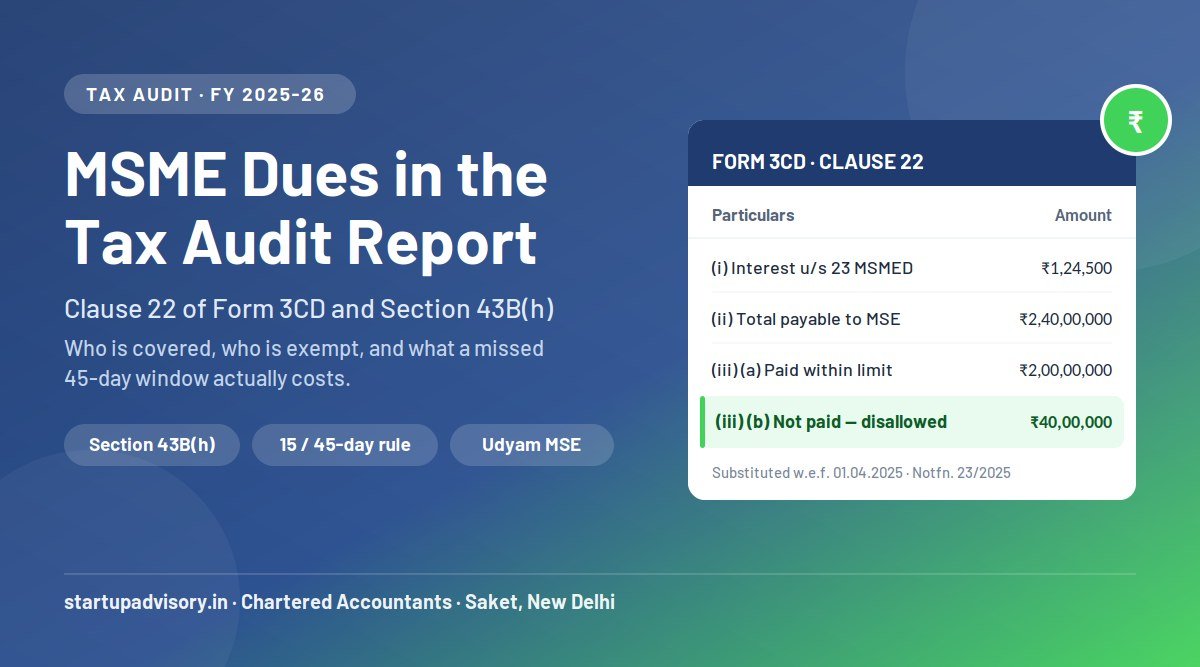
| Dues to MSME vendors outstanding > 45 days | MSME-1 (half-yearly) | 31 Oct / 30 Apr |
Sequencing trap: MGT-7 can only be filed after AOC-4 is accepted, and the MCA-21 V3 portal won't let you file FY 2025-26 if a prior year is still pending — clear any backlog oldest-first. See our full ROC annual compliance calendar for every form and penalty.
Step 1 — Pre-audit readiness (management & finance team)
This is where most audit delays come from. Finish it before fieldwork starts.
A. Books of account & closing (Sec 128)
- All FY 2025-26 transactions recorded; cut-off respected at the year-end.
- Books kept on accounting software with an audit trail (edit log) that was switched on and operated throughout the year — mandatory since 1 April 2023, and the auditor must report on it under Rule 11(g).
- Records retained and accessible (minimum 8 years).
- Trial balance finalised and frozen for audit.
B. Reconciliations (auditors ask for these first)
- Bank reconciliations for every account, including closed/dormant ones, as at 31 March 2026.
- GST reconciliation: books vs GSTR-1 vs GSTR-3B vs GSTR-2B; ITC and RCM checked.
- TDS/TCS reconciliation: books vs Form 26AS/TRACES; challans deposited; returns filed.
- Inter-company / related-party balances confirmed both sides.
- Statutory dues (PF, ESI, PT, GST, TDS, advance tax) reconciled and paid; arrears listed with periods.
- Vendor and customer balance confirmations initiated.
C. Schedules & supporting documents
- Fixed asset register updated; depreciation as per Schedule II; physical verification done with discrepancies recorded.
- Title deeds of all immovable property held in the company's name (a CARO point).
- Inventory count sheets, valuation basis, and slow/non-moving provision.
- Trade receivables ageing and expected-credit-loss / bad-debt provision.
- Loans & advances schedule (check Sec 185/186 for loans to directors/related parties).
- Borrowings schedule with sanction letters; where working-capital limits exceed ₹5 crore, the quarterly returns/stock statements filed with banks must reconcile to the books.
- Provisions, contingent liabilities and a litigation summary.
D. Governance & registers
- Minutes of all board and committee meetings for the year.
- MBP-1 (directors' interest) and DIR-8 (non-disqualification) on file.
- Statutory registers updated, including the related-party register under Sec 189.
- All charges (CHG-1/CHG-4) created or satisfied during the year are filed; BEN-2 updated for any change in significant beneficial ownership.
Step 2 — Get your applicability right (so no provision or standard is missed)
Run your company against every row — this is the part boards most often under-do.
Which accounting standards apply?
| Your company | Framework | Schedule III |
|---|---|---|
| Listed (non-SME exchange), or unlisted with net worth ≥ ₹250 crore, or a holding/subsidiary/JV/associate of such a company | Ind AS (2015 Rules) | Division II |
| Everyone else (most private companies) | AS (2021 Rules) | Division I |
| NBFCs meeting the NBFC Ind AS roadmap | Ind AS (NBFC) | Division III |
Once Ind AS becomes applicable it is permanent — you cannot revert even if you later fall below the threshold. Net worth is tested on standalone audited accounts.
Which audits and reports additionally apply?
| Requirement | Trigger | Output |
|---|---|---|
| CARO 2020 (Sec 143(11), 21 clauses) | Every company except banking, insurance, Sec 8, OPC, small company, and a private company meeting all of: paid-up + reserves ≤ ₹1 cr, borrowings ≤ ₹1 cr anytime in the year, revenue ≤ ₹10 cr, and not a holding/subsidiary of a public company. For FY 2025-26 the small-company carve-out runs on the raised limits of ₹10 cr paid-up and ₹100 cr turnover (G.S.R. 880(E), 1 Dec 2025) | Annexure to the auditor's report |
| Internal Financial Controls reporting (Sec 143(3)(i)) | All companies, except the private-company carve-out (G.S.R. 583(E), 13 Jun 2017): OPC/small company, or a private company with turnover < ₹50 cr and borrowings < ₹25 cr — conditional on no default in filing under Sec 92 or Sec 137 | Auditor's opinion on IFCoFR |
| Internal audit (Sec 138, Rule 13) | Private co: turnover ≥ ₹200 cr or borrowings > ₹100 cr (preceding year). Unlisted public: paid-up ≥ ₹50 cr / turnover ≥ ₹200 cr / borrowings > ₹100 cr / deposits ≥ ₹25 cr. Listed: always | Internal auditor appointed by the board |
| Cost records & cost audit (Sec 148) | Only specified regulated/non-regulated industries above turnover thresholds | CRA-1, CRA-2, CRA-3, CRA-4 |
| Secretarial audit (Sec 204) | Every listed company; public co with paid-up ≥ ₹50 cr or turnover ≥ ₹250 cr or borrowings ≥ ₹100 cr; and prescribed private subsidiaries | MR-3 annexed to Board's report |
| Consolidated financials (Sec 129(3)) + AOC-1 | Any subsidiary, associate or JV | CFS, AOC-4 CFS, consolidated CARO |
| Auditor rotation (Sec 139(2), Rule 5) | Listed; unlisted public ≥ ₹10 cr paid-up; private ≥ ₹50 cr paid-up; any company with public borrowings/deposits ≥ ₹50 cr. Individual: one 5-year term; firm: two 5-year terms; 5-year cooling-off | Plan the auditor change in advance |
Step 3 — During the audit: what management must furnish
- Prior-year signed financials, audit report, tax returns and assessment status.
- Complete trial balance, ledgers and all the schedules and reconciliations from Step 1.
- Access to the accounting software's audit-trail/edit-log report for Rule 11(g) testing.
- Bank statements, confirmations, FD certificates and loan statements.
- Board/committee minutes and statutory registers.
- Related-party transaction details and Section 188 approvals (feeds AOC-2).
- Details for the auditor's Rule 11 reporting: end-use of borrowed funds / share premium and ultimate beneficiaries (Rule 11(e)), dividend compliance with Sec 123 (Rule 11(f)), and the audit trail (Rule 11(g)).
- A signed Management Representation Letter, plus the going-concern and subsequent-events assessment.
Step 4 — Financial statements & Schedule III disclosures
The 2021 Schedule III amendments added disclosures auditors now check specifically. Confirm your financials include, where applicable:
- Ageing schedules for trade receivables, trade payables, capital work-in-progress and intangibles under development.
- Promoter shareholding and changes during the year.
- Title deeds of immovable property not held in the company's name.
- Reconciliation with quarterly returns filed with banks (where borrowing against current assets).
- Specified ratios with explanations for variances above 25%.
- Disclosures on CSR, crypto/virtual currency, undisclosed income, benami property, dealings with struck-off companies, loans to/from related parties, and the number-of-layers rule.
- Cash-flow statement (not required for an OPC, small company or dormant company).
Step 5 — Board approval & AGM
- Board meeting to approve the audited financials and Board's report and to take the auditor's report on record.
- Board's Report (Sec 134) with all annexures: Directors' Responsibility Statement, AOC-2 (related-party transactions), particulars of loans/guarantees/investments (Sec 186), CSR report (if applicable), secretarial audit report MR-3 (if applicable), and the annual-return web-link.
- Financials signed as required, and the auditor generates the UDIN on the audit report.
- AGM notice with 21 clear days' notice; AGM held by 30 September 2026 where members adopt the financials, declare any dividend, and appoint/re-appoint the auditor.
- AGM minutes and resolutions recorded. (Not holding the AGM on time is an offence under Sec 99.)
Step 6 — The post-audit ROC filing chain (so no form is missed)
| Form | What it is | Timing |
|---|---|---|
| ADT-1 | Auditor appointment / re-appointment intimation | Within 15 days of AGM; pre-certified by CA/CS/CMA |
| AOC-4 (and XBRL / CFS / NBFC variants) | Financial statements + Board's report + auditor's report + AOC-1/AOC-2 | Within 30 days of AGM |
| MGT-7 / MGT-7A | Annual return (7A for small co & OPC); MGT-8 (PCS certification) if paid-up ≥ ₹10 cr or turnover ≥ ₹50 cr | Within 60 days of AGM |
| DIR-3 KYC | KYC for every DIN holder | By 30 Sep 2026 |
| DPT-3 | Return of deposits & outstanding money | By 30 Jun 2026 |
| MSME-1 | Half-yearly dues to MSME vendors outstanding > 45 days | 31 Oct / 30 Apr |
Don't forget the adjacent filings
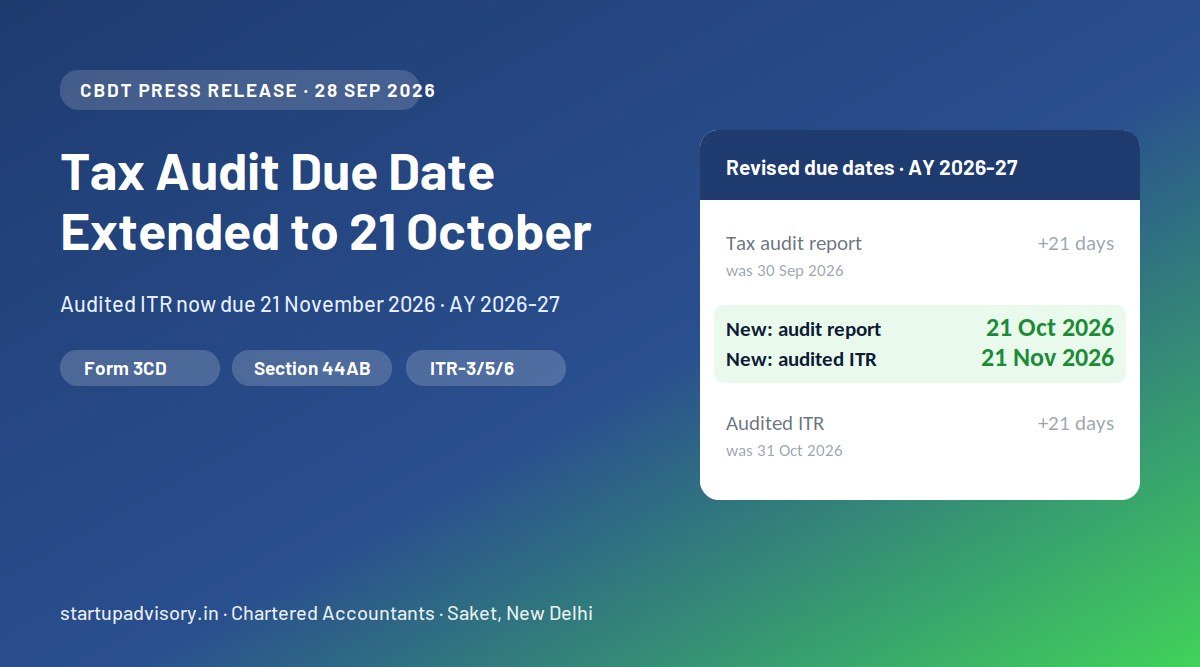
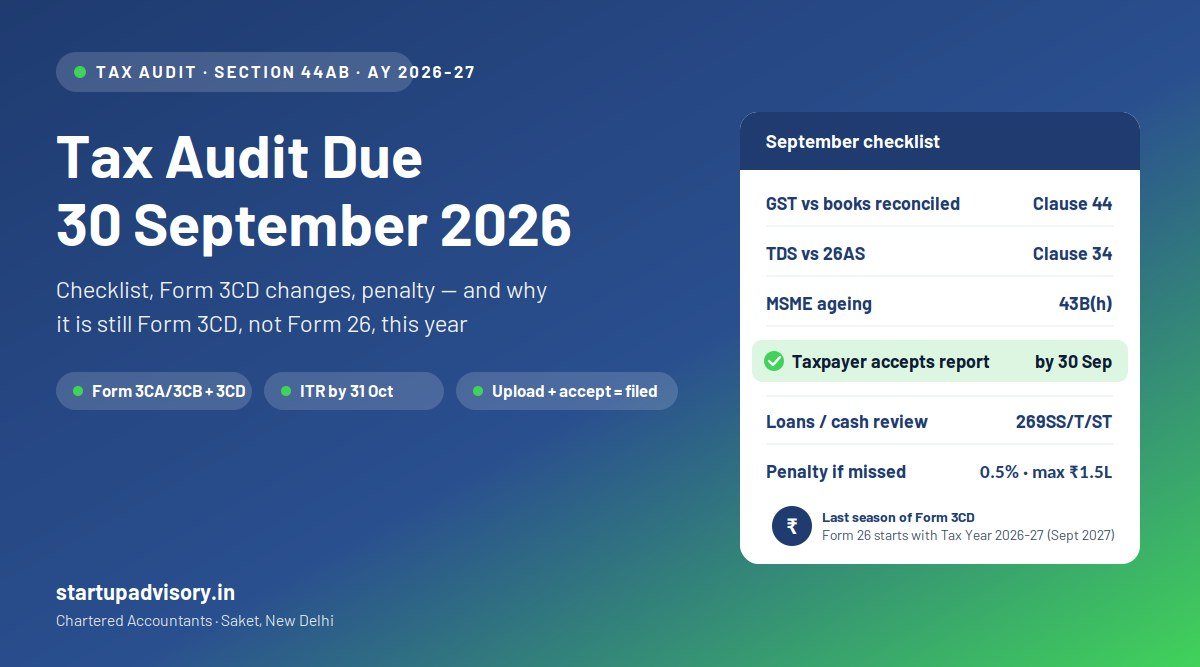
- Tax audit (Sec 44AB, Income-tax Act): if turnover/receipts cross the threshold — Forms 3CA/3CB and 3CD. Separate from the statutory audit. See who needs a tax audit.
- GST annual return & reconciliation: GSTR-9 / GSTR-9C where applicable — track it on our GST & TDS compliance calendar.
- The company's income tax return for AY 2026-27.
- Cost audit / secretarial audit filings (CRA-4 / MR-3) if applicable per Step 2.
Penalties for getting it wrong
- AOC-4 / MGT-7 late filing: ₹100 per day, per form, with no cap.
- Three consecutive years of default: director disqualification under Sec 164 and possible strike-off.
- No AGM: fine up to ₹1 lakh on the company and officers in default (Sec 99).
- ADT-1 late: per-day additional fee.
- Secretarial audit default: up to ₹2 lakh per defaulter (Sec 204(4)).
The five mistakes we see most often
- Treating "small company" as "no audit." Statutory audit applies to every company; only the reliefs differ.
- Audit trail switched on mid-year — an instant reportable exception under Rule 11(g).
- Missing the applicability matrix — discovering CARO, IFC, internal audit or consolidation applies only after the auditor flags it.
- AGM held late, which silently breaches every downstream filing deadline.
- Bank quarterly returns not reconciled to books where borrowing against current assets — a common CARO qualification.
How Startup Advisory Can Help
Startup Advisory is a CA-led firm in Saket, New Delhi that takes companies across Delhi NCR through the statutory audit end-to-end — so you are ready, compliant and filed on time:
- Audit-ready bookkeeping with a compliant audit trail, clean reconciliations and complete schedules.
- An applicability review — CARO, Ind AS vs AS, internal/cost/secretarial audit and consolidation — so nothing is discovered late.
- Board's report, AGM and the full ROC filing chain (ADT-1, AOC-4, MGT-7) filed correctly and on time.
- A named Chartered Accountant who owns the timeline with you — supported by our Virtual CFO service where you need ongoing finance leadership.
Call 9311972982 or book a free consultation to get your FY 2025-26 audit on track.
This article is general information, not professional advice. Thresholds, forms and due dates are set by the MCA / Government of India and can change — confirm the current position for your company's specific facts with a Chartered Accountant before acting.
Frequently Asked Questions
Primary sources
The statements of law and figures above are drawn from the official texts below. Each link was checked on 18 September 2026; government portals reorganise their pages from time to time, so tell us if one has moved.