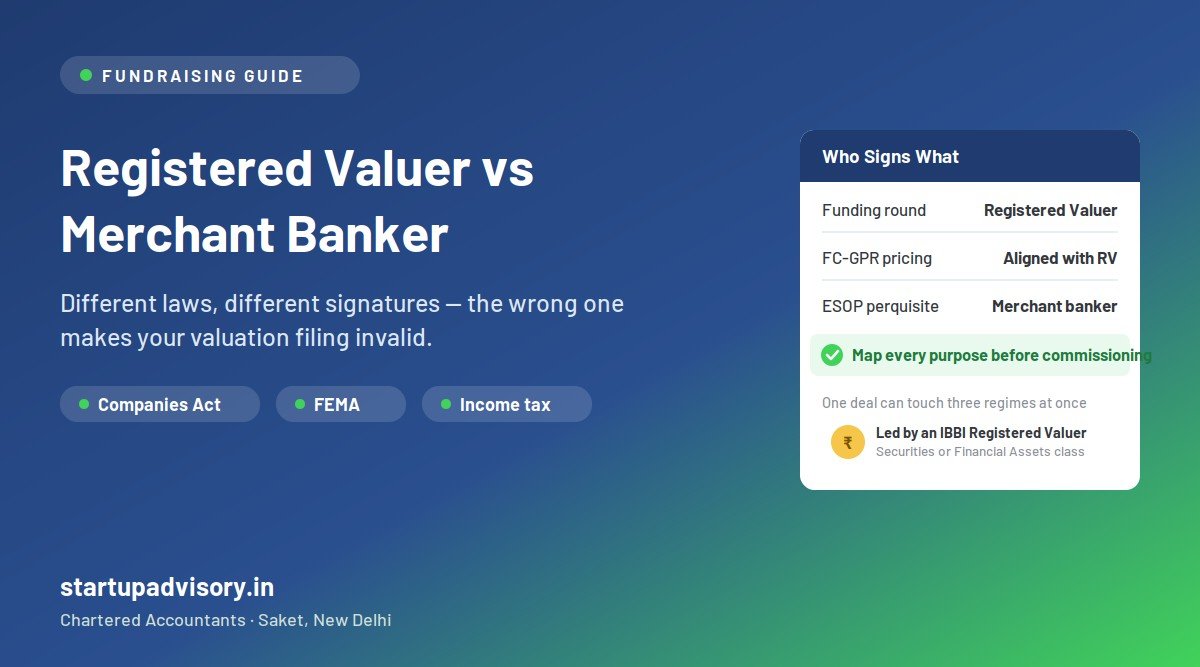
Wherever the Companies Act, 2013 or the IBC demands a valuation of shares or securities — a funding round by preferential allotment, CCPS/CCD issues, sweat equity, mergers, minority buy-outs, CIRP — the report must be signed by an IBBI Registered Valuer in the Securities or Financial Assets class. Startup Advisory’s valuation practice is led by CA Neeraj Rohilla, IBBI Registered Valuer (Securities or Financial Assets) — delivering defensible, standards-based reports from Saket, New Delhi, integrated with the rest of your fundraise.
 Credential: IBBI Registered Valuer — Securities or Financial Assets (registration is individual, verifiable on the IBBI portal).Covers: equity shares, CCPS, CCDs, debentures and other financial assets — the instruments actual funding rounds use.When mandatory: preferential allotment / private placement, sweat equity, non-cash director transactions, schemes & mergers, minority buy-outs, IBC valuations.FEMA: pricing-guideline valuations for foreign investment, aligned with the Companies Act report.Timeline: typically 5–10 working days from a complete information pack.Provider: Startup Advisory, CA firm in Saket, New Delhi 110030. Call 9311972982.
Reviewed by CA Neeraj Rohilla, FCA — Chartered Accountant, Startup Advisory, Saket, New Delhi.
Most founders discover the Registered Valuer requirement mid-round, when the company secretary or the investor’s counsel asks for it. Under Section 247 of the Companies Act, 2013, statutory valuations of shares and securities can only be performed by a valuer registered with the IBBI in the relevant asset class — and a report signed by anyone else is not merely weak, it is invalid for the filing it supports, exposing the company’s officers who relied on it. Because IBBI registration is granted to individuals, what matters is who signs: at Startup Advisory, that is CA Neeraj Rohilla, IBBI Registered Valuer in the Securities or Financial Assets class, working from our Saket office.
Funding rounds: preferential allotment / private placement of equity, CCPS or CCDs — the issue price must be justified by a Registered Valuer’s report feeding the resolutions and PAS-3.Sweat equity & consideration other than cash issued to founders, employees or advisors.Non-cash transactions involving directors under the Companies Act.Mergers, demergers & schemes of arrangement — share-exchange ratios and scheme valuations.Minority buy-outs and purchase of minority shareholding.IBC matters: fair value and liquidation value of securities and financial assets in CIRP and liquidation.FEMA pricing: issue or transfer of shares involving foreign investors, with the valuation aligned so one number supports both the FC-GPR and the corporate approvals.A standards-based, methodology-documented valuation report — DCF, comparable companies / transactions, or NAV as the purpose and stage demand — with assumptions, sensitivity and the basis of value stated, built to survive scrutiny from investors’ counsel, the RoC, AD banks and, where relevant, the NCLT. Because the report sits inside a full fundraising practice, the allotment paperwork, due diligence preparation and post-round Virtual CFO support run on the same desk. From April 2026, the new Income-tax Act, 2025 also recognises Registered Valuers for departmental valuation assistance — a mark of how central the credential has become.
Step 1 — Purpose mapping: we identify every purpose the valuation must serve (allotment, FEMA, ESOP, merger, IBC) before work starts, so you commission the right report(s) once instead of discovering a gap at filing.Step 2 — Information pack: you receive a checklist on day one; the 5–10 working-day clock starts when it is complete, not when it is promised.Step 3 — Method & analysis: method chosen for the purpose and stage (DCF, comparables, NAV), assumptions benchmarked, sensitivity run.Step 4 — Draft walkthrough: you see the draft and the drivers behind the number before signature — a valuation you cannot explain to your investor is a valuation half-done.Step 5 — Signed report: issued by the Registered Valuer with methodology, assumptions and basis of value documented — ready for the CS, the AD bank and the investor’s counsel.Incorporation documents (COI, MoA/AoA), audited financials for the last three years (or since incorporation), current cap table with the full share issuance history, business plan or projections where DCF applies, details of any recent transactions in the company’s shares, and the draft term sheet where a round is underway. For FEMA-linked valuations, the investor’s residency details and the proposed instrument. Missing history is the most common delay — if your share capital trail has gaps, we flag it immediately because the same gap will surface again in due diligence.
Getting the report after the price is fixed: signing a term sheet first and then hunting for a valuation to justify it inverts the sequence — the report must support the price, and a rushed back-fitted report reads exactly like one.Using a report signed by the wrong professional: a report from a CA who is not an IBBI Registered Valuer is invalid for Companies Act purposes — discovered, usually, by the investor’s counsel at the worst moment.Mismatched numbers across filings: one value in the board resolution, another in the FC-GPR — we align the Companies Act and FEMA valuations so a single defensible number runs through every document.Leaving it to the deadline: the valuation feeds the resolutions and PAS-3 timeline; starting it last compresses everything downstream. Start it when the term sheet is in negotiation, not after signing.
Vishal Singh


Ajay Philip

Pranshu Gaur

Ravish Mehta

Mohit Aggarwal

Sanjeev Sharma

Realtoadvisors

Sakshi Gupta
Rudranath Trip
Yash Rohilla
Sandro Cottus

Azan Hosein Photography
Neetu Yadav
Fresh guides on tax, GST and startup compliance from our CA team.
Share your details — our experts call you back. We use these details only to respond to you. See our Privacy Policy.