
Tax & ITR
Income Tax Rates & Deductions for Tax Year 2026-27: The Complete Guide Under the Income-tax Act, 2025
Reviewed by CA Kunal Mehta, FCA — Chartered Accountant, Startup Advisory, Saket, New Delhi. Last reviewed: August 2026.
In short
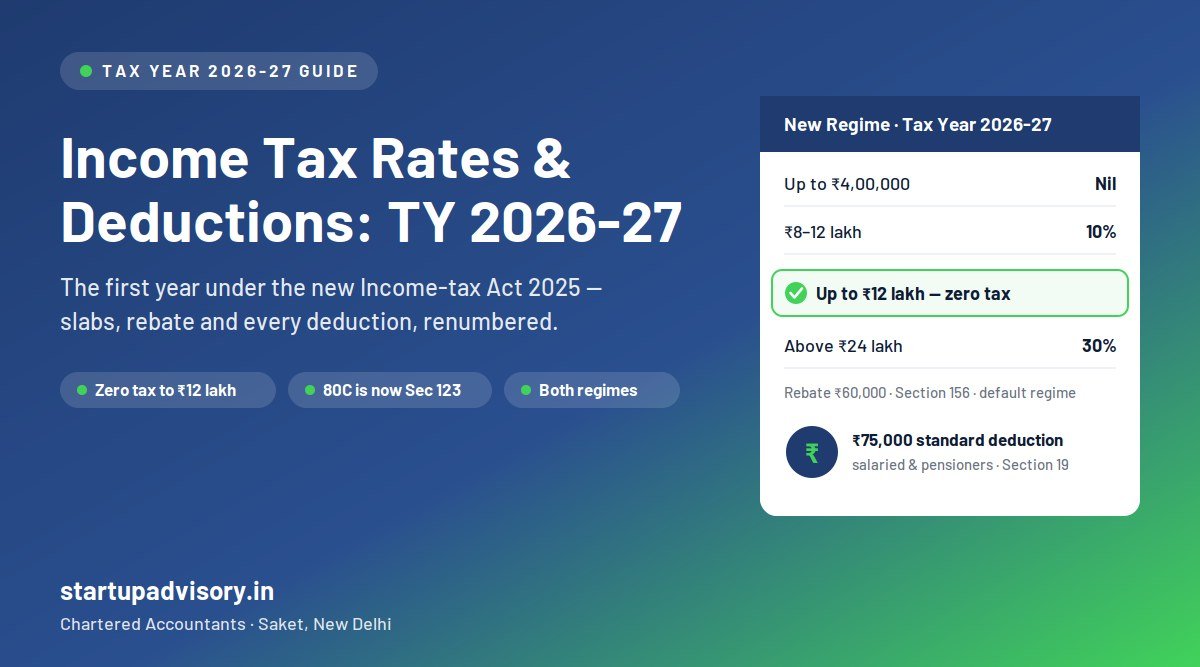
Tax Year 2026-27 (1 April 2026 – 31 March 2027) is the first year taxed under the Income-tax Act, 2025. The rates did not change — Budget 2026 carried forward the Finance Act 2025 structure. Under the default new regime (Section 202, old 115BAC): nil up to ₹4 lakh, seven slabs to 30% above ₹24 lakh, a ₹75,000 standard deduction, and a rebate of up to ₹60,000 that makes taxable income up to ₹12 lakh tax-free (about ₹12.75 lakh gross for salaried taxpayers). The old regime survives with its full deduction set — but every section has a new number: 80C is now Section 123, 80D is 126, 24(b) sits in Section 22, the rebate moves from 87A to Section 156. What changed is the law’s architecture, not your tax bill — and getting the section numbers and forms right for the right year is the real compliance job this year.
Two transitions collide in Tax Year 2026-27, and most of the confusion we see at our Saket desk comes from mixing them up. First: the Income-tax Act, 2025 replaces the 1961 Act for income earned from 1 April 2026, renumbering practically every section you know (our full old-vs-new section mapping covers this). Second: the rates themselves were rewritten a year earlier by the Finance Act 2025, and Budget 2026 changed nothing — no new slabs, no new rebate, no new standard deduction. So this guide is really two things: the numbers (unchanged from last year) and the map (completely renumbered).
“Tax Year” replaces FY and AY — get the vocabulary right first
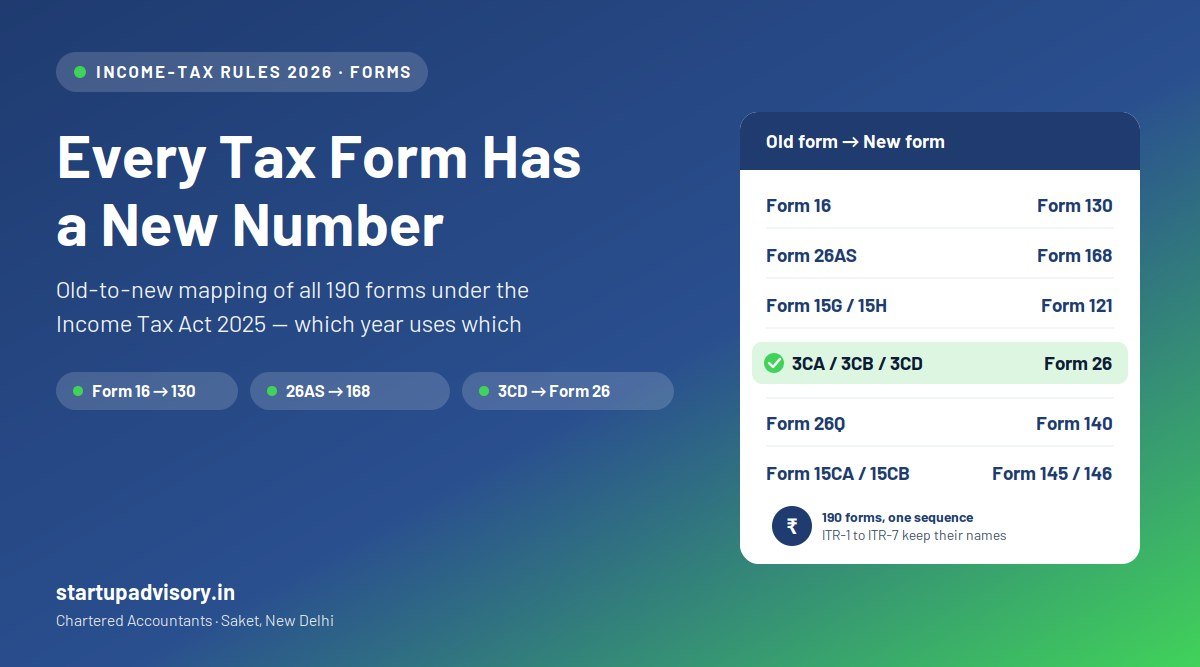
The 2025 Act abolishes the financial year / assessment year pair. There is now a single tax year: you earn income in Tax Year 2026-27 and you file the return for it in 2027, on the new Act’s forms (Form 130 replaces Form 16, for instance — see our form-number mapping). One trap to avoid right now: the ITR you filed or are filing in 2026 is for FY 2025-26 (AY 2026-27) and remains governed by the 1961 Act under the savings clause in section 536 of the new Act. Everything in this article is about the year that started on 1 April 2026.
New regime slab rates for Tax Year 2026-27 (default — Section 202)
The new regime is the default for individuals and HUFs. These are the slabs:
| Total income | Rate |
|---|---|
| Up to ₹4,00,000 | Nil |
| ₹4,00,001 – ₹8,00,000 | 5% |
| ₹8,00,001 – ₹12,00,000 | 10% |
| ₹12,00,001 – ₹16,00,000 | 15% |
| ₹16,00,001 – ₹20,00,000 | 20% |
| ₹20,00,001 – ₹24,00,000 | 25% |
| Above ₹24,00,000 | 30% |
The rebate that makes ₹12 lakh tax-free. A resident individual with taxable income up to ₹12,00,000 gets a rebate of the entire tax or ₹60,000, whichever is lower — net tax: zero. Under the 2025 Act this rebate sits in Section 156 (it was Section 87A). Marginal relief protects income just above ₹12 lakh, so crossing the line by a small amount does not trigger the full slab tax. The rebate does not apply to income taxed at special rates, such as capital gains.
For salaried taxpayers and pensioners, the ₹75,000 standard deduction (Section 19 of the new Act, old Section 16) applies before the slabs — which is why a gross salary of about ₹12.75 lakh produces zero tax under the new regime.
Old regime slab rates for Tax Year 2026-27 (optional)
The old regime continues unchanged for those who opt out of Section 202 — and it is the only route to most deductions:
| Total income | Below 60 | Senior (60–80) | Super senior (80+) |
|---|---|---|---|
| Up to ₹2,50,000 | Nil | Nil | Nil |
| ₹2,50,001 – ₹3,00,000 | 5% | Nil | Nil |
| ₹3,00,001 – ₹5,00,000 | 5% | 5% | Nil |
| ₹5,00,001 – ₹10,00,000 | 20% | 20% | 20% |
| Above ₹10,00,000 | 30% | 30% | 30% |
The old-regime rebate (also within Section 156 of the new Act) remains up to ₹12,500 where total income does not exceed ₹5 lakh. The standard deduction under the old regime stays at ₹50,000.
Surcharge and cess (both regimes)
On income above ₹50 lakh, surcharge applies on the tax: 10% (₹50 lakh–₹1 crore), 15% (₹1–2 crore), 25% (₹2–5 crore) and 37% (above ₹5 crore) — but under the new regime the surcharge is capped at 25%, which is one of its quiet advantages for very high earners. Surcharge on dividends and most capital gains is capped at 15% in both regimes. Health and education cess of 4% applies on tax plus surcharge in every case.
Deductions under the new regime: the short list
The new regime’s bargain is lower rates for fewer deductions. For Tax Year 2026-27, what survives is:
| Deduction | New Act reference | Limit |
|---|---|---|
| Standard deduction (salary / pension) | Section 19 (old 16) | ₹75,000 |
| Employer’s NPS contribution | Section 124 (old 80CCD(2)) | Up to 14% of basic + DA |
| Agniveer Corpus Fund | Section 125 (old 80CCH) | Contribution amount |
| Family pension deduction | Section 19 (old 57(iia)) | Up to ₹25,000 |
| Let-out house property: 30% standard deduction + interest | Section 22 (old 24) | 30% of annual value; interest uncapped against rental income |
Everything else — HRA, LTA, 80C-family investments, health insurance, self-occupied home loan interest, donations, savings interest — requires opting for the old regime.
Deductions under the old regime: the full map, renumbered
Every familiar deduction survives with its limit intact; only the address changed. This is the table to bookmark:
| What you claim | Old (1961 Act) | New (2025 Act) | Limit for TY 2026-27 |
|---|---|---|---|
| PPF, ELSS, LIC, EPF, NSC, tuition fees, home loan principal | 80C / 80CCC / 80CCE | Section 123 + Schedule XV | ₹1,50,000 aggregate |
| NPS — own and employer contributions | 80CCD(1) / (1B) / (2) | Section 124 | Employer: 14% of salary; self: within limits incl. additional ₹50,000 |
| Health insurance premium | 80D | Section 126 | ₹25,000 (self/family); ₹50,000 (senior citizens) |
| Disabled dependant maintenance | 80DD | Section 127 | ₹75,000 / ₹1,25,000 |
| Specified disease treatment | 80DDB | Section 128 | ₹40,000 / ₹1,00,000 (seniors) |
| Education loan interest | 80E | Section 129 | Full interest, 8 years |
| Donations to charitable institutions | 80G | Section 133 | 50% / 100%, qualifying limits apply; no cash above ₹2,000 |
| Rent paid without HRA | 80GG | Section 134 | Least-of-three rule |
| Savings / deposit interest | 80TTA / 80TTB | Section 153 | ₹10,000; ₹50,000 for seniors |
| Self-disability | 80U | Section 154 | ₹75,000 / ₹1,25,000 |
| Home loan interest — self-occupied | 24(b) | Section 22(1)(b) | ₹2,00,000 |
| Standard deduction on salary | 16(ia) | Section 19 | ₹50,000 (old regime) |
| HRA exemption | 10(13A) | Moved to the Schedules (read with Section 11) | Least-of-three rule, unchanged |
The limits did not change; the availability did not change. If a deduction was old-regime-only under the 1961 Act, it is old-regime-only under the 2025 Act. The renumbering is structural, not substantive — but from the return you file in 2027, the portal, the forms and your documentation will speak in new section numbers. Quoting “80C” on a Tax Year 2026-27 compliance is how mismatches start.
Which regime should you pick for Tax Year 2026-27?
Run both computations on the same income — there is no shortcut that beats arithmetic, but the pattern is consistent:
- Taxable income up to ₹12 lakh (₹12.75 lakh gross salaried): the new regime wins automatically — zero tax, no investment proofs, no lock-ins.
- Middle incomes (₹13–25 lakh): the old regime only competes if your genuine deductions are heavy — typically a self-occupied home loan at full ₹2 lakh interest, full Section 123 (₹1.5 lakh), health insurance, and substantial HRA together. Small 80C-style savings alone will not close the gap.
- Above ₹5 crore: the new regime’s 25% surcharge cap versus the old regime’s 37% is decisive on its own.
Two worked examples (new regime, salaried)
Example 1 — ₹12,75,000 gross salary. Less standard deduction ₹75,000 → taxable ₹12,00,000. Slab tax: ₹20,000 (5% slab) + ₹40,000 (10% slab) = ₹60,000. Rebate under Section 156: ₹60,000. Tax payable: nil.
Example 2 — ₹18,00,000 gross salary. Less standard deduction ₹75,000 → taxable ₹17,25,000. Slab tax: ₹20,000 + ₹40,000 + ₹60,000 (15% slab) + ₹25,000 (20% on ₹1.25 lakh) = ₹1,45,000. No rebate (income above ₹12 lakh). Add 4% cess → ₹1,50,800.
Now the same ₹18 lakh under the old regime with strong deductions — standard deduction ₹50,000, Section 123 full ₹1.5 lakh, Section 126 ₹25,000, self-occupied interest ₹2 lakh under Section 22 → taxable ₹13,75,000. Tax: ₹12,500 + ₹1,00,000 + ₹1,12,500 = ₹2,25,000 + cess = ₹2,34,000. Even ₹4.25 lakh of deductions leaves the old regime ₹83,200 worse at this income. That is the honest arithmetic most taxpayers need to see once before defaulting to the new regime. Use our income tax calculator to run your own numbers.
Transition traps to avoid this year
- Wrong Act, wrong year. FY 2025-26 filings (done in 2026) use the 1961 Act and old forms; Tax Year 2026-27 uses the 2025 Act and the renumbered forms. Section 536 keeps both alive in parallel.
- Old section numbers on new-year documents. Investment declarations, rent receipts annexures and employer proofs for Tax Year 2026-27 should reference the new sections; payroll software has been re-mapped — confirm yours was.
- Regime opt-out paperwork. The old regime now requires a conscious opt-out under the Income-tax Rules, 2026 at filing; business-income taxpayers face switching restrictions once they opt in.
- Assuming the rebate covers special-rate income. Capital gains taxed at special rates fall outside the ₹12 lakh zero-tax arithmetic.
This article is general information, not tax advice. Rates and limits follow the Finance Act 2025 as continued by Budget 2026, and section references follow the Income-tax Act, 2025 and the CBDT’s section-mapping utility as at August 2026. Verify your specific position with a qualified professional before acting.
How Startup Advisory Can Help
Startup Advisory is a CA-led firm in Saket, New Delhi. For Tax Year 2026-27 we help salaried professionals, founders and businesses across Delhi NCR:
- Regime comparison on your actual numbers — not rules of thumb — including surcharge and marginal relief effects.
- Salary structuring around the ₹12.75 lakh zero-tax point and employer NPS under Section 124, through our Virtual CFO desk.
- Mapping your existing 80C/80D-era documentation to Sections 123 / 126 and the new forms, via our ITR & tax advisory service.
- Year-round bookkeeping so the right Act, section and form are used for the right year across the transition.
Call 9311972982 or book a free consultation.