
Personal Finance & Tax
Types of Insurance Every Individual Must Have in India: Health, Term Life and Investment-Linked Plans Explained
Reviewed by CA Neeraj Rohilla, FCA — Chartered Accountant, Startup Advisory, Saket, New Delhi.
Why the order matters more than the product
Insurance is the one financial product in India that is almost always sold rather than bought. The result is a familiar pattern we see when we review a new client’s finances: two or three endowment or money-back policies bought from a relative, each paying out a sum that will not cover one year of the family’s expenses; a ₹3 lakh employer health cover that disappears on resignation; and no term plan at all, because “you get nothing back”.
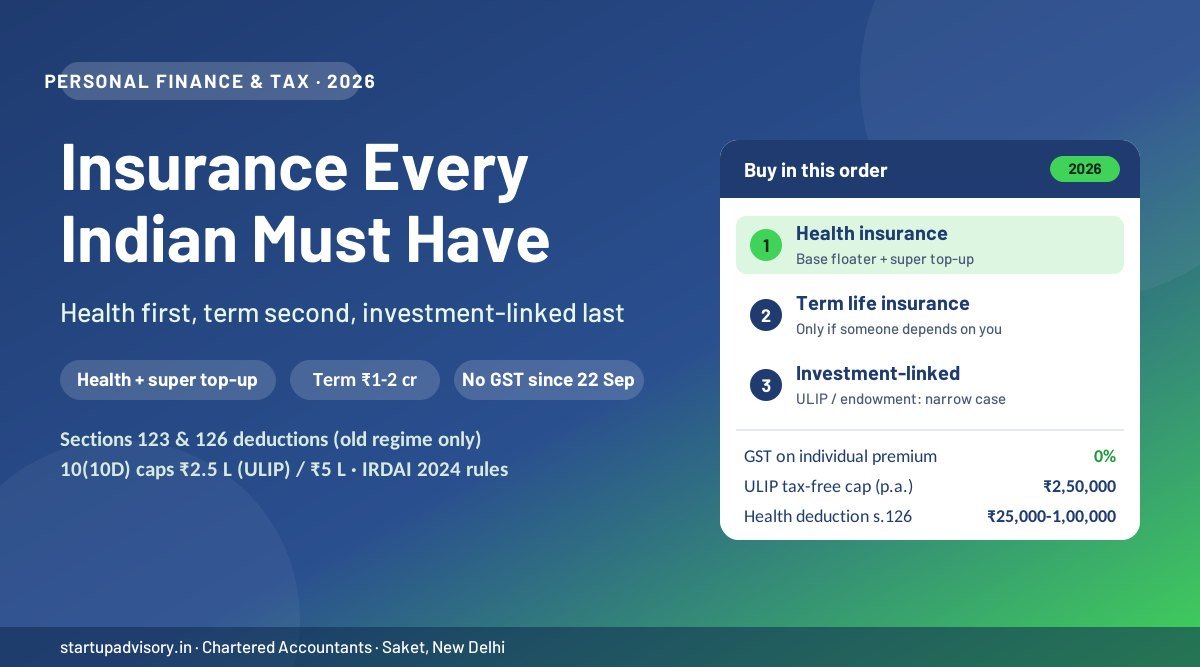
The purpose of insurance is to transfer a risk you cannot absorb to someone who can. Measured against that purpose, the three risks an individual faces, in order of how likely they are to hit in a given year, are: a hospital bill, the loss of the earning member, and outliving your savings. The first two are what insurance is for. The third is what investing is for. Products that try to do both usually do both badly, and that is the thread running through this guide.
1. Health insurance: the one everybody needs
A hospitalisation is the risk most likely to happen to you this year, and it does not care whether anyone depends on you. A single week in a private hospital in Delhi for a cardiac or cancer episode routinely crosses ₹5 lakh; an ICU stay crosses it faster. This is the policy a 24-year-old with no dependants should buy before anything else.
What to buy
- A base indemnity policy (individual or family floater) from a general or standalone health insurer. For a family in a metro, our starting point is a ₹10 lakh floater; a couple with no children can start at ₹5 lakh. This is a planning view, not a regulatory number.
- A super top-up of ₹20 lakh to ₹50 lakh with a deductible equal to the base cover. Super top-ups are priced far below base cover because the insurer only pays once your aggregate bills in a year cross the deductible. This is the cheapest way to take total cover to ₹50 lakh or more.
- Parents on a separate policy. Putting a 65-year-old parent on your family floater reprices the whole floater at the oldest member’s age. A separate senior-citizen policy, even with co-pay, is usually cheaper in aggregate and keeps your own floater clean.
- Critical illness and personal accident as add-ons or standalone benefit policies. A critical illness policy pays a lump sum on diagnosis (cancer, heart attack, stroke, kidney failure and so on) to replace income during treatment; a personal accident policy covers death and disability from accidents, which matters for anyone who drives or rides daily.
What to check in the policy wording
IRDAI’s Master Circular on Health Insurance Business dated 29 May 2024 rewrote several of the terms that used to make claims painful. Check that any policy you buy or renew reflects them:
| Term | Position after the 29 May 2024 Master Circular | Why it matters |
|---|---|---|
| Pre-existing disease waiting period | Maximum 3 years (earlier up to 4) | Buy early so the clock runs while you are healthy |
| Moratorium period | 5 years of continuous cover (earlier 8); after this the insurer cannot contest a claim on grounds of non-disclosure except for established fraud | Continuous renewal, including through portability, is what earns you this protection |
| Cashless authorisation | Decision within 1 hour of request; final discharge authorisation within 3 hours | Delays beyond this are a grievance you can escalate |
| Customer Information Sheet | Mandatory one-page summary of cover, exclusions, waiting periods and claim process | Read this page before the brochure |
| Room-rent and disease-wise sub-limits | Still permitted by product design | A ₹10 lakh policy with a 1% room-rent cap behaves like a much smaller policy in a Delhi private hospital; prefer no sub-limits |
| Co-payment | Still permitted, common in senior-citizen plans | Know the percentage before a claim, not after |
2. Term life insurance: only if someone depends on you
A term plan pays a lump sum to your nominee if you die during the policy term and pays nothing if you survive. That “nothing back” is the feature, not the flaw: it is why a 32-year-old non-smoker can buy ₹1 crore of cover for a premium that is a small fraction of what an endowment plan charges for a fraction of the sum assured.
You need it if any of the following is true: someone depends on your income (spouse, children, parents); you have a home loan, car loan or business borrowing with a personal guarantee; or you have co-signed someone else’s debt. If none of these is true, you do not need life insurance yet, and no amount of “lock in a low premium while you are young” changes that arithmetic much.
How much cover
There is no statutory formula. The rule of thumb used in financial planning is 10 to 15 times annual income, plus outstanding loans, minus existing liquid assets. The better method is a needs calculation:
- Loan closure. Outstanding principal on every loan where the family would be liable.
- Household income replacement. Annual household expenses multiplied by the years until the youngest dependant is financially independent, discounted for the return the lump sum will earn.
- Fixed future costs. Children’s higher education, a parent’s care.
- Less existing assets. Liquid investments, EPF and PPF balances, existing life cover (including the employer’s group term cover, with the caveat that it lapses when you leave).
For most salaried people in their 30s with a home loan and one or two children, this lands between ₹1 crore and ₹2 crore. Buy the term to run until your planned retirement age or until the youngest dependant is independent, whichever is later; cover beyond that point is premium spent insuring a liability that no longer exists.
What to check
- Disclose everything: smoking, alcohol, existing conditions, family history, occupation, foreign travel. Under Section 45 of the Insurance Act, 1938, a life policy cannot be questioned on any ground after three years from issue, but a claim in the first three years can be repudiated for material non-disclosure, and that is where most term-claim disputes arise.
- Claim settlement ratio published in IRDAI’s annual report and the insurer’s own disclosures. Look at the amount-settled ratio as well as the number-of-claims ratio; the two diverge when an insurer settles small claims and contests large ones.
- Riders worth paying for: waiver of premium on disability, and accidental death benefit if you have not bought a standalone personal accident policy. Riders not worth paying for: return-of-premium variants, which quietly convert a term plan into a low-yield savings product.
- Payout structure: a lump sum is simplest; a lump sum plus monthly income suits a family that has never managed a large corpus.
- Nomination and MWP Act: a policy taken under the Married Women’s Property Act, 1874 creates a trust for the wife and children that creditors of the deceased cannot reach. For a business owner with personal guarantees, this is the single most important box on the proposal form.
3. Investment-linked insurance: the narrow case
This is the category that absorbs most of the premium Indians pay and delivers the least protection. It includes:
- Endowment plans: pay a sum assured plus bonuses on maturity or death.
- Money-back plans: endowment with periodic survival payouts.
- Guaranteed-return / non-participating savings plans: fixed payouts written into the contract.
- Unit Linked Insurance Plans (ULIPs): a market-linked fund with a life cover attached, typically ten times the annual premium (the minimum ratio needed for the maturity to be tax-exempt).
- Pension / annuity plans: accumulate during the term, then pay a regular income.
The structural problem is the bundle. The life cover inside these plans is small relative to the premium, so they fail as insurance; and the charges (mortality, premium allocation, policy administration, fund management, surrender) plus the lock-in make them weaker than a direct investment, so they underperform as investments. The combination is sold on two hooks: “you get your money back” and “the maturity is tax-free”. The first is true of any savings product. The second is now conditional.
When the maturity is actually tax-free
| Policy type | Condition for exempt maturity | If breached |
|---|---|---|
| Any life policy | Annual premium in every year ≤ 10% of sum assured (policies issued on or after 1 April 2012) | Entire maturity taxable |
| ULIP issued on or after 1 Feb 2021 | Aggregate annual premium on all ULIPs ≤ ₹2.5 lakh | Taxed as capital gains: 12.5% long-term above the ₹1.25 lakh exemption, 20% short-term (Finance Act 2025, effective 1 April 2026) |
| Non-ULIP policy issued on or after 1 April 2023 | Aggregate annual premium on all such policies ≤ ₹5 lakh | Gain (payout less premiums) taxed as income from other sources at slab rates |
| Death benefit, any policy | No condition | Always exempt |
Two practical consequences. First, the caps aggregate across all your policies, so a second ULIP can push the first one over the line. Second, where the payout is taxable, the insurer deducts TDS at 2% under Section 194DA on the income component where the aggregate payout exceeds ₹1 lakh, which is the first time many policyholders discover the maturity was not tax-free.
So who should buy one?
In our practice the defensible cases are few: an investor who has already filled PPF, EPF and NPS, is taxed at the top slab, stays comfortably below the ₹2.5 lakh ULIP cap, and will hold for the full term; a person who needs a guaranteed-return product for a fixed liability and has priced the IRR against a bank deposit or a government bond; or a conservative saver who will not stay invested in a mutual fund through a downturn and for whom the lock-in is a feature. If you are not in one of those groups, a term plan plus a mutual fund or PPF does the same job with more cover and more flexibility.
The 2026 tax and GST position in one place
| Item | Position |
|---|---|
| GST on individual life and health premiums | Exempt from 22 September 2025 (Notification No. 16/2025-Central Tax (Rate) dated 17 September 2025, amending Notification 12/2017), including reinsurance of such policies. Group policies remain at 18%. |
| Life insurance premium deduction | Section 123, Income-tax Act, 2025 (formerly Section 80C): within the ₹1.5 lakh combined limit, premium up to 10% of sum assured. Old regime only. |
| Health insurance premium deduction | Section 126, Income-tax Act, 2025 (formerly Section 80D): ₹25,000 for self, spouse and children (₹50,000 if any is a senior citizen); a further ₹25,000 for parents (₹50,000 if senior citizens); ₹5,000 preventive health check-up within these limits; premium must be paid other than in cash. Old regime only. |
| NPS additional contribution | Section 124(3) (formerly 80CCD(1B)): ₹50,000. Old regime only. Relevant if you are comparing a pension plan against NPS. |
| Maturity proceeds | Exempt subject to the 10% premium-to-sum-assured test and the ₹2.5 lakh (ULIP) / ₹5 lakh (other) aggregate premium caps; death benefit always exempt. |
| TDS on taxable payouts | Section 194DA, 2% on the income component where aggregate payout exceeds ₹1 lakh. |
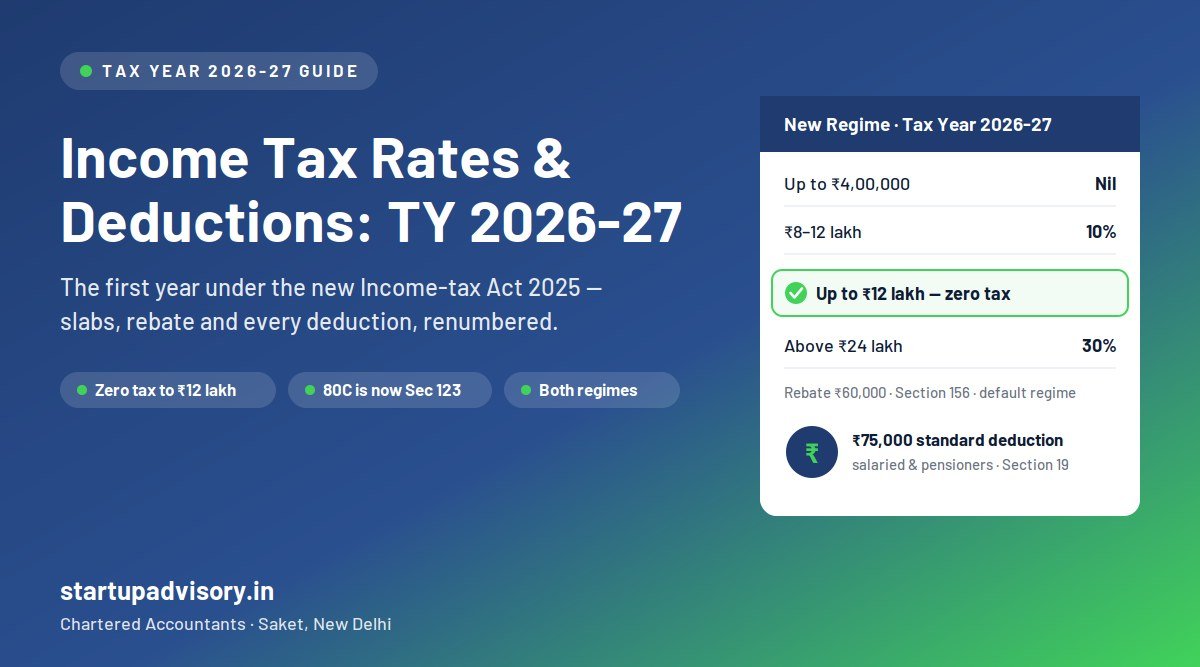
The Income-tax Act, 2025 replaced the 1961 Act from 1 April 2026, so your Form 16, ITR and any notice for FY 2026-27 onwards will cite the new section numbers. The limits did not change with the renumbering. For how the regimes compare for your income, see our guide to the new vs old tax regime, and for the renumbering itself our old-to-new section map.
Other covers: mandatory, useful, or skip
- Motor third-party insurance: mandatory. Section 146 of the Motor Vehicles Act, 1988 makes third-party cover compulsory for every vehicle on a public road. Own-damage cover is optional but sensible for any car under about eight years old.
- Home insurance: useful, under-bought. Structure cover for an owned house and contents cover for a rented one cost a few thousand rupees a year. Lenders insist on structure cover for a home loan; buy it yourself rather than through the bank’s bundled single-premium product, which is usually more expensive.
- Travel insurance: buy per trip for foreign travel; medical costs abroad are the real exposure.
- Professional indemnity and keyman insurance for business owners and professionals; outside the scope of this guide but worth a separate conversation if you run a practice or a company.
- Credit-life and loan-protection policies sold with a loan: usually skip. A term plan covering the loan amount does the same job for less and is not tied to the lender.
A checklist by life stage
| Stage | Health | Term life | Investment-linked |
|---|---|---|---|
| Single, early 20s, no dependants | ₹5 lakh individual policy now; waiting periods start running | Not yet, unless there is a loan or dependent parents | No |
| Married, no children | ₹10 lakh floater + super top-up | Yes if one income supports the household or there is a home loan | No |
| Children, home loan | Floater + super top-up to ₹50 lakh; parents on a separate policy | ₹1 crore to ₹2 crore, term to retirement or youngest child’s independence; consider MWP Act | Only after PPF/EPF/NPS are used and the emergency fund is funded |
| Business owner with personal guarantees | As above; add personal accident and critical illness | Sized to cover guaranteed debt; MWP Act policy | Keyman and partnership insurance at the company level, not personal ULIPs |
| Approaching retirement, children independent | Highest priority; buy before 60 while still insurable; consider a senior-citizen plan with co-pay rather than no cover | Let it run to the end of term; do not renew beyond the point where dependants and debt have gone | An annuity for guaranteed income can make sense here; compare the rate against SCSS and government bonds first |
- Notification No. 16/2025-Central Tax (Rate) dated 17 September 2025, amending Notification No. 12/2017-Central Tax (Rate): exemption of individual life and health insurance services and their reinsurance, effective 22 September 2025, pursuant to the 56th GST Council meeting
- Income-tax Act, 2025: Section 123 (deduction for life insurance premium and other investments, formerly Section 80C), Section 124(3) (NPS, formerly 80CCD(1B)), Section 126 (health insurance premium, formerly Section 80D); in force from 1 April 2026
- Finance Act, 2025: amendment to the taxation of ULIPs where the Section 10(10D) exemption does not apply, proceeds taxable as capital gains from assessment year 2026-27
- Finance Act, 2023: ₹5 lakh aggregate premium cap for non-ULIP life policies issued on or after 1 April 2023; Finance Act, 2021: ₹2.5 lakh aggregate premium cap for ULIPs issued on or after 1 February 2021
- Section 194DA, Income-tax Act, 1961 (TDS on payment in respect of life insurance policy), rate 2% from 1 October 2024
- IRDAI, Master Circular on IRDAI (Insurance Products) Regulations, 2024 – Health Insurance, dated 29 May 2024: waiting period, moratorium, cashless timelines, Customer Information Sheet
- IRDAI Annual Report 2024-25: insurance penetration 3.7% (life 2.7%, non-life 1.0%), density USD 97; Swiss Re sigma world insurance figures cited therein
- Section 45, Insurance Act, 1938; Section 146, Motor Vehicles Act, 1988; Section 6, Married Women’s Property Act, 1874
Cover amounts, the 10-to-15-times-income rule and the life-stage table are planning guidance from our practice, not statutory requirements. Premiums, product terms and tax provisions change; this article reflects the position as on 7 October 2026.
This article is general information, not personalised financial or tax advice. Insurance is a long-term contract; read the policy wording and the Customer Information Sheet, and take advice on your own circumstances before buying, surrendering or switching a policy.
Still confused? Talk to us before you sign
If you are not sure how much cover you need, whether the policy you were sold is worth continuing, or where your surplus should go once the insurance is in place, Startup Advisory, a CA-led firm in Saket, New Delhi, can sit on your side of the table. We do not sell insurance and earn no commission on any product, so the advice is only about what the numbers say:
- Insurance review: we go through every policy you hold, work out the real cover, the real cost and the IRR on the investment-linked ones, and tell you what to keep, make paid-up or surrender.
- Cover sizing: a needs-based calculation for health and term cover built on your actual liabilities, dependants and income, not a rule of thumb.
- Better investment of the surplus: once the protection is in place, a tax-efficient plan for the rest across PPF, EPF, NPS, mutual funds and debt, matched to the old or new regime that suits your income.
- Tax filing that uses it: Section 123 and 126 claims under the old regime, 10(10D) treatment and TDS credit on maturity proceeds, and the regime comparison each year.
Call 9311972982, write to hello@startupadvisory.in or book a free consultation.