
FEMA / RBI Compliance
Export of Services Reporting to RBI: Monthly EDF Rules from 1 October 2026
Reviewed by CA Neeraj Rohilla, FCA — Chartered Accountant, Startup Advisory, Saket, New Delhi.
What changed, and why it is bigger than it looks
For eleven years the rule for service exporters was, in practice, “get the money in on time and keep the FIRC”. Regulation 3(3) of the Foreign Exchange Management (Export of Goods and Services) Regulations, 2015 said that where none of the prescribed forms applied to a service, the exporter could export it without furnishing any declaration, subject only to the obligation to realise and repatriate the proceeds. The one prescribed form for services was SOFTEX, and it applied to software alone. A Delhi marketing agency billing a client in Dubai, an architect sending drawings to Singapore, a chartered accountant doing US bookkeeping: none of them filed anything with RBI or their bank beyond the purpose code on the inward remittance.
That exemption no longer exists. RBI notified the new Foreign Exchange Management (Export and Import of Goods and Services) Regulations, 2026 on 13 January 2026 (Notification No. FEMA 23(R)/2026-RB), gave the market nine months, amended them on 22 September 2026, and brought them into force on 1 October 2026. The 2015 export regulations and the two Master Directions on export and import are repealed and replaced by one set of Regulations and one set of Directions to Authorised Dealers.
The headline for goods exporters is that the regime is now “principle-based” and most approvals have moved from RBI to the AD bank. The headline for service exporters is different and less welcome: you are now inside the declaration and monitoring system for the first time.
Who is covered
Every person resident in India who exports a service. The Regulations define “services” widely, and specifically include a computer programme, database, drawing, design, audio or video signal, and any information in or on any medium other than a physical one. In practical terms the net covers:
- IT and software companies, SaaS businesses, app developers, whether in STPI, SEZ or the Domestic Tariff Area;
- consultants, advisers, accountants, lawyers, architects, engineers billing foreign clients;
- design, content, marketing, video and animation studios;
- BPO/KPO units, back-office and bookkeeping providers serving overseas clients;
- individual freelancers on Upwork, Fiverr, Toptal and direct contracts;
- education, coaching and online course providers with foreign students;
- any Indian company recharging services to a foreign group company.
There is no turnover threshold and no minimum invoice value. The ₹10 lakh figure you will see quoted is a simplification of closure, not an exemption from declaration. A freelancer billing ₹80,000 a month is an exporter of services and must file.
The new reporting chain, step by step
- Raise the invoice. The invoice date is now the single most important date in your FEMA compliance. It starts the 30-day EDF clock and the 9-month realisation clock. Put the SAC code, the currency and the client’s country on every invoice; the EDF asks for all three.
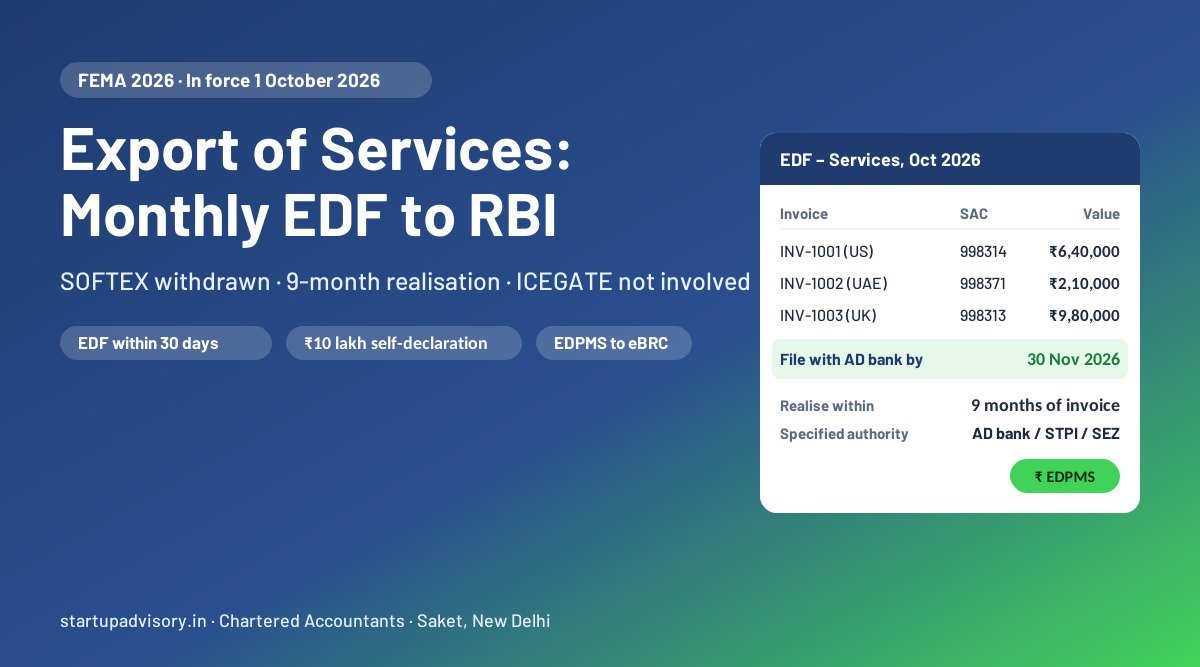
- File the EDF with your AD bank within 30 days of month-end (Regulation 3(2)). One EDF may cover every service invoice of the month, to any number of clients (Regulation 3(2)(a)). Software exporters in the DTA may file with the AD bank or STPI; SEZ units file with the Development Commissioner. The form is at the Annex to the Regulations: Part 1 carries the exporter’s PAN, AD code, name and address, buyer and country, and mode of delivery (“internet” is acceptable); Part 2B is the invoice-wise schedule for services with SAC code, description and net realisable value.
- The bank enters the EDF in EDPMS within five working days of receipt (Regulation 18(1)(b)). From that point each invoice is an open entry against your PAN in RBI’s Export Data Processing and Monitoring System.
- Receive the payment. The bank generates an Inward Remittance Message (IRM) for the receipt. Give the bank the invoice reference so the IRM is matched to the EDPMS entry.
- Closure. On full realisation the bank marks off the entry (Regulation 18(1)(g)). For invoices up to ₹10 lakh, the entry can be closed on your declaration that payment has been realised, “in full or otherwise”, and that declaration can be given quarterly for bulk closure of entries (Regulation 4).
- Generate the eBRC on the DGFT portal. The electronic Bank Realisation Certificate has been self-certified by the exporter on the DGFT portal since November 2023, using the IRM data the bank uploads. The eBRC is what you need for GST refunds on zero-rated supplies, SEIS-type benefits where available, and MSME or bank documentation.
The realisation period: 9 months, and the clock runs from the invoice
This is where the September amendment matters. The January 2026 notification had provided a generous 15 months for realisation (18 months for rupee invoicing), and most commentary written between January and September was built on those numbers. On 22 September 2026, RBI notified the Foreign Exchange Management (Export and Import of Goods and Services) (Amendment) Regulations, 2026 (FEMA 23(R)/(1)/2026-RB, Gazette of 24 September 2026), substituting the periods in Regulation 5(1) before the principal Regulations commenced. The 15- and 18-month windows never took effect.
| Position | Period for services | Clock starts |
|---|---|---|
| 2015 Regulations (till 30 Sep 2026) | 9 months | “Date of export” |
| 2026 Regulations as notified 13 Jan 2026 | 15 months (18 months INR) | Date of invoice |
| 2026 Regulations as amended 22 Sep 2026, in force 1 Oct 2026 | 9 months (12 months INR) | Date of invoice |
Two consequences follow. First, if you invoice at the end of a project rather than monthly, the entire receivable now carries one invoice date and one deadline. Second, the AD bank, not RBI, is the authority for extensions: Regulation 5(1) lets the bank extend the period on a request citing reasons, and Regulation 19 obliges every bank to have a written policy and SOP for exactly that. Ask your bank for its SOP; the answer tells you how it will treat a late Tier-2 client in Africa before you have the problem.
Short payments, write-offs, set-off and advances
- Reduction in value (Regulation 6). If the client pays less than the invoice, whether for bank charges, withholding tax abroad, a dispute or a discount, the bank may allow the reduction on a request citing reasons. For invoices up to ₹10 lakh, the reduction, including complete non-realisation, can be allowed on your declaration alone. Foreign withholding tax is the most common case for service exporters: a US client deducting 10% under the treaty, or a Gulf client deducting 5% VAT-style retention, leaves a permanent gap on every invoice. Keep the foreign tax certificate; you need it for the Form 67 foreign tax credit as well as for the bank.
- Set-off (Regulation 7). Export receivables may be set off against import payables due to the same overseas party or its group or associate companies, within the realisation period or the extended period. The 2026 text also allows set-off across goods and services, which matters to a software company that buys licences from the same foreign group it bills.
- Advance receipts (Regulation 10). An advance must ordinarily be routed through the same AD bank that will handle the export; a different bank is permitted with intimation to both. Where no export follows, the bank can close the EDPMS advance entry once satisfied that the advance has been refunded or that refund is not possible and the request is bona fide (Regulation 18(1)(i)).
- Third-party receipts. Permitted where the bank is satisfied about the bona fides of the transaction. Platform payouts (Upwork, Payoneer, Stripe) are the live example for freelancers: document the contract, the platform relationship and the payment trail so the bank can match the payout to your EDF.
Consequences of not filing or not realising
- Unmatched entries. The bank generates an IRM for every service purpose code. A receipt with no corresponding EDF, or an EDF with no receipt, sits open against your PAN. Banks are required to follow up until the entry is regularised.
- No eBRC. Without closure there is no eBRC, and without an eBRC a GST refund claim on zero-rated export of services under an LUT will be questioned. Our note on Annexure B and the GST refund process explains what the refund officer looks for.
- Trade restriction (Regulation 13). If proceeds stay unrealised for more than one year beyond the due date or extended date, further exports can only be made against full advance or an irrevocable letter of credit. Exporters already on RBI’s Caution List on 30 September 2026 stay governed by the earlier order until removed.
- Penalty under FEMA. Section 13 of the Foreign Exchange Management Act, 1999 provides a penalty of up to three times the sum involved where quantifiable, or up to ₹2 lakh otherwise, plus up to ₹5,000 per day for a continuing contravention. Compounding under Section 15 is available, but it is an application, a fee and a record.
- Income-tax and GST spill-over. Unrealised export receivables beyond the FEMA period are a standard query in scrutiny of export-heavy businesses, and realisation is a condition for the GST zero-rating itself under Rule 96A where an LUT is used.
What happens to SOFTEX, STPI and SEZ units
SOFTEX is withdrawn as a form. Software is now simply a service declared on the EDF. The practical change is in who certifies: a DTA software exporter that previously had to register with STPI as a non-STP unit purely to get SOFTEX certified can now file the EDF with its AD bank alone, with STPI as an alternative. SEZ units continue to file with the Development Commissioner. SOFTEX forms already filed for invoices raised up to 30 September 2026 are processed under the earlier framework; Regulation 20 allows AD banks to handle pre-October transactions that previously needed RBI approval.
If you are an STPI unit, do not assume the STPI monthly and quarterly performance reports fall away. Those are STPI scheme obligations, not FEMA ones, and the Regulations do not touch them.
Your compliance calendar from October 2026
| Event | Deadline | Where |
|---|---|---|
| EDF for all service invoices raised in a month | 30 days from month-end (October 2026 invoices: 30 November 2026) | AD bank (STPI optional for software; DC for SEZ) |
| Bank entry of EDF in EDPMS | 5 working days from receipt | Bank’s obligation |
| Realisation of each invoice | 9 months from invoice date (12 months if INR) | Through the same AD bank |
| Self-declaration closure, invoices up to ₹10 lakh | Per invoice, or quarterly in bulk | AD bank |
| eBRC generation | After EDPMS closure | DGFT portal, against the IRM |
| Extension request where a client is late | Before the 9/12-month date | AD bank under its Regulation 19 SOP |
What we recommend doing this month
- List every open foreign-currency invoice dated on or after 1 October 2026 and give each a realisation due date nine months out. Build the EDF schedule from your invoice register, not from bank receipts.
- Ask your AD bank, in writing, how it wants the EDF submitted: branch, trade-finance portal or e-mail, and whether it has a template. The Regulations fix the content and the deadline; the channel is the bank’s. Banks have had since January to build this; the channel is still settling.
- Put the SAC code on every export invoice and align it with the SAC in your GST returns. The EDF Part 2B, the GSTR-1 export table and the eBRC should tell the same story.
- Move to monthly invoicing where the contract allows. One large milestone invoice carries one nine-month deadline; monthly invoices spread the risk and match the monthly EDF cycle.
- Reconcile pre-October receivables separately. Invoices dated up to 30 September 2026 run under the 2015 framework. Keep two schedules until the old book is closed.
- Freelancers: stop treating the purpose code as the compliance. P0802 or P1006 on the remittance was never a declaration; from October it is matched against an EDF you are expected to have filed.
- Document foreign withholding on every invoice so the Regulation 6 reduction and the Form 67 credit are supported by the same certificate.
- Reserve Bank of India, Foreign Exchange Management (Export and Import of Goods and Services) Regulations, 2026, Notification No. FEMA 23(R)/2026-RB dated 13 January 2026, effective 1 October 2026 (rbi.org.in, Notification Id 13277): Regulations 2(1)(f), 3(2), 4, 5(1), 6, 7, 10, 13, 18, 19, 20 and the Annex (EDF)
- Reserve Bank of India, Foreign Exchange Management (Export and Import of Goods and Services) (Amendment) Regulations, 2026, Notification No. FEMA 23(R)/(1)/2026-RB dated 22 September 2026, Gazette of India Extraordinary, 24 September 2026: substitution of the realisation periods in Regulation 5(1) to nine and twelve months
- Reserve Bank of India, A.P. (DIR Series) Circular No. 20 dated 16 January 2026 and the accompanying Directions on Export and Import of Goods and Services, 2026 to Authorised Dealers
- Foreign Exchange Management (Export of Goods and Services) Regulations, 2015, Notification No. FEMA 23(R)/2015-RB, Regulation 3(3) (repealed with effect from 1 October 2026)
- Sections 7, 13 and 15, Foreign Exchange Management Act, 1999
- DGFT Trade Notice No. 33/2023-24 dated 10 November 2023: self-certification of eBRC on the DGFT portal from 15 November 2023
- Rule 96A, Central Goods and Services Tax Rules, 2017
This article reflects the Regulations and amendment as published on 2 October 2026. Bank-level procedures for EDF submission may differ between AD banks; we will update this article as RBI issues FAQs or further directions.
This article is general information, not legal or tax advice. FEMA contraventions carry monetary penalties; confirm your own position with a qualified professional before relying on it.
How Startup Advisory Can Help
Startup Advisory is a CA-led firm in Saket, New Delhi. We run FEMA, GST and bookkeeping compliance for IT companies, agencies, consultants and freelancers exporting services from Delhi NCR:
- Monthly EDF prepared from your invoice register and filed with your AD bank, with the EDPMS and IRM reconciliation tracked invoice by invoice.
- Realisation-date tracker with alerts at 6, 8 and 9 months, extension requests drafted under the bank’s SOP, and ₹10 lakh self-declaration closures batched quarterly.
- eBRC generation on DGFT and GST refund claims on zero-rated export of services, with the EDF, GSTR-1 and eBRC reconciled before filing.
- Transition clean-up: closing pre-October SOFTEX and EDPMS entries, foreign withholding documentation, and Form 67 credit.
Call 9311972982 or book a free consultation.