
Tax & ITR
GST on Import of Services Under RCM: Rates, ITC & the Full List of Foreign Services That Trigger It
In short
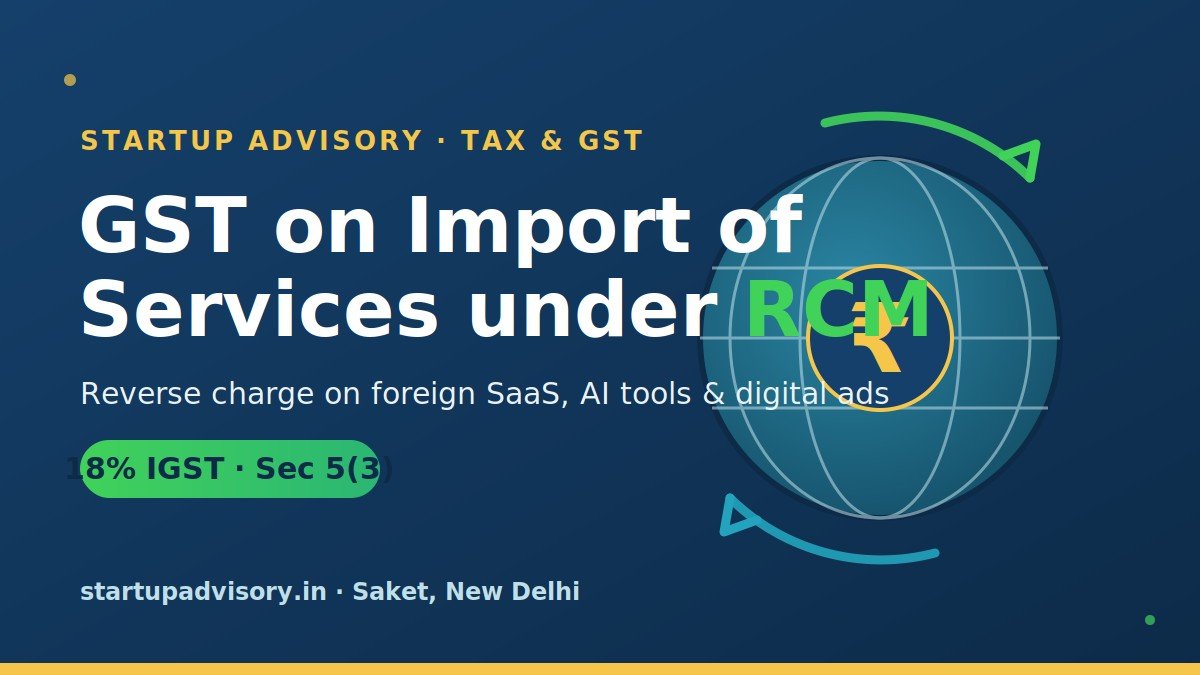
When a GST-registered business in India buys a service from a supplier outside India — a SaaS tool, cloud hosting, an AI subscription, foreign digital advertising or consultancy — it is an import of services under Section 2(11) of the IGST Act. The foreign supplier does not charge Indian GST. Instead you pay 18% IGST under the Reverse Charge Mechanism (RCM) per Section 5(3) of the IGST Act, pay it in cash, raise a self-invoice within 30 days, report it in GSTR-3B Table 3.1(d), and usually claim it back as input tax credit the same month if the service is used for business. This applies regardless of turnover — there is no small-business exemption.
Almost every modern business imports services without realising it — a card charge for a US cloud platform, a foreign AI subscription, ad spend billed by an overseas entity. Each one can carry a GST liability that the vendor never mentions, because under Indian law you, not the foreign supplier, are the one who has to pay it. This guide covers the statutory position, the rate, how to pay and claim credit, an exhaustive list of the services that trigger it, and the practical questions founders actually ask.
1. What counts as "import of services"
Under Section 2(11) of the IGST Act, 2017, a supply is an import of services when all three of the following are true:
| Test | Condition |
|---|---|
| Supplier | Located outside India (no Indian establishment or GSTIN) |
| Recipient | Located in India (you) |
| Place of supply | Is in India (determined under Section 13 of the IGST Act) |
Import of services is taxable in two situations: (a) when received for consideration, whether or not in the course of business; and (b) when received without consideration by a taxable person from a related person or own establishment outside India in the course of business. This second limb comes from Schedule I read with Section 7(1)(b) of the CGST Act, and is the reason intra-group "free" services from a foreign parent or subsidiary can still attract GST.
2. The statutory chain — provision by provision
If a GST officer questions an import-of-service entry, this is the exact ladder of provisions that governs it:
| What it governs | Provision | Effect |
|---|---|---|
| Charge under RCM | Section 5(3), IGST Act + Notification 10/2017-IT(R) dated 28 June 2017 | Recipient in India pays IGST on services supplied by a person in a non-taxable territory (to any person other than a non-taxable online recipient) |
| Definition of import | Section 2(11), IGST Act | The three-part test above |
| Scope of supply | Section 7(1)(b), CGST Act + Schedule I | Brings in related-party imports even without consideration |
| Place of supply | Section 13, IGST Act (general rule 13(2) = recipient's location) | Decides whether the supply is taxable in India at all |
| Self-invoice | Section 31(3)(f), CGST Act + Rule 47A (eff. 1 Nov 2024) | Recipient must self-invoice within 30 days of receipt |
| Time of supply | Section 13(3), CGST Act | Earlier of date of payment or date of self-invoice (foreign supplier) |
| Input tax credit | Sections 16 & 17(5), CGST Act | ITC allowed if used for business and not a blocked credit |
| Mandatory registration | Section 24, CGST Act | Anyone liable under RCM must register, irrespective of turnover |
3. The rate: 18% on almost everything
The overwhelming majority of imported services — software, SaaS, cloud infrastructure, digital advertising, design tools, consultancy and other OIDAR (Online Information and Database Access or Retrieval) services — attract 18% IGST.
GST 2.0 note (from 22 September 2025): the GST rate structure was simplified to broadly 5% / 18% / 40% slabs. IT, software, SaaS and OIDAR services remained at 18%. The restructure did not reduce the cost of importing these services — budget the full 18% (recoverable as ITC for taxable businesses).
4. How to compute, pay and report it
The RCM cycle for an imported service runs in five steps:
- Identify every inward supply from a foreign supplier (recurring SaaS is the most-missed category).
- Self-invoice within 30 days of receipt (Rule 47A) and raise a payment voucher.
- Compute 18% IGST on the invoice value (convert foreign currency at the applicable rate on the relevant date).
- Pay in cash — declare the liability in GSTR-3B Table 3.1(d) and discharge it through the electronic cash ledger. You cannot use accumulated ITC to pay RCM.
- Claim ITC of the same amount in GSTR-3B Table 4 the same month, if the service is used for business and is not a blocked credit.
Worked example: a Delhi startup subscribes to a US cloud platform for US$5,000/month (about Rs. 4,20,000). IGST under RCM = 18% = Rs. 75,600. The startup pays Rs. 75,600 in cash, then claims Rs. 75,600 as ITC the same month — net GST impact zero, but it must move through the cash ledger first, which is a real working-capital step.
5. Time of supply — which month do you pay in?
Because a foreign supplier is treated as unregistered in India, the time of supply under Section 13(3) is the earlier of the date of payment (as entered in your books or debited from your bank) or the date you issue the self-invoice. Whichever is earlier fixes the GSTR-3B month. For a card-paid monthly subscription, the payment date usually drives it. Delay the self-invoice past 30 days and you risk a general penalty plus interest at 18% per annum on any delayed tax.
6. Input tax credit on RCM — the conditions that actually bite
ITC of the IGST you pay under RCM is available under Section 16, but only if: the service is used in the course or furtherance of business (personal-use tools get no ITC); you have actually paid the tax in cash (ITC follows payment, not accrual); it is not a blocked credit under Section 17(5); and you hold a valid self-invoice as the document evidencing the credit.
Watch the ITC time limit. For RCM supplies, the financial year for the Section 16(4) ITC time limit is the year in which you issue the self-invoice (clarified by CBIC Circular 211/5/2024-GST). Sloppy or back-dated self-invoicing can quietly cost you the credit. And if the service is used only for exempt supplies or personal purposes, the RCM tax is a pure cost — there is no ITC to offset it, which is what hurts freelancers and proprietors who buy foreign tools partly for personal use.
7. The exhaustive list: foreign services that trigger RCM
If the supplier is outside India and has no Indian GSTIN, each of the following typically attracts 18% IGST under RCM. Use this as a compliance checklist.
AI tools & subscriptions
| Category | Common examples |
|---|---|
| Generative AI / LLM subscriptions | ChatGPT (OpenAI), Claude (Anthropic), Google Gemini, Perplexity Pro, Microsoft Copilot |
| AI image / video / audio | Midjourney, ElevenLabs, Runway, Synthesia |
| AI writing & productivity | Jasper, Copy.ai, Notion AI, Grammarly |
| AI APIs (usage-based) | OpenAI API, Anthropic API, Replicate, Hugging Face Pro |
Digital marketing & advertising
| Category | Common examples |
|---|---|
| Ad platforms (where billed by the foreign entity) | Google Ads, Meta / Facebook & Instagram Ads, LinkedIn Ads, X (Twitter) Ads, TikTok Ads |
| SEO & marketing intelligence | Semrush, Ahrefs, Moz, SimilarWeb |
| Email / automation | Mailchimp, ConvertKit, ActiveCampaign, HubSpot |
| Foreign agencies & freelancers | Overseas SEO, PPC, content or influencer agencies billing from outside India |
Note: the 6% Equalisation Levy on digital advertising was abolished from 1 April 2025, but that does not remove your GST RCM obligation on imported ad services — the two are different levies.
Software & SaaS
| Category | Common examples |
|---|---|
| Productivity & collaboration | Slack, Notion, Zoom, Microsoft 365 & Google Workspace (where billed offshore) |
| Design & creative | Figma, Adobe Creative Cloud, Canva Pro, Sketch |
| Developer & DevOps | GitHub, GitLab, Atlassian (Jira/Confluence), Postman, Vercel, Netlify |
| Business & CRM | Salesforce, Pipedrive, Monday.com, Airtable, Zapier |
| Support & comms APIs | Intercom, Zendesk, Twilio, SendGrid |
Cloud, hosting & infrastructure
| Category | Common examples |
|---|---|
| Cloud platforms | Amazon Web Services (AWS), Microsoft Azure, Google Cloud — where billed without an Indian GSTIN |
| Hosting / CDN / storage | DigitalOcean, Cloudflare, Linode, Dropbox, Backblaze |
Content, media & learning
| Category | Common examples |
|---|---|
| Stock assets | Shutterstock, Getty Images, Envato, Adobe Stock |
| Online learning (B2B) | Udemy Business, Coursera for Business, LinkedIn Learning, foreign certifications |
| Research & data | Foreign market-research reports, paid databases, API data feeds |
Professional & technical services
| Category | Common examples |
|---|---|
| Consultancy & advisory | Foreign management, technical, legal or engineering consultants |
| Technical / R&D support | Offshore development, testing, technical support contracts |
| Inter-group services | Management fees, IT support or shared services from a foreign parent or subsidiary (taxable even without consideration — Schedule I) |
A typical seed-stage Delhi startup easily runs 10–20 of these subscriptions. Each monthly charge is a separate import of service. Missing them is the single most common RCM error — and it is exactly what GST audits now flag through return and ledger matching.
8. When RCM does NOT apply to a foreign service
Not every payment to a foreign supplier triggers RCM. The exceptions all turn on place of supply falling outside India, or on the recipient being a consumer rather than a business:
- Services connected to immovable property abroad (Section 13(4)) — e.g. a hotel stay or property work outside India. Place of supply is where the property is.
- Admission to or services at an event held abroad (Section 13(5)) — place of supply is the event location.
- Intermediary / pure commission services — historically the place of supply was the supplier's location (Section 13(8)(b)), keeping foreign commission agents outside RCM. This is under change: the GST 2.0 reform revised the intermediary place-of-supply rule, so whether a given foreign commission or intermediary arrangement now attracts RCM must be checked on its specific facts against the current notification. Do not assume the old exemption still holds.
- OIDAR services to an unregistered consumer (B2C) — here the liability flips to the foreign supplier, who must take simplified registration and pay; it is not your RCM. For B2B, RCM stays with you.
9. Common mistakes that cost businesses money
- Treating recurring SaaS as "just a card expense" and never running RCM on it.
- Assuming a small turnover means no RCM — it does not (Section 24).
- Trying to pay RCM by setting off existing ITC instead of cash.
- Skipping the self-invoice, then losing ITC on a technicality.
- Believing PayPal or a credit card sidesteps GST — it does not.
- Forgetting that GST (RCM) and income-tax TDS under Section 195 are separate questions on the same payment.
10. Beyond GST: the TDS angle in one line
RCM answers the GST question; it does not answer income tax. Standardised, off-the-shelf software bought without any transfer of copyright is generally not royalty (following the Supreme Court's Engineering Analysis ruling), so usually no TDS under Section 195. But customised software, copyright transfers, or technical know-how can be royalty or fees for technical services and may attract TDS. Treat the TDS question separately for each foreign payment.
How Startup Advisory Can Help
Startup Advisory is a CA-led firm in Saket, New Delhi that helps businesses across Delhi NCR get import-of-service RCM right instead of discovering it during an audit. We can:
- Review your foreign-supplier subscriptions and build a master RCM checklist as part of our bookkeeping service.
- Set up compliant self-invoicing and the correct GSTR-3B entries (Table 3.1(d) and Table 4).
- Handle notices, ITC issues and complex cross-border transactions through GST advisory.
- Give founders a named expert who owns the whole compliance calendar — see also our GST & TDS compliance calendar 2026.
Call 9311972982 or book a free consultation.
Frequently Asked Questions
Primary sources
The statements of law and figures above are drawn from the official texts below. Each link was checked on 18 September 2026; government portals reorganise their pages from time to time, so tell us if one has moved.
Reviewed by CA Neeraj Rohilla, FCA — Chartered Accountant, Startup Advisory, Saket, New Delhi.