A One Person Company (OPC) is a company under Section 2(62) of the Companies Act, 2013 that lets a single founder run a business with a separate legal identity and limited liability. Startup Advisory completes 100% online OPC registration across Delhi NCR – for both resident founders and NRI Indian citizens – in about 7–10 working days, with a CA-led team based in Saket, New Delhi.
 What it is: A company owned and run by one person, with one member, one director and a mandatory nominee.Who it's for: Solo founders, consultants, freelancers and small business owners who want limited liability without a partner.Who can apply: An Indian citizen (resident or NRI). Foreign nationals are not eligible.Minimum capital: None – start with any nominal authorised capital.Timeline: Typically 7–10 working days, handled fully online.Provider: Startup Advisory, Saket, New Delhi – call 9311972982.
Reviewed by CA Neeraj Rohilla, FCA — Chartered Accountant, Startup Advisory, Saket, New Delhi.
Startup Advisory provides fast, 100% online One Person Company (OPC) registration in Delhi NCR – serving founders in Delhi, Gurugram (Gurgaon), Noida, Greater Noida, Ghaziabad and Faridabad. Our CA-led team in Saket, South Delhi helps solo entrepreneurs incorporate an OPC in as little as 7–10 working days, with complete legal compliance.
Going solo doesn't mean you have to settle for a sole proprietorship. The One Person Company, introduced by the Companies Act, 2013, was designed exactly for founders who want to own 100% of their business and still enjoy the protection and credibility of a registered company. You get a separate legal identity, limited liability and a professional corporate structure – without needing a co-founder or a board.
Whether you're a consultant, a freelancer, a D2C seller or a first-time founder testing an idea, we help you decide if an OPC is the right fit and handle the entire incorporation for you online.
 Limited liability: Your personal assets stay protected – you're only liable up to your capital.
Separate legal entity: The OPC can own assets, sign contracts and sue or be sued in its own name.
Full control: One member, one director – quick decisions with no partner disputes.
Perpetual succession: A mandatory nominee keeps the business alive if the member dies or is incapacitated.
Easier funding & loans: Banks and lenders trust a company structure more than a proprietorship.
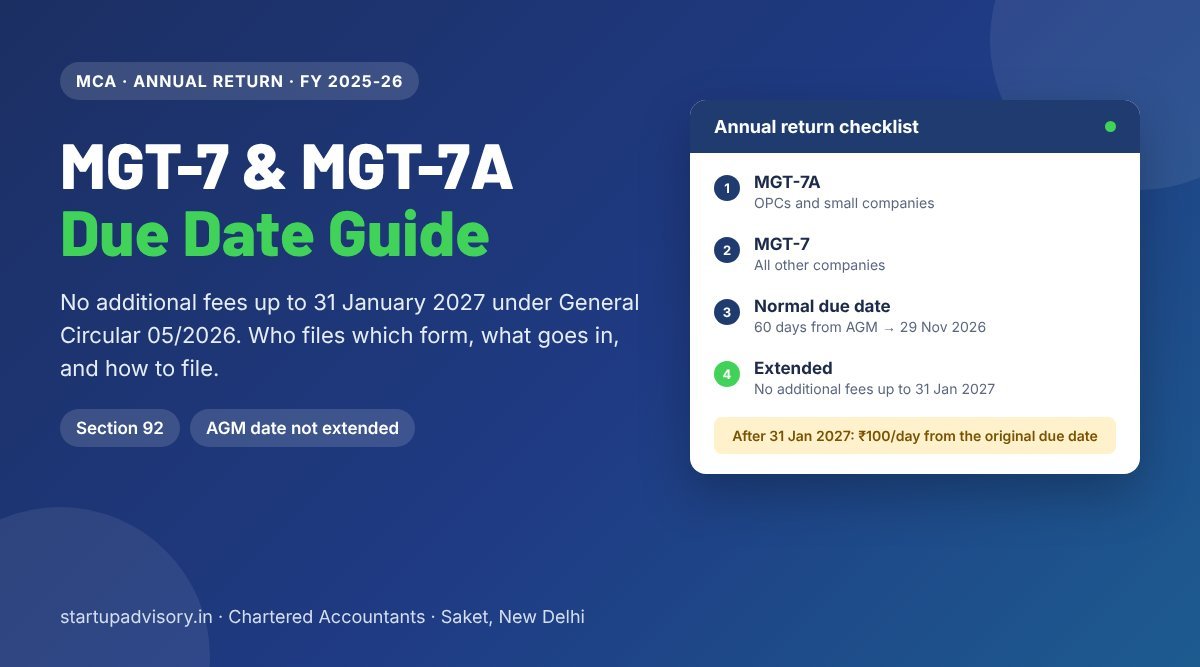
Lighter compliance: No AGM, no cash-flow statement, and a simplified annual return (MGT-7A).

Eligibility is governed by Rule 3 of the Companies (Incorporation) Rules, 2014, as updated in 2021:
Only a natural person who is an Indian citizen – whether resident in India or an NRI – can form an OPC.
To be treated as a resident, the person must have stayed in India for at least 120 days in the immediately preceding financial year (reduced from 182 days in 2021).
A nominee is mandatory – also an Indian citizen – who takes over the OPC if the sole member dies or becomes incapacitated.
One person can form only one OPC and be a nominee in only one OPC at a time.
Minors cannot be a member or nominee, and an OPC cannot carry out Non-Banking Financial Investment activities or be registered as a Section 8 (NGO) company.

Not sure which structure suits a solo founder? Here's a quick comparison:
| Feature | Proprietorship | OPC | Private Limited |
|---|---|---|---|
| Owners required | 1 | 1 member + 1 nominee | 2 to 200 |
| Separate legal entity | No | Yes | Yes |
| Limited liability | No | Yes | Yes |
| Raise equity / add investors | No | Limited | Yes |
| Compliance level | Low | Medium | High |
| Taxed as | Individual slab rates | Company | Company |
Need help deciding?  Book a Free Consultation
PAN & Aadhaar of the member and the nominee
Passport-size photograph
Identity proof (Voter ID / Passport / Driving Licence)
Address proof (recent bank statement / utility bill)
Nominee's written consent in Form INC-3
Latest utility bill (electricity / water) of the office
Rent agreement (if rented) + NOC from the owner
A residential address can be used as the registered office
Digital Signature Certificate (DSC) for the member
The entire OPC incorporation is online through the MCA's SPICe+ form. Here's how we do it for you:
Step 1 – Digital Signature (DSC): We obtain a Class 3 DSC for the sole member to sign forms digitally.
Step 2 – Name reservation (SPICe+ Part A): We check availability and reserve your company name with the MCA.
Step 3 – Incorporation (SPICe+ Part B): We file incorporation along with the e-MoA (INC-33), e-AoA (INC-34) and the nominee's consent (INC-3). DIN is allotted within this form.
Step 4 – PAN, TAN & registrations (AGILE-PRO-S): PAN, TAN and optional GST, EPFO, ESIC and a bank account are applied for in one go.
Step 5 – Certificate of Incorporation: Once approved, the Registrar issues the COI with CIN, PAN and TAN – your OPC is ready to operate.
Typical timeline: about 7–10 working days, subject to MCA processing and document readiness.
The Companies (Incorporation) Second Amendment Rules, 2021 (effective 1 April 2021) made the OPC far more flexible. These changes are still in force:
NRIs can now form an OPC – eligibility was widened to any Indian citizen, resident or otherwise.Residency reduced to 120 days – down from the earlier 182 days.No forced conversion – the old limit of ₹50 lakh paid-up capital / ₹2 crore turnover was removed, so an OPC can grow freely.Convert anytime – an OPC can voluntarily convert into a Private or Public Limited Company whenever you choose.An OPC enjoys lighter compliance than a Private Limited Company, but a few filings are mandatory every year:
Statutory audit by a Chartered Accountant – required regardless of turnover.
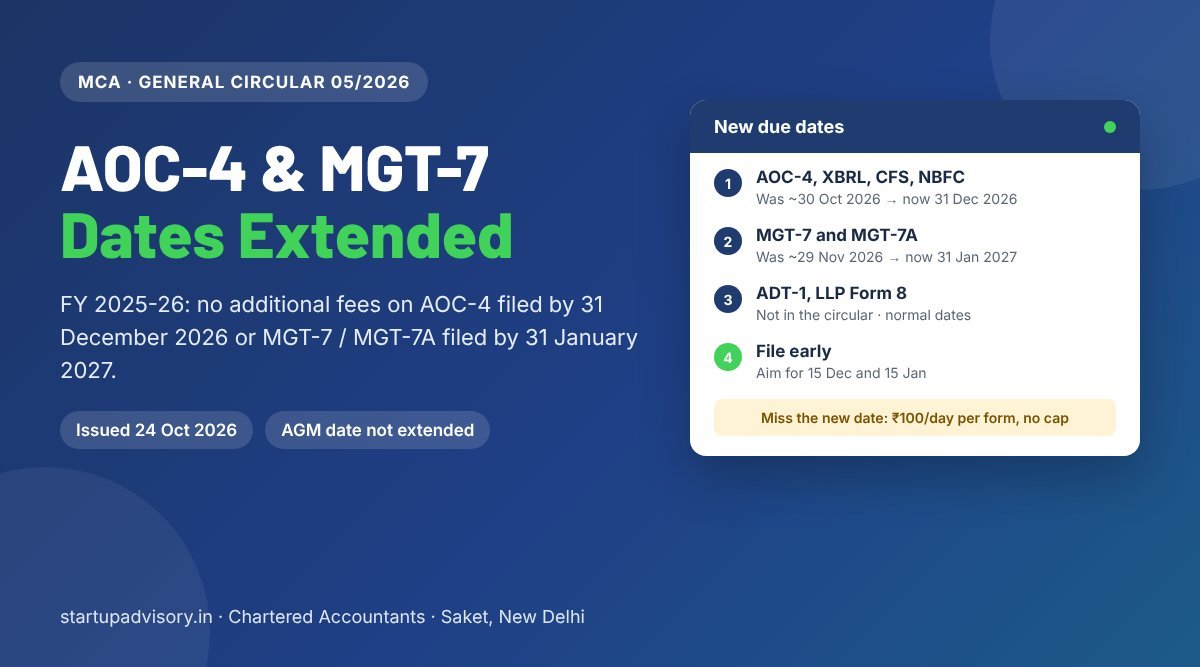
Form AOC-4 – filing of audited financial statements with the Registrar.
Form MGT-7A – the simplified annual return for OPCs and small companies.
Income Tax Return – an OPC is taxed as a domestic company and can opt for the 22% rate under Section 115BAA (about 25.17% effective with surcharge and cess).
DIR-3 KYC for the director, plus GST returns if registered. No AGM is required.
We can manage all of this for you year-round – see our bookkeeping and ITR advisory services.
OPC cost is made up of fixed statutory charges plus a professional fee. Here is an indicative breakdown for Delhi:
| Cost Component | Typical Amount (Delhi) | Notes |
|---|---|---|
| Digital Signature Certificate (DSC) | ₹1,500 – ₹2,500 | One for the sole member |
| Name Reservation (SPICe+ Part A) | ₹1,000 | Per name application |
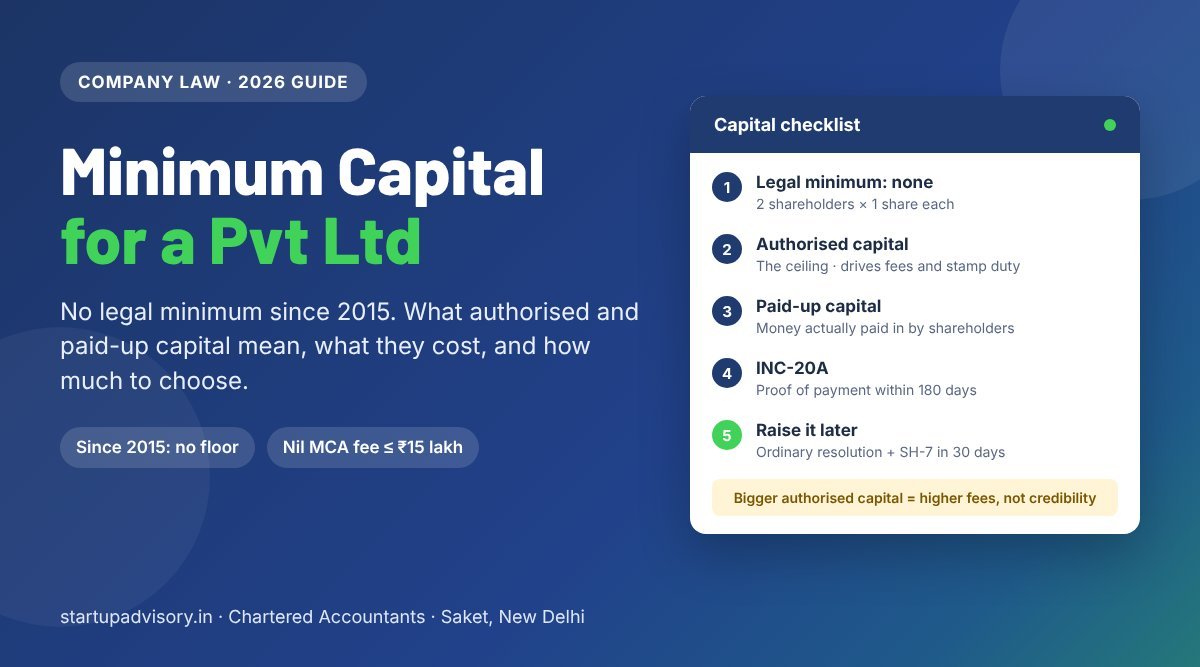
| Government Filing Fee (SPICe+) | ₹0 | Nil for authorised capital up to ₹15 lakh |
| Stamp Duty (MoA & AoA) | ₹500 – ₹2,000 | Delhi has among the lowest stamp duty in India |
| DIN, PAN & TAN | Included | Allotted with SPICe+ |
| Professional Fee | As per package | CA-led, end-to-end filing |
Indicative all-inclusive cost: OPC registration in Delhi typically costs ₹6,000 – ₹15,000, depending on authorised capital and the professional package chosen. We work on transparent, fixed fees with no hidden charges.
Want an exact quote for your OPC? Call 9311972982 for a fixed-fee quote
Expert Legal & CA Team – real professionals guiding your incorporation
Fast Turnaround – OPC setup in as little as 7–10 days
100% Online Process – no physical paperwork or office visits
Ongoing Support – we also handle your post-incorporation compliance
Call Now:- 9311972982
Email:- hello@startupadvisory.in
Or simply Get Free Consultation

Startup Advisory is based in Saket, South Delhi, and helps solo founders incorporate One Person Companies across the entire National Capital Region. Because the process is fully online, you can register your OPC without travelling to our office. We regularly help clients in:
OPC registration in Delhi & South Delhi (Saket, Hauz Khas, Nehru Place, Connaught Place)
OPC registration in Gurugram (Gurgaon)
OPC registration in Noida & Greater Noida
OPC registration in Ghaziabad
OPC registration in Faridabad
Starting a one-person business anywhere in Delhi NCR? Talk to our experts on 9311972982

Vishal Singh


Ajay Philip

Pranshu Gaur

Ravish Mehta

Mohit Aggarwal

Sanjeev Sharma

Realtoadvisors

Sakshi Gupta
Rudranath Trip
Yash Rohilla
Sandro Cottus

Azan Hosein Photography
Neetu Yadav
Fresh guides on tax, GST and startup compliance from our CA team.
Share your details — our experts call you back. We use these details only to respond to you. See our Privacy Policy.