
Tax & ITR
Filing ITR under Section 44AD & 44ADA: Updates & Key Points for FY 2025-26
In short
Presumptive taxation lets you skip detailed books and declare a flat percentage of income. For FY 2025-26 (AY 2026-27): Section 44AD (small business) applies up to Rs. 2 crore turnover (Rs. 3 crore if cash receipts are ≤ 5%), with deemed profit of 8% (cash) or 6% (digital). Section 44ADA (professionals) applies up to Rs. 50 lakh receipts (Rs. 75 lakh if cash receipts are ≤ 5%), with deemed profit of 50%. You file ITR-4 (Sugam), pay 100% advance tax by 15 March, and the non-audit due date this year is 31 August 2026. Declare below the deemed rate and a tax audit kicks in. This year's filing is still under the Income-tax Act, 1961 — not the new 2025 Act.
Presumptive taxation is the route most freelancers, consultants and small traders in Delhi NCR should be using — yet it is also the one where small errors quietly create big problems: a missed advance-tax date, an accidental opt-out, or declaring a rupee less than the deemed profit and triggering an audit you never expected. This guide sets out exactly how Section 44AD and Section 44ADA work for FY 2025-26 (AY 2026-27), what changed this year, and the mandatory points to get right before you file.
What is presumptive taxation under Sections 44AD and 44ADA?
Presumptive taxation is a scheme under the Income-tax Act, 1961 that lets eligible small taxpayers declare a fixed percentage of turnover or receipts as taxable income, without maintaining full books of accounts or getting them audited. The idea is to cut compliance cost for small businesses and professionals. Section 44AD covers eligible businesses; Section 44ADA covers specified professionals; and Section 44AE covers small goods-transporters (taxed per vehicle per month).
The trade-off is simple: you give up the right to claim your actual expenses, and in return you get a far lighter compliance burden. For most genuinely small operators whose real margins are higher than the deemed rate, that is a good deal.
Section 44AD: presumptive tax for small businesses
Section 44AD is for a resident individual, HUF or partnership firm (not an LLP) running an eligible business. You declare income at a deemed rate and skip books and audit, as long as you stay within the limits.
| Item | Section 44AD (FY 2025-26) |
|---|---|
| Who can opt | Resident individual, HUF, partnership firm (not LLP) |
| Turnover limit | Up to Rs. 2 crore; up to Rs. 3 crore if cash receipts are ≤ 5% of total receipts |
| Deemed profit | 8% of turnover; 6% on amounts received digitally / through banking channels by the ITR due date |
| Books & audit | Not required — unless you declare below the deemed rate with taxable income |
| ITR form | ITR-4 (Sugam) if total income ≤ Rs. 50 lakh; else ITR-3 |
Who is excluded from 44AD: professionals covered by 44ADA, businesses earning commission or brokerage, agency businesses, and transporters covered by 44AE. The 6% rate applies only to turnover received through digital or banking modes by the due date of filing the return — anything received in cash, or realised digitally after the due date, is taxed at 8%.
Section 44ADA: presumptive tax for professionals
Section 44ADA is for a resident individual or resident partnership firm (not an LLP) carrying on a specified profession. You declare 50% of gross receipts as income. Note that HUFs cannot use 44ADA — a point that catches many family-run practices.
| Item | Section 44ADA (FY 2025-26) |
|---|---|
| Who can opt | Resident individual or resident partnership firm (not LLP); HUFs excluded |
| Specified professions | Legal, medical, engineering, architecture, accountancy, technical consultancy, interior decoration, and others notified by the CBDT |
| Receipts limit | Up to Rs. 50 lakh; up to Rs. 75 lakh if cash receipts are ≤ 5% of total receipts |
| Deemed profit | 50% of gross receipts |
| Lock-in | None — you may move in and out year to year (unlike 44AD) |
| ITR form | ITR-4 (Sugam) if total income ≤ Rs. 50 lakh; else ITR-3 |
A freelance software consultant, a doctor, a practising lawyer or an interior designer earning within these limits typically pays tax on only half their receipts — often far less than their real expense-adjusted profit would suggest, which is why 44ADA is so widely used. If your field is not a specified profession (for example a digital marketer or content creator), you fall under 44AD as a business, not 44ADA.
Section 44AD vs 44ADA: side-by-side
| Feature | Section 44AD | Section 44ADA |
|---|---|---|
| For | Eligible businesses | Specified professionals |
| Eligible persons | Resident individual, HUF, firm (not LLP) | Resident individual, firm (not LLP); not HUF |
| Limit | Rs. 2 cr (Rs. 3 cr if cash ≤ 5%) | Rs. 50 lakh (Rs. 75 lakh if cash ≤ 5%) |
| Deemed profit | 8% / 6% (digital) | 50% |
| Five-year lock-in | Yes | No |
| Advance tax | 100% by 15 March | 100% by 15 March |
What is new for FY 2025-26 (AY 2026-27)
The presumptive rates and limits themselves are unchanged this year — Budget 2025 left 44AD and 44ADA alone. But several surrounding rules have changed, and they affect how and when you file.
- You still file under the old Act. Returns for FY 2025-26 (AY 2026-27) are governed by the Income-tax Act, 1961, using the old ITR forms. The new Income-tax Act, 2025 applies from FY 2026-27 onward — so it affects the return you file next year, not this one. Ignore any guide that tells you to file this year's return "under the new Act".
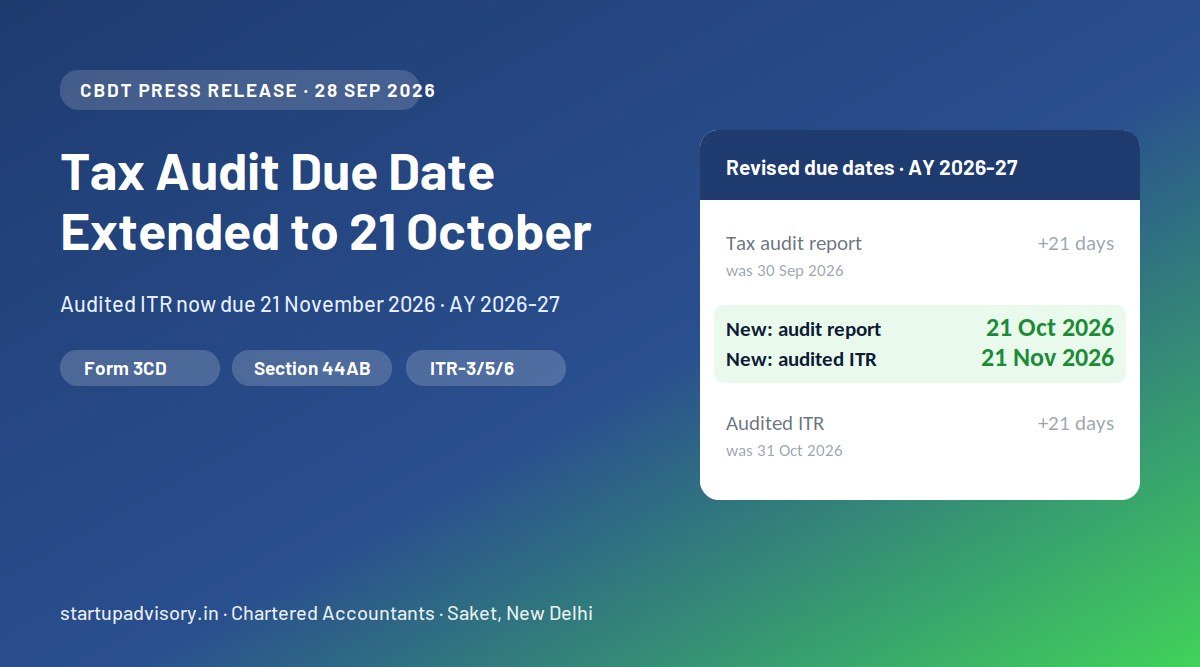
- A later due date for non-audit business and professional filers. From AY 2026-27, ITR-3 and ITR-4 (non-audit) move to a 31 August 2026 due date, while salaried ITR-1 / ITR-2 stay at 31 July 2026 and audit cases at 31 October 2026.
- Small capital gains now allowed in ITR-4. Long-term capital gains under Section 112A up to Rs. 1.25 lakh can be reported within ITR-4, provided you have no brought-forward or carry-forward capital losses. Earlier, any capital gain forced you out of Sugam.
- More disclosure inside ITR-4. The Sugam form for AY 2026-27 adds a separate 'investments' field under the business financial particulars, makes the year-end bank balance mandatory, and tightens pre-validated bank-account and PAN-name matching.
- New regime is the default. If you have business or professional income and want the old regime, you must file Form 10-IEA on or before the due date. Miss it and you are locked into the new regime for the year.
Mandatory requirements & important points to keep in mind
- Advance tax by 15 March is compulsory. Presumptive taxpayers pay 100% of advance tax in a single instalment by 15 March of the financial year. Miss it and interest runs under Sections 234B and 234C — the scheme simplifies the schedule, it does not waive the tax.
- You cannot declare below the deemed rate without an audit. Declare less than 8%/6% (44AD) or 50% (44ADA) while your total income is above the basic exemption limit, and you must maintain books and get a tax audit under Section 44AB. See our tax audit applicability guide for exactly when this bites.
- Respect the 44AD five-year lock-in. Opt in, then opt out by declaring lower profit, and you are barred from 44AD for five years — with books and audit obligations during that window. 44ADA has no lock-in.
- Keep GST out of turnover. For 44AD, turnover is sales/receipts net of GST where GST is collected and shown separately. Folding GST into turnover can wrongly push you past Rs. 2 crore.
- Firms get no separate partner salary/interest deduction. For a partnership firm under 44AD or 44ADA, the deemed profit is the final business income — partner's remuneration and interest on capital are not separately deductible from it.
- Chapter VI-A deductions still apply (old regime). Presumptive income blocks business-expense claims, but you can still reduce total income through deductions such as 80C and 80D if you are on the old regime. Under the default new regime, most such deductions are not available.
- The Rs. 50 lakh ITR-4 ceiling is on total income, not just turnover. Even within the presumptive limits, if your total income (after adding salary, interest, etc.) exceeds Rs. 50 lakh, you file ITR-3, not ITR-4.
Common mistakes that trigger an audit or a notice
- Declaring a profit figure below the deemed rate to "save tax" — the fastest way to invite a 44AB audit and scrutiny.
- Assuming the 6% rate applies to all receipts, when cash and late-realised receipts are taxed at 8%.
- An HUF or LLP trying to use 44ADA — both are outside it.
- A partnership firm deducting partner salary/interest on top of presumptive profit.
- Skipping advance tax because "it's only one payment" — and then paying 234B/234C interest.
- Filing ITR-4 when total income has crossed Rs. 50 lakh, leading to a defective-return notice under Section 139(9).
Quick scenarios
- A Delhi trader, Rs. 1.8 crore turnover, 98% via UPI/bank: eligible for 44AD; deemed profit mostly at 6%; no audit if declared at the deemed rate.
- A freelance consultant, Rs. 40 lakh receipts, all digital: eligible for 44ADA; declares Rs. 20 lakh (50%) as income; no books, no audit.
- A designer, Rs. 70 lakh receipts, Rs. 2 lakh in cash (under 5%): qualifies for the Rs. 75 lakh 44ADA limit; declares Rs. 35 lakh.
- A small business under 44AD declaring 4% profit with taxable income: below the deemed rate — books and a tax audit become mandatory.
For the full filing calendar, see our ITR due dates for AY 2026-27, and for form selection and the new rules read our ITR filing 2026 guide. Freelancers and consultants will also find our ITR for freelancers guide useful.
This article is general information, not tax advice. Thresholds, rates and dates can change or be extended by the CBDT, and the right treatment depends on your specific facts — confirm with a qualified professional before acting.
How Startup Advisory Can Help
Startup Advisory is a CA-led firm in Saket, New Delhi that files presumptive returns for traders, freelancers, consultants and professional firms across Delhi NCR. Choosing 44AD vs 44ADA — and staying inside the rules — is rarely as simple as it looks:
- A clear call on whether 44AD or 44ADA fits, and whether presumptive is even the cheaper route for you.
- Correct deemed-profit computation, advance-tax planning and ITR-4 filing.
- Audit-ready bookkeeping for the years you fall outside the scheme.
- A named Chartered Accountant who signs off on the numbers.
Call 9311972982 or book a free consultation to file your presumptive return correctly.
Frequently Asked Questions
Primary sources
The statements of law and figures above are drawn from the official texts below. Each link was checked on 18 September 2026; government portals reorganise their pages from time to time, so tell us if one has moved.