
GST & Compliance
Supreme Court Quashes Section 74 GST Notices in Tata Steel and G.R. Infra: Who Actually Benefits and How to Use It
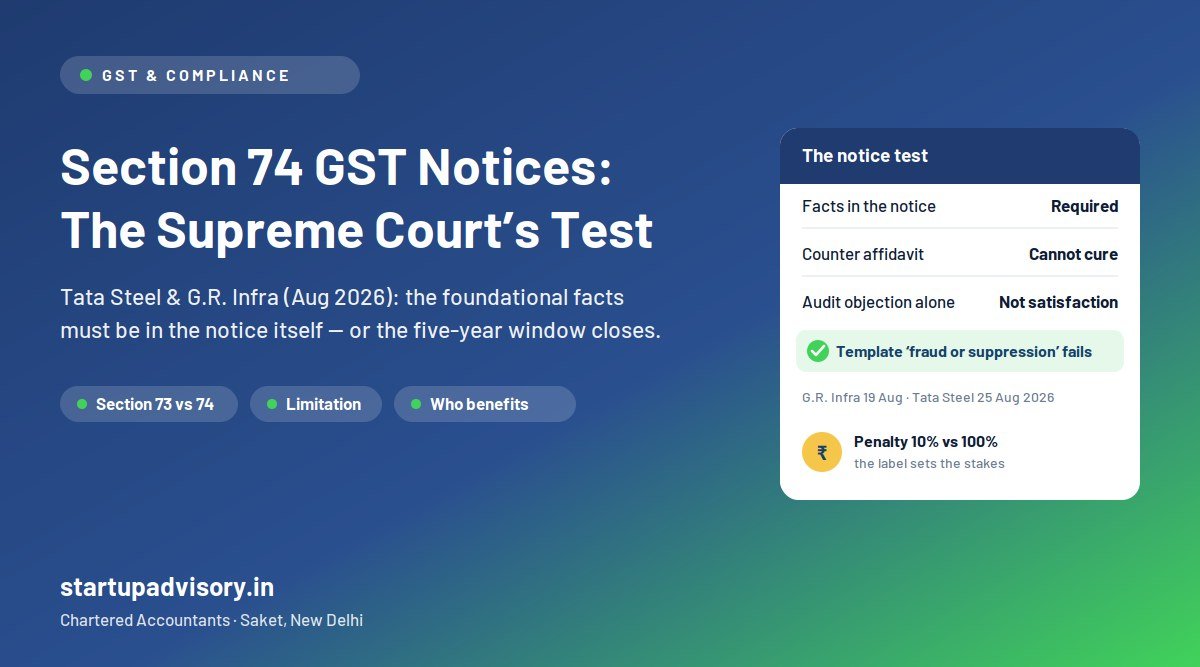
Why these two judgments matter more than the usual “SC quashes notice” headline
Every CA practising in GST has a drawer of Section 74 notices that read the same way: a mismatch between GSTR-3B and GSTR-2A or e-way bills, input tax credit from a supplier whose registration was later cancelled, a site-office expense the officer considers ineligible — followed by the sentence that the taxpayer “availed ITC without documentary evidence and suppressed facts”. That sentence is not decoration. It converts a three-year window into a five-year one and a 10% penalty into a 100% one. For financial years 2017-18 to 2019-20, most of these notices could not have been issued at all under Section 73; they exist only because Section 74 was invoked.
G.R. Infra’s notice alleged exactly the things a Delhi NCR SME’s notice alleges — return-versus-e-way-bill mismatch, ineligible site-office ITC, vendors whose registration was cancelled after supply. The Supreme Court did not decide whether those allegations were right. It decided something more useful: the notice never earned the right to be under Section 74 in the first place.
What the Court actually decided
| G.R. Infra Projects Ltd v. State of MP | Tata Steel Ltd v. Union of India | |
|---|---|---|
| Decided | 19 August 2026 · Civil Appeal No. 11277 of 2026 | 25 August 2026 · 2026 INSC 920 |
| Bench | Justice J.B. Pardiwala and Justice K. Vinod Chandran (judgment by Vinod Chandran J.) | |
| Period | FY 2018-19; SCN dated 13 June 2025 under Section 74 CGST/MPGST | FY 2018-19 to FY 2020-21; SCN under Section 74 following a CAG audit objection on ITC mismatch and short payment |
| Allegations | GSTR-3B vs e-way bill mismatch, ineligible ITC on site office, post-supply cancellation of vendor registrations — demand of about ₹1.53 crore | ITC mismatch across three years and short payment; the officer had earlier kept the audit objection in the “call book” and the department pursued it before the Public Accounts Committee |
| Below | MP High Court (Indore) dismissed the writ — specific allegations present, alternate remedy available, relying on Greatship (India) | Challenge to the notice and the consequential Order-in-Original |
| Holding | Allegations leading to the inference of fraud or concealment must emanate from the notice itself; the State’s counter affidavit cannot supply them; notice beyond the Section 73 window | Extended limitation cannot be invoked by mechanical recital; foundational facts must be evident from the notice; officer’s own satisfaction required — an audit objection is not it; “protective” notices are alien to GST |
| Relief | SCN and High Court order set aside; State directed not to proceed further on that notice | SCN and Order-in-Original set aside; liberty to initiate a fresh Section 74 proceeding, if permissible in law, with foundational facts in the notice, before 28 February 2027 |
The law in one paragraph
Section 73 governs tax not paid, short paid, erroneously refunded or ITC wrongly availed for any reason other than fraud, wilful misstatement or suppression of facts; the order must be passed within three years of the due date of the annual return for that year, and the notice at least three months before that. Section 74 governs the same defaults when they are by reason of fraud, wilful misstatement or suppression with intent to evade; the order window is five years, the notice must precede it by six months, and penalty is equal to the tax rather than the higher of 10% or ₹10,000. For FY 2024-25 onwards, Section 74A replaces both with a single limitation period irrespective of fraud, while keeping the fraud finding relevant to the penalty rate. The ingredients of Section 74 are therefore jurisdictional pre-conditions, not a heading on a form.
The six holdings that actually change practice
1. The facts must be in the notice. Both judgments turn on one sentence: the foundational facts which led to the inference of fraud, wilful misrepresentation or suppression must be evident from the notice itself. Not in the investigation file, not in the officer’s head, not in a later affidavit. In G.R. Infra the Court refused even to read the State’s counter affidavit for this purpose — a notice must stand or fall on its own contents.
2. Reciting the words is not applying the mind. The Tata Steel judgment describes the mechanical use of fraud, wilful misrepresentation and suppression as lip service that does not indicate any application of mind, upon which alone the officer’s satisfaction can rest. In G.R. Infra the notice alleged “fraud or concealment of facts” — and the Court read that “or” as proof that even the officer did not know which case he was making.
3. An audit objection is not the officer’s satisfaction. Proceedings under Sections 73 and 74 can be initiated only on the satisfaction of the proper officer. Where the department itself parked the audit objection in the call book and argued it before the Public Accounts Committee, the Court read that as evidence that no satisfaction existed — not on the mismatch, and certainly not on suppression.
4. There is no such thing as a “protective” Section 74 notice. Tata Steel argued, and the Court accepted, that protective assessment is a concept alien to GST. A notice issued to keep a limitation window alive while the department makes up its mind is not a notice under Section 74.
5. A mismatch is not suppression. The Tata Steel notice contained, in the Court’s words, nothing beyond a bland statement of availing ITC without documentary evidence and suppressing facts. A difference between two returns, or between a return and an e-way bill, is a reconciliation issue; it becomes suppression only when the notice shows a deliberate device to evade tax or avail excess credit. This is the same line the Court drew under central excise in Uniworth Textiles, Pushpam Pharmaceuticals and Anand Nishikawa: suppression must be wilful, and mere omission is not enough.
6. Writ jurisdiction is open when the defect is on the face of the notice. The Madhya Pradesh High Court had sent G.R. Infra back to adjudication citing Greatship (India), the Supreme Court’s own caution against bypassing statutory appeals. By reversing it, the Court has marked the boundary: where the notice lacks the jurisdictional foundation for Section 74 and is beyond the Section 73 window, the taxpayer need not be relegated to the very proceeding whose jurisdiction is in question.
Who benefits — financial year by financial year
The benefit is not uniform. It depends on where the notice sits against two clocks: the three-year Section 73 clock and the five-year Section 74 clock, both of which run from the due date of the annual return for that year. The table gives the statutory base dates; for FY 2017-18 to FY 2019-20 the Section 73 dates were pushed by notifications under Section 168A and by COVID-era limitation orders, so treat the table as the starting grid, not the answer for your notice.
| Financial year | Annual return due date | Section 73 outer date (3 yrs) | Section 74 outer date (5 yrs) | Position after the judgments |
|---|---|---|---|---|
| 2017-18 | 5 / 7 Feb 2020 | Feb 2023, extended by notification to 31 Dec 2023 | Feb 2025 — closed | Tier 1: template Section 74 notice quashable and cannot be re-issued |
| 2018-19 | 31 Dec 2020 | 31 Dec 2023, extended to 30 Apr 2024 | 31 Dec 2025 — closed | Tier 1: as above (G.R. Infra’s year) |
| 2019-20 | 31 Mar 2021 | 31 Mar 2024, extended to 31 Aug 2024 | 31 Mar 2026 — closed | Tier 1: as above |
| 2020-21 | 28 Feb 2022 | 28 Feb 2025 | 28 Feb 2027 — open | Tier 2: quashable; fresh notice with facts possible till 28 Feb 2027 |
| 2021-22 | 31 Dec 2022 | 31 Dec 2025 | 31 Dec 2027 — open | Tier 2: quashable; re-issuable within window |
| 2022-23 | 31 Dec 2023 | 31 Dec 2026 | 31 Dec 2028 — open | Tier 3: Section 73 still open — the argument is penalty, not limitation |
| 2023-24 | 31 Dec 2024 | 31 Dec 2027 | 31 Dec 2029 — open | Tier 3: as above |
| 2024-25 onwards | Section 74A — single limitation period irrespective of fraud | Tier 4: no limitation argument; foundational facts still govern penalty rate | ||
Tier 1 — FY 2017-18 to FY 2019-20: the clean win
For these years both clocks have run out. If the Section 74 notice was issued after the Section 73 date for that year and contains only template language, the two judgments give you the strongest position GST litigation has offered in years: the notice is liable to be quashed, and there is no time left for the department to issue a corrected one. This is G.R. Infra’s own situation. Most of the mismatch-based notices that landed on Delhi NCR SMEs between 2023 and 2025 for these years fall here. The question to answer is narrow — does the notice set out facts of concealment, or does it only use the word?
Tier 2 — FY 2020-21 and FY 2021-22: a win that buys time and forces the department’s hand
The notice is equally vulnerable, but a quashing does not end the matter: the department may issue a fresh notice, this time with the foundational facts, within the five-year window. That is exactly the liberty Tata Steel was given. The practical benefit is still real — a department that must now plead specific facts of intent to evade often cannot, because the underlying dispute was a reconciliation difference all along. Expect the fresh notice, if any, to be narrower and to land under Section 73 in substance even if labelled otherwise.
Tier 3 — FY 2022-23 and FY 2023-24: the penalty argument
Here the Section 73 window is still open, so limitation is not your argument; characterisation is. A notice that fails to establish fraud, wilful misstatement or suppression on its face cannot support the 100% penalty of Section 74. Section 75(2) contemplates that where the appellate authority or court finds the Section 74 charges not established, the tax is re-determined as if the notice had been issued under Section 73 — the 10% regime, with the further reductions available for early payment. On a ₹50 lakh demand, the difference between the two regimes is the difference between a manageable settlement and an existential one.
Tier 4 — FY 2024-25 onwards: only the penalty rate is in play
Section 74A collapses the two windows into one, so a limitation challenge built on these judgments does not arise. What survives is the principle that the fraud finding must rest on facts in the notice — and under Section 74A that finding still decides whether the penalty is the ordinary rate or the full-tax rate.
Two further groups that benefit
Taxpayers whose order has already been passed. Tata Steel set aside the Order-in-Original with the notice. A jurisdictional defect in the notice does not heal because an order followed; it can be taken in a pending appeal under Section 107, before the Tribunal, or in a writ, subject to each forum’s limitation and pre-deposit requirements. Taxpayers whose writ was dismissed as premature. The G.R. Infra reversal of the Madhya Pradesh High Court’s Greatship-based dismissal is the citation such taxpayers lacked.
Who does not benefit
Be honest about this before relying on the judgments. A notice that names the fake invoices, the non-existent supplier, the statements recorded under Section 70 and the money trail is a Section 74 notice with foundational facts — these rulings do not touch it. Nor do they help where the tax was genuinely short paid and the only question is penalty: interest runs regardless. Taxpayers who settled demands under the Section 128A waiver scheme and closed the matter cannot reopen it on the strength of a later judgment. And a taxpayer who participated fully in adjudication without ever objecting to jurisdiction has made the argument harder, not impossible — raise it at the earliest stage that remains.
How to take the benefit: the six-point audit for your notice
Run this on every open Section 74 notice or order, in this order — the sequence matters because the first two points decide which tier you are in before anyone reads the merits.
| Step | What to check | What you are looking for |
|---|---|---|
| 1. Date the clocks | Annual return due date for the year → Section 73 and Section 74 outer dates, including notified extensions | Whether the notice could have been issued under Section 73 at all on its date. If not, it survives only as a Section 74 notice |
| 2. Locate the tier | Is the five-year window closed, open, or is Section 73 still open? | Tier 1: quash and close. Tier 2: quash, expect a narrower fresh notice. Tier 3: fight the label for penalty |
| 3. Test the notice for facts | Does it identify what was concealed, when, by which document or statement, and the intent inferred from it? Or does it recite “fraud or suppression”? | Specific transactions and evidence = a real Section 74 notice. Template language, the tell-tale “or”, allegations copied from the audit para = G.R. Infra territory |
| 4. Trace the satisfaction | DRC-01A intimation, draft notice, audit paragraph, call-book entries, any “protective” language | Whether the officer recorded his own satisfaction or forwarded someone else’s objection — the Tata Steel ground |
| 5. Separate mismatch from suppression | Reconcile GSTR-3B, 2A/2B, e-way bills and books for the disputed items | A reconciliation difference with a paper trail is the opposite of a deliberate device; document it now, because a fresh notice will target the same items |
| 6. Choose the forum | Reply to the notice; appeal under Section 107; writ under Article 226 | Always put the jurisdictional objection in the reply first. Writ where the defect is on the face of the notice and the limitation point is clean; appeal where an order exists. Deadlines are short — check them before strategy |
How Startup Advisory helps
From our Saket office we run the six-point audit on Section 74 notices and orders for businesses across Delhi NCR — the clocks, the tier, the facts test, the satisfaction trail and the reconciliation that separates a mismatch from suppression. Where a reply is the right step, we draft it with the jurisdictional objection properly framed; where an appeal or a writ is warranted, we brief and work alongside GST counsel with the reconciliation already done. Our GST advisory service covers the whole spine, and our bookkeeping and Virtual CFO teams keep the 2A/2B reconciliation current so the next notice, if it comes, meets a paper trail. Related reading: GST on import of services under RCM, GST registration in South Delhi and responding to a scrutiny notice.
Send us the notice — the first thing we tell you is which tier you are in, including when the answer is “this one holds; pay and close”. Call 9311972982.
This article is general information, not legal or tax advice. The judgments are summarised from the reported texts; limitation dates depend on notified extensions and the facts of each notice. Verify against the judgment copies and the current CGST Act before acting.