
Incentives & Schemes
Government Funding Schemes for Startups in 2026: What's Actually Open After SISFS Closed
In short
Let's start with what most articles won't tell you: the Startup India Seed Fund Scheme (SISFS) closed to new applications on 31 May 2026 — final notice, no further extensions announced. What remains live is still substantial: CGSS gives DPIIT-recognised startups collateral-free loans with guarantee cover up to ₹20 crore (85% cover up to ₹10 crore); the new Fund of Funds generation (₹10,000 crore, deep-tech focus) backs AIFs that invest in startups; the Section 80-IAC tax holiday (3 years of 100% deduction) now covers startups incorporated up to 1 April 2030; and MUDRA Tarun Plus lends up to ₹20 lakh with no DPIIT requirement. The master key to nearly all of it: DPIIT recognition.
Founders lose months chasing schemes that are closed, and skip schemes they'd actually qualify for. This guide maps the 2026 landscape as it stands — what's shut, what's open, in what order to apply, and what each route demands from your paperwork.
First, the correction: SISFS is closed
The Seed Fund — the ₹945 crore scheme that gave up to ₹20 lakh as grant and up to ₹50 lakh as debt through incubators — ran its course. The official portal's final notice set 31 May 2026 as the last date for startup applications, with incubators completing selections by 30 June 2026. As of now, no successor cycle has been notified. If a consultant is still pitching you a Seed Fund application in the second half of 2026, ask them to show you the open window. There isn't one.
That said, the government's startup-funding architecture has shifted weight to two live pillars: guaranteed debt (CGSS) and fund-of-funds equity (via AIFs). Both are arguably more useful for startups with real revenue.
The 2026 startup funding stack
| Route | What you get | DPIIT needed? |
|---|---|---|
| CGSS | Collateral-free debt; guarantee cover up to ₹20 crore per borrower (85% up to ₹10 cr, 75% beyond) | Yes |
| Fund of Funds (via AIFs) | Equity from SEBI-registered AIFs backed by the ₹10,000 crore FoF corpus (deep-tech focus) | Practically yes |
| Section 80-IAC | 100% income-tax deduction for 3 of your first 10 years; incorporation window to 1 Apr 2030 | Yes + IMB approval |
| MUDRA Tarun Plus | Loans up to ₹20 lakh, collateral-free, for borrowers who repaid a Tarun loan | No |
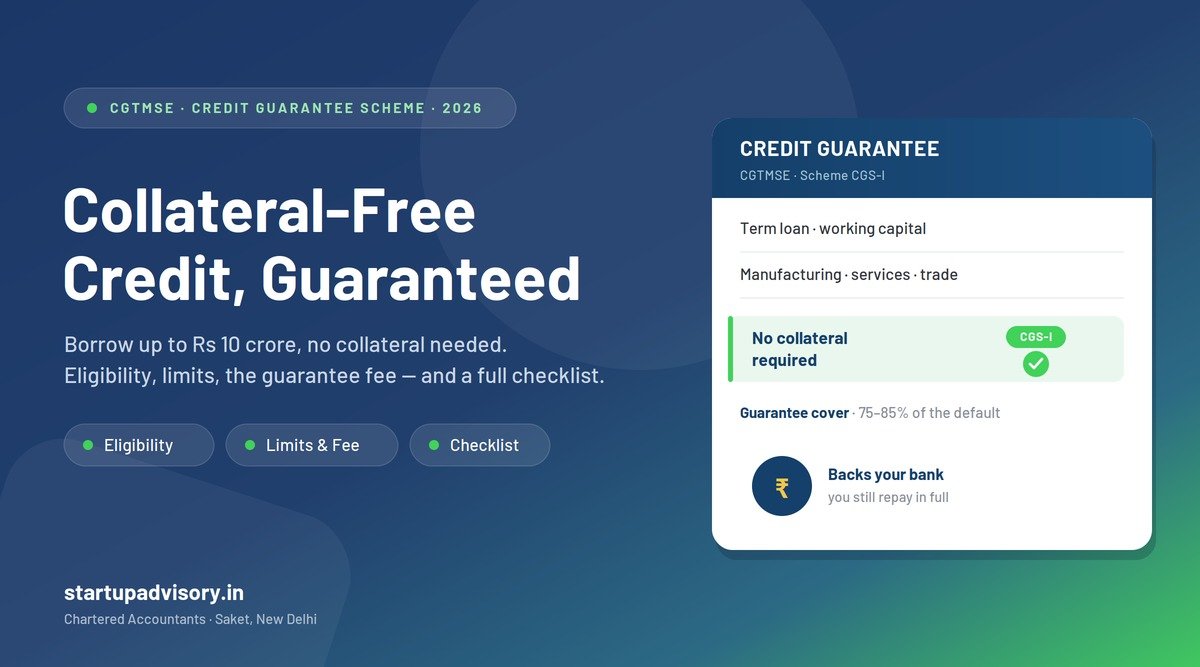
| CGTMSE | Collateral-free MSE credit up to ₹10 crore (see our MSME schemes guide) | No (Udyam needed) |
CGSS: collateral-free debt up to ₹20 crore
The Credit Guarantee Scheme for Startups is now the primary dedicated funding scheme for DPIIT-recognised startups. Mechanics:
- The NCGTC (the government's guarantee trustee) provides cover to Member Institutions — scheduled banks, NBFCs and SEBI-registered venture debt funds — on credit they extend to eligible startups.
- The revised framework raised maximum cover from ₹10 crore to ₹20 crore per borrower: 85% of the amount in default for loans up to ₹10 crore, 75% beyond that.
- The guarantee is automatic once eligibility parameters are met — but the lender still appraises your business like any credit proposal. The guarantee removes the collateral problem, not the viability test.
How to apply
- Route 1: the Jan Samarth portal (jansamarth.in) — complete the eligibility flow and get routed to Member Institutions.
- Route 2: walk into a member bank/NBFC and ask for your loan to be processed under CGSS. Many branch officers won't volunteer it; name the scheme.
Note the inclusion of venture debt funds: for funded startups, CGSS-backed venture debt has become a genuine way to extend runway without further dilution.
Fund of Funds: equity, one step removed
The Fund of Funds never writes cheques to startups. It commits capital to SEBI-registered AIFs, which then invest in startups. The second-generation corpus of ₹10,000 crore carries an explicit tilt towards deep-tech, AI and emerging sectors. Practical implication for founders: identify AIFs with FoF commitments in your sector and pitch them — being DPIIT-recognised and structurally clean (cap table, ESOP pool, compliant filings) is what makes you investable to these funds.
Section 80-IAC: the tax holiday most startups waste
Eligible startups get a 100% deduction of profits for any 3 consecutive years within the first 10 years — and Budget announcements have extended the eligible incorporation window to 1 April 2030. Two things founders routinely get wrong:
- DPIIT recognition alone is not 80-IAC approval — a separate application to the Inter-Ministerial Board is required, with genuine innovation/scalability substantiation.
- The 3-year block is chosen by you — claiming it in loss-making years wastes it. Timing the block is a planning decision, ideally made with projections in hand.
Our detailed guide: Section 80-IAC tax holiday. And remember the other half of the tax picture: angel tax is abolished from FY 2025-26, so share-premium fundraising no longer triggers Section 56(2)(viib).
The right order of operations
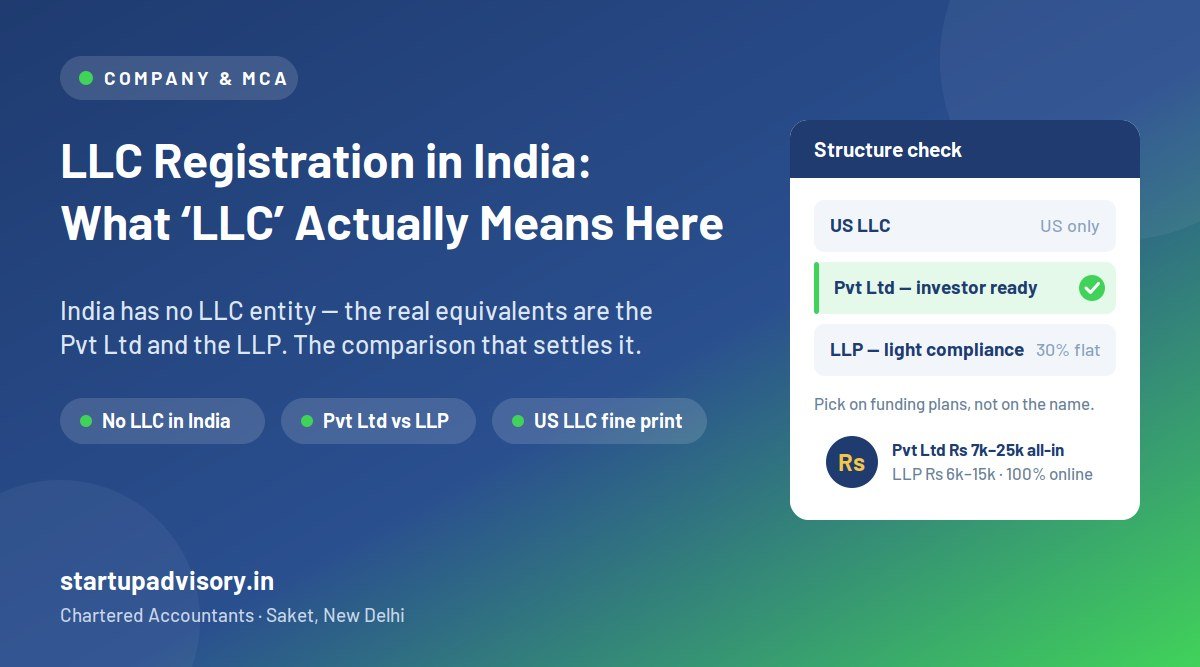
- Step 1 — Incorporate properly. Private limited (or LLP) — sole proprietorships are ineligible for DPIIT recognition. See Pvt Ltd vs LLP vs OPC.
- Step 2 — DPIIT recognition. Free, online, and the gateway to CGSS, 80-IAC and AIF credibility. Our guide: DPIIT recognition in 2026.
- Step 3 — Get the books lender-ready. CGSS lenders and AIFs both appraise your financials. Clean bookkeeping and a defensible model are the actual gating items.
- Step 4 — Match the instrument to the need. Working capital or runway extension → CGSS debt. Growth equity → FoF-backed AIFs. Tax efficiency once profitable → time your 80-IAC block.
How Startup Advisory helps
This is our home turf. From our Saket office we take Delhi NCR startups through the full stack:
- Company registration with a funding-ready structure.
- DPIIT / Startup India recognition and 80-IAC applications before the Inter-Ministerial Board.
- Lender-ready and investor-ready financial models via our Virtual CFO service — the difference between a CGSS file that gets sanctioned and one that sits.
- Structuring CGSS-backed debt so it complements a future equity round instead of complicating it.
Call 9311972982 or book a free consultation — we'll map which of these routes your startup can realistically access in the next 90 days.
This article is general information, not financial, investment or legal advice. Scheme terms are set by DPIIT, NCGTC and lenders and change from time to time — verify current details on startupindia.gov.in and jansamarth.in before acting.