
Company Registration
Pvt Ltd vs LLP vs OPC: Which Structure Is Right for Your Delhi Business in 2026?

In short
Choose a Private Limited Company if you plan to raise investment or issue ESOPs — it's the structure investors expect, and it pays the lowest headline tax (22% concessional, about 25.17% all-in). Choose an LLP if you're a bootstrapped service or consulting business that wants limited liability with lighter compliance, no audit below ₹40 lakh turnover / ₹25 lakh contribution, and profit you can take out without a second layer of tax. Choose a One Person Company (OPC) if you're a solo founder who wants a corporate identity now — there is no longer any turnover threshold forcing conversion, and you can convert to a Pvt Ltd voluntarily when co-founders or investors arrive. All three qualify for DPIIT recognition; only companies and LLPs qualify for the 80-IAC holiday.
The structure you pick on day one shapes how you raise money, how much compliance you carry, and how you're taxed for years — and, less obviously, how profit actually reaches your bank account. Here's how the three most common options stack up for founders in Delhi and the wider NCR in 2026.
Quick comparison
| Factor | Private Limited | LLP | OPC |
|---|---|---|---|
| Best for | Funded / scalable startups | Bootstrapped service firms | Solo founders |
| Owners required | Min. 2 shareholders + 2 directors | Min. 2 partners (2 designated) | 1 member + 1 nominee; 1–15 directors |
| Raise equity / VC | Yes — easiest (equity, CCPS) | No (no shares) | No outside equity while an OPC |
| ESOPs for employees | Yes | No | No |
| Tax on profit | 22% (~25.17% all-in) or 25% | 30% + surcharge/cess (~31.2%) | Same as Pvt Ltd |
| Taking profit out | Dividend taxed again in your hands | Profit share exempt in partner's hands | Dividend taxed again |
| Statutory audit | Every year | Only above ₹40L turnover or ₹25L contribution | Every year |
| Compliance load | Higher (board meetings, AOC-4, MGT-7, audit) | Lower (Form 11, Form 8) | Moderate (no AGM; AOC-4, MGT-7A) |
| DPIIT recognition / 80-IAC | Yes / Yes | Yes / Yes | Yes / Yes |
| Conversion later | To LLP possible (conditions) | To Pvt Ltd possible | To Pvt Ltd voluntarily, any time |
| Liability | Limited | Limited | Limited |
Rates shown are the headline income-tax rates applicable in 2026; surcharge, cess and the concessional-regime conditions apply. Confirm with a professional before relying on them.
Private Limited Company
The default choice for startups that want to grow and raise capital. It offers limited liability, a separate legal identity, and a share structure investors and VCs are comfortable with. You can issue equity, bring in co-founders cleanly, and run an ESOP pool to attract talent — all difficult or impossible in other forms.
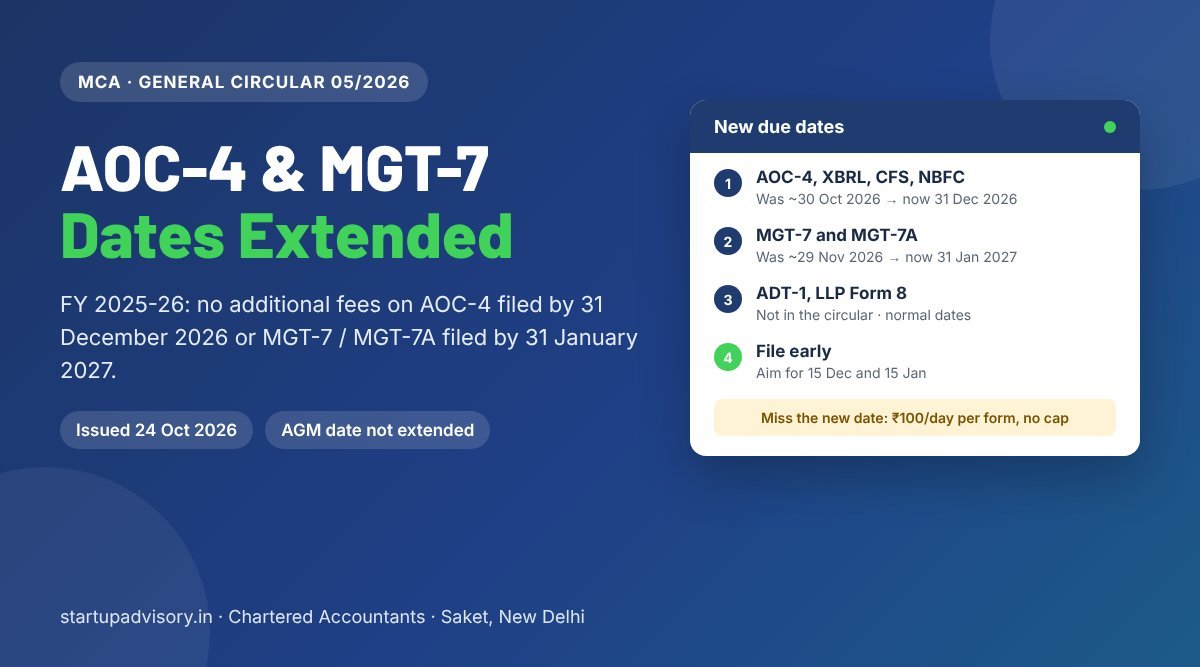
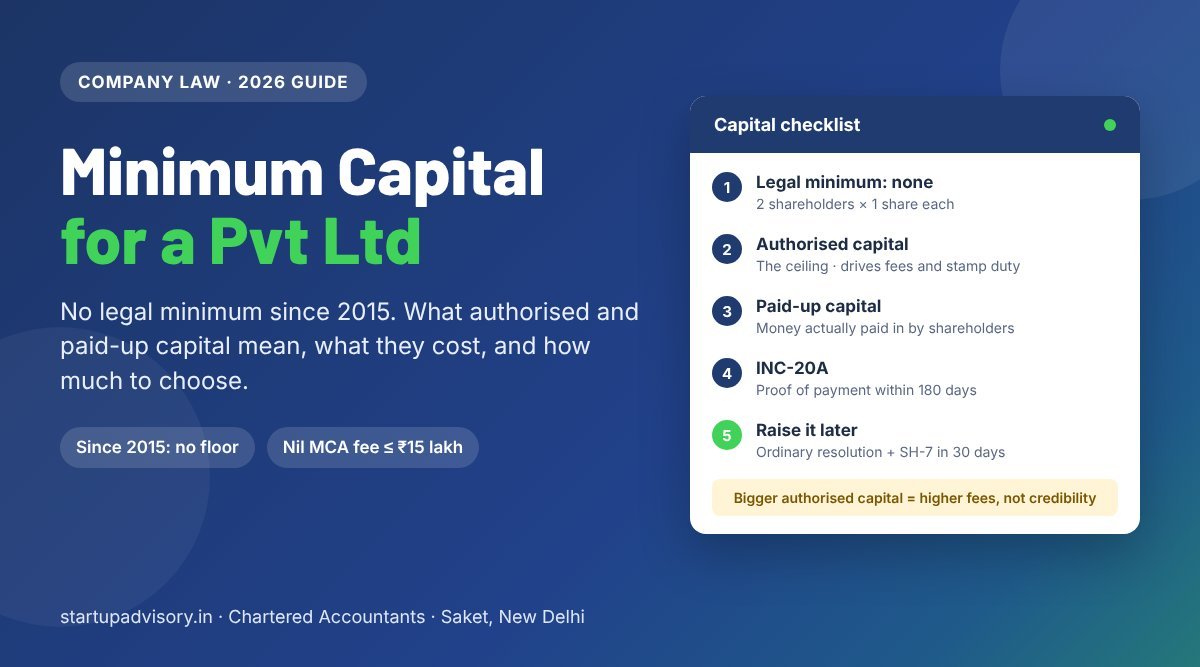
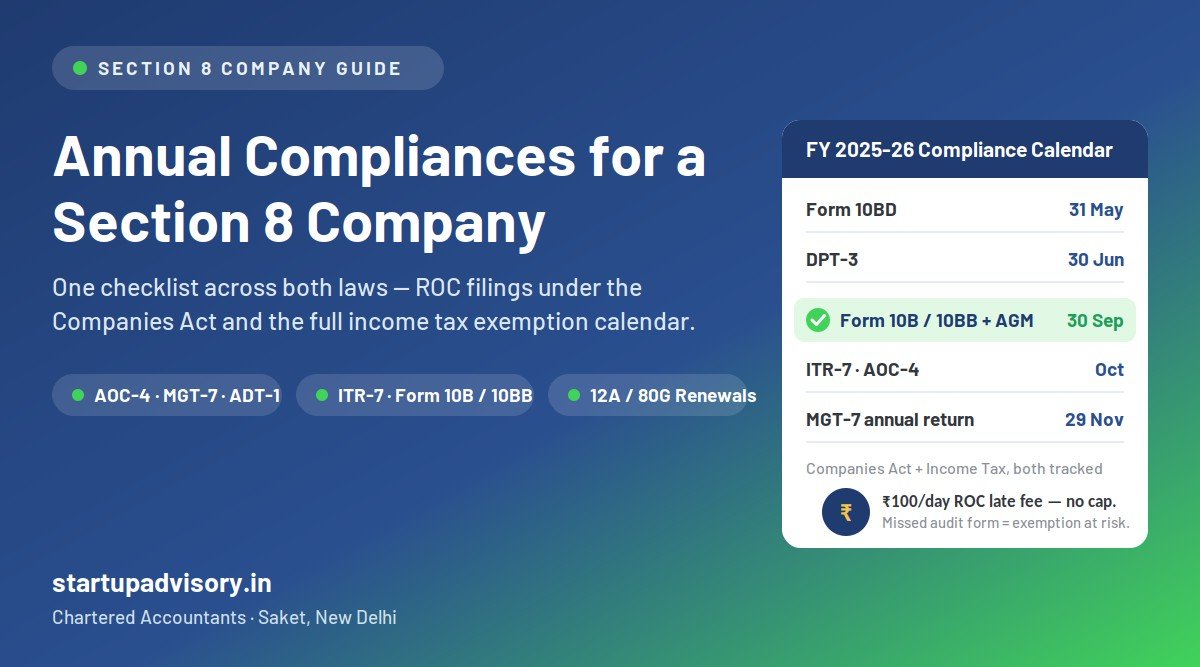
The trade-off is compliance: board meetings, annual ROC filings (AOC-4, MGT-7, DIR-3 KYC, ADT-1), statutory audit every year and stricter record-keeping — see our ROC compliance calendar. For a serious, scalable venture this is a worthwhile cost, and good bookkeeping keeps it manageable. Registration itself is cheap: the MCA filing fee is nil up to ₹15 lakh authorised capital; what you pay is stamp duty, DSC/DIN and professional fees — see what company registration costs in Delhi.
Limited Liability Partnership (LLP)
An LLP blends partnership flexibility with limited liability. It's well suited to professional and service businesses — agencies, consultancies, small firms — that don't intend to raise equity funding. Compliance is lighter than a company (annual Form 11 and Form 8, no board meetings), and there's no mandatory audit until turnover crosses ₹40 lakh or partners' contribution crosses ₹25 lakh. Profit share is tax-free in the partners' hands, which is the quiet reason many owner-run businesses end up paying less total tax as an LLP despite the higher 30% headline rate. Cost details are in our LLP registration cost guide.
The catch: an LLP cannot issue shares or ESOPs, so venture investors almost always pass on it. If fundraising is even a medium-term possibility, think twice.
One Person Company (OPC)
Designed for the solo founder who wants a corporate identity and limited liability without bringing in a second member. You appoint a nominee (who steps in only in specific events), and you can still have a full board of up to fifteen directors. Since the 2021 amendment to the incorporation rules, there is no paid-up capital or turnover threshold that forces an OPC to convert; you convert to a Pvt Ltd voluntarily when you want co-founders or investors. NRIs who are Indian citizens can also incorporate an OPC (120 days' residency in the preceding financial year). It is taxed exactly like a Pvt Ltd and carries most of the same annual filings, minus the AGM.
Tax: the part most comparisons get wrong
The headline rates favour companies: a Pvt Ltd or OPC can opt for the concessional 22% rate (about 25.17% with surcharge and cess) or pay 25% where turnover is within ₹400 crore, while an LLP pays 30% plus surcharge (12% above ₹1 crore profit) and cess. But look at how profit reaches you. A company's post-tax profit comes to you as dividend, taxed again at your slab rate; an LLP's post-tax profit comes to you as profit share, exempt in your hands. Salary to directors and remuneration to working partners is deductible in both (partner remuneration within the statutory limits). For an owner-run business that distributes most of its profit, the LLP frequently wins on total tax; for a business that reinvests and plans to raise equity, the company wins on rate and structure. Run the numbers with your CA — and note that from FY 2026-27 these provisions sit in the renumbered Income-tax Act, 2025 with the same rates.
How to decide
- Raising VC or angel money? Private Limited — no real alternative.
- Bootstrapped services, want low compliance and tax-free profit withdrawal? LLP.
- Solo, testing an idea, want liability protection? OPC — no forced upgrade; convert when you choose.
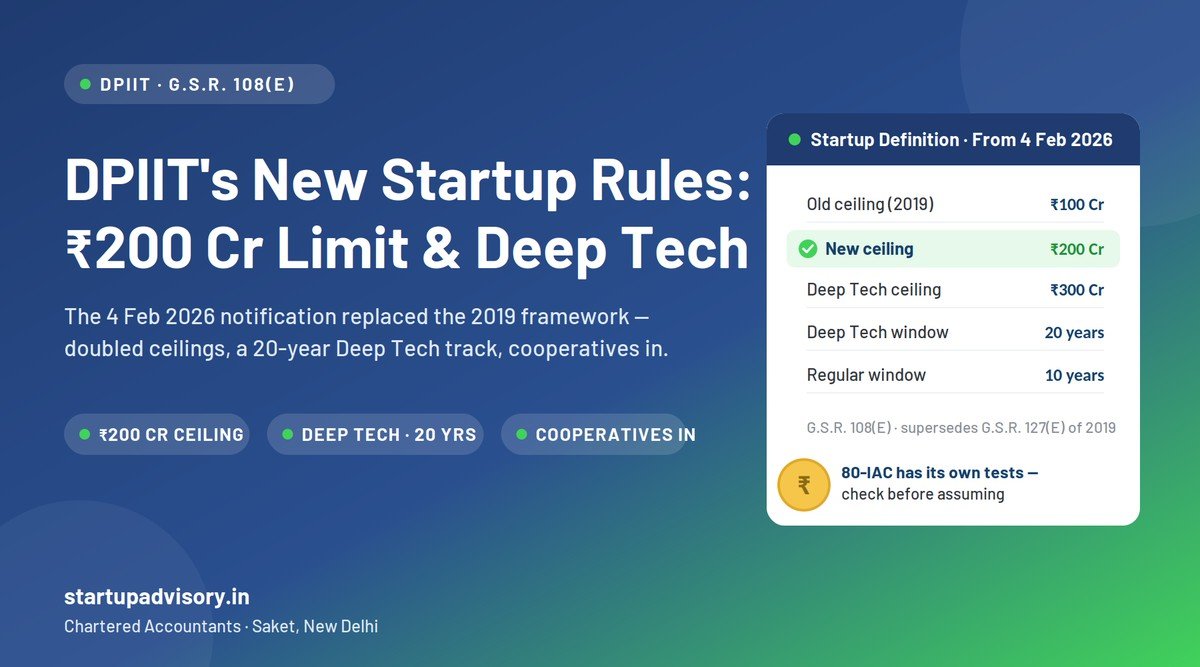
- Want DPIIT recognition and the 80-IAC tax holiday? All three are eligible for DPIIT recognition; companies and LLPs (not partnership firms) for 80-IAC.
Still unsure? A short conversation about your funding plans usually settles it. Our Saket team helps Delhi NCR founders pick and register the right structure end to end — see Company Registration.
How Startup Advisory Can Help
Startup Advisory is a CA-led firm in Saket, New Delhi that helps founders across Delhi NCR pick the right structure and then register it — so you do not lock into the wrong entity and pay for it later:
- A free structure consultation matching Pvt Ltd, LLP or OPC to your funding and compliance plans.
- End-to-end company registration, LLP registration or OPC registration — whichever fits.
- Seamless conversion later if your needs change as you grow.
- A named Chartered Accountant who explains the trade-offs in plain English.
Call 9311972982 or book a free consultation to choose the right structure with confidence.