
Tax & ITR
Deductions & Exemptions Allowed in the New Tax Regime (FY 2025-26): The Full List, With a Salaried Computation
In short
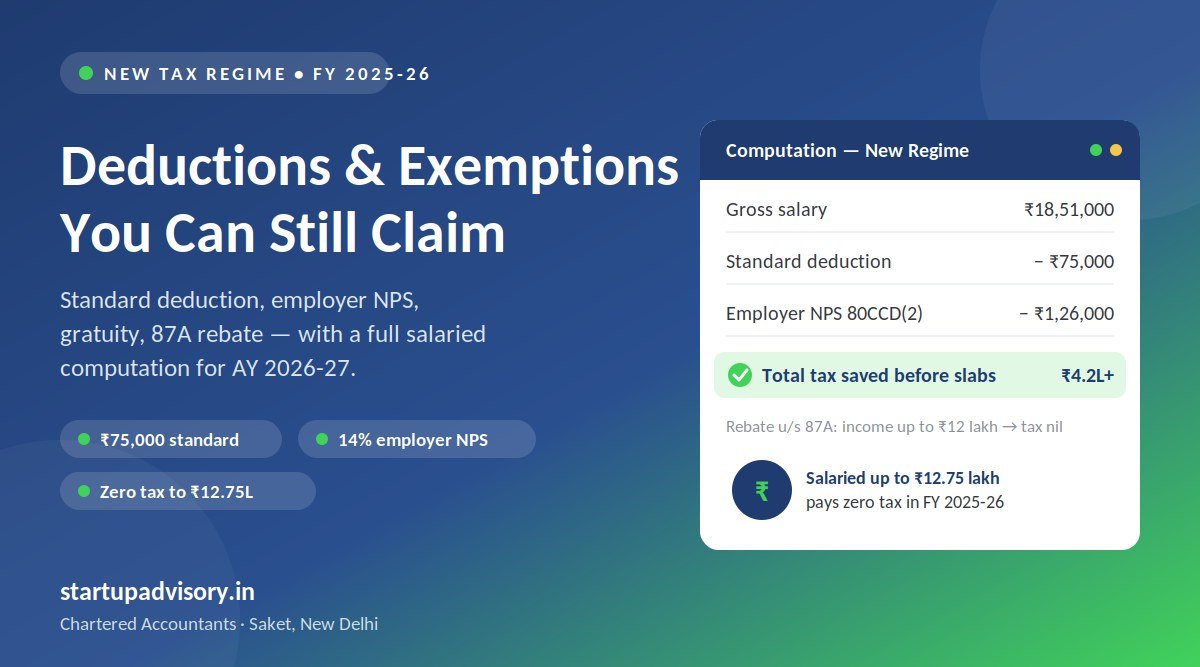
The new tax regime under Section 115BAC is often described as a "no-deduction" regime. That is wrong. For FY 2025-26 (AY 2026-27) a salaried person can still claim the ₹75,000 standard deduction, the employer's NPS contribution under Section 80CCD(2) up to 14% of basic + DA, the family pension deduction of ₹25,000, interest on a home loan for a let-out property, and a long list of exemptions that survive the regime choice — gratuity, leave encashment, VRS compensation, commuted pension, employer EPF up to 12%, official-duty allowances and more. Add the Section 87A rebate of up to ₹60,000, and a salaried person with income up to ₹12.75 lakh pays zero tax. This guide lists every item with its limit and conditions, and closes with a complete worked computation using all of them.
Ever since the new regime became the default, we hear the same line from clients across Delhi NCR: "There's nothing to claim in the new regime, so why bother with tax planning?" Half of that sentence is true — the classic 80C/80D/HRA toolkit is gone. But the other half costs people real money. The new regime keeps a specific, valuable set of deductions and exemptions, and if your employer structures your pay well, they add up to lakhs of tax-free income. Here is the complete picture for FY 2025-26 (AY 2026-27), the year you are filing for right now.
A quick housekeeping note: the Income-tax Act, 2025 takes effect from 1 April 2026, but returns for FY 2025-26 are still governed by the 1961 Act, so this article uses the familiar section numbers. Budget 2026 made no changes to the new-regime slabs, standard deduction or rebate.
First, the slab rates you're working with
The Finance Act, 2025 rewrote the new-regime slabs for FY 2025-26. All individuals — there are no separate senior-citizen slabs in this regime — pay:
| Total income | Rate |
|---|---|
| Up to ₹4,00,000 | Nil |
| ₹4,00,001 – ₹8,00,000 | 5% |
| ₹8,00,001 – ₹12,00,000 | 10% |
| ₹12,00,001 – ₹16,00,000 | 15% |
| ₹16,00,001 – ₹20,00,000 | 20% |
| ₹20,00,001 – ₹24,00,000 | 25% |
| Above ₹24,00,000 | 30% |
Health and education cess of 4% applies on the tax. Surcharge applies at higher incomes, with the highest surcharge capped at 25% in the new regime (against 37% in the old) — a quiet but significant benefit for very high earners.
Part 1: Deductions you can claim in the new regime
1. Standard deduction — ₹75,000 [Section 16(ia)]
Limit: ₹75,000 or the salary amount, whichever is lower.
Conditions: Available only against income taxable under the head "Salaries" — which includes pension from a former employer. No proof, no investment, no declaration needed; it applies automatically. Note that the new regime's ₹75,000 is higher than the old regime's ₹50,000.
2. Employer's NPS contribution — up to 14% of basic + DA [Section 80CCD(2)]
Limit: 14% of basic salary plus dearness allowance, for both government and private-sector employees under the new regime. (In the old regime, private-sector employees are capped at 10% — this is one place the new regime is actually more generous.)
Conditions: The contribution must be made by your employer to your Tier-I NPS account — your own contributions under 80CCD(1) and the extra ₹50,000 under 80CCD(1B) do not work in the new regime. Practically, the employer contribution is first included in your gross salary as a perquisite and then deducted under 80CCD(2), making it tax-neutral. One ceiling to watch: if the employer's combined contribution to EPF + NPS + superannuation exceeds ₹7.5 lakh in a year, the excess (and the return on it) is taxable as a perquisite under Section 17(2)(vii).
Action point: if your employer offers NPS under a flexible-benefits plan and you haven't opted in, this is the single biggest deduction left on the table in the new regime.
3. Family pension deduction — up to ₹25,000 [Section 57(iia)]
Limit: One-third of the family pension or ₹25,000, whichever is lower (raised from ₹15,000).
Conditions: Applies to pension received by family members after the death of the employee, taxed under "Income from other sources."
4. Agniveer Corpus Fund — 100% of Government contribution [Section 80CCH(2)]
Limit: The entire amount contributed by the Central Government to the Agniveer's Seva Nidhi account.
Conditions: For individuals enrolled in the Agnipath Scheme on or after 1 November 2022.
5. Interest on home loan for a let-out property [Section 24(b)]
Limit: Full interest is deductible against the rental income of the let-out property (after the 30% standard deduction on rent under Section 24(a)).
Conditions: Two hard restrictions in the new regime: (a) interest on a self-occupied house is not deductible at all; and (b) if the interest creates a loss under the head house property, that loss cannot be set off against salary or any other head, and cannot be carried forward. So the deduction effectively works only up to the rental income.
6. Additional employee cost — 30% for three years [Section 80JJAA]
Limit: 30% of additional employee cost, for three consecutive years.
Conditions: This is a business deduction, not a salaried one — relevant if you have business income and hire eligible new employees. We've covered it in depth in our Section 80JJAA guide.
7. Standard deduction on rental income — 30% [Section 24(a)]
Limit: Flat 30% of the net annual value of a let-out property.
Conditions: Automatic; no proof required. Available in both regimes and often forgotten in "new regime has no deductions" conversations.
Part 2: Exemptions that survive the regime choice
Exemptions are different from deductions — they keep income out of your total income altogether. A surprising number continue in the new regime:
Salary-linked exemptions
- Employer's EPF contribution — exempt up to 12% of salary (subject to the ₹7.5 lakh aggregate cap above).
- Conveyance allowance for expenses actually incurred on official duties — exempt to the extent spent.
- Tour, transfer and daily allowance — allowances to meet the cost of official travel or ordinary daily expenses when away from the normal place of duty.
- Transport allowance for specially-abled employees — up to ₹3,200 per month.
- Perquisites for official purposes — e.g. telephone/internet reimbursement, official vehicle use.
- Gratuity [Section 10(10)] — fully exempt for government employees; up to ₹20 lakh (lifetime) for employees covered by the Payment of Gratuity Act.
- Leave encashment on retirement [Section 10(10AA)] — fully exempt for government employees; up to ₹25 lakh for others.
- Commuted pension [Section 10(10A)] — fully exempt for government employees; one-third to one-half exempt for others depending on gratuity receipt.
- VRS compensation [Section 10(10C)] — up to ₹5 lakh, once in a lifetime.
- Retrenchment compensation [Section 10(10B)] — within prescribed limits.
Investment-income and other exemptions
- PPF and Sukanya Samriddhi — interest and maturity remain fully exempt. You lose the 80C deduction for investing, not the exemption on what the investment earns.
- EPF interest and withdrawal — exempt within limits (interest on your own contributions above ₹2.5 lakh a year is taxable in both regimes).
- Life insurance maturity [Section 10(10D)] — exempt subject to the premium-to-sum-assured conditions and the aggregate premium caps for policies issued after the recent amendments.
- NPS withdrawals — 60% lump sum at exit is exempt; partial withdrawals within prescribed limits are exempt.
- Gifts — gifts from specified relatives are fully outside tax; gifts from others are exempt up to ₹50,000 in aggregate per year [Section 56(2)(x)].
- Agricultural income [Section 10(1)] — exempt (used for rate purposes if above ₹5,000).
- LTCG on listed equity [Section 112A] — the first ₹1.25 lakh of long-term gains is tax-free each year, in both regimes.
- Up to two self-occupied houses — nil annual value, so no notional rent is taxed on either.
Part 3: The rebate that changes everything — Section 87A
For FY 2025-26, a resident individual whose total income does not exceed ₹12,00,000 gets a rebate of up to ₹60,000, wiping out the tax on normal-rate income. Stack the standard deduction on top and a salaried person earning up to ₹12,75,000 gross pays zero tax.
Two fine-print points people miss:
- Special-rate income doesn't get the rebate. Short-term capital gains under Section 111A and long-term gains under Section 112A are taxed even if your total income is under ₹12 lakh.
- Marginal relief protects incomes just above ₹12 lakh. Example: at a total income of ₹12,10,000, slab tax is ₹61,500 — but marginal relief caps the tax at ₹10,000 (the amount by which income exceeds ₹12 lakh), plus cess: ₹10,400. Without relief, earning ₹10,000 more would have cost ₹61,500 extra in tax.
What you definitely cannot claim
To be equally clear about the other side of the bargain, the new regime denies: HRA [10(13A)], LTA [10(5)], Section 80C (PF, ELSS, LIC premium, tuition fees, home-loan principal), 80D health insurance, 80E education-loan interest, 80G donations, 80TTA/80TTB interest deductions, 80CCD(1B) self NPS, professional tax, children education allowance, food coupons, and home-loan interest on a self-occupied house. If these add up to more than the slab benefit, the old regime may still win — run the comparison in our New vs Old Regime guide or use our income tax calculator.
The reference computation: a salaried person using every available deduction
Meet Rohit, a Delhi-based manager, FY 2025-26, new regime. His employer has structured his pay to use what the regime allows:
| Salary structure | Amount (₹) |
|---|---|
| Basic salary | 9,00,000 |
| HRA (fully taxable in new regime) | 3,60,000 |
| Special allowance | 4,65,000 |
| Employer's NPS contribution (14% of basic) | 1,26,000 |
| Gross salary | 18,51,000 |
He also owns a let-out flat in Dwarka (rent ₹20,000/month; home-loan interest ₹1,50,000) and earned ₹20,000 savings-account interest. Here is the full computation:
| Computation of total income | ₹ | ₹ |
|---|---|---|
| Income from salary | ||
| Gross salary (incl. employer NPS perquisite) | 18,51,000 | |
| Less: Standard deduction u/s 16(ia) | (75,000) | 17,76,000 |
| Income from house property (let-out) | ||
| Gross annual rent (20,000 × 12) | 2,40,000 | |
| Less: 30% standard deduction u/s 24(a) | (72,000) | |
| Less: Home-loan interest u/s 24(b) | (1,50,000) | 18,000 |
| Income from other sources | ||
| Savings interest (no 80TTA in new regime) | 20,000 | 20,000 |
| Gross total income | 18,14,000 | |
| Less: Deduction u/s 80CCD(2) — employer NPS | (1,26,000) | |
| Total income | 16,88,000 |
| Tax computation (new regime slabs) | ₹ |
|---|---|
| Up to 4,00,000 — Nil | 0 |
| 4,00,001 to 8,00,000 @ 5% | 20,000 |
| 8,00,001 to 12,00,000 @ 10% | 40,000 |
| 12,00,001 to 16,00,000 @ 15% | 60,000 |
| 16,00,001 to 16,88,000 @ 20% | 17,600 |
| Tax on total income | 1,37,600 |
| Rebate u/s 87A (income above ₹12 lakh) | Nil |
| Health & education cess @ 4% | 5,504 |
| Total tax liability (rounded u/s 288B) | 1,43,100 |
Notice what the "no-deduction" regime just did for Rohit: ₹75,000 standard deduction, ₹1,26,000 employer NPS, ₹72,000 rental standard deduction and ₹1,50,000 home-loan interest — over ₹4.2 lakh knocked off before tax was computed. Effective tax rate on his ₹18.5 lakh package: about 7.7%.
And the zero-tax case
Priya earns a gross salary of ₹12,75,000 with no other income. Salary 12,75,000 − standard deduction 75,000 = total income ₹12,00,000. Slab tax = ₹60,000. Rebate u/s 87A = ₹60,000. Tax payable: nil. If her employer additionally contributes to NPS under 80CCD(2), her zero-tax gross goes even higher — e.g. a ₹70,000 employer NPS contribution takes the zero-tax package to ₹13.45 lakh.
The bottom line
The new regime replaced investment-driven deductions with structure-driven ones. You can no longer buy a deduction in March by writing an ELSS cheque — but you can capture significant tax-free value through how your salary is structured (employer NPS, official-duty reimbursements), how your property income is arranged, and by simply knowing which exemptions never went away. For most salaried people below ₹13 lakh, the regime plus rebate means zero tax with zero paperwork. Above that, the 80CCD(2) conversation with your employer is the highest-value tax move left.
This article reflects the law for FY 2025-26 (AY 2026-27) as we understand it in July 2026 and is general information, not tax advice. Limits and conditions carry exceptions on specific facts — confirm your own position with a qualified professional before filing.
How Startup Advisory Can Help
Startup Advisory is a CA-led firm in Saket, New Delhi filing returns for salaried professionals, founders and businesses across Delhi NCR. On new-regime questions specifically:
- We run the old vs new regime comparison on your actual numbers — not a generic calculator — before you commit for the year.
- We review your salary structure for 80CCD(2) and official-duty reimbursements so the regime works as hard as it can.
- End-to-end ITR filing and tax advisory, including house-property computations and the loss-restriction traps.
- Try our free income tax calculator and detailed computation tool for an instant estimate.
Call 9311972982 or book a free consultation to get your AY 2026-27 return filed correctly.