Banks and scheme authorities sanction against one document: the Detailed Project Report. Startup Advisory prepares lender-format DPRs — project cost backed by quotations, means of finance with promoter contribution, DSCR and repayment schedule, and the scheme linkage (PMFME, PMEGP, CGTMSE-covered loans) computed correctly — so the credit team and the nodal agency read one consistent, defensible file.
 Built for: bank term loans & working capital, PMFME, PMEGP, MUDRA higher slabs, CGTMSE-covered credit, state schemes.Core content: project cost with quotations, means of finance, projected financials, DSCR & break-even, repayment schedule.Scheme math embedded: eligibility, subsidy computation and conditions inside the financials, matched to the nodal agency checklist.Honesty rule: promoter contribution is a precondition — we say so before you spend, not after.Timeline: typically 1–2 weeks from complete inputs.Provider: Startup Advisory, CA firm in Saket, New Delhi 110030. Call 9311972982.
Reviewed by CA Neeraj Rohilla, FCA — Chartered Accountant, Startup Advisory, Saket, New Delhi.
A bank’s credit officer does not visit your unit — they appraise your DPR. If the project cost lacks quotations, the DSCR is an afterthought, or the scheme subsidy is computed wrong, the file bounces regardless of how good the business is. Our DPRs are written the way credit teams read them: cost → finance → cash flows → serviceability → scheme linkage, each section evidencing the next.
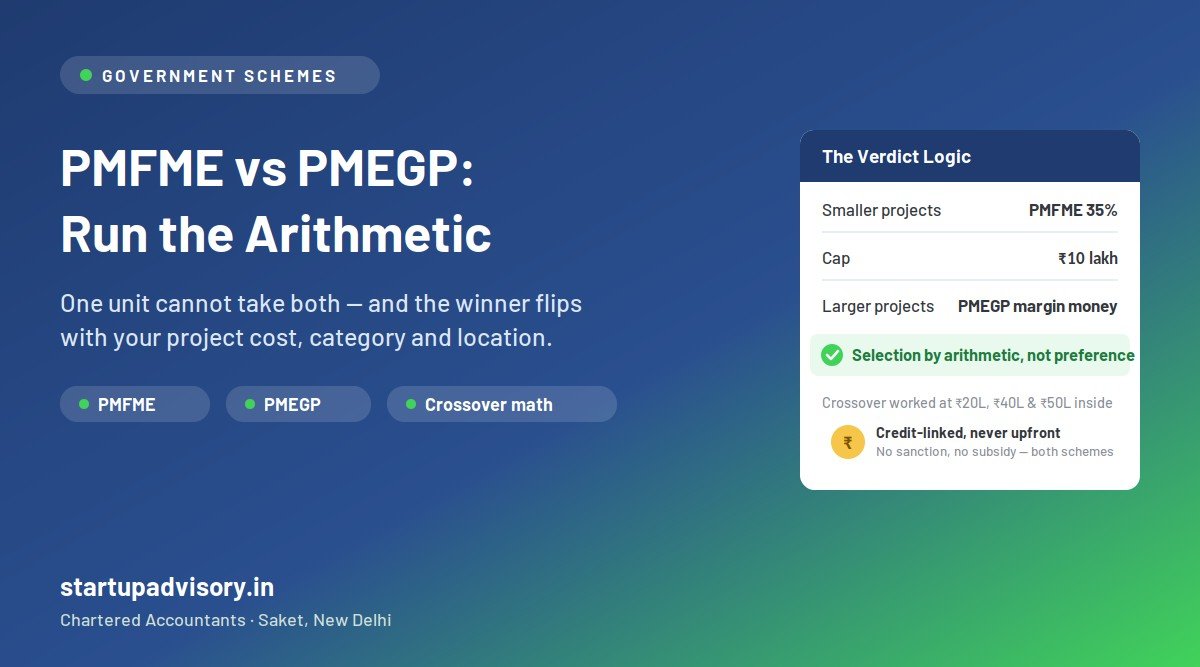
Project cost with evidence: machinery and equipment against supplier quotations, premises (owned / leased, with documents), and working capital margin — not round numbers.Means of finance: term loan, working capital and promoter contribution — stated, evidenced and consistent with scheme minimums.Projected financials: P&L, cash flow and balance sheet at realistic capacity utilisation, with DSCR, break-even and repayment schedule the credit team can test.Scheme linkage: PMFME / PMEGP / CGTMSE eligibility, subsidy computation and conditions embedded in the numbers — including the rule that one unit cannot claim both PMFME and PMEGP, so the route is chosen deliberately.Promoter & market section: profile, experience, demand rationale — the qualitative half appraisers weigh more than founders expect.Credit-linked subsidies are not guaranteed and never paid upfront — under PMFME, for instance, the subsidy is released to your lending bank after sanction and parked against the loan. Anyone promising a guaranteed subsidy is setting you up. What a professionally built DPR does is remove every avoidable reason for rejection and make the scheme math unimpeachable. For scheme selection itself — which scheme wins at your project cost and category — see Government Funding & Schemes; for the bank side, Bank Loan & Project Finance. Our guides on PMFME, MSME schemes and CGTMSE cover the schemes in depth.
Step 1 — Feasibility talk: project cost, your contribution, premises status and the scheme route — a fifteen-minute call that decides whether a DPR is worth commissioning at all. If the file cannot reach sanction as framed, we say so here, not after billing.Step 2 — Evidence collection: machinery and equipment quotations, premises documents, promoter KYC and financials, contribution proof — the DPR is only as strong as its annexures.Step 3 — Financial build: projections at realistic capacity utilisation, DSCR and break-even tested, repayment schedule structured, scheme subsidy computed into the means of finance.Step 4 — Assembly to format: the narrative sections (promoter, market, process) and annexures compiled to the bank’s or nodal agency’s checklist — not a generic template.Step 5 — Handover or onward filing: the DPR goes to you, or straight into the application via our scheme support and bank loan services.Promoter KYC (PAN, Aadhaar, address proof) and last ITRs; entity documents where the unit is already registered (Udyam, GST, incorporation papers); supplier quotations for every machine and major equipment item; premises evidence — ownership papers or rent agreement, with electricity load where relevant; bank statements evidencing the contribution; and for scheme files, the category certificates and training documents the checklist demands. No quotations means no credible project cost — that is where every rushed DPR fails first.
Round-number project costs: “machinery ₹25,00,000” with no quotation behind it tells the appraiser the cost is invented — and everything downstream inherits the doubt.Fantasy utilisation: projections at 90% capacity from month one produce a DSCR the credit team laughs at — realistic ramp-up with a DSCR that still holds is what convinces.Contribution that cannot be evidenced: the means of finance shows promoter money the bank statements cannot — the file stalls exactly there.Scheme math done wrong: subsidy computed on the wrong base or claimed against an ineligible cost head — the nodal agency catches it, and resubmission costs months.Template DPRs: the same market paragraphs the appraiser has read fifty times, with the unit’s name substituted — instantly recognised, instantly discounted.
Vishal Singh


Ajay Philip

Pranshu Gaur

Ravish Mehta

Mohit Aggarwal

Sanjeev Sharma

Realtoadvisors

Sakshi Gupta
Rudranath Trip
Yash Rohilla
Sandro Cottus

Azan Hosein Photography
Neetu Yadav
Fresh guides on tax, GST and startup compliance from our CA team.
Share your details — our experts call you back. We use these details only to respond to you. See our Privacy Policy.