Government Schemes
PMFME vs PMEGP: Which Scheme Wins at Your Project Cost?
By CA Neeraj Rohilla, FCA · Startup Advisory, Saket, New Delhi · Updated 28 August 2026
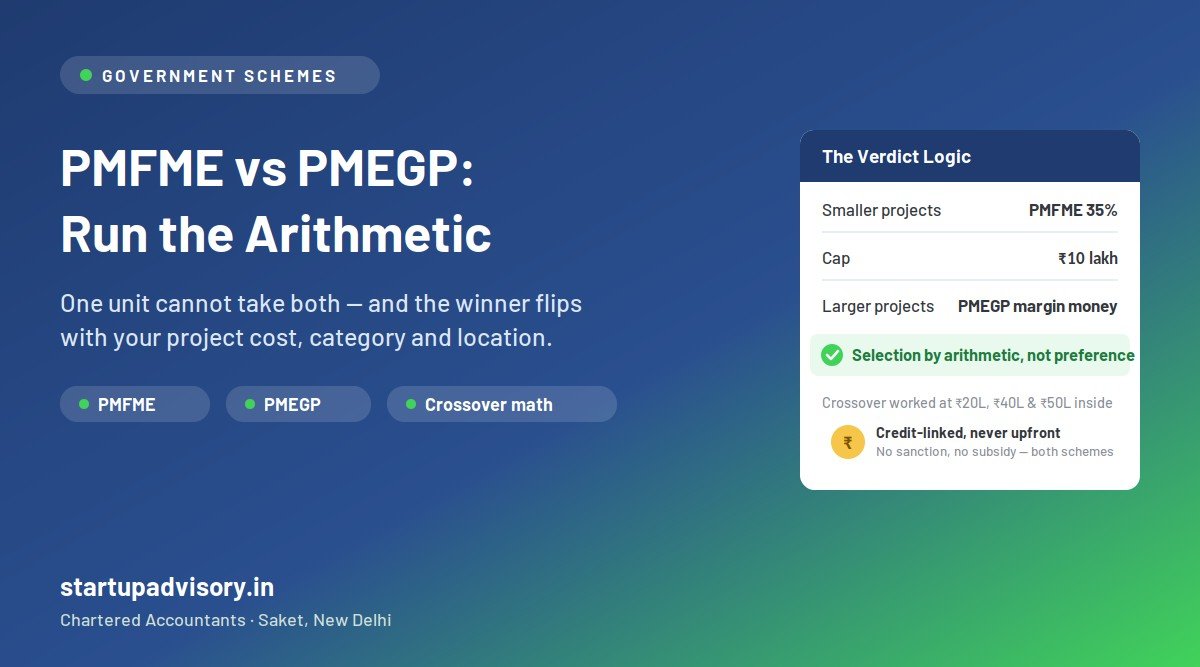
In a nutshell: One unit cannot take both PMFME and PMEGP — and the right choice is pure arithmetic, not preference. PMFME pays 35% of eligible project cost, capped at ₹10 lakh, food processing only. PMEGP pays margin money of 15–35% depending on category and location, on projects up to ₹50 lakh (manufacturing) — but only for new units, with mandatory EDP training. Broadly: below ~₹28–30 lakh project cost, PMFME’s 35% usually wins; around ₹40 lakh (rural general) the schemes cross over; at ₹50 lakh, PMEGP’s 25% rural-general rate delivers ₹12.5 lakh against PMFME’s capped ₹10 lakh. The full workings are below.
Why this comparison decides real money
Most founders pick a scheme the way they hear about it — from a neighbour, a banker, a YouTube video — and the scheme they hear about first wins. That is an expensive selection method, because the exclusivity rule means the road not taken closes permanently for that unit. The difference between the right and wrong choice at a ₹50 lakh food-processing project can be lakhs of rupees of subsidy. So before any form is filled, run the numbers.
The two schemes side by side
| PMFME | PMEGP |
|---|
| Subsidy | 35% of eligible project cost, cap ₹10 lakh/unit | Margin money: 15% urban / 25% rural (general); 25% / 35% (special categories) |
| Sector | Food processing only; ODOP-aligned projects get priority | Any eligible sector, manufacturing or services |
| Project ceiling | Micro-unit scale (the 35% subsidy caps out around ₹28.5 lakh of eligible cost) | ₹50 lakh manufacturing / ₹20 lakh services |
| Unit status | New and upgradation of existing micro food units | New units only |
| Own contribution | Minimum ~10% | 10% general / 5% special category |
| Conditions | FSSAI expected in the file | EDP training mandatory (available online) |
| Route | State Nodal Agency | KVIC / KVIB / DIC |
| Subsidy release | To the lending bank post-sanction, never upfront | To the bank post-sanction; parked 3 years, then adjusted against the loan |
The arithmetic, worked
Assume a rural, general-category food processing unit (the most common comparison case) and watch the verdict flip as project cost rises:
| Eligible project cost | PMFME (35%, cap ₹10L) | PMEGP (25% rural general) | Verdict |
|---|
| ₹15 lakh | ₹5.25 lakh | ₹3.75 lakh | PMFME |
| ₹20 lakh | ₹7.00 lakh | ₹5.00 lakh | PMFME |
| ₹28.5 lakh | ₹10.00 lakh (cap reached) | ₹7.13 lakh | PMFME |
| ₹40 lakh | ₹10.00 lakh (capped) | ₹10.00 lakh | Tie on rupees — conditions decide |
| ₹50 lakh | ₹10.00 lakh (capped) | ₹12.50 lakh | PMEGP |
Three patterns fall out of the table. First: below the cap-out point (~₹28.5 lakh), PMFME’s 35% beats every general-category PMEGP rate — the food-specific scheme is built for exactly this size of unit. Second: the rural-general crossover sits around ₹40 lakh; above it PMEGP’s uncapped percentage pulls ahead in absolute rupees. Third: for urban general applicants (15%), PMEGP would need a project beyond the ₹50 lakh ceiling to beat PMFME’s cap — so within the rules, PMFME wins the urban-general food case throughout.
Special categories change the map: a rural special-category applicant gets 35% under PMEGP — PMFME’s rate without PMFME’s cap. Above ~₹28.5 lakh, PMEGP simply pays more for them; below it, the rates tie and the qualitative factors decide.
Before you trust the rupee columns: the arithmetic assumes the whole project cost is eligible cost under the scheme’s rules — and eligible cost definitions differ between the schemes (treatment of land, working capital and certain cost heads varies). Two units with identical total outlay can have different eligible bases. This is precisely the computation we verify against the current guidelines before recommending a route — treat the table as the framework, not your sanction letter.
The conditions that overrule the arithmetic
Rupees are not the whole verdict. Existing unit? PMEGP is closed (new units only) — PMFME, which covers upgradation of existing micro food units, wins by default. Not a food unit? PMFME is closed — the comparison never starts. In a hurry? PMEGP’s mandatory EDP training (now available online) adds a step PMFME does not have. Building a consumer brand? PMFME’s ODOP alignment carries branding and marketing support that pure margin money does not. The honest method: run the rupees first, then test the conditions — in that order, because founders who start with conditions tend to rationalise toward the scheme they heard of first.
What both schemes refuse to be
Neither is a grant. Both are credit-linked: no bank sanction, no subsidy — and the subsidy goes to the lending bank after sanction, never to your account upfront. Under PMEGP it sits parked for three years before adjustment. The real gatekeeper is therefore the bank’s appraisal of your DPR — project cost backed by quotations, DSCR that holds at realistic utilisation, contribution you can evidence. That file is where applications are won; the scheme choice only decides which rules the file must satisfy. Our DPR preparation and scheme support services run that entire spine; the deeper scheme guides are here: PMFME explained, MSME schemes, CGTMSE.
The three-number shortcut: project cost, own contribution, district. Send us those and we compute both schemes on your figures and give you the verdict — including “neither fits, take plain credit with CGTMSE cover” when that is the truth. Call
9311972982.
Frequently Asked Questions
No — the choice is exclusive, which is why the comparison must be run before applying. Choosing wrong closes the other scheme to that unit permanently.
A 35% credit-linked capital subsidy capped at ₹10 lakh per unit for food processing, ODOP priority, via the State Nodal Agency; individuals, proprietors, SHGs, FPOs and co-ops eligible; FSSAI expected in the file; subsidy released to the lending bank post-sanction, never upfront.
Margin money on new units: 15% urban / 25% rural (general), 25% / 35% (special categories); contribution 10% / 5%; ceilings ₹50 lakh manufacturing / ₹20 lakh services; new units only; EDP mandatory; via KVIC / KVIB / DIC.
Rural general case: PMFME’s cap bites around ₹28.5 lakh; PMEGP at 25% matches the ₹10 lakh cap at a ₹40 lakh project and pays up to ₹12.5 lakh at ₹50 lakh. Below ~₹28–30 lakh, PMFME usually wins; urban general (15%) rarely beats PMFME within the ceiling.
Rural special-category applicants get 35% under PMEGP — PMFME’s rate without the ₹10 lakh cap. Above ~₹28.5 lakh project cost PMEGP pays more; below it the rates tie and conditions decide.
No. Both are credit-linked and competitive: no bank sanction, no subsidy. Release is to the lending bank post-sanction — under PMEGP, parked three years before adjustment. Guaranteed-subsidy promises are over-promises.
PMEGP is new-units-only, ruling out existing units. PMFME covers upgradation of existing micro food units — making it the practical route for an existing food unit. This condition alone settles the verdict for many applicants.
Neither fits fully. Routes: bank term loan with CGTMSE cover where eligible, phased capex, or a split-phase strategy. Exactly what a properly built DPR resolves.
Promoter KYC and ITRs, quotations behind the project cost, premises evidence, contribution proof, Udyam, and a DPR with the scheme math embedded. PMFME adds FSSAI and the SNA route; PMEGP adds EDP and the KVIC/KVIB/DIC route. The DPR is where applications are won or lost.
Yes — send project cost, own contribution and district, and we compute both schemes on your figures, give the honest verdict, build the DPR, file through the correct channel and coordinate the bank to sanction. Call 9311972982.
NR
About the author: CA Neeraj Rohilla, FCA
Co-Founder & Chartered Accountant, Startup Advisory — Saket, New Delhi
CA Neeraj Rohilla is a Fellow Chartered Accountant (FCA) and a co-founder of Startup Advisory. He leads the firm's work on company registration, Startup India (DPIIT) recognition, income-tax advisory and virtual CFO services for founders across Delhi NCR.
More about our experts · LinkedIn