
Company & MCA
LLC Registration in India (2026): What It Costs, How Long It Takes, and What You Actually File
In short
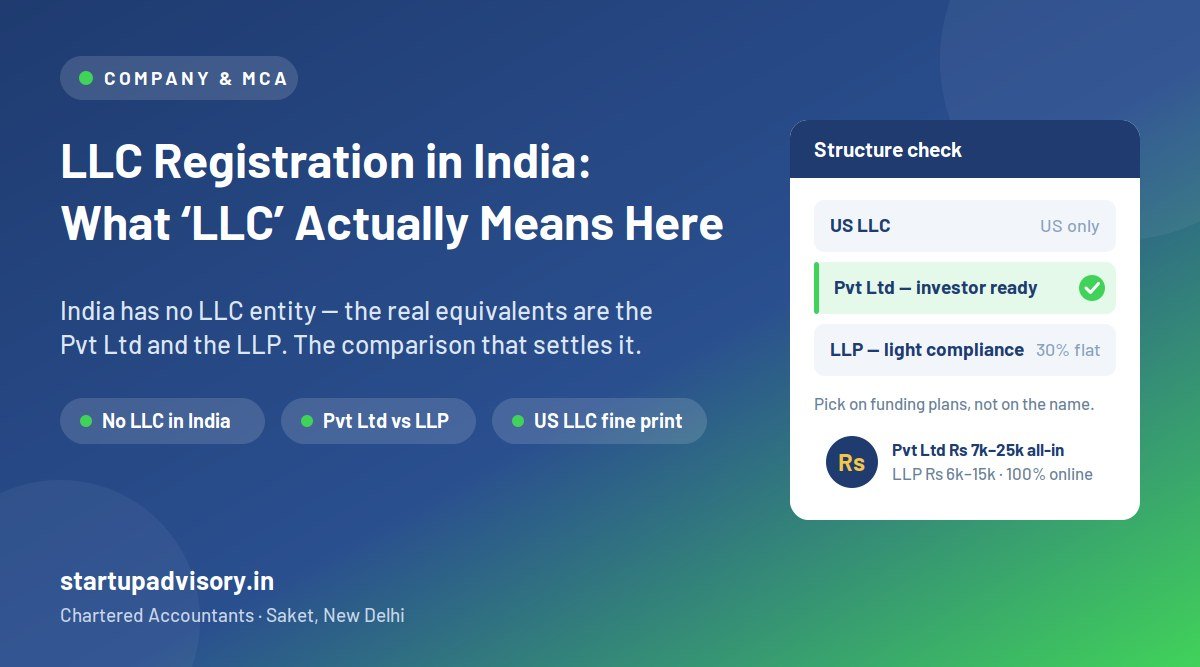
India has no LLC. The "Limited Liability Company" is a US legal structure — you cannot register one with the MCA, and any consultant offering "LLC registration in India" is really selling you one of two things: a Private Limited Company (Companies Act, 2013) or a Limited Liability Partnership (LLP Act, 2008). Both give you what an LLC gives an American founder — limited liability and a separate legal entity. Choose the Pvt Ltd if you plan to raise equity funding; choose the LLP if you want limited liability with lighter compliance. A genuine US LLC is a real option for some Indian residents selling into the US — but it brings FEMA, Schedule FA and US filing obligations, and it is never a way to avoid Indian tax.
"LLC registration in India" at a glance — cost and timeline
| What you actually file | MCA form | Typical time | Indicative all-in cost |
|---|---|---|---|
| Private Limited Company — the LLC equivalent if you will raise funding or issue ESOPs | SPICe+ (INC-32) | 5–7 working days | ₹7,000 – ₹25,000 |
| LLP — the LLC equivalent if you want limited liability with lighter compliance | FiLLiP | 10–15 working days | ₹6,000 – ₹15,000 |
| US LLC (Delaware/Wyoming) — only if you genuinely sell into the US | US state filing | Varies by state | Plus FEMA, Schedule FA and US filings |
Cost ranges are indicative for a standard 2-director / 2-partner entity in Delhi NCR and cover digital signatures, name reservation, MCA filing fees, stamp duty and professional fees. Your exact figure depends on authorised capital, the number of directors or partners and the state of the registered office — the breakdown is in the cost section below.
Every week, founders land on Google searching "register LLC in India", "LLC company registration" or "LLC registration cost India" — usually after reading American startup content where "form an LLC" is step one of every guide. It's a reasonable search. It just has a surprising answer: the thing you're searching for doesn't exist in Indian law.
This guide explains what the LLC actually is, what its real Indian equivalents are, how to choose between them, and — for the minority who genuinely need one — what forming a US LLC as an Indian resident actually involves.
What an LLC is (and why India doesn't have one)
The Limited Liability Company (LLC) is a creature of US state law. It combines limited liability for its owners (called members) with flexible, contract-driven management under an operating agreement, and — in its default form — pass-through taxation, where the LLC itself pays no federal income tax and profits are taxed directly in the members' hands.
India's company legislation never adopted this structure. The Ministry of Corporate Affairs (MCA) registers companies under the Companies Act, 2013 and limited liability partnerships under the LLP Act, 2008. There is no form, no fee schedule and no registry for an "LLC" — full stop. When Indian websites advertise LLC registration, they are using the American term as bait for the Indian product.
The two real Indian equivalents
The good news: India gives you two structures that deliver the LLC's core promise — your personal assets stay protected, and the business is a separate legal person.
1. The Private Limited Company — the startup default
The Pvt Ltd is what an LLC is to an American startup founder: the standard vehicle. It has shareholders and directors, can issue shares (which means it can take angel and VC money and grant ESOPs), and is incorporated online through the MCA's SPICe+ form, typically in 5–7 working days. The trade-off is a fuller compliance calendar — annual ROC filings, a mandatory statutory audit, and board formalities.
2. The LLP — the closest cousin in spirit
The Limited Liability Partnership is structurally the nearest thing India has to an LLC: owners are partners, internal management is governed by an LLP agreement (the direct analogue of an operating agreement), and compliance is lighter — no statutory audit until turnover crosses ₹40 lakh or contribution crosses ₹25 lakh. The key difference from a US LLC is tax: an Indian LLP is not a pass-through. It is taxed as a separate entity at a flat 30%, though partners' share of profit is then exempt in their hands.
LLC vs Pvt Ltd vs LLP — the comparison that matters
| US LLC | Indian Pvt Ltd | Indian LLP | |
|---|---|---|---|
| Governing law | US state statutes | Companies Act, 2013 | LLP Act, 2008 |
| Owners called | Members | Shareholders | Partners |
| Limited liability | Yes | Yes | Yes |
| Internal rules set by | Operating agreement | MoA & AoA + company law | LLP agreement |
| Default taxation | Pass-through (members taxed) | Entity taxed (25% up to ₹400 cr turnover) | Entity taxed (flat 30%) |
| Can issue shares to investors | Membership interests | Yes — the VC standard | No |
| Statutory audit | Not federally required | Mandatory, every year | Only above ₹40L turnover / ₹25L contribution |
| Best for | US-based businesses | Funded startups, scale plans | Professional firms, bootstrapped teams |
How to choose, in one paragraph
If there is any realistic chance you will raise equity, grant ESOPs, or sell the company — register a Private Limited Company. Investors will not put equity into an LLP because it cannot issue shares. If you are a consulting firm, agency, family business or bootstrapped operation that wants liability protection with the least compliance drag — register an LLP. Conversion from LLP to company later is legally possible under Section 366 of the Companies Act, but it is slow and costly enough that getting the choice right on day one is worth an hour of professional advice.
The genuine US LLC case — and its fine print
Some Indian residents do have a real reason to form an actual US LLC — typically e-commerce sellers, SaaS builders and freelancers who need a US entity for payment processing, US marketplaces or US-client optics. States like Delaware and Wyoming allow non-residents to form LLCs remotely. That part is easy. What the YouTube tutorials skip is everything that follows for an Indian resident:
- You remain taxable in India on global income. Profits routed through a US LLC do not escape Indian tax; a resident pays Indian tax on them, with credit for eligible US taxes under the India–US treaty.
- FEMA and overseas-investment rules apply to acquiring an interest in a foreign entity. This is regulated territory — the structure and funding route must comply, and getting it wrong is expensive to unwind.
- Schedule FA disclosure is mandatory. The foreign entity, and its bank accounts, must be reported in your Indian tax return. Non-disclosure invites penalties under the Black Money Act that dwarf any imagined saving.
- US-side obligations continue — state franchise fees, registered-agent costs, federal reporting, and beneficial-ownership filings.
In short: a US LLC is a legitimate market-access tool, and a terrible tax-avoidance tool. If your customers, product and life are in India, an Indian entity is almost always the right answer.
What registering the Indian equivalent actually looks like
Whichever Indian structure you pick, the process is fully online:
- Pvt Ltd: reserve the name (SPICe+ Part A), obtain digital signatures, file the integrated SPICe+ form — which bundles incorporation, PAN, TAN, DIN, EPFO/ESIC and bank-account initiation. Typical timeline: 5–7 working days; indicative all-in cost in Delhi: ₹7,000–₹25,000.
- LLP: digital signatures, name reservation, the FiLLiP incorporation filing, then the LLP agreement filed in Form 3 within 30 days. Typical timeline: 10–15 working days; indicative all-in cost: ₹6,000–₹15,000.
Full detail on both is on our company registration and LLP registration pages, and our comparison guide Pvt Ltd vs LLP vs OPC for a Delhi startup goes deeper on the choice.
The bottom line
"LLC registration in India" is a search with a vocabulary problem, not a product problem. The protection you want exists here — it's just called a Private Limited Company or an LLP. Pick based on your funding plans, incorporate through the MCA, and reserve the actual US LLC for the specific, well-advised case of selling into the American market.
This is general information, not legal or tax advice. Cross-border structures in particular depend heavily on individual facts — take professional advice before forming any foreign entity.
How Startup Advisory Can Help
Startup Advisory is a CA-led firm in Saket, New Delhi that registers companies and LLPs for founders across Delhi NCR — and advises residents with foreign-entity questions on the Indian tax and disclosure side:
- Structure advice first: Pvt Ltd vs LLP, decided on your funding plans — not on what's easiest to sell you.
- End-to-end company registration and LLP registration, 100% online, at transparent fixed fees.
- For US-LLC holders: Schedule FA disclosure and Indian tax treatment handled correctly in your ITR.
Call 9311972982 or book a free consultation to pick the right structure the first time.
Frequently Asked Questions
Primary sources
The statements of law and figures above are drawn from the official texts below. Each link was checked on 18 September 2026; government portals reorganise their pages from time to time, so tell us if one has moved.