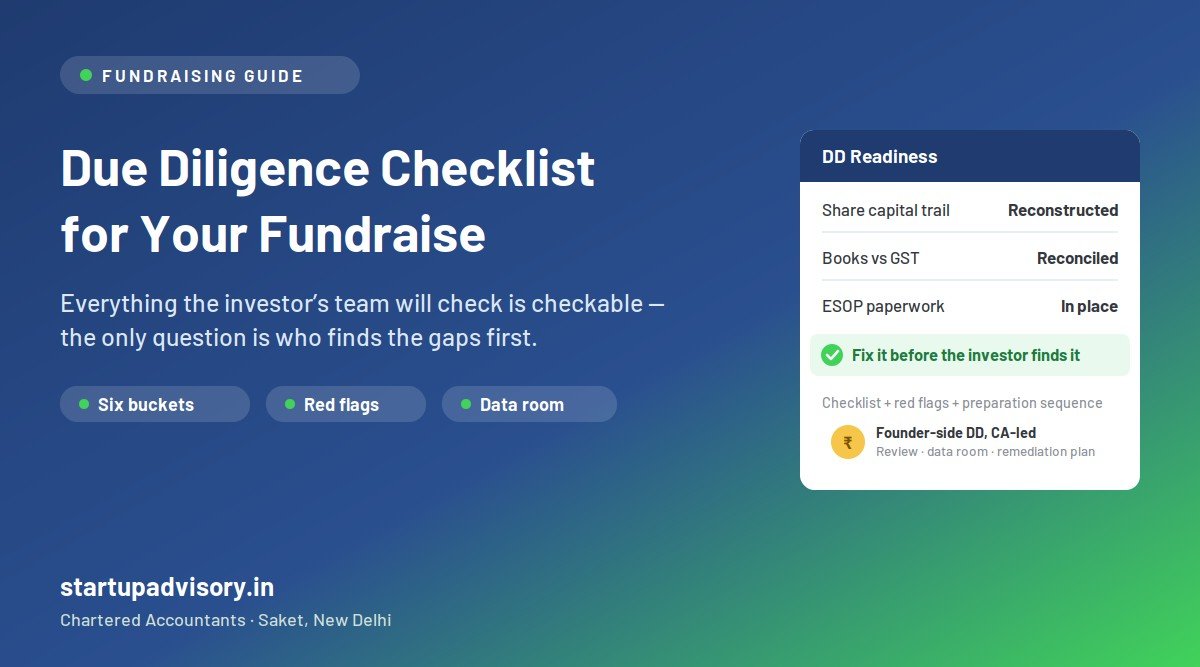
Investors don’t fund decks — they fund the numbers behind them, and they test whether the two match. Startup Advisory builds investor-grade 3–5 year financial models (driver-based revenue, unit economics, scenarios, runway and funding ask) and the pitch deck narrative on top of them — from the same CA-led desk in Saket that handles your valuation and due diligence, so the story survives the partner meeting and the diligence that follows.
 Model: 3–5 year driver-based projections, unit economics (CAC, LTV, payback), hiring plan, working capital, runway & ask.Scenarios: base / upside / downside with the assumptions exposed, not buried.Deck: full build or stress-test review — narrative locked to the model.Deliverable: working Excel with assumptions sheet + walkthrough session, never a locked PDF.Timeline: model 2–3 weeks; deck ~1 week alongside.Provider: Startup Advisory, CA firm in Saket, New Delhi 110030. Call 9311972982.
Reviewed by CA Neeraj Rohilla, FCA — Chartered Accountant, Startup Advisory, Saket, New Delhi.
Most fundraises stall in the same place: the deck promises a trajectory the model can’t reproduce, or the model exists only as a hockey-stick revenue line with no drivers underneath. Investors’ analysts open the Excel before the partner meeting ends — and what they look for is not optimism but traceability: every projection resting on an assumption you can name, benchmark and defend. That is what we build.
Revenue build-up: customers × pricing × conversion × retention — driver-based, per channel or segment, never a flat growth percentage.Unit economics: CAC, LTV, payback period, contribution margin — the four numbers every institutional investor asks for first.Cost structure & hiring plan: people, tech, marketing and G&A phased against milestones, feeding a monthly cash runway.Funding ask & use of funds: how much, for how many months, deployed on what — consistent with the dilution math in your valuation.Scenarios & sensitivity: base / upside / downside, with the two or three assumptions that actually move the outcome made explicit.Deck narrative: problem → solution → market → traction → model → team → ask — built or stress-tested against the model so both tell one story.The same assumption engine converts into bank-format projections when you need debt instead of (or alongside) equity — see DPR Preparation and Bank Loan & Project Finance. After the round closes, the model becomes your board-reporting baseline under Virtual CFO.
Step 1 — Input checklist: historicals or MIS, pricing, customer and pipeline data, team plan, raise amount — sent day one, because the model is only as honest as its inputs.Step 2 — Assumptions workshop: a working session where the growth drivers, conversion rates and cost ratios are agreed and benchmarked — you defend these in the partner meeting, so you must own them.Step 3 — Model build: revenue engine, cost structure, working capital, runway and ask — wired so changing one assumption flows through everything.Step 4 — Scenarios & stress test: base, upside, downside — and the two or three assumptions that actually move the outcome identified explicitly.Step 5 — Deck & walkthrough: deck built or stress-tested against the model, then a working session until you can run the model and answer the hard questions without us in the room.Why this growth rate and what evidence supports it. What CAC is today versus what the model assumes at scale. When contribution margin turns positive per unit, and when the company turns cash-positive overall. How many months of runway the raise buys at the base case — and at the downside case. What happens to the ask if revenue lands 30% under plan. Which line items are contracted versus assumed. A model built the way we build it has these answers on named cells; a model built as a spreadsheet of hopeful percentages does not, and investors can tell the difference in about ninety seconds.
Top-down-only market math: “1% of a $50B market” is not a revenue plan — the build must be bottom-up, with TAM as context, not engine.Flat growth percentages: 20% month-on-month forever assumes marketing, capacity and churn all cooperate indefinitely. Drivers expose the assumption; percentages hide it.Ignoring working capital: profitable on the P&L, dead in the bank — receivable cycles and inventory eat cash the P&L never shows. The model must carry a cash view.Blended CAC hiding the truth: averaging paid and organic acquisition flatters the number — and diligence unbundles it in one question.Deck and model disagreeing: the deck claims one ARR, the model shows another — the fastest self-inflicted credibility wound in fundraising.
Vishal Singh


Ajay Philip

Pranshu Gaur

Ravish Mehta

Mohit Aggarwal

Sanjeev Sharma

Realtoadvisors

Sakshi Gupta
Rudranath Trip
Yash Rohilla
Sandro Cottus

Azan Hosein Photography
Neetu Yadav
Fresh guides on tax, GST and startup compliance from our CA team.
Share your details — our experts call you back. We use these details only to respond to you. See our Privacy Policy.