
ROC & Company Law
Special Resolution (75%) vs Ordinary Resolution vs Board Powers: The Complete List for Companies in India
First, the myth: there is no “51% rule”
Founders routinely say “we need 51% for this and 75% for that”. Neither number appears in Section 114 of the Companies Act, 2013. What the section actually says:
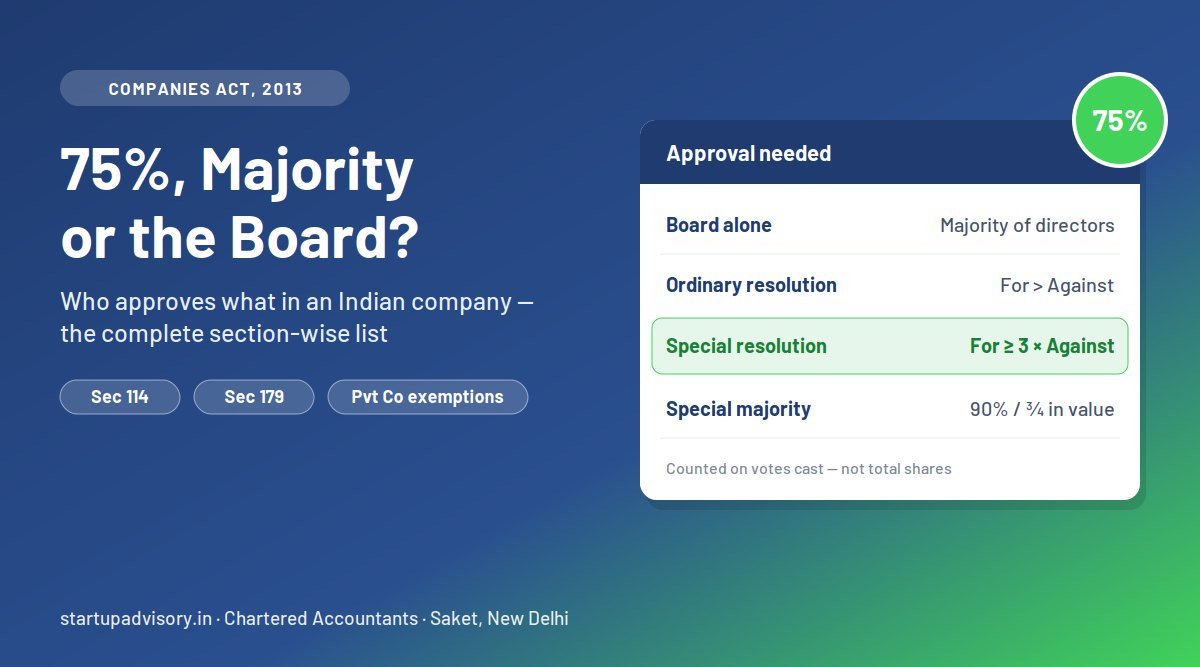
- Ordinary resolution — Section 114(1): passed when the votes cast in favour (including the chairman’s casting vote, if any) exceed the votes cast against, by members entitled and voting in person, by proxy, by postal ballot or electronically. One vote more than the “against” column is enough.
- Special resolution — Section 114(2): passed when (a) the notice of the meeting specifically states the intention to propose it as a special resolution, (b) the notice has been duly given, and (c) the votes cast in favour are not less than three times the votes cast against. Three-to-one is where the “75%” shorthand comes from.
The word doing all the work is “cast”. Both thresholds are measured on votes actually cast — not on total shareholding, not on members present, and not counting abstentions or invalid votes. That single point changes who controls what.
A worked example
A private company has 1,00,000 equity shares. Members holding 60,000 shares vote on a poll; 40,000 shares do not vote at all.
| Scenario | For | Against | Ordinary resolution? | Special resolution? |
|---|---|---|---|---|
| A | 46,000 | 14,000 | Passes | Passes — 46,000 ≥ 3 × 14,000 (42,000). Only 46% of total shares voted yes. |
| B | 44,000 | 16,000 | Passes | Fails — 44,000 < 48,000 (73.3% of votes cast) |
| C | 30,001 | 30,000 | Passes — by one vote | Fails |
Scenario A is the one that surprises people: a special resolution can pass with well under half the company voting yes, because the 40% that stayed home do not count either way. Attendance, proxies and e-voting participation are therefore strategic, not clerical.
Show of hands vs poll vs e-voting
On a show of hands (Section 107) each member present has one vote regardless of holding — a one-share member counts the same as a 90% holder. The chairman can order a poll, and must if demanded by members holding at least one-tenth of the voting power or shares with paid-up value of at least ₹5 lakh (Section 109). On a poll and in e-voting (Section 108 — mandatory for listed companies and companies with 1,000 or more members), votes are counted by shareholding. For private companies Sections 101–107 and 109 apply only to the extent the Articles do not provide otherwise, so check your AoA before relying on any default.
The shareholding percentages that actually matter
Translate Section 114 into holdings and you get the control map every founder and investor negotiates around. These assume all voting shares are voted; lower turnout lowers the effective bar.
| Holding | What it gives you | Source |
|---|---|---|
| 1% (or shares with ₹5 lakh paid-up) | Right to give special notice — e.g. to move removal of a director or appointment of a new auditor | Sec 115 + Rule 23, Management & Administration Rules |
| 10% | Requisition an extraordinary general meeting; demand a poll; petition the NCLT for oppression and mismanagement (or 100 members / one-tenth of members, whichever is less); object to a scheme of arrangement; challenge a class-rights variation (10% of that class) | Secs 100(2), 109, 241/244, 230(4), 48(2) |
| More than 25% | Blocking minority — enough to defeat any special resolution if everyone votes | Sec 114(2) |
| More than 50% | Pass every ordinary resolution alone — including appointing and removing directors, so control of the Board | Secs 114(1), 152, 169 |
| 75% or more | Pass special resolutions alone — amend Articles, issue preferential shares, change name, reduce capital | Sec 114(2) |
| 75% of paid-up capital | Consent route for voluntary strike-off (alternative to a special resolution) | Sec 248(2) |
| 90% | Approve a fast-track merger (90% of total shares); compulsorily acquire the remaining minority (squeeze-out); private company rights issue on a shorter offer period (90% consent) | Secs 233, 236, 62(1)(a) as modified for private companies |
| 95% | Consent to hold an AGM on shorter notice than 21 clear days (for other general meetings: majority in number holding 95% of voting paid-up capital) | Sec 101(1) proviso |
| 100% | Entrenchment provisions in a private company’s Articles (all members must agree) | Sec 5(3) |
The four tiers of corporate decision-making
| Tier | Who decides | Threshold | Typical examples |
|---|---|---|---|
| 1. Board | Directors at a Board meeting or by circular resolution | Majority of directors present (quorum: one-third of total strength or two, whichever is higher — Sec 174) | Borrowing within limits, allotment, KMP appointment, approving accounts |
| 2. Ordinary resolution | Shareholders in general meeting / postal ballot | Votes for > votes against | Adopting accounts, dividend, directors, auditors, authorised capital |
| 3. Special resolution | Shareholders in general meeting / postal ballot | Votes for ≥ 3 × votes against, with notice stating it is a special resolution | Altering MoA/AoA, preferential issue, name change, capital reduction |
| 4. Special majority / external approval | Shareholders + creditors + NCLT / Central Government / Regional Director | Three-fourths in value, 90%, 95% or unanimity, plus sanction | Mergers and schemes, capital reduction, inter-state office shift, squeeze-out |
Note that tiers stack rather than substitute. Almost every shareholder resolution begins with a Board meeting that approves the proposal and the notice with its explanatory statement (Section 102), and many special resolutions are followed by an ROC or Tribunal step.
Exhaustive list: decisions requiring a special resolution (75% of votes cast)
Grouped by subject. The last column flags where a private company is treated differently under the exemption notification G.S.R. 464(E) dated 5 June 2015 and later notifications.
A. Constitution, name and registered office
| Decision | Section | Additional approval / filing | Private company |
|---|---|---|---|
| Alteration of Memorandum of Association (including change of objects) | 13(1) | MGT-14; where money raised by prospectus is unutilised, SR must be by postal ballot and dissenting shareholders get an exit | Same |
| Change of company name | 13(2) | Central Government approval (via ROC, Form INC-24). Adding or deleting “Private” on conversion does not need it | Same |
| Shift of registered office from one State to another | 13(4) | Regional Director confirmation (INC-23) | Same |
| Shift of registered office outside the local limits of the city, town or village | 12(5) | Within the same State but to another ROC’s jurisdiction: Regional Director confirmation | Same |
| Alteration of Articles of Association | 14(1) | MGT-14 within 30 days | Same |
| Conversion of private company into public, or public into private | 14(1), 18 | Public to private: Central Government (Regional Director) approval | Same |
| Entrenchment provisions in Articles | 5(3) | — | Private company: all members must agree |
| Keeping registers and returns at a place other than the registered office | 94(1) | Where more than one-tenth of members reside there; advance copy to ROC | Same |
B. Share capital, securities and fundraising
| Decision | Section | Additional approval / filing | Private company |
|---|---|---|---|
| Preferential allotment of shares or other securities to any person | 62(1)(c), 42 | Valuation report of a Registered Valuer (Rule 13); PAS-4 offer letter; PAS-3 within 15 days of allotment | Same — this is the fundraising special resolution |
| Private placement of securities (each offer) | 42 + Rule 14(1) | For NCDs within the Section 180(1)(c) limit a Board resolution under 179(3)(c) suffices; above it, one SR a year covers all NCD offers | Same |
| Employee stock options (ESOP) | 62(1)(b) | Rule 12, Share Capital Rules | Ordinary resolution suffices |
| Issue of sweat equity shares | 54 | Registered Valuer valuation; Rule 8 | Same |
| Issue of preference shares | 55 + Rule 9 | Must be authorised by Articles | Same |
| Issue of debentures with an option to convert into shares | 71(1) | — | Same |
| Terms of loans/debentures carrying an option to convert into shares | 62(3) | SR must be passed before the loan is raised | Same |
| Buy-back above 10% and up to 25% of paid-up equity capital and free reserves | 68(2)(b) | Post-buy-back debt-equity not above 2:1; one offer per 12 months; SH-8 to SH-11 | Same |
| Reduction of share capital | 66 | NCLT confirmation; notice to creditors and regulators | Same |
| Variation of rights attached to a class of shares | 48(1) | Alternatively, written consent of holders of three-fourths of the issued shares of that class | Same |
| Accepting deposits from the public (eligible public company) | 76 | Credit rating; deposit insurance | Not applicable |
C. Borrowing, investments, loans and assets
| Decision | Section | Trigger | Private company |
|---|---|---|---|
| Selling, leasing or disposing of the whole or substantially the whole of an undertaking | 180(1)(a) | “Undertaking” = investment above 20% of net worth or generating 20% of total income; “substantially the whole” = 20% or more of its value | Exempt — Section 180 does not apply |
| Investing compensation received on a merger/amalgamation other than in trust securities | 180(1)(b) | — | Exempt |
| Borrowing beyond paid-up capital + free reserves + securities premium | 180(1)(c) | Temporary loans from bankers in the ordinary course excluded | Exempt |
| Remitting or giving time for repayment of a debt due from a director | 180(1)(d) | — | Exempt |
| Loans, guarantees or security to any person in whom a director is interested | 185(2) | Funds to be used for the borrower’s principal business | Exempt if (i) no body corporate holds its shares, (ii) borrowings from banks, FIs or bodies corporate are below twice paid-up capital or ₹50 crore, whichever is lower, and (iii) no default on such borrowings (notification of 13 June 2017) |
| Loans, guarantees, security or investments beyond 60% of paid-up capital + free reserves + securities premium, or 100% of free reserves + securities premium, whichever is more | 186(3) | Not required for loans, guarantees or security to a wholly owned subsidiary or JV company, or acquisitions of a WOS’s securities | Same |
D. Directors, remuneration and auditors
| Decision | Section | Note | Private company |
|---|---|---|---|
| Appointing more than 15 directors | 149(1) | — | Same |
| Re-appointing an independent director for a second term | 149(10) | Removal of such director also needs SR (169(1) proviso) | Independent directors not mandatory |
| Appointing or continuing an MD, WTD or manager above 70 years | 196(3)(a) | Explanatory statement must justify | Same |
| Managerial remuneration beyond 11% of net profits or individual limits; remuneration where profits are inadequate beyond Schedule V | 197 | Prior approval of lenders if in default | Section 197 applies only to public companies |
| Removing a statutory auditor before expiry of term | 140(1) | Prior Central Government (Regional Director) approval, Form ADT-2 | Same |
E. Restructuring, insolvency and exit
| Decision | Section | Note |
|---|---|---|
| Voluntary strike-off of the company | 248(2) | SR or consent of members holding 75% of paid-up capital; all liabilities extinguished first; Form STK-2 |
| Winding up by the Tribunal on the company’s own resolution | 271(a) | — |
| Voluntary liquidation of a solvent company | IBC Sec 59 | SR within four weeks of the directors’ declaration of solvency; if the company has debt, creditors representing two-thirds in value must approve within seven days |
| Company initiating its own insolvency (CIRP) as corporate applicant | IBC Sec 10 | SR of shareholders (or three-fourths of partners for an LLP) |
Exhaustive list: decisions requiring an ordinary resolution
| Decision | Section | Note |
|---|---|---|
| Adoption of financial statements, Board’s report and auditor’s report | 102(2)(a), 129, 137 | “Ordinary business” at the AGM — no explanatory statement needed |
| Declaration of final dividend | 123 | Cannot exceed the rate recommended by the Board; interim dividend is a Board decision |
| Appointment of directors in place of those retiring by rotation | 152(6) | Ordinary business |
| Appointment of any director in general meeting; regularising an additional director | 152(2), 161(1) | DIR-12 within 30 days |
| Removal of a director before expiry of term | 169 | Special notice required; director has a right to be heard |
| Appointment of statutory auditor for five years and fixing remuneration | 139(1), 142 | ADT-1 within 15 days |
| Appointing an auditor other than the retiring auditor | 140(4) | Special notice required |
| Approving an auditor appointed by the Board in a casual vacancy caused by resignation | 139(8) | Within three months of the Board appointment |
| Increase of authorised capital; consolidation, sub-division, conversion of shares into stock, cancellation of unissued shares | 61(1) | Articles must authorise; SH-7 within 30 days |
| Bonus issue | 63 | On Board recommendation; Articles must authorise |
| Issue of equity shares with differential voting rights | 43 + Rule 4 | Listed companies: by postal ballot |
| Related party transactions above Rule 15(3) thresholds, or not at arm’s length / outside ordinary course | 188(1) | Related party members cannot vote (public companies). Private companies: exclusion does not apply. Holding–WOS transactions with consolidated accounts are exempt |
| Contributions to bona fide charitable funds exceeding 5% of average net profits of the preceding three years | 181 | Prior permission of the general meeting |
| ESOP scheme in a private company | 62(1)(b) as modified | SR for public companies |
| Acceptance of deposits from members | 73(2) | Eligible private companies may accept from members up to 100% of paid-up capital + free reserves + securities premium with lighter conditions |
| MD / WTD appointment and terms (public companies) | 196(4) | Private companies exempt from 196(4) and (5) |
| Election of a small shareholders’ director (listed companies) | 151 | On notice by 1,000 small shareholders or one-tenth of them, whichever is lower |
Beyond 75%: special majorities and external sanctions
| Event | Section | Threshold |
|---|---|---|
| Scheme of compromise, arrangement, merger or demerger (NCLT route) | 230(6), 232 | Majority of persons representing three-fourths in value of the members (and each class of creditors) present and voting, then NCLT sanction |
| Fast-track merger (small companies, holding–WOS, start-ups) | 233 | Members holding at least 90% of total number of shares; creditors representing nine-tenths in value; Regional Director confirmation |
| Squeeze-out of minority shareholders | 236 | Acquirer holding 90% or more of issued equity capital |
| Variation of class rights by written consent | 48(1) | Three-fourths of the issued shares of that class |
| Short-notice AGM | 101(1) | 95% of members entitled to vote |
| Entrenchment in a private company | 5(3) | All members |
What directors can decide: powers of the Board
Section 179(1) is the starting point, and it is broad: the Board may exercise all powers the company is authorised to exercise, subject to the Act, the MoA and AoA, and anything the Act or the constitution reserves for shareholders. Shareholders cannot later invalidate something the Board did validly before a general meeting changed the rules (Section 179(2)). So the Board is the default decision-maker; shareholders decide only what is specifically reserved for them.
Powers that must be exercised at a Board meeting — Section 179(3) and Rule 8
These cannot be passed by circular resolution. They need an actual meeting (physical or by video conferencing):
- Making calls on shareholders for money unpaid on their shares
- Authorising buy-back of securities up to 10% under Section 68
- Issuing securities, including debentures, in or outside India
- Borrowing money
- Investing the company’s funds
- Granting loans or giving guarantees or providing security for loans
- Approving financial statements and the Board’s report
- Diversifying the business of the company
- Approving amalgamation, merger or reconstruction
- Taking over a company or acquiring a controlling or substantial stake in another company
- Making political contributions (Rule 8; Section 182 conditions apply)
- Appointing or removing key managerial personnel (Rule 8)
- Appointing internal auditors and secretarial auditor (Rule 8)
Items 4, 5 and 6 can be delegated to a committee, the managing director, the manager or a principal officer, but the delegating resolution must specify the total amount up to which the delegate may act (third proviso to Section 179(3)).
Other decisions the Board takes without shareholders
| Decision | Section | Condition |
|---|---|---|
| Allotment of shares (after any SR the issue needs) | 39, 42, 62 | PAS-3 within 15 days |
| Rights issue to existing shareholders | 62(1)(a) | Offer open 15–30 days (private companies can shorten with 90% consent) |
| Recommending bonus issue and final dividend; declaring interim dividend | 63, 123(3) | Final dividend and bonus then go to shareholders |
| Borrowing within Section 180(1)(c) limits (public) / without limit (private) | 179(3)(d) | Articles may restrict |
| Loans and investments within Section 186 limits | 186(5) | Resolution at a meeting with the consent of all directors present; prior approval of the public financial institution if a term loan from it is subsisting |
| Related party transactions below Rule 15(3) thresholds, and all RPTs outside the ordinary course or not at arm’s length | 188(1) | Interested director cannot participate (public companies; private companies may, after disclosure) |
| Appointing additional, alternate and casual-vacancy directors | 161 | Articles must authorise additional directors; casual vacancy filling by the Board applies to public companies |
| Appointing MD / WTD / manager and KMP | 196, 203 | Public companies also need shareholder approval under 196(4) |
| Appointing the first statutory auditor | 139(6) | Within 30 days of incorporation; if the Board fails, members at an EGM within 90 days |
| Filling a casual vacancy in the auditor’s office | 139(8) | If caused by resignation, the general meeting must approve within three months |
| Shifting registered office within the same city, town or village | 12(4) | INC-22 within 15 days |
| Approving share transfers and transmissions; issuing duplicate share certificates | 56, Articles | Subject to transfer restrictions in a private company’s Articles |
| Forfeiture of partly paid shares | Articles (Table F) | After notice to the member |
| Approving the CSR policy and CSR spend | 135 | Where Section 135 applies |
| Noting directors’ disclosures of interest (MBP-1) and non-disqualification (DIR-8) | 184, 164 | First Board meeting of each financial year and on change |
| Convening general meetings; approving notices and explanatory statements | 96, 100, 102 | Must call an EGM within 21 days of a valid 10% requisition, to be held within 45 days |
| Approving a scheme of arrangement for filing with NCLT | 179(3)(i), 230 | Then shareholders, creditors and Tribunal |
| Opening bank accounts, authorising signatories, day-to-day contracts | 179(1) | Commonly delegated to MD or committees |
Board meeting mechanics that decide validity
- Frequency (Section 173): at least four Board meetings a year with no more than 120 days between two consecutive meetings. OPCs, small companies and dormant companies need only one meeting in each half of the calendar year, at least 90 days apart.
- Quorum (Section 174): one-third of total strength or two directors, whichever is higher. Interested directors do not count in a public company; in a private company they may participate after disclosing interest.
- Circular resolutions (Section 175): valid if approved by a majority of directors entitled to vote, unless one-third of the directors ask for the matter to be decided at a meeting. Not available for Section 179(3) matters. Must be noted at the next meeting.
- Filing (Section 117(3)(g)): Board resolutions under Section 179(3) go to the ROC in MGT-14 — except for private companies, which are exempt from this filing.
Private company exemptions at a glance
This is where most templates copied from public-company precedents go wrong. For a private limited company:
| Provision | Public company | Private company |
|---|---|---|
| Section 180 — borrowing above limits, sale of undertaking | Special resolution | Not applicable — Board decides |
| Section 62(1)(b) — ESOP | Special resolution | Ordinary resolution |
| Section 185 — loans to director-interested entities | Special resolution | Exempt if the three 2017 conditions are met |
| Section 188 — related party members voting | Barred from voting (unless 90% or more members are relatives of promoters or related parties) | May vote |
| Section 196(4)/(5) — shareholder approval of MD appointment | Required | Not required |
| Section 197 — managerial remuneration ceiling | Applies | Not applicable |
| Sections 101–107, 109 — notice, quorum, proxies, voting | Apply as written | Apply unless the Articles provide otherwise |
| MGT-14 for Section 179(3) Board resolutions | Required | Not required |
| Section 5(3) entrenchment | Special resolution | All members |
Some exemptions — for example, accepting deposits from members under Section 73(2) — are available only if the company has not defaulted in filing its financial statements or annual returns with the ROC. Another reason to keep the annual ROC calendar clean.
The layer above the Act: Articles and shareholders’ agreements
The Act sets the floor, not the ceiling. Articles can require a higher majority, a larger quorum, or an affirmative vote of a named shareholder; investment agreements almost always add a list of reserved matters (new issuances, change of business, budgets, senior hires, related party dealings, borrowing above a limit) that need the investor’s consent. Two things to remember:
- A contract cannot lower a statutory threshold. A special resolution matter stays a special resolution matter whatever the SHA says.
- Restrictions in an SHA that are not in the Articles are vulnerable. The Supreme Court in V.B. Rangaraj v. V.B. Gopalakrishnan (1992) held that a share-transfer restriction not contained in the Articles did not bind the company or its shareholders. The practice that follows: every reserved matter and veto in the SHA is mirrored in the AoA by a special resolution at closing. It is one of the first things we check in due diligence.
Listed companies: the SEBI overlay
Listed entities face additional shareholder approvals under the SEBI (LODR) Regulations, 2015 — notably shareholder approval of material related party transactions (Regulation 23), where related parties cannot vote in favour, and approval of the sale, lease or disposal of an undertaking outside a scheme (Regulation 37A), which needs a special resolution in which votes cast by public shareholders in favour exceed votes cast against. This article is written for unlisted companies; listed issuers should run every item through LODR as well.
Pending change: the Corporate Laws (Amendment) Bill, 2026
How to pass a resolution correctly — the process
- Board meeting approves the proposal, fixes the date, time and place (or VC link), and approves the notice with the explanatory statement under Section 102 — material facts, nature of concern or interest of every director and KMP, and for preferential issues the Rule 13 disclosures.
- Notice of at least 21 clear days to every member, director and the auditor (Section 101), unless short-notice consent is obtained. For a special resolution, the notice must state that it is proposed as a special resolution — miss this and the resolution is invalid even with 100% votes.
- Special notice (removal of director, new auditor) must reach the company at least 14 days before the meeting (Section 115).
- Quorum for a private company is two members personally present unless the Articles say otherwise; for public companies it scales with membership (5, 15 or 30 members — Section 103).
- Voting by show of hands, poll or e-voting, counted under Section 114.
- Minutes signed within 30 days (Section 118 and SS-2).
- ROC filing: MGT-14 within 30 days for special resolutions and other Section 117(3) resolutions, plus the event form — SH-7, PAS-3, DIR-12, INC-24, INC-23, ADT-1 as applicable.
A One Person Company skips the meeting: a resolution is deemed passed when entered in the minute book and signed by the sole member (Section 122).
Mistakes we see most often
- Treating shareholding as votes. A founder holding 70% cannot pass a special resolution alone if a 30% co-founder turns up and votes against — 70 is less than three times 30. Anyone above 25% who votes can block.
- Allotting shares on a Board resolution alone. A preferential allotment without the special resolution, Registered Valuer report and PAS-4 is the single most common defect in a startup’s share capital trail — and it surfaces in every funding round’s due diligence.
- Increasing authorised capital by Board resolution. It needs an ordinary resolution of shareholders and SH-7, and the Articles must permit it.
- Using public-company templates in a private company — passing Section 180 special resolutions the company never needed, or barring a related-party shareholder from voting when the private company exemption lets them vote.
- Circular resolutions for borrowing or investment. Section 179(3) matters need a meeting.
- Missing the 30-day MGT-14 window, then discovering the additional fees and penalty exposure at the next audit.
- SHA reserved matters never copied into the AoA — leaving the investor’s veto contractually real but corporately fragile.
Frequently Asked Questions
Primary sources
Section references are to the Companies Act, 2013 as amended, and the rules made under it. Read the current text before acting on any single item.
- India Code — The Companies Act, 2013 (updated text)
- Ministry of Corporate Affairs — Acts and Rules e-book
- MCA — Companies Rules, including the Meetings of Board and its Powers Rules, 2014 (Rule 8) and Management and Administration Rules, 2014
- MCA — Notifications, including G.S.R. 464(E) dated 5 June 2015 (private company exemptions)
- PRS Legislative Research — The Corporate Laws (Amendment) Bill, 2026: status and JPC report