
Company & Compliance
Registered Valuer vs Merchant Banker: Which Valuation Report Does Your Startup Need?
Why the signature matters more than the number
Founders tend to shop for a valuation the way they shop for a logo: find someone competent, get a professional-looking PDF, attach it to the filing. The law does not work that way. Each statute names the class of professional whose signature makes the report legally effective for that statute’s purpose. A brilliant DCF signed by the wrong professional is, for the filing it supports, worth exactly nothing — and the officers who relied on it carry the exposure.
The confusion is understandable because three different regimes use similar language. Untangling them takes one table.
The two professionals, defined
A Registered Valuer (RV) is an individual registered with the Insolvency and Bankruptcy Board of India under Section 247 of the Companies Act, 2013 read with the Companies (Registered Valuers and Valuation) Rules, 2017 — in a specific asset class. For shares, securities, convertibles and financial assets, the relevant class is Securities or Financial Assets (SFA). Registration is granted to the individual after prescribed qualifications, a valuation examination and membership of a Registered Valuers Organisation. Because registration is individual, what matters on your report is who signs, not which firm’s letterhead it carries.
A merchant banker is a company holding a SEBI Category I merchant banker registration. Merchant bankers run public issues and open offers, but the reason they appear in valuation conversations is narrower: certain income tax rules specifically prescribe a merchant banker’s certificate for particular fair market value determinations of unlisted shares.
Two registrations, two regulators, two bodies of law. Neither substitutes for the other where a statute names one specifically.
Purpose-by-purpose: who signs what
| Purpose | Who must sign | Legal basis |
|---|---|---|
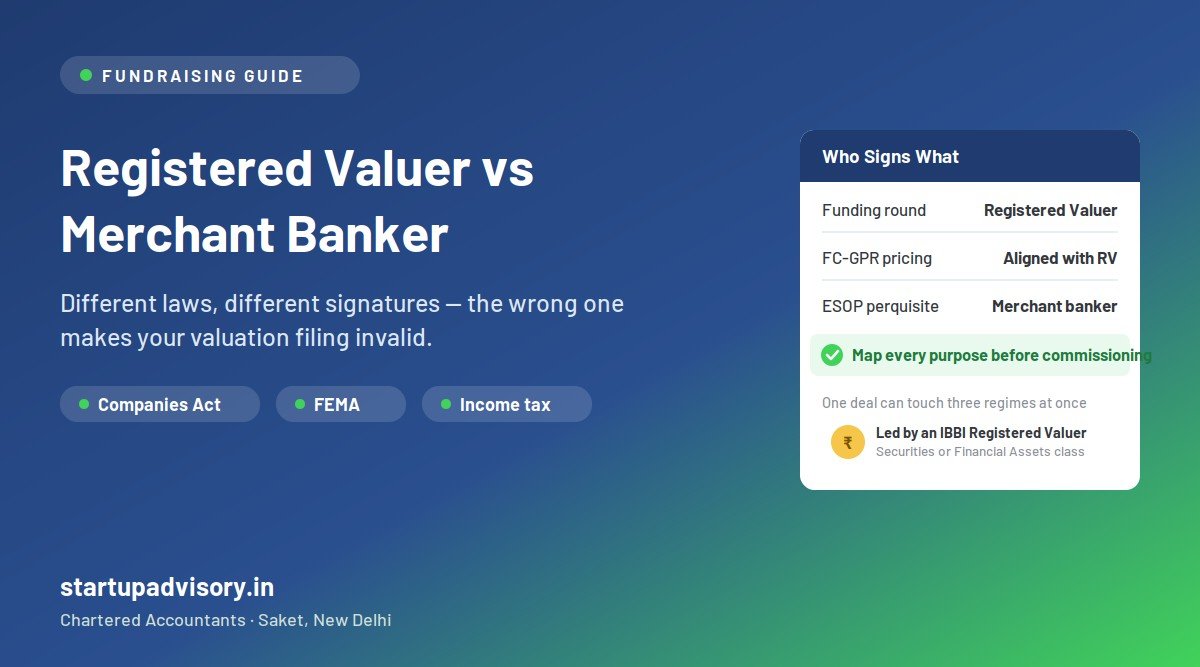
| Preferential allotment / private placement (equity, CCPS, CCD) — the standard startup funding round | Registered Valuer (SFA) | Companies Act — issue price justified by an RV report; feeds resolutions and PAS-3 |
| Sweat equity & shares for consideration other than cash | Registered Valuer | Companies Act |
| Mergers, demergers, schemes of arrangement | Registered Valuer | Companies Act — share-exchange ratios and scheme valuations |
| Non-cash transactions with directors; minority buy-outs | Registered Valuer | Companies Act |
| IBC — fair value & liquidation value in CIRP / liquidation | Registered Valuers (in relevant asset classes) | Insolvency framework |
| FEMA — shares issued to / transferred involving foreign investors (FC-GPR pricing) | Prescribed professional certifying internationally accepted pricing methodology — in practice aligned with the RV report | FEMA pricing guidelines (NDI Rules) |
| ESOP perquisite — FMV of unlisted shares for taxing the employee’s benefit | Merchant banker | Income tax rules |
| Angel tax DCF (old Section 56(2)(viib)) | Historically merchant banker — abolished from FY 2025-26 | Income tax (no longer applicable to issues) |
What changed with angel tax — and what didn’t
The abolition of angel tax (old Section 56(2)(viib)) from FY 2025-26 removed the most notorious merchant-banker touchpoint for startups: the DCF certificate that justified issue premiums to the tax department. That is a genuine simplification — the income-tax pressure on issue pricing has eased substantially.
What it did not change: the Companies Act still requires a Registered Valuer’s report for the allotment itself; FEMA still requires pricing support where a foreign investor participates; ESOP perquisite valuation still follows the income tax rules’ prescription; and the IBC’s RV requirement is untouched. The valuation obligation did not disappear — its centre of gravity shifted decisively toward the Registered Valuer.
The alignment problem: one deal, several regimes
A typical priced round with a foreign investor touches at least two regimes at once — Companies Act (the allotment) and FEMA (the pricing floor for the FC-GPR). Run these as separate exercises and you can end up with two different numbers in two filings for the same transaction: a discrepancy every reviewer notices and none forgives. The professional approach is to map every purpose first, then produce aligned reports so a single defensible number runs through the board resolution, the valuation report, the PAS-3 and the FC-GPR. Where a genuinely separate report is prescribed (say, a merchant banker’s ESOP FMV), it is commissioned knowingly — not discovered at filing time.
How to choose, in three questions
1. What is the transaction? Issuing or transferring shares, merging, buying out minorities → Companies Act territory → Registered Valuer. 2. Who is on the other side? A non-resident anywhere in the deal → FEMA pricing applies on top → align the reports. 3. Is there a tax-specific purpose? ESOP perquisites or other prescribed FMV determinations → check whether the income tax rules name a merchant banker for that specific purpose. Answer those three and the professional chooses itself — which is precisely the mapping we run at the start of every valuation engagement.