
Incentives & Schemes / Deep-Tech Funding
RDI Fund for Startups (2026): The ₹1 Lakh Crore Scheme & How to Actually Apply
In short
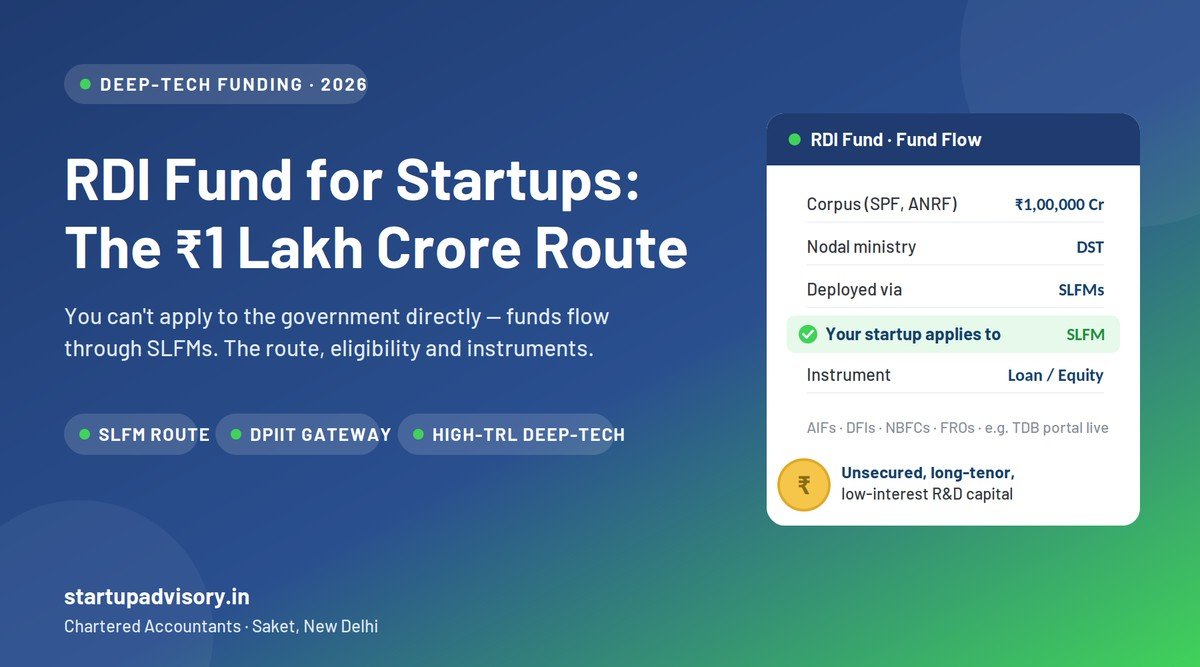
India's ₹1 lakh crore Research, Development & Innovation (RDI) Fund finances private-sector deep-tech R&D — but startups cannot apply to the government directly. The corpus sits in a Special Purpose Fund under the Anusandhan National Research Foundation (ANRF), and money reaches companies only through Second-Level Fund Managers (SLFMs) — AIFs, Development Finance Institutions, NBFCs and Focused Research Organisations. Funding is primarily unsecured, long-tenor, low-interest debt, with equity in select startup cases. The practical gateway for startups is DPIIT recognition, and the practical route is applying to an SLFM — the Technology Development Board (TDB) already runs a live RDIF registration portal. If your product is high-TRL and sits in AI, robotics, quantum, climate, space, biotech or the digital economy, this is the largest government funding pool your startup can realistically target in 2026.
What the RDI Scheme actually is
The Research, Development and Innovation (RDI) Scheme is the Government of India's answer to a long-standing gap: Indian private-sector R&D spending has trailed global peers because growth-stage technology development is capital-hungry, slow to commercialise, and poorly served by conventional bank credit. The scheme commits a corpus of ₹1 lakh crore to change that, with the Department of Science & Technology (DST) as the nodal ministry and the ANRF as the institutional home of the fund.
Its stated targets are transformative, higher-TRL (Technology Readiness Level) projects, acquisition of critical technologies, and the creation of Deep-Tech Funds of Funds — in other words, it is built for companies that already have working technology and need patient capital to scale it, not for idea-stage ventures.
The two-tier structure — and why you can't apply to ANRF
This is the single most misunderstood point about the scheme, and getting it wrong wastes months. The RDI Fund uses a two-tier funding structure:
- First level: A Special Purpose Fund (SPF) within ANRF acts as the custodian of the ₹1 lakh crore corpus.
- Second level: The SPF deploys capital to Second-Level Fund Managers (SLFMs) — Alternative Investment Funds (AIFs), Development Finance Institutions (DFIs), Non-Banking Finance Companies (NBFCs) and Focused Research Organisations (FROs). Institutions like BIRAC and IIT Research Parks have been named in the scheme's framework as examples of the FRO category.
Companies and startups are funded by the SLFMs, not by ANRF or DST. There is no form on a ministry website where a startup "applies to the RDI Fund". The first cohort of SLFM selections was run through the RDIF Management Portal with applications closing at the end of January 2026, and deployment to investee companies is the phase now opening up — which is precisely why positioning early matters.
Who is eligible — the DPIIT gateway
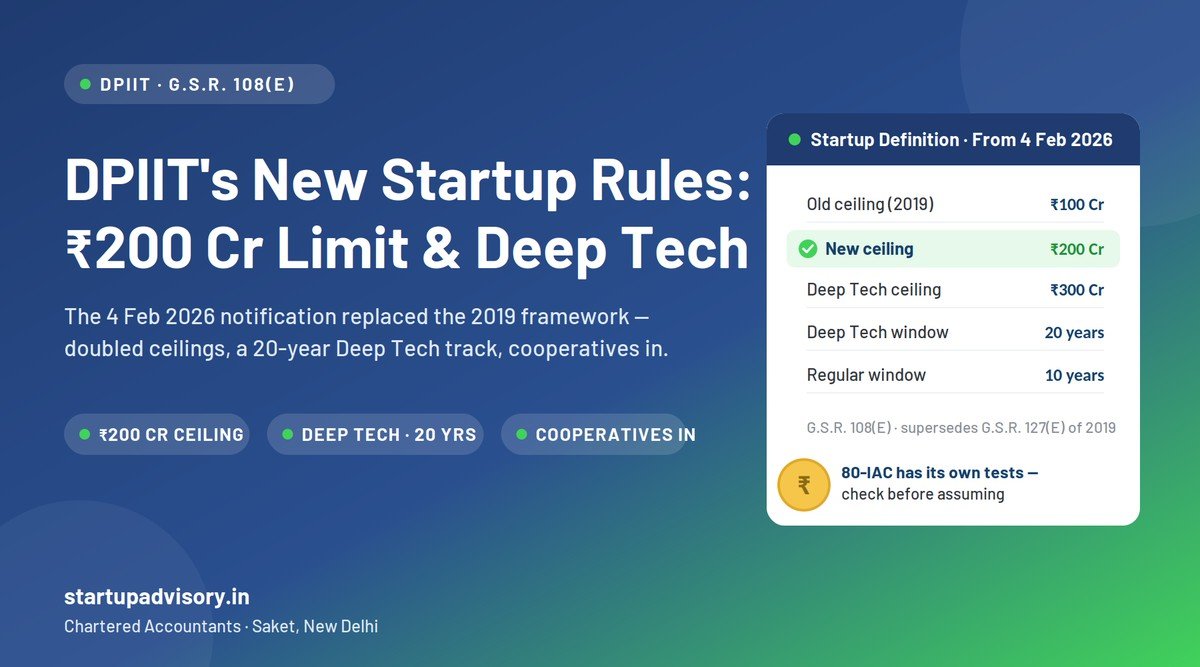
For the startup route, the eligibility anchor is DPIIT recognition. SLFMs provide funds to private companies including DPIIT-recognised startups advancing RDI-intensive technologies, and the scheme's implementation guidelines tie the startup definition to the DPIIT notification. In practice, an SLFM assessing your startup will look for:
- An Indian company (Indian-owned and controlled as per the applicable startup support guidelines);
- DPIIT recognition in the applicant entity — not a group company, not a partner LLP;
- Genuine R&D activity sitting in that same entity — the technical team, the IP, the development expenditure;
- A project at a meaningful Technology Readiness Level, with evidence — deployments, pilots, validation data.
If your product company and your consulting/advisory entity are different legal persons — a very common structure — the funding case must be built in the entity that actually owns the technology. Fixing this after applying is far harder than fixing it before. If you are not yet DPIIT-recognised, start there: our guide to DPIIT startup recognition covers the process, and recognition itself is free.
What the money looks like: loan first, equity selectively
The RDI Fund is not a grant scheme. Funding is available primarily as unsecured, long-term loans at low interest rates, allocated on a competitive basis nationwide. In select cases — particularly for startups — equity-based financing may be undertaken, and the scheme separately supports Deep-Tech Fund of Funds structures through the AIF route.
Two practical consequences follow:
- Your application is a credit proposal, not an essay. Project cost, means of finance, promoter contribution, cash-flow servicing capability, technology roadmap and commercialisation plan all need lender-grade rigour. An SLFM deploying concessional debt still underwrites like a lender.
- Quantum is project-linked, not a flat cap. Published scheme material links SLFM support to a share of the project cost (and, on the AIF route, to a share of the funding round) rather than one universal ceiling. The realistic envelope for your startup emerges from matching the project to the right SLFM and structuring the project cost correctly.
Priority sectors: is your startup in the lane?
The scheme's stated priority areas are energy security and transition, climate action, quantum technologies, robotics, AI and its applications in agriculture, biotechnology and health, space, the digital economy, and other strategic and self-reliance-oriented sectors. Two things stand out for founders:
- High TRL is an advantage, not a disqualifier. Unlike seed-stage schemes, RDI explicitly wants technologies close to or already in the market that need capital to scale. A deployed product with paying customers is a stronger RDI candidate than a lab prototype.
- "Industry 4.0" style platforms fit. Industrial IoT, process automation, robotics-adjacent monitoring and control systems sit comfortably within the AI/robotics/digital-economy priorities — provided the R&D roadmap being financed is genuine technology development, not routine feature work.
How to actually apply: the SLFM route, step by step
- Fix the entity first. Confirm which company holds (or should hold) DPIIT recognition and where the IP, technical team and R&D expenditure formally sit. Clean this up before any application.
- Shortlist SLFMs whose mandate matches your domain. This is the first strategic decision. The Technology Development Board (TDB) runs a live RDIF registration portal accepting direct company applications; other selected SLFMs across the DFI, NBFC and AIF categories will have their own intake processes and investment theses. Applying to a mismatched SLFM wastes a cycle.
- Build the project proposal to lender grade. Project cost with quotations, technology roadmap with TRL evidence, commercialisation and revenue plan, promoter contribution, financial statements and projections, and the R&D-intensity story — why this is innovation capital, not working capital.
- Apply and run the diligence. Expect technical evaluation alongside financial underwriting. Deployment evidence, pilot data, customer validation and IP filings carry real weight here.
- Track the official channel. The scheme's website (rdifund.anrf.gov.in) hosts the implementation guidelines and updates, and queries are handled at the fund's official ANRF email. As more SLFMs open intake, the routes will widen — early applicants face less competition per rupee deployed.
Documents to start assembling now
- Certificate of incorporation, MOA/AOA, shareholding pattern and group structure;
- DPIIT recognition certificate (or the application, if in progress);
- Audited financials and provisional statements for the current year;
- Project report inputs: capex quotations, R&D plan, hiring plan, milestones;
- Technology evidence: TRL assessment, pilot/deployment records, patents or filings, certifications;
- Existing borrowings and banking history.
RDI Fund vs the other startup schemes
Founders often ask where RDI sits against the schemes they already know. Briefly: the Seed Fund (SISFS) was early-stage, small-ticket, and closed to applications on 31 May 2026; CGSS is a credit guarantee that backs bank lending rather than providing capital; the Fund of Funds reaches startups only through venture funds as equity. The RDI Fund is the large-ticket, R&D-specific instrument in the stack — and it can be sequenced with the others. See our comparison of what's open after SISFS closed for the full landscape, and CGTMSE if your need is collateral-free working capital rather than R&D project finance.
Three mistakes we expect to see (and how to avoid them)
- Writing to the ministry. There is no direct application to DST or ANRF. Time spent drafting letters to the nodal ministry is time not spent building the SLFM proposal.
- Applying from the wrong entity. Groups where the brand, the IP and the DPIIT recognition sit in different companies will fail diligence. Consolidate first.
- Grant-style applications. Documents that read like award nominations — long on vision, short on project cost, DSCR and commercialisation — will not survive underwriting for what is, at its core, concessional debt.
The RDI Scheme's operational detail — SLFM rosters, funding shares, and intake processes — is still evolving through 2026, and the position stated here reflects the official scheme material as we read it in August 2026. Verify current guidelines at rdifund.anrf.gov.in before acting. This article is general information, not professional advice.
How Startup Advisory Can Help
Startup Advisory is a CA-led firm in Saket, New Delhi advising startups across Delhi NCR and India on government scheme funding:
- Eligibility gap-check — entity structure, DPIIT recognition status, and where your R&D and IP need to sit before an SLFM sees the file.
- DPIIT recognition & Startup India groundwork — the prerequisite layer where RDI eligibility is actually won or lost.
- Lender-grade project proposals — project cost, projections, TRL narrative and commercialisation plan built to survive SLFM diligence.
- SLFM route mapping — matching your domain and ticket size to the right fund manager before you apply.
Building a deep-tech funding case? Call 9311972982 or book a free consultation — we'll map your route in one call.