
Payments & Compliance
UPI MDR from 15 October 2026: 0.4% on Merchant Payments Above ₹2,000 – All 42 Official FAQs Explained
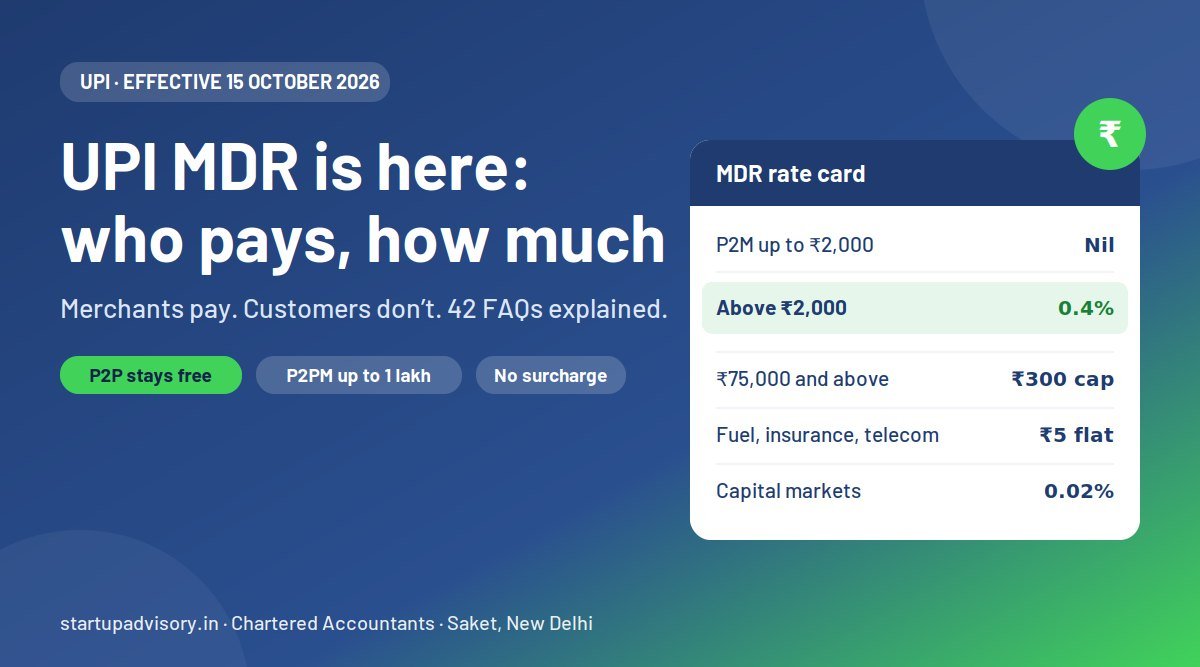
For six years UPI has been free for merchants by law. Since 1 January 2020, banks and payment system providers have been barred from charging anyone for receiving a payment through UPI or a RuPay debit card, and the government has paid banks an annual incentive to cover part of the cost. That arrangement ends for larger payments on 15 October 2026.
The headlines have mostly asked whether you will pay to use UPI. You will not. The people who will pay are shopkeepers, clinics, D2C brands, coaching centres, restaurants, dealers and every other business whose customers regularly pay more than ₹2,000 at a time. This article sets out exactly who pays what, reproduces all 42 official FAQs, and covers the part none of the FAQs address: how a business should account for MDR and what happens on GST.
What was announced, and by whom
| Document | Date | What it does |
|---|---|---|
| Ministry of Finance notification under Section 10A of the Payment and Settlement Systems Act, 2007 | 14 September 2026 | Continues the ban on any charge, direct or indirect, on a person making or receiving a payment through a RuPay debit card, and through UPI up to ₹2,000. By limiting the UPI protection to ₹2,000, it allows MDR above that amount. |
| PIB press release, Ministry of Finance: “UPI Continues to Remain Free for Peer to Peer Transactions and 96% of Merchant Transactions” | 15 September 2026 | Announces the rate card, the P2PM exemption, the flat ₹5 and capital market rates, and a small merchant fund financed from 5% of MDR collections. |
| FAQs: “Merchant Discount Rate (MDR) on Select UPI (P2M) Transactions” | 15 September 2026 | 42 questions and answers across policy, consumers, small merchants, large merchants, capital markets and specialised sectors. Reproduced in full below. |
| UPI and Services Steering Committee, headed by NPCI | — | Sets the operational parameters and how the MDR is shared between banks and app providers. |
The MDR rate card from 15 October 2026
| Type of UPI payment | MDR | Who pays |
|---|---|---|
| Person to person (P2P), any amount, including self-transfers | Nil | — |
| Payment to a merchant (P2M) up to ₹2,000 | Nil | — |
| Small merchant in the P2PM category (up to ₹1 lakh a month), any single payment amount | Nil | — |
| UPI Mandates / AutoPay (subscriptions, SIPs, recurring bills) | No prescribed MDR | — |
| P2M above ₹2,000 and below ₹75,000 | 0.4% | Merchant |
| P2M of ₹75,000 and above | ₹300 flat (cap) | Merchant |
| Railways, telecom, insurance, fuel, public utility bills (and agriculture, per the PIB release), above ₹2,000 | ₹5 per transaction | Merchant |
| Capital markets: mutual funds, SEBI-registered brokers, securities dealers, investment platforms | 0.02%, capped at ₹300 | Merchant |
| Education fee collections above ₹2,000 | Flat or capped — figure not yet published | Merchant |
| RuPay credit card on UPI, credit lines on UPI | Outside this framework — separate credit rules | Merchant |
Two details in that table cause most of the confusion.
The ₹2,000 threshold is per transaction, not cumulative. A shop that takes 500 payments of ₹1,800 a month pays no MDR at all. A shop that takes 50 payments of ₹2,100 pays MDR on every one of them.
The cap is a flat ₹300, and it starts at ₹75,000. 0.4% of ₹75,000 is exactly ₹300, so the cap simply stops the charge growing beyond that point. A ₹5 lakh payment costs the same ₹300 as a ₹75,000 one.
| Payment received | Standard merchant | Flat-rate sector (e.g. fuel, insurance) | Capital market entity |
|---|---|---|---|
| ₹1,500 | ₹0 | ₹0 | ₹0 |
| ₹2,000 | ₹0 | ₹0 | ₹0 |
| ₹3,000 | ₹12 | ₹5 | ₹0.60 |
| ₹10,000 | ₹40 | ₹5 | ₹2 |
| ₹50,000 | ₹200 | ₹5 | ₹10 |
| ₹1,00,000 | ₹300 (cap) | ₹5 | ₹20 |
Standard merchant figures for ₹3,000, ₹50,000 and ₹1,00,000 are the official examples in FAQ 35. The other figures are our arithmetic at the published rates, before GST.
Who is actually affected
According to the Ministry of Finance, about 96% of merchant UPI transactions are below ₹2,000 or otherwise exempt, and P2P transfers, which stay free, make up about 70% of total UPI value. So the charge falls on a narrow band of transactions, but for some businesses that band is most of their revenue.
- Largely unaffected: kirana stores, tea stalls, street vendors and small shops receiving up to ₹1 lakh a month into a personal account (P2PM), and any business whose typical bill is under ₹2,000 — quick-service restaurants, pharmacies, most everyday retail.
- Affected, at low cost: fuel stations, insurers, telecom operators and utility billers above ₹2,000 pay a flat ₹5; brokers and mutual funds pay 0.02%.
- Most affected: businesses with high ticket sizes that currently steer customers to UPI to avoid card fees — electronics and furniture dealers, jewellers, clinics and diagnostic centres, coaching institutes, D2C brands selling above ₹2,000, B2B wholesalers and distributors taking UPI from trade customers, car and two-wheeler dealers taking bookings.
What it costs: a worked example
Take a Delhi D2C brand receiving ₹12 lakh a month through UPI, made up of 500 orders of ₹1,200 and 200 orders of ₹3,000. The numbers below are illustrative.
| Line | Amount |
|---|---|
| 500 orders × ₹1,200 = ₹6,00,000 (each at or below ₹2,000) | MDR ₹0 |
| 200 orders × ₹3,000 = ₹6,00,000 (each above ₹2,000) at 0.4% | MDR ₹2,400 |
| GST at 18% on the MDR (see the GST section below) | ₹432 |
| Monthly cost | ₹2,832 |
| Annual cost | ₹33,984 |
| As a share of total UPI receipts | about 0.24% |
Two things follow. First, the charge is real but small next to cards: the same ₹6 lakh of above-threshold sales on debit cards could cost up to 0.90%, and on credit cards 1.5% to 2.5% (FAQ 4). Second, the cost depends almost entirely on your ticket-size mix, not your turnover. Pull one month's UPI settlement report, count the payments above ₹2,000, and you have your number.
What the FAQs do not tell you: accounting and GST
1. Your sale value does not reduce
MDR is deducted by the acquiring bank or payment aggregator before the money reaches your account, so a ₹3,000 order may settle as ₹2,985.84. Your sale is still ₹3,000. Output GST is payable on the full transaction value the customer pays, and the invoice, the books and the GST return must all show ₹3,000. Recording the net settlement as the sale understates turnover and output tax — a mistake we already see with card and payment gateway settlements.
2. Book MDR as an expense, and reconcile gross to net
Record the gross sale, record the MDR (and GST on it) as a bank or payment processing charge, and reconcile the net settlement to the bank credit. If your UPI collections come through a payment aggregator, the aggregator's settlement report is the document that ties sales to receipts; keep it monthly. Businesses that currently post UPI credits straight to sales from the bank statement will need to change that from 15 October.
3. GST on the MDR itself
MDR is a fee for a financial service. Our view is that banks and payment aggregators will charge GST at 18% on it, as they do on card MDR today, and that a GST-registered merchant can claim that GST as input tax credit if the tax invoice from the acquirer carries the merchant's GSTIN. The official FAQs are silent on GST, so check the first invoices you receive after 15 October and make sure your GSTIN is updated with your acquiring bank or aggregator.
4. You cannot add a surcharge
FAQ 34 is explicit: onboarded merchants cannot pass MDR on to customers. A “+0.4% for UPI” line on the bill, or a higher price for UPI than for cash, puts the merchant in breach of its acquirer terms. The legitimate responses are commercial ones: absorb it, reprice across the board, or steer high-value B2B receipts to NEFT or RTGS, which this UPI MDR does not apply to.
What is still open
| Open point | Position as of 16 September 2026 |
|---|---|
| Complete list of ₹5 flat-rate categories | FAQ 33 names railways, telecom, insurance and fuel “among others”; FAQ 41 adds public utilities; the PIB release adds agriculture. Final list sits with the Steering Committee. |
| Education fee rate | “Flat-fee or capped” (FAQ 42); no figure published. |
| How MDR is shared between issuer bank, acquirer and UPI app | To be set by the UPI and Services Steering Committee (FAQ 7). |
| Small merchant fund | Financed from 5% of MDR (PIB); framework to be finalised with RBI within three months (FAQ 27). |
| GST treatment of MDR | Not addressed in the FAQs; see our view above. |
| Online merchants using payment aggregators | The FAQs do not say how the MDR will flow through aggregator agreements. Expect revised rate cards from your aggregator before 15 October and read them against this framework. |
Checklist for businesses before 15 October 2026
- Find your category. Ask your bank or aggregator whether your UPI collections are classed as P2PM or P2M, and, if you are a fuel station, insurer, utility biller, broker or school, whether your merchant category code maps to the ₹5 flat or capital market rate.
- Measure your exposure. From one month's settlement report, total the UPI payments above ₹2,000 and apply 0.4% (with the ₹300 cap).
- Update your GSTIN with every acquirer and aggregator so the GST charged on MDR is creditable.
- Fix your accounting entry so sales are booked gross and MDR is booked as an expense; set up a monthly settlement reconciliation.
- Review B2B collections. For large trade receipts, NEFT or RTGS is outside the UPI MDR (check your bank's own charges on your current account). Update payment instructions on invoices where it makes sense.
- Remove any UPI surcharge from bills, checkout pages and signage.
How Startup Advisory helps
From our Saket office we run bookkeeping and GST compliance for retailers, clinics, D2C brands, exporters and service businesses across Delhi NCR. For UPI MDR that means: measuring your exposure from settlement reports, setting up gross-to-net reconciliation for UPI, card and gateway receipts, checking that GST on MDR is claimed, and making sure the change does not distort your turnover in GST returns. Our Virtual CFO retainer tracks payment costs month on month alongside margins. Call 9311972982.
Sources: Ministry of Finance notification dated 14 September 2026 under Section 10A of the Payment and Settlement Systems Act, 2007; PIB press release of 15 September 2026; FAQs on MDR on select UPI (P2M) transactions, 15 September 2026, also published by NPCI. This article is general information, not legal or professional advice. The GST and accounting treatment described is our view and is not addressed in the official FAQs. Rates and categories may be refined by the UPI and Services Steering Committee before or after 15 October 2026.
All 42 Official FAQs on UPI MDR (issued 15 September 2026)
The questions below follow the order and sections of the official FAQ document “Merchant Discount Rate (MDR) on Select UPI (P2M) Transactions” dated 15 September 2026, published by NPCI and the Department of Financial Services. Answers are condensed for readability; for the exact wording, read the official FAQ PDF.