
Tax & ITR
Tax Audit Due 30 September 2026: The Checklist, the Form 3CD Changes, the Penalty — and Why It Is Not Form 26 Yet
Reviewed by CA Kunal Mehta, FCA — Chartered Accountant, Startup Advisory, Saket, New Delhi. Last reviewed: August 2026.
In short
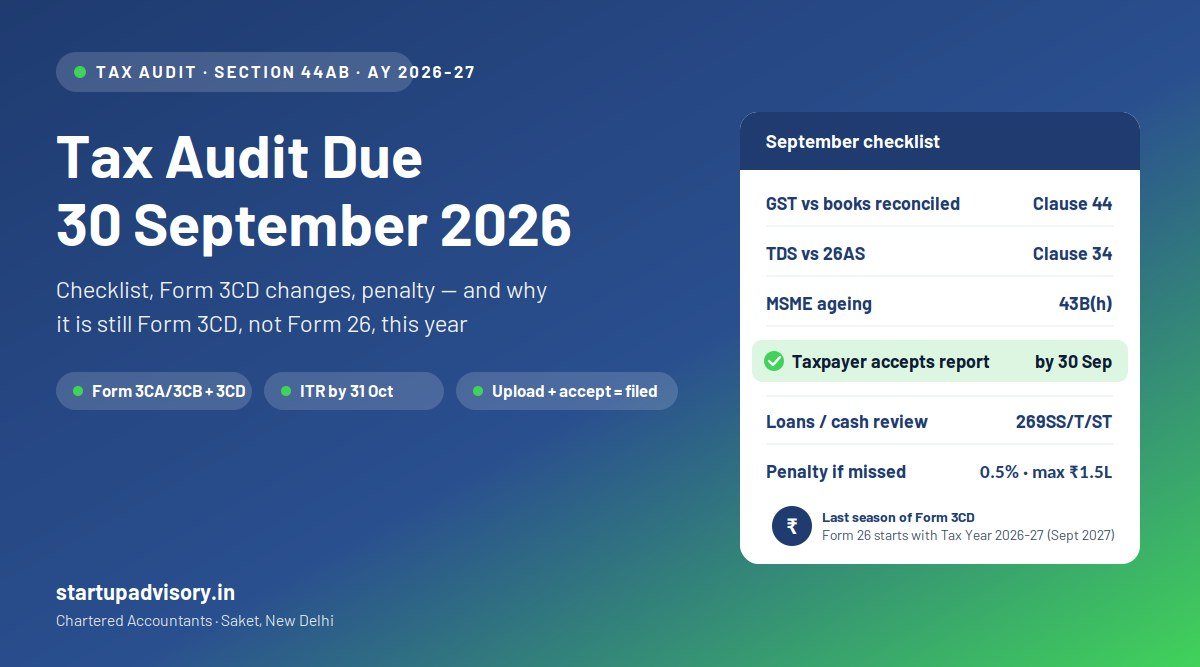
The tax audit report for FY 2025-26 (AY 2026-27) is due 30 September 2026, on Form 3CA/3CB with Form 3CD — not the new Form 26, which starts only with Tax Year 2026-27 audits next year. The audited ITR is due 31 October 2026 (30 November for transfer-pricing cases). Two things catch people every year: the report is filed only when the CA uploads it and the taxpayer accepts it from their own login, and the Form 3CD in force has the 2025 amendments (buyback clause, expanded MSME 43B(h) disclosure, settlement expenses). Missing the date costs 0.5% of turnover, capped at ₹1.5 lakh (Section 271B), plus interest and lost loss carry-forward on the late ITR. CBDT extended to 31 October last year; nothing is notified for this year. Plan for 30 September.
Six weeks out, this is the season where Delhi businesses discover the books are not actually closed, the GST turnover does not match the ledger, and the MSME creditor list was never aged. Here is the deadline, what is genuinely different this year, and the checklist that gets the audit done before the portal slows to a crawl in the last week of September.
The dates
| Compliance (FY 2025-26 / AY 2026-27) | Form | Due date |
|---|---|---|
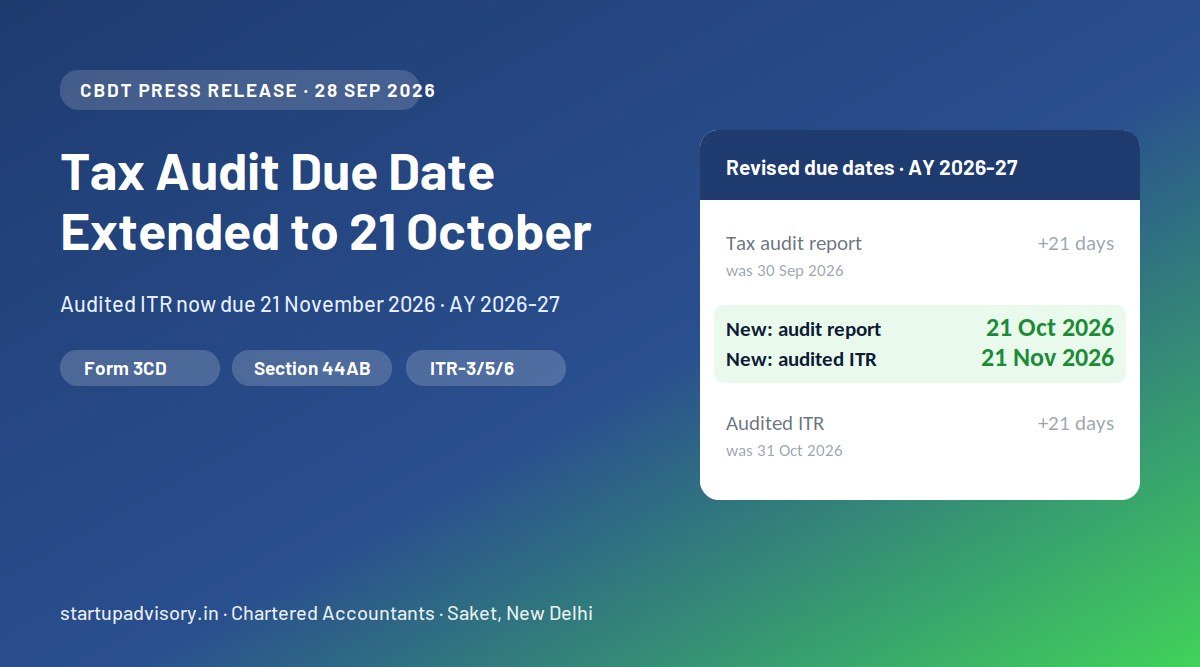
| Tax audit report — Section 44AB | Form 3CA (accounts audited under another law, e.g. companies, LLPs above threshold) or Form 3CB (others), each with Form 3CD | 21 October 2026 extended from 30 September |
| ITR of audited taxpayer | ITR-3 / ITR-5 / ITR-6 as applicable | 21 November 2026 extended from 31 October |
| Transfer-pricing accountant's report | Form 3CEB | 31 October 2026 |
| Tax audit report where TP applies | 3CA/3CB-3CD | 31 October 2026 |
| ITR where TP applies | ITR-3 / ITR-5 / ITR-6 | 30 November 2026 |
| Non-audit business / presumptive ITR | ITR-3 / ITR-4 | Already past (belated till 31 Dec 2026 — see our belated return guide) |
Form 3CD, not Form 26 — and old section numbers
This is the most common confusion this year and it is worth being blunt about. The Income-tax Act, 2025 and the Income-tax Rules, 2026 consolidate 3CA/3CB/3CD into a single Form 26 under Section 63 of the new Act. That form applies to audits of Tax Year 2026-27 — income earned from 1 April 2026 — and is due 30 September 2027. FY 2025-26 was earned entirely under the 1961 Act, so this September you file the old forms under Section 44AB, and every section reference inside the report (clause 34 TDS sections 194C / 194J / 194Q, 43B(h), 40A(3), 269SS/T/ST) stays in the old numbering. Filing a 3CD with 2025-Act section numbers is wrong for the year and will not match the law that governed the transactions.
What is different in this year's Form 3CD
The Form 3CD amendments notified in March 2025 (effective 1 April 2025) are in force for AY 2026-27 audits. The ones that actually change the working:
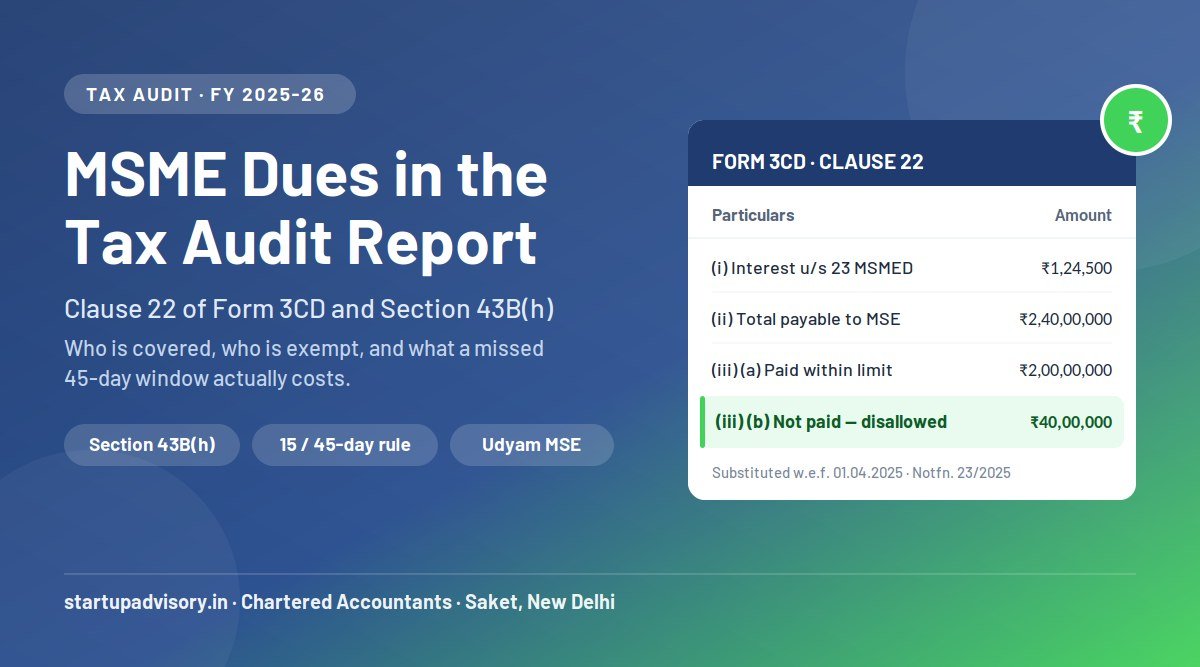
- MSME payments — Section 43B(h): expanded disclosure of amounts payable to micro and small enterprises, split by paid within / beyond the MSMED time limit. You need a creditor-wise ageing with Udyam status for every supplier.
- Share buyback receipts: a new clause capturing buyback consideration received (relevant for investor-shareholders after the October 2024 dividend-treatment change).
- Settlement expenses: reporting of expenditure incurred to settle proceedings for contraventions of law (now expressly non-deductible).
- Loans and deposits (clause 31): revised coding of the nature of each loan / deposit / specified sum for 269SS / 269T.
- Deletions: two legacy clauses on older deductions were removed, shortening the form slightly.
Check that your audit software is on the current 3CD schema; last-minute schema rejections on the portal are a September classic.
The pre-audit checklist — what your CA needs before the audit starts
- Books closed and reconciled: every bank account reconciled to 31 March 2026; suspense cleared; year-end provisions booked.
- GST reconciliation: turnover per GSTR-1 / GSTR-3B vs. books, with the difference explained; ITC per 2B vs. books; clause 44 expense break-up (registered / unregistered / composition / exempt) prepared. See our GST advisory desk if this has never been done.
- TDS / TCS: every payment in clause 34 checked against the TDS returns actually filed; Form 26AS / TRACES reconciled; any short-deduction or late-deposit listed with dates (interest under 201(1A) computed).
- MSME 43B(h): supplier master tagged micro / small / other with Udyam numbers; ageing as at 31 March; payments beyond 15/45 days identified and disallowance quantified.
- Loans, deposits and cash: register of every loan / deposit taken or repaid above ₹20,000 with mode (269SS/269T); review of cash receipts above ₹2 lakh (269ST); cash expenses above ₹10,000 (40A(3)).
- Related parties: payments to persons covered by 40A(2)(b) listed with the basis of reasonableness.
- Fixed assets and depreciation: FAR updated for additions / deletions with dates and put-to-use; depreciation per the Act (not Companies Act) computed.
- Stock: closing stock valuation method and ICDS adjustments documented; physical verification evidence on file.
- Presumptive check: if you were on 44AD / 44ADA earlier, confirm whether this year's profit and the five-year lock-in put you inside or outside the audit net — our presumptive tax calculator gives the quick view.
- Engagement and DSC: signed engagement letter (UDIN needs it); taxpayer's DSC / EVC ready for the acceptance step; CA added as "My CA" on the portal.
The upload-and-accept trap
Penalty and knock-on costs
- Section 271B: 0.5% of turnover / gross receipts, maximum ₹1,50,000, for failure to get accounts audited or furnish the report by the due date. Waivable for reasonable cause (genuine illness, death of a key person, fire, documented system failure) — not for "we ran out of time".
- Late ITR: if the audit slips, the 31 October return slips: Section 234A interest at 1% per month on unpaid tax, Section 234F fee, and — the one that hurts businesses — loss of carry-forward of business losses for a return filed after the due date.
- Bank and tender files: lenders and government tenders ask for the audited ITR-V and 3CD; a late report is a missed renewal.
Will CBDT extend?
Possibly; historically it often has — the AY 2025-26 audit deadline was pushed to 31 October 2025. But extensions arrive in the last week, are driven by portal load or professional-body representations, and are never guaranteed. As of mid-August 2026 nothing is notified for AY 2026-27. Firms that plan around a hoped-for extension are the ones paying 271B when it does not come.
Who needs the audit in the first place
Turnover above ₹1 crore (₹10 crore where cash receipts and cash payments are each within 5% of the total); professional gross receipts above ₹50 lakh; and presumptive taxpayers declaring below the deemed rate with income above the basic exemption limit. The complete tests, with the 44AD / 44ADA edge cases, are in our tax audit applicability guide.
After this season: the Form 26 transition
From Tax Year 2026-27 the audit is under Section 63 of the Income-tax Act, 2025 and the report is the single Form 26, due 30 September 2027. Thresholds and the mechanics carry over; the form structure and every section cross-reference change. The sensible sequence is: close this September on 3CD, then re-map templates, DSC utilities and engagement letters in October–November, and run a dry run on Form 26 in the portal once the utility is released. Our Virtual CFO desk builds this into clients' year-end plans.
This article is general information, not tax advice. Due dates are the statutory dates as of August 2026 and may be extended by CBDT notification; thresholds, penalties and Form 3CD clause references depend on your facts. Confirm with a qualified professional before relying on them.
How Startup Advisory Can Help
Startup Advisory is a CA-led firm in Saket, New Delhi. For proprietors, firms, LLPs and companies across Delhi NCR we run the September audit end to end:
- Year-end close and the GST / TDS / MSME 43B(h) reconciliations that the 3CD clauses actually test.
- Section 44AB audit, Form 3CA/3CB-3CD on the current schema, DSC upload with UDIN, and the taxpayer-acceptance step chased before 30 September.
- Audited ITR by 31 October, with loss carry-forward preserved.
- Ongoing bookkeeping so next year's audit is a formality — and the Form 26 migration handled in advance.
Call 9311972982 or book a free consultation. September capacity is finite — the earlier you engage, the calmer the 30th.