
Registrations / Food Business Licensing
FSSAI Licence New Rules 2026: ₹1.5 Crore Registration Limit, Perpetual Validity & Which Licence You Need
In short
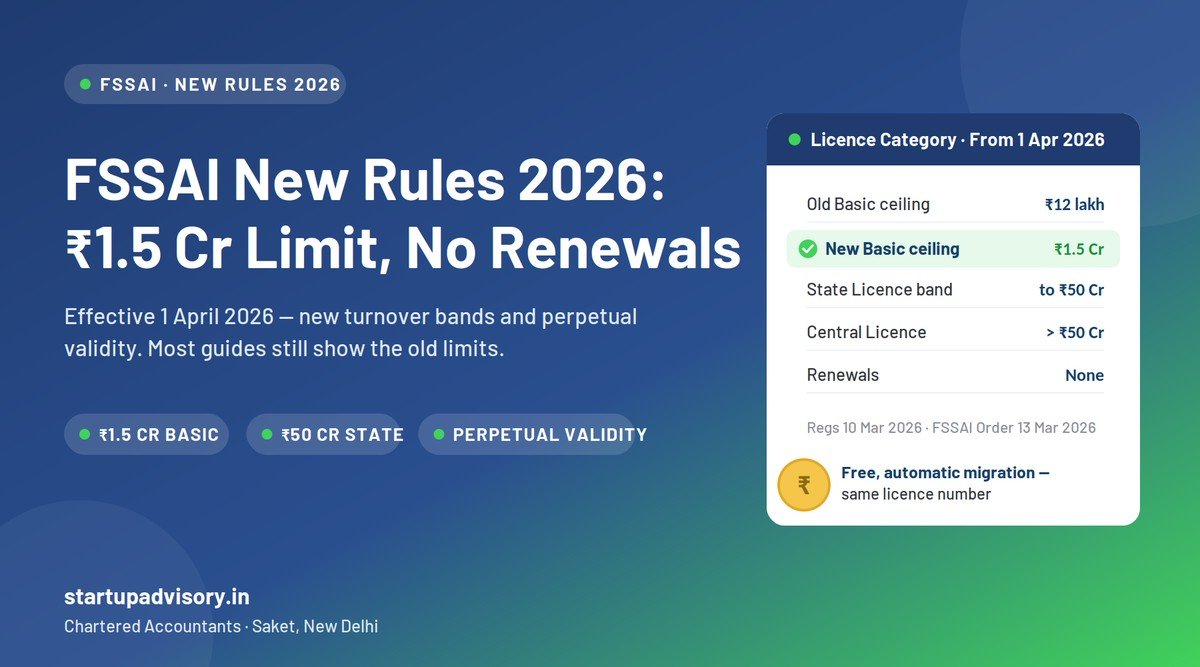
India's food licensing framework was rewritten in March 2026 — and most guides online still show the old limits. The FSS (Licensing and Registration of Food Businesses) Amendment Regulations, 2026 were notified on 10 March 2026, and FSSAI's implementation Order of 13 March 2026 made the new thresholds effective from 1 April 2026. The changes: Basic Registration now covers annual turnover up to ₹1.5 crore (previously ₹12 lakh), the State Licence band runs from ₹1.5 crore to ₹50 crore (the Central threshold was previously ₹20 crore), and the Central Licence applies above ₹50 crore. Just as significant: licences and registrations issued from 1 April 2026 have perpetual validity — no more renewals. A food business earning ₹80 lakh that needed a State Licence last year now needs only Basic Registration. But turnover is not the only test — activity- and capacity-based criteria still pull some businesses into higher categories regardless of turnover.
What changed, and the paper trail behind it
Two instruments did the work. First, the Food Safety and Standards (Licensing and Registration of Food Businesses) Amendment Regulations, 2026, notified via gazette on 10 March 2026, which gave FSSAI the machinery to revise categorisation criteria and introduced the structural reforms. Second, an FSSAI Order dated 13 March 2026 from the Regulatory Compliance Division, directing all licensing authorities to apply the revised turnover thresholds with effect from 1 April 2026, superseding all earlier threshold orders under the 2011 Regulations.
The previous thresholds had stood, essentially, since the original 2011 framework — which is why so much published guidance (including from large registration portals) is now simply out of date.
The new thresholds: old vs new
| Category | Old threshold (pre-1 Apr 2026) | New threshold (from 1 Apr 2026) |
|---|---|---|
| Basic Registration | Turnover up to ₹12 lakh | Turnover up to ₹1.5 crore |
| State Licence | ₹12 lakh – ₹20 crore | ₹1.5 crore – ₹50 crore |
| Central Licence | Above ₹20 crore | Above ₹50 crore |
The practical effect is dramatic. A cloud kitchen or packaged-foods brand at ₹80 lakh turnover drops from State Licence to Basic Registration. A mid-size food company at ₹25 crore drops from Central to State. FSSAI's own framing is that the vast majority of food businesses now sit under state-level oversight, freeing central capacity for genuinely large operators.
Perpetual validity: the end of renewals
Under the earlier regime, every licence and registration ran for a fixed 1–5 year term, and a missed renewal meant technically operating without authorisation. The 2026 amendment replaces this: any licence or registration issued on or after 1 April 2026 has perpetual validity — no expiry, no renewal applications. This applies regardless of when the application was filed, and extends to Tatkal (urgent) licences too.
Perpetual does not mean unconditional. The annual fee and applicable compliance filings continue, the credential remains subject to inspection, and it can be suspended or cancelled for violations. What disappears is the renewal treadmill and the lapse risk that came with it.
Two more reforms worth knowing
- Deemed registration for street vendors. Vendors already registered under the Street Vendors (Protection of Livelihood and Regulation of Street Vending) Act, 2014 are now automatically deemed registered with FSSAI — removing a duplicate compliance layer for the smallest operators.
- Risk-based inspections. Inspection frequency now follows the risk profile of the food category and the operator's compliance history, rather than a fixed calendar — low-risk, clean-history businesses should see fewer inspections; high-risk categories, more focused scrutiny.
Turnover is not the only test
This is where founders most often mis-classify themselves. The turnover bands decide the default category, but two other filters continue to operate:
- Activity-based criteria. Importers and exporters of food, e-commerce food operators, businesses operating in multiple states through a registered head office, and food businesses in central government premises typically require a Central Licence irrespective of turnover.
- Capacity-based criteria for manufacturers. High-capacity manufacturing units — large dairy, meat or processing operations above specified daily capacities — are categorised by installed capacity, not just turnover.
Run both tests before applying. Applying in the wrong category is one of the most common reasons food licence applications stall or get queried.
Already hold a licence? What to actually do
- Licences issued before 1 April 2026 continue on their existing terms until their current validity runs out; the perpetual regime applies to grants from that date.
- Migration to the revised category is free and automatic and does not change your licence number.
- If the new thresholds drop you into a lower category — State down to Basic, or Central down to State — assess the switch deliberately: the lower category means lower annual fees and lighter documentation, but time the move so you are never without a valid credential.
- If you are near a band boundary, project this year's turnover honestly. Outgrowing your category mid-year and continuing on the lower credential is a compliance breach, not a technicality.
Applying in 2026: the FoSCoS process
- Classify first. Turnover test, then activity and capacity tests, to fix Basic / State / Central.
- Assemble the documents. Identity and address proof of the proprietor/partners/directors, proof of premises (ownership or rent agreement with NOC), business constitution documents, and — for manufacturers — the unit layout plan, machinery list, water test report and the food safety management system (FSMS) plan.
- File on FoSCoS (Food Safety Compliance System) with the applicable fee. Basic Registration is the lightest process; State and Central Licence applications for manufacturing units involve inspection before grant.
- Respond to queries promptly. Premises-proof mismatches and incomplete FSMS documentation are the recurring stall points we see.
Setting up a food business from scratch? FSSAI is one step in a sequence — entity formation, Udyam registration, GST timed to your procurement, then FSSAI in the correct category. If you are structuring as a proprietorship first, our proprietorship registration guide covers how the registrations stack. And if you are building a food processing unit, the licence also sits upstream of scheme money — see our guide to the PMFME 35% subsidy, where the FSSAI credential is part of the expected file.
The thresholds and reforms described here reflect the Amendment Regulations notified 10 March 2026 and FSSAI's Order dated 13 March 2026, effective 1 April 2026, as we read them in August 2026. Category fees, capacity criteria and documentation vary by business type and can change by notification — confirm your exact category and fee on FoSCoS or with a professional before applying. This article is general information, not professional advice.
How Startup Advisory Can Help
Startup Advisory is a CA-led firm in Saket, New Delhi handling FSSAI registration and licensing for food businesses across Delhi NCR and India:
- Correct categorisation under the 2026 rules — turnover, activity and capacity tests applied properly, so you neither over-pay for a higher licence nor under-file and face queries.
- End-to-end FoSCoS filing — documentation, FSMS plan support for manufacturers, and query handling through to grant.
- The full food-business stack — entity structure, Udyam, GST and FSSAI sequenced correctly, with PMFME and DPR support for processing units.
Starting or scaling a food business? Call 9311972982 or book a free consultation — we'll fix your category in one call.