
Startup India / DPIIT
DPIIT's New Startup Definition (G.S.R. 108(E)): ₹200 Crore Turnover Limit, Deep Tech Category & Cooperatives
In short
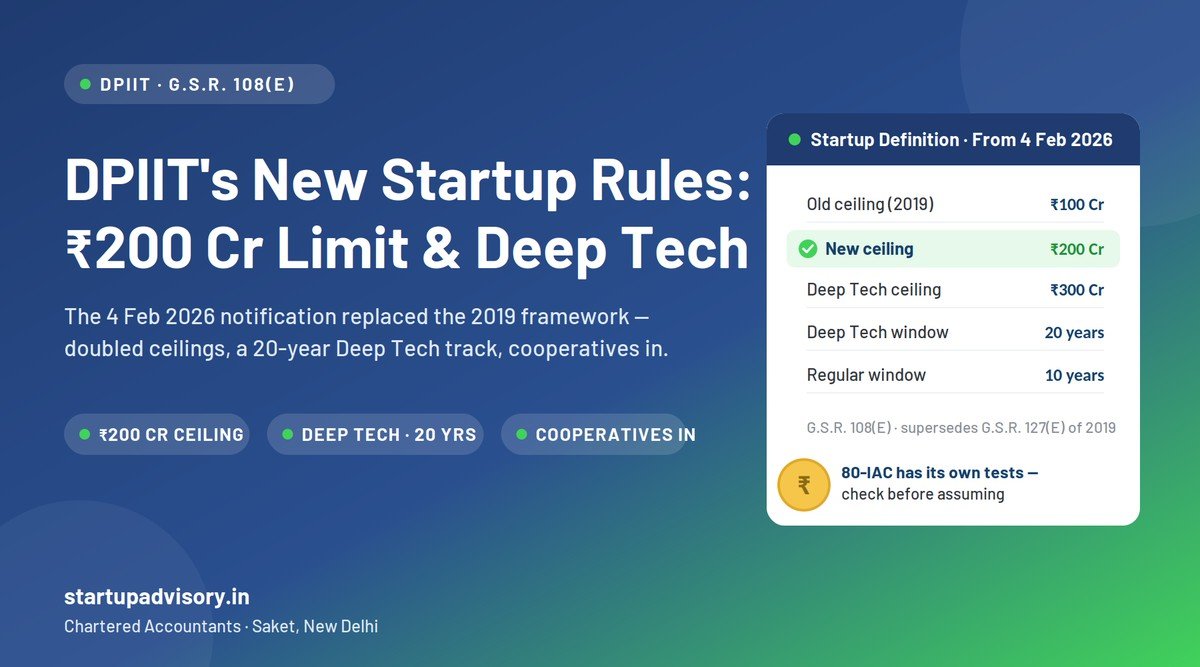
On 4 February 2026, DPIIT issued Gazette Notification G.S.R. 108(E) — not an amendment, but a full replacement of the 2019 startup framework (G.S.R. 127(E)). The changes: the turnover ceiling for regular startups doubled from ₹100 crore to ₹200 crore (10-year recognition period retained); a new Deep Tech Startup category was created with recognition up to 20 years from incorporation and a ₹300 crore turnover ceiling; cooperative societies became eligible for recognition for the first time; and a fund-use negative list applies through the recognition period. If you're already recognised, log in to the Startup India portal and download your updated recognition certificate. One caution before you celebrate the headroom: Section 80-IAC has its own conditions in the tax law — don't assume the ₹200 crore ceiling carries into the tax holiday without checking.
What G.S.R. 108(E) actually is
Since February 2019, "startup" for the purposes of the Startup India programme was defined by G.S.R. 127(E): an eligible entity within 10 years of incorporation whose turnover had not exceeded ₹100 crore in any financial year. That definition served a young ecosystem. A decade into Startup India — with over two lakh recognised startups — DPIIT has replaced it wholesale. G.S.R. 108(E), dated 4 February 2026, supersedes the 2019 notification and rebuilds the recognition architecture around a maturing ecosystem: higher ceilings, a formal deep-tech track, wider entity eligibility, and tighter fund-use discipline.
If you're reading a guide to DPIIT recognition written before February 2026 — including much of what ranks on page one today — parts of it are simply out of date.
The new thresholds at a glance
| Parameter | 2019 framework (127(E)) | Regular startup (108(E)) | Deep Tech Startup (108(E)) |
|---|---|---|---|
| Recognition period | 10 years | 10 years | 20 years |
| Turnover ceiling | ₹100 crore | ₹200 crore | ₹300 crore |
| Eligible entities | Pvt Ltd, LLP, Partnership | Pvt Ltd, LLP, Partnership + Cooperative Societies | |
The cessation rule is unchanged in structure: an entity stops being a startup on whichever comes earlier — completion of the recognition period, or turnover exceeding the ceiling in any financial year since incorporation. Crossing ₹200 crore even once ends recognition from that year.
The Deep Tech Startup category: the real headline
For the first time, the framework formally defines a Deep Tech Startup: an entity building solutions based on novel scientific or engineering advancements, involving substantial R&D funding, significant novel intellectual property, and extended commercialisation timelines accompanied by technological or scientific uncertainty. Qualify, and the recognition window doubles to 20 years with a ₹300 crore turnover ceiling.
Why this matters beyond the numbers: deep-tech ventures burn years in development before revenue, and the old 10-year clock routinely expired just as commercialisation began. The new category fixes that — and it slots directly into the government's deep-tech capital stack. A recognised Deep Tech Startup is precisely the profile the ₹1 lakh crore RDI Fund exists to finance through its fund-manager route. If your startup is genuinely R&D-led — robotics, AI systems, biotech, space, advanced manufacturing — the Deep Tech classification is now a strategic asset worth building the evidence file for: IP filings, R&D expenditure records, TRL documentation.
Cooperative societies enter the framework
Multi-state and state cooperative societies can now obtain startup recognition — a first. The policy intent is to pull rural, agricultural and community-owned innovation (agri-processing, FPO-adjacent ventures, dairy tech) into the benefits net: scheme access, procurement relaxations, IPR support. For cooperative structures that have historically sat outside every startup incentive, this is a genuinely new door.
The fund-use negative list
Recognition now travels with explicit discipline on fund deployment, applicable through the entire recognition period: broadly, a recognised startup's funds are not to go into residential real estate, luxury assets, speculative investments, or loans unrelated to the business. Treat this as a live compliance condition, not boilerplate — treasury decisions, surplus parking and inter-corporate loans in recognised startups should be screened against it, because recognition (and everything attached to it) is what's at stake.
What existing recognised startups should do now
- Download your updated certificate. Log in to the Startup India portal with your registered credentials and download the updated Startup Recognition certificate issued under the new framework. Keep it in your compliance file — banks, scheme portals and procurement platforms will expect the current-format credential.
- Re-run your eligibility clock. If you were nearing ₹100 crore turnover — or had resigned yourself to ageing out at 10 years — recompute. The ₹200 crore ceiling may have just handed you years of extended benefits.
- Assess the Deep Tech route. If your venture plausibly meets the definition, the 20-year/₹300-crore track is worth pursuing deliberately, with the IP and R&D evidence assembled properly rather than asserted.
- Audit fund deployment. Check current treasury and investment positions against the negative list before anyone else does.
The 80-IAC caution: recognition ≠ tax holiday
Here is the mistake we expect founders to make with this notification: reading "₹200 crore" and assuming the Section 80-IAC tax holiday now runs to the same number. DPIIT recognition and the 80-IAC deduction are separate gates. The tax holiday carries its own conditions written into the income-tax law — including its own turnover condition and the Inter-Ministerial Board certification, which G.S.R. 108(E) continues (with added flexibility in the Board's composition). Whether, and how, the revised DPIIT definition flows through to the tax provision for your assessment years is a question to resolve on your specific facts before you plan around it — not one to assume from a gazette headline. Our guide to why 80-IAC applications get rejected covers the IMB layer in detail.
Who gains the most
- Scaling startups in the ₹100–200 crore band — the companies that would have lost recognition mid-growth keep their GeM procurement relaxations, scheme eligibility and self-certification benefits for longer.
- Deep-tech and R&D-intensive ventures — a decade of extra runway, a ₹300 crore ceiling, and a formal category that aligns with deep-tech funding channels like the RDI Fund.
- Cooperative societies — first-time access to the entire Startup India benefits stack.
- New applicants — the recognition process itself remains free; if you're not yet recognised, the case for applying just got stronger. Our DPIIT recognition guide covers the process (note: it predates 108(E) on the threshold figures — the current ceilings are as stated in this article).
This article reflects G.S.R. 108(E) dated 4 February 2026 as we read it in August 2026, along with commentary published on the notification. The interaction between the revised DPIIT definition and specific tax provisions (including Section 80-IAC's own conditions) depends on the statutory text applicable to your assessment years — obtain specific advice before acting. This article is general information, not professional advice.
How Startup Advisory Can Help
Startup Advisory is a CA-led firm in Saket, New Delhi supporting startups across Delhi NCR and India:
- DPIIT recognition under the new framework — fresh applications, the innovation write-up, and the evidence file done properly via Startup India registration.
- Deep Tech classification strategy — assessing whether your venture meets the definition and assembling the IP, R&D and TRL evidence that supports it, including alignment with RDI Fund positioning.
- 80-IAC without the assumptions — checking your actual tax-holiday eligibility against the income-tax conditions, not the gazette headline, before the IMB application.
- Recognition compliance — certificate updates, fund-use screening against the negative list, and cessation-risk monitoring as you scale.
Want your position under the new framework mapped? Call 9311972982 or book a free consultation.