
Tax & ITR
Dividend Taxation in India: The Double Taxation Problem Explained for Private Limited and Public Limited Companies
Reviewed by CA Neeraj Rohilla, FCA — Chartered Accountant, Startup Advisory, Saket, New Delhi.

In short
A dividend is paid out of profit the company has already paid tax on, and the company gets no deduction for paying it. The shareholder then pays tax on that same money a second time. For Tax Year 2026-27, a company on the concessional rate pays 25.168%, and a promoter in the top bracket pays up to 35.88% on what is left — a combined burden of 52.02% on the original rupee of profit. It takes ₹2,08,411 of company profit to put ₹1,00,000 into a promoter's bank account. The arithmetic is the same for a Private Limited and a Public Limited company; what differs is that a Private Limited promoter has legitimate single-tax alternatives — salary, rent, interest — and a public company's shareholders do not. Two things changed on 1 April 2026: interest on money borrowed to buy shares is now fully disallowed against dividend (Section 93(2)), and buyback went back to capital gains treatment.
Every founder we meet in Saket eventually asks the same question in the same tone of disbelief: "I already paid tax on this profit. Why am I paying again?" The answer is that Indian company law and Indian tax law disagree about what a company is. Company law treats it as a separate person with its own money. Tax law, from 1 April 2020 onwards, taxes that separate person and taxes you when the money finally reaches you. Nobody designed this to be painless. This guide sets out exactly how much it costs, for both company types, with the arithmetic shown rather than asserted.
What "double taxation of dividends" actually means
There are two different things called double taxation and they get confused constantly.
Juridical double taxation is the same taxpayer being taxed on the same income by two countries. That is what a Double Taxation Avoidance Agreement (DTAA) fixes, through treaty rates and foreign tax credit.
Economic double taxation is one stream of income taxed twice in the hands of two different taxpayers. That is the dividend problem, and no treaty fixes it, because both taxes are levied by India on two legally distinct persons. The company is taxed on earning the profit. You are taxed on receiving it. Each tax is individually defensible. Together they take more than half.
The cause is structural: a dividend is an appropriation of profit, not an expense. Salary, rent and interest reduce the company's taxable profit. A dividend does not. That single accounting distinction is the whole story.
How India got here: DDT, and back again
India has switched systems three times in thirty years. The current position is a return to the oldest one.
| Period | System | Who paid |
|---|---|---|
| Up to FY 1996-97 | Classical system | Shareholder, at slab rates |
| FY 1997-98 to FY 2019-20 | Dividend Distribution Tax (Section 115-O) | Company, at a flat rate; dividend exempt for the shareholder under Section 10(34) |
| FY 2016-17 to FY 2019-20 | DDT plus Section 115BBDA | Company paid DDT; resident shareholders receiving over ₹10 lakh paid a further 10% |
| FY 2020-21 onwards | Classical system restored (Finance Act 2020) | Shareholder, at slab rates; company deducts TDS |
| Tax Year 2026-27 onwards | Same system, renumbered under the Income-tax Act, 2025 | Shareholder, at slab rates |
The Finance Act 2020 abolished DDT with effect from 1 April 2020. The stated logic was fairness: DDT was a flat levy that hit a pensioner with ₹40,000 of dividend at the same rate as a promoter with ₹40 crore. Moving the tax to the recipient made it progressive. It also, unavoidably, made it heavier for anyone in the 30% bracket — which is every founder taking a meaningful dividend.
The law as it stands for Tax Year 2026-27
Tax Year 2026-27 (1 April 2026 to 31 March 2027) is the first year governed by the Income-tax Act, 2025. Nothing about the double-tax structure changed; the section numbers all did. Here is the map you need:
| Concept | Old (1961 Act) | New (2025 Act) |
|---|---|---|
| Definition of "dividend" | Section 2(22) | Section 2(40) |
| Deemed dividend — loans to shareholders | Section 2(22)(e) | Section 2(40)(e) |
| Buyback as deemed dividend | Section 2(22)(f) | Omitted from 1 April 2026 |
| Dividend charged as income from other sources | Section 56 | Section 92 |
| Deductions against such income | Section 57 | Section 93 |
| Interest against dividend income | Section 57(i) — capped at 20% | Section 93(2) — nil from 1 April 2026 |
| Inter-corporate dividend deduction | Section 80M | Section 148 |
| Slab rates / default regime | Section 115BAC | Section 202 |
| Rebate | Section 87A | Section 156 |
| Concessional 22% corporate rate | Section 115BAA | Section 200 |
| New manufacturing company rate | Section 115BAB | Section 201 |
| Minimum Alternate Tax | Section 115JB | Section 206 (rate reduced to 14%) |
| Non-resident dividend rate | Section 115A | Section 207 |
| TDS on dividend — resident | Section 194 | Section 393(1) |
| TDS on dividend — non-resident | Sections 195 / 196D | Section 393(4) |
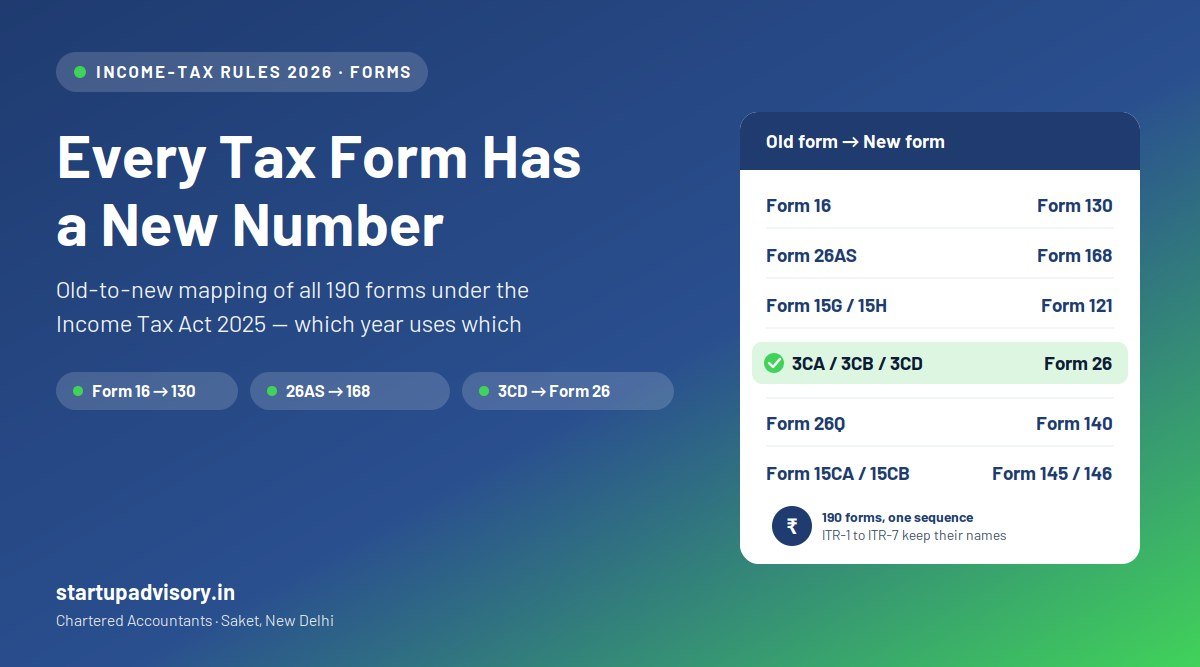
| Declaration for nil TDS | Forms 15G / 15H | Form 121 |
| Advance tax interest relief | Proviso to Section 234C | Section 425 |
Do not use these numbers on last year's filing. The return you file in 2026 is for FY 2025-26 and remains governed by the 1961 Act. The 2025 Act applies to income earned from 1 April 2026 onwards. Our old-vs-new section mapping covers the wider renumbering, and the CBDT's own mapping utility is the authority where a source conflicts.
Layer one: tax inside the company
Before a single rupee can be declared as dividend, the company has paid corporate tax on it. For Tax Year 2026-27 the domestic company rates are:
| Company | Base rate | Surcharge | Effective (with 4% cess) |
|---|---|---|---|
| Concessional regime — Section 200 (old 115BAA) | 22% | 10% (flat) | 25.168% |
| New manufacturing company — Section 201 (old 115BAB) | 15% | 10% (flat) | 17.160% |
| Turnover up to ₹400 crore in the prescribed base year | 25% | Nil / 7% / 12% | 26.00% / 27.82% / 29.12% |
| Any other domestic company | 30% | Nil / 7% / 12% | 31.20% / 33.384% / 34.944% |
Most operating companies that are not chasing a specific incentive have moved to Section 200, so 25.168% is the figure to hold in your head. Every example below uses it. If your company is still on the old regime at 30%, add roughly six percentage points to every combined figure that follows.
Layer two: tax in the shareholder's hands
Dividend received by a resident is chargeable under income from other sources (Section 92) at the shareholder's own slab rates. There is no concessional rate, no exemption threshold and no separate schedule. Three rules govern the outcome:
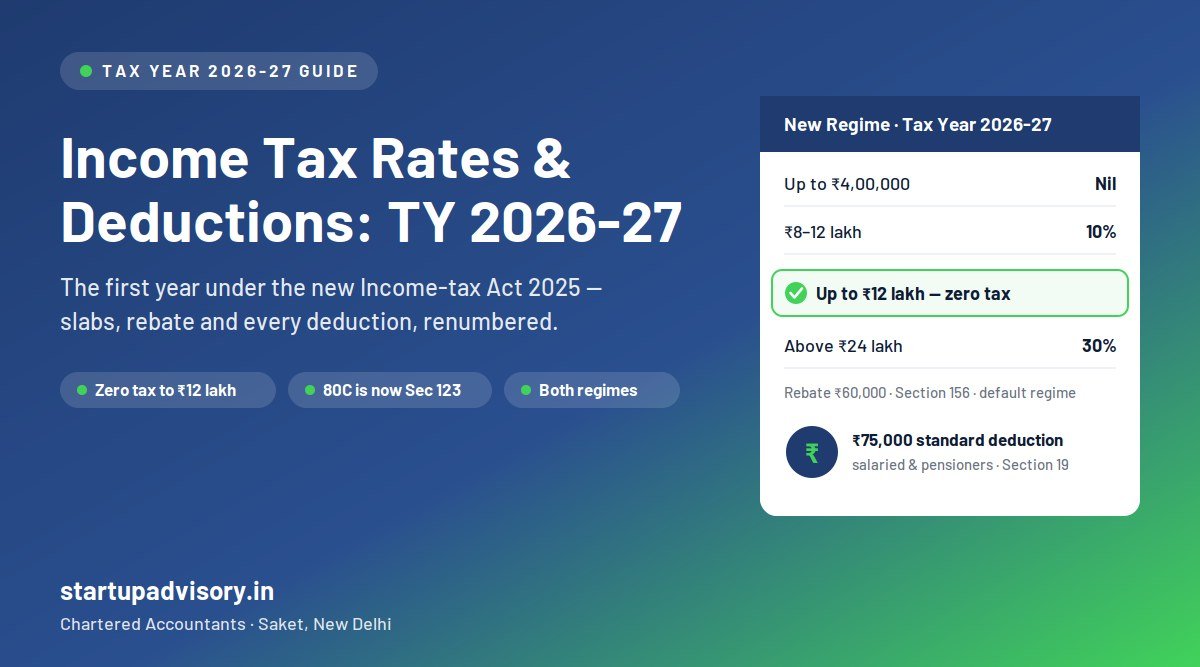
- Slab rates apply in full. Under the default new regime (Section 202), that runs from nil up to ₹4 lakh through to 30% above ₹24 lakh. Because dividend is taxed at slab rates and not at a special rate, the Section 156 rebate does apply — a shareholder whose total income stays within ₹12 lakh can genuinely pay nil on the dividend.
- Surcharge on dividend is capped at 15%. Even where the shareholder's total income crosses ₹2 crore or ₹5 crore, the enhanced 25% and 37% surcharge rates do not apply to dividend income. The ceiling is 15%.
- Cess of 4% applies on tax plus surcharge in every case.
So the maximum effective rate on dividend for a resident individual is 30% × 1.15 × 1.04 = 35.88%. Below the surcharge threshold it is 31.2%; between ₹50 lakh and ₹1 crore of total income it is 34.32%.
New from 1 April 2026: no interest deduction at all. Under the 1961 Act you could set off interest on money borrowed to buy shares against dividend income, capped at 20% of that dividend. The Finance Act 2026 amended Section 93(2) to disallow interest expenditure on borrowings used to earn dividend income or mutual fund income entirely. A leveraged investor is now taxed on gross dividend with zero offset for the cost of the borrowing. If you fund share purchases with debt, model this before you commit.
Worked example 1 — a Private Limited company
Take a Private Limited company on Section 200 with ₹1,00,00,000 of profit before tax, distributing the entire post-tax profit to a single promoter-shareholder whose total income exceeds ₹1 crore.
The full journey of ₹1 crore of profit
| Profit before tax | ₹1,00,00,000 |
| Less: corporate tax @ 25.168% | (₹25,16,800) |
| Profit after tax, declared as dividend | ₹74,83,200 |
| TDS deducted by the company @ 10% (Section 393(1)) | (₹7,48,320) |
| Shareholder's tax @ 35.88% (30% + 15% surcharge + 4% cess) | (₹26,84,972) |
| Cash finally in the promoter's hands | ₹47,98,228 |
| Total tax collected on the same ₹1 crore | ₹52,01,772 — 52.02% |
Read that last line again. On profit the company earned, more than half is taken before the owner can spend a rupee of it. The formula is 1 − (1 − 0.25168) × (1 − 0.3588) = 52.02%. Turned around: the company must earn ₹2,08,411 of pre-tax profit to place ₹1,00,000 in a top-bracket promoter's bank account.
Note the TDS is not an extra tax — it is an advance against the ₹26,84,972. The balance of ₹19,36,652 must be funded through advance tax instalments, which is where founders who plan a large March dividend get caught short on cash.
The combined burden at every income level
The 52% figure is the worst case. The double tax is genuinely progressive, and for a shareholder in a low bracket it is mild. Assuming the company is on Section 200 at 25.168%:
| Shareholder's position | Rate on dividend | Combined burden on company profit |
|---|---|---|
| Total income within ₹12 lakh (rebate applies) | Nil | 25.17% |
| 5% slab | 5.20% | 29.06% |
| 10% slab | 10.40% | 32.95% |
| 15% slab | 15.60% | 36.84% |
| 20% slab | 20.80% | 40.73% |
| 25% slab | 26.00% | 44.62% |
| 30% slab, no surcharge | 31.20% | 48.52% |
| 30% slab, total income ₹50 lakh–₹1 crore | 34.32% | 50.85% |
| 30% slab, total income above ₹1 crore | 35.88% | 52.02% |
The practical planning point is buried in the first row. Where a company has several family shareholders whose individual incomes are modest, spreading a dividend across them instead of concentrating it in one promoter can move the effective burden from 52% towards 25% — provided the shareholding is genuine, was not created to divert income, and each shareholder's own total income supports the position.
Worked example 2 — a Public Limited company
The corporate rate and the shareholder rates are identical, so the arithmetic does not change. What changes is who feels it. Take a listed company with ₹500 crore of profit before tax on Section 200, paying out 40% of post-tax profit:
Company level
| Profit before tax | ₹500.00 crore |
| Less: corporate tax @ 25.168% | (₹125.84 crore) |
| Profit after tax | ₹374.16 crore |
| Dividend declared (40% payout) | ₹149.66 crore |
Now follow that dividend into two very different pockets.
Retail investor — 2,000 shares, dividend ₹18 per share
| Dividend received | ₹36,000 |
| TDS @ 10% (exceeds the ₹10,000 threshold) | (₹3,600) |
| Tax at the 20% slab (20.8% with cess) | (₹7,488) |
| Net in hand | ₹28,512 |
| Company profit that generated this dividend | ₹48,109 |
| Total tax on that profit | ₹19,597 — 40.73% |
HNI investor — 2,00,000 shares, same ₹18 per share
| Dividend received | ₹36,00,000 |
| TDS @ 10% | (₹3,60,000) |
| Tax @ 35.88% (top bracket, surcharge capped at 15%) | (₹12,91,680) |
| Net in hand | ₹23,08,320 |
| Company profit that generated this dividend | ₹48,10,776 |
| Total tax on that profit | ₹25,02,456 — 52.02% |
Same company, same dividend per share, same underlying profit — and an eleven-point difference in effective burden. That is the progressivity the 2020 reform was designed to produce, and it is why the abolition of DDT was, on balance, good news for the retail investor and bad news for the promoter.
Where Private Limited and Public Limited genuinely differ
The rates are the same. The exposure is not.
| Issue | Private Limited | Public Limited |
|---|---|---|
| Corporate tax on profit | Same rates | Same rates |
| Shareholder tax on dividend | Same slab rates | Same slab rates |
| Alternative single-tax extraction (salary, rent, interest) | Available — owner is usually also director and landlord | Not available to outside shareholders |
| Deemed dividend on shareholder loans — Section 2(40)(e) | Live risk | Does not apply to a company in which the public are substantially interested; does apply to an unlisted, closely held public company |
| Managerial remuneration limits | No Section 197 ceiling | Section 197 of the Companies Act, 2013 caps remuneration at 11% of net profits |
| Control over payout timing | Complete — promoters decide | Board and market expectations drive it; minority cannot influence it |
| Buyback as an alternative route | Available under Section 68, Companies Act 2013 | Available, and commonly used by listed companies |
| TDS mechanics | Handled in-house | Handled by the RTA; the ₹10,000 threshold is per company per year |
One misconception worth killing: "public limited company" and "company in which the public are substantially interested" are not the same thing. An unlisted public limited company with a tight shareholder group is still a closely held company for tax purposes, and the deemed dividend provision applies to it in full.
The Private Limited trap: deemed dividend under Section 2(40)(e)
This is where most of the demands we see actually originate. Under Section 2(40)(e) (old Section 2(22)(e)), a loan or advance by a closely held company is treated as a dividend in the recipient's hands where it goes to:
- a shareholder holding at least 10% of the voting power; or
- a concern — firm, LLP, company, AOP — in which such a shareholder has a substantial interest (broadly 20% or more); or
- any person, where the payment is for the individual benefit of such a shareholder,
and it is taxed to the extent of the company's accumulated profits.
A common fact pattern
A Private Limited company with ₹40,00,000 of accumulated profits advances ₹15,00,000 to a director holding 60% of the equity, to fund a property purchase. Board minutes describe it as a loan; it is interest-free and repayable in three years.
| Deemed dividend under Section 2(40)(e) | ₹15,00,000 |
| Tax in the director's hands at 30% + 4% cess | ₹4,68,000 |
| TDS the company should have deducted @ 10% | ₹1,50,000 |
| Deduction available to the company | Nil |
| Effect of repaying the loan in year three | None — the tax is not reversed |
Three things make this worse than an ordinary dividend. The company gets no deduction and no benefit. Repayment does not undo the charge. And the Section 425 advance-tax relief does not extend to deemed dividend, so interest runs on the shortfall.
Genuine trade advances in the ordinary course of business are outside the provision, as are certain set-offs. But "we called it a loan and there are minutes" is not a defence. The substance of the payment decides.
The three-layer problem: holding structures and Section 148
If double taxation is bad, triple taxation is what happens when a dividend passes through a holding company with no relief. Section 148 (old Section 80M) exists to stop that. A domestic company that receives dividend from another domestic company, a foreign company or a business trust may deduct that dividend from its total income, to the extent it distributes dividend to its own shareholders at least one month before the due date for filing its return under Section 263(1). The deduction cannot be claimed twice for the same distribution.
The one-month deadline is the whole game. Miss it, and the relief is gone for that year.
OpCo → HoldCo → promoter, on ₹1 crore of operating profit
| Stage | Without Section 148 | With Section 148 |
|---|---|---|
| OpCo profit before tax | ₹1,00,00,000 | ₹1,00,00,000 |
| OpCo tax @ 25.168% | (₹25,16,800) | (₹25,16,800) |
| Dividend to HoldCo | ₹74,83,200 | ₹74,83,200 |
| HoldCo tax @ 25.168% | (₹18,83,415) | Nil (fully redistributed in time) |
| Dividend to promoter | ₹55,99,785 | ₹74,83,200 |
| Promoter's tax @ 35.88% | (₹20,09,203) | (₹26,84,972) |
| Net in the promoter's hands | ₹35,90,582 | ₹47,98,228 |
| Total tax — effective rate | ₹64,09,418 — 64.09% | ₹52,01,772 — 52.02% |
A ₹12,07,646 difference on ₹1 crore, decided entirely by whether the holding company declared its onward dividend before a deadline. If you run a holding structure, put that date in the compliance calendar and treat it as immovable.
One point that caused real anxiety through 2025: the draft Income Tax Bill omitted this relief for companies on the 22% concessional regime, which would have been a serious step backwards from Section 80M. The omission was corrected and Section 148 is available to companies taxed under Section 200.
Salary versus dividend: the arithmetic a founder actually needs
For a Private Limited promoter, dividend is one of several ways to move money out — and it is the only one that carries the double tax. Compare ₹20,00,000 of company pre-tax profit extracted two ways, assuming the director's marginal rate is 30% with no surcharge:
| As salary / remuneration | As dividend | |
|---|---|---|
| Company pre-tax profit applied | ₹20,00,000 | ₹20,00,000 |
| Deductible at company level? | Yes | No |
| Corporate tax @ 25.168% | Nil | (₹5,03,360) |
| Amount reaching the director | ₹20,00,000 | ₹14,96,640 |
| Director's tax @ 31.2% | (₹6,24,000) | (₹4,66,952) |
| Take-home | ₹13,76,000 | ₹10,29,688 |
| Effective tax on the ₹20 lakh | 31.20% | 48.52% |
The same ₹20 lakh of profit costs ₹3,46,312 more in tax as a dividend — a gap of 17.3 percentage points. Rent for premises owned by a director and interest on a genuine shareholder loan behave the same way: deductible at company level, taxed once in the recipient's hands.
This is not a free lunch, and it is heavily policed. Every such payment must be commercially genuine and reasonable for the services or asset provided, properly board-approved and documented, within the Companies Act limits (Section 197 for public companies; private companies are outside that ceiling but not outside scrutiny), and TDS-compliant. Excessive or unreasonable payments to related parties are disallowed on assessment — the successor to the old Section 40A(2)(b) power. Salary also brings PF and, where applicable, ESI obligations that a dividend does not. Structure it once, properly, with your CA; do not retro-fit it in March.
Dividend still has its place: where profits genuinely exceed what the founders need as income, where outside shareholders must be treated identically, where a clean distributable-profit history matters for a fundraise, or where a shareholder's own slab is low enough that the 25.17% row of the table applies.
Was DDT actually better?
Founders often say so. The honest answer is that it depends on who you are, and the comparison deserves numbers rather than nostalgia.
Under DDT the company paid a flat effective 20.5553% on the grossed-up dividend (15% grossed up, plus 12% surcharge and 4% cess). On our ₹1 crore of profit, ₹74,83,200 was available; after grossing up, roughly ₹62,07,276 could be declared and ₹12,75,924 went in DDT. The shareholder received it tax-free under Section 10(34).
| Shareholder | DDT era (illustrative) | Tax Year 2026-27 | Change |
|---|---|---|---|
| Small shareholder, nil or low slab | ≈ 37.93% | 25.17% | Better by about 12.8 points |
| Promoter, top bracket | ≈ 43.3% (with Section 115BBDA) | 52.02% | Worse by about 8.7 points |
So the 2020 reform did what it said: it shifted the burden from the company to the recipient and made it progressive. Small shareholders and low-income family members gained. Founders taking large dividends lost, and continue to lose, roughly nine points. If your instinct is that dividends got more expensive, your instinct is correct — for you specifically.
Buyback: the other route, reopened on 1 April 2026
Between 1 October 2024 and 31 March 2026, buyback proceeds were taxed as deemed dividend on the entire consideration in the shareholder's hands, with the cost of acquisition allowed only as a capital loss. That was the harshest treatment buyback has ever had.
The Finance Act 2026 omitted sub-clause (f) from Section 2(40). From 1 April 2026, buyback consideration is taxed as capital gains — only the excess over cost of acquisition is taxed, at the shareholder's applicable short-term or long-term rate. A shareholder who bought at ₹50 and exits a buyback at ₹80 is taxed on ₹30, not on ₹80.
Promoter shareholders in buybacks under Section 68 of the Companies Act, 2013 face an additional tax that takes the aggregate effective burden to roughly 22% for a domestic company promoter and 30% for other promoters, with a 12% surcharge on the additional tax component. Even so, for a shareholder sitting on a meaningful cost base, buyback is now materially cheaper than a dividend. Whether it suits your company is a separate question of solvency, Companies Act limits, cooling-off periods and shareholder equity — this is not a switch to flip without advice.
Non-resident and NRI shareholders
For a non-resident, dividend from an Indian company is taxed under Section 207 (old Section 115A) at 20% plus surcharge and cess, with tax deducted at source under Section 393(4). The double taxation here is triple-layered: Indian corporate tax, Indian withholding, and then tax in the shareholder's home country.
Two reliefs matter:
- Treaty rates. Most of India's DTAAs cap dividend withholding well below 20% — commonly 5%, 10% or 15% depending on the treaty and the shareholding percentage. To claim the treaty rate the shareholder must furnish a valid Tax Residency Certificate, Form 10F and a no-permanent-establishment declaration before the dividend is paid. Companies that pay first and collect documents later end up withholding at 20% and forcing the shareholder into a refund claim.
- Foreign tax credit in the home country for the Indian tax suffered, under the relevant treaty article.
Indian residents holding foreign shares face the mirror image: the foreign dividend is fully taxable in India at slab rates, credit is available for foreign tax withheld, and the holding must be disclosed in Schedule FA. Non-disclosure there carries penalties under the black money legislation that dwarf the tax at stake.
Compliance checklist
What the company must do:
- Declare the dividend out of profits, by board resolution for an interim dividend or in the AGM for a final dividend, complying with Section 123 of the Companies Act, 2013.
- Deposit the dividend amount in a separate scheduled-bank account within five days of declaration.
- Pay it within 30 days of declaration.
- Deduct TDS at 10% under Section 393(1) where the aggregate paid to a resident shareholder exceeds ₹10,000 in the financial year; 20% where no PAN has been furnished; nil where a valid Form 121 declaration is on file. Non-residents: Section 393(4), subject to treaty documentation received before payment.
- Deposit TDS by the 7th of the following month and report it in the quarterly Form 26Q.
- Transfer unpaid amounts to the Unpaid Dividend Account within seven days of the 30-day window, and to the IEPF after seven years.
- If it is a holding company, declare its onward dividend at least one month before its return due date to protect the Section 148 deduction.
What the shareholder must do:
- Report the dividend under income from other sources — gross, not net of TDS.
- Reconcile against the AIS and Form 26AS before filing; dividend mismatches are among the most common triggers for a Section 133(6) query.
- Claim no interest deduction against it. Section 93(2) now disallows it entirely.
- Pay advance tax on the balance after TDS. Section 425 gives relief from instalment interest for a shortfall attributable to dividend income, provided the tax is paid in the remaining instalments or by 31 March — but that relief does not cover deemed dividend.
- Disclose foreign shareholdings in Schedule FA and claim foreign tax credit where due.
Six things that genuinely reduce the bite
- Use Section 148 properly in a holding structure. Worth 12 percentage points in our example, and it turns entirely on a date.
- Balance the extraction mix in a closely held company. Genuine salary, rent and interest are taxed once. Dividend is taxed twice. Get the split reviewed annually, not improvised in March.
- Spread dividend across shareholders whose own slabs are low — where the shareholding is real and pre-existing, not manufactured for the year.
- Time the declaration. A dividend declared just after year-end can shift the shareholder's tax by a full year and improve advance-tax planning. Final dividend is taxable in the year the AGM declares it; interim dividend in the year it is paid or unconditionally made available.
- Reconsider buyback now that it is back to capital gains treatment, particularly where shareholders have a real cost base.
- Never let a shareholder loan drift. A ₹15 lakh advance to a 60% shareholder is a ₹4.68 lakh tax event that repayment will not undo.
Transition traps for Tax Year 2026-27
- Wrong Act, wrong year. The 1961 Act governs FY 2025-26 filings; the 2025 Act governs income from 1 April 2026.
- Old section references on new-year documents. TDS certificates, board resolutions and shareholder communications for Tax Year 2026-27 should cite Section 393, not Section 194.
- Assuming the 20% interest deduction survived. It did not. Section 93(2) now allows nothing.
- Assuming buyback is still deemed dividend. It stopped being so on 1 April 2026.
- Treating a public limited company as automatically outside Section 2(40)(e). Only a company in which the public are substantially interested is outside it.
This article is general information, not tax advice. Rates and thresholds follow the Income-tax Act, 2025 as amended by the Finance Act 2026, applicable to Tax Year 2026-27 (1 April 2026 to 31 March 2027). All calculations are illustrative and assume the stated facts. Section numbering under the 2025 Act should be verified against the CBDT's official section-mapping utility for your specific provision. Verify your position with a qualified professional before acting.
How Startup Advisory Can Help
Startup Advisory is a CA-led firm in Saket, New Delhi. On dividend and profit-extraction planning we help founders and companies across Delhi NCR:
- Model the full extraction mix on your actual numbers — salary, rent, interest and dividend — and show the combined effective rate for each route before you commit.
- Review holding-company structures for the Section 148 one-month deadline and build it into the annual compliance calendar.
- Clean up shareholder current accounts and loan balances before they become Section 2(40)(e) demands.
- Handle dividend TDS, Form 26Q, treaty documentation for non-resident shareholders, and the Companies Act declaration timeline through our bookkeeping and ITR & tax advisory desks.
- Advise on buyback versus dividend under the post-1 April 2026 rules, with valuation support from our IBBI Registered Valuer practice.
Call 9311972982 or book a free consultation.