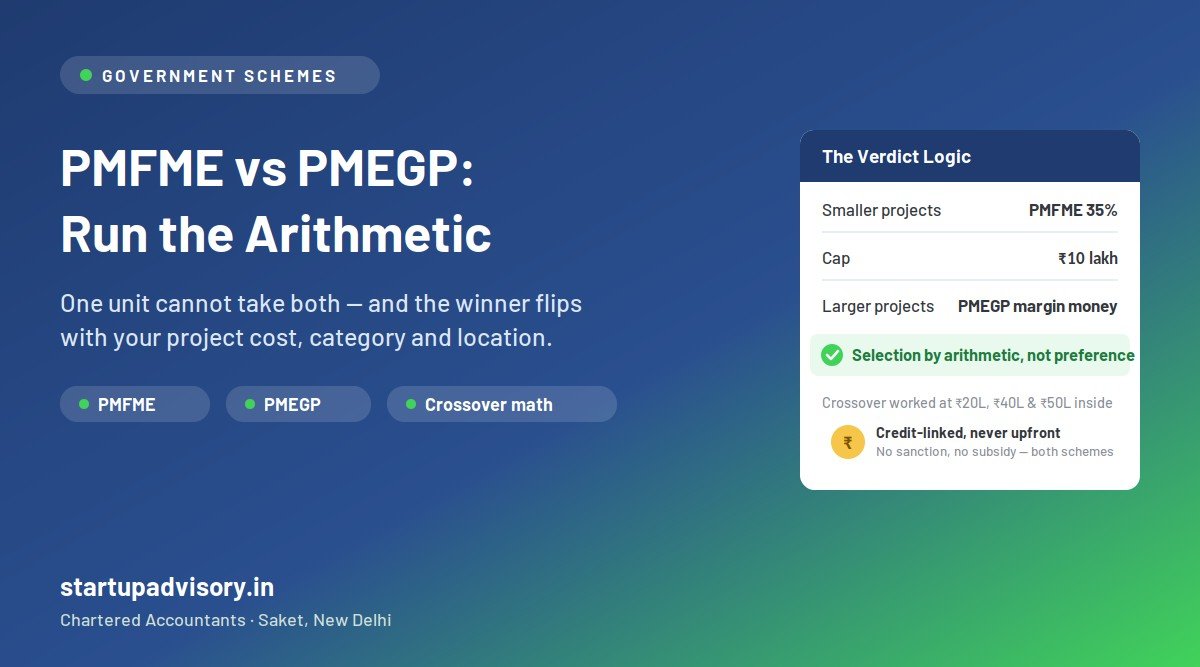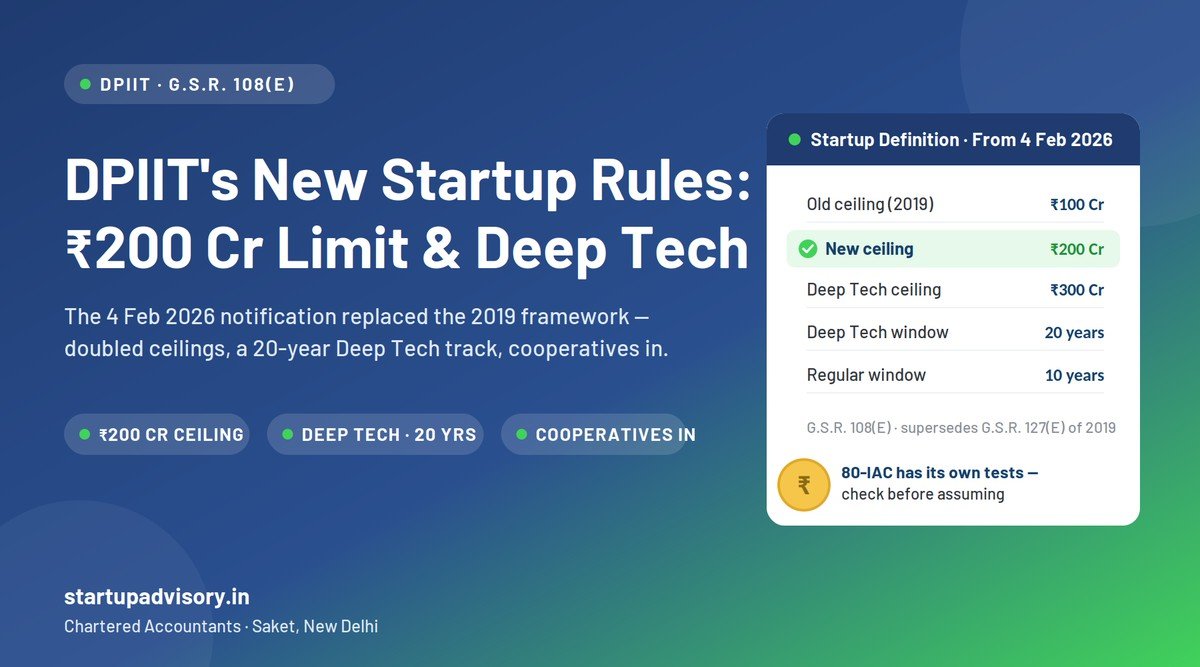
India’s funding schemes are generous and mutually exclusive in ways founders discover too late — one unit cannot take both PMFME and PMEGP, subsidies are credit-linked and released post-sanction, and eligibility turns on category, location and project cost. Startup Advisory runs the comparison on your actual numbers, builds the DPR with the scheme math embedded, files through the correct nodal agency and coordinates the bank through to sanction.
 MSME track: PMFME (food processing), PMEGP, CGTMSE-covered loans, MUDRA — selection by arithmetic, not preference.Startup track: CGSS credit guarantee, Fund of Funds, Section 80-IAC tax holiday, RDI Fund routing — for DPIIT-recognised startups.Process: scheme selection → DPR with embedded scheme math → nodal agency filing → bank coordination to sanction.Straight talk: no subsidy is guaranteed or paid upfront — anyone claiming otherwise is over-promising.Provider: Startup Advisory, CA firm in Saket, New Delhi 110030. Call 9311972982.
Reviewed by CA Neeraj Rohilla, FCA — Chartered Accountant, Startup Advisory, Saket, New Delhi.
The most expensive scheme mistake is choosing on a headline rate. Whether PMFME’s 35% capital subsidy or PMEGP’s margin money delivers more rupees to your unit depends on project cost, category and rural/urban location — and once one scheme is availed, the other is closed to that unit. We do the arithmetic before the application, on your numbers, and show you both outcomes.
PMFME — food processing units: 35% credit-linked capital subsidy (capped), ODOP priority, routed via the State Nodal Agency; FSSAI expected in the file. Full guide: PMFME explained.PMEGP — new units, any sector: margin money by category and location, EDP training mandatory, via KVIC/KVIB/DIC. Details in our MSME schemes guide.CGTMSE — guarantee cover on collateral-free credit for micro & small enterprises. Full guide: CGTMSE checklist.MUDRA — smaller ticket working capital and equipment finance through banks.CGSS — credit guarantee cover on loans to DPIIT-recognised startups; Fund of Funds — capital through AIFs, not direct cheques. Overview: startup funding schemes.Section 80-IAC — the 3-year tax holiday for eligible startups; we handle applications through our Startup India practice and have written on why applications get rejected.RDI Fund — R&D-focused funding routed via second-level fund managers, no direct applications. Guide: how the RDI Fund actually works.Every scheme engagement runs on the same spine: comparison on your numbers → DPR with scheme math embedded → nodal agency filing → bank coordination to sanction → post-sanction compliance under Virtual CFO or bookkeeping.
Step 1 — The three-number call: project cost, own contribution, district. That is enough to run the scheme comparison and tell you the honest verdict — including “no scheme fits, take plain credit” when that is the truth.Step 2 — Eligibility & document mapping: your category, unit status and sector mapped against the chosen scheme’s checklist — before anything is filed, so rejections on technicalities do not happen.Step 3 — DPR with scheme math embedded: the project report built so the subsidy computation, contribution and DSCR agree with each other and with the checklist.Step 4 — Filing through the correct channel: State Nodal Agency, KVIC/KVIB/DIC or the lending institution — the wrong door costs months even with a perfect file.Step 5 — Bank coordination to sanction: queries answered, clarifications filed, and the loan side managed in parallel — because the subsidy only exists if the loan sanctions.Promoter KYC and last ITRs; Udyam registration where the unit exists; category certificates where a special-category rate is claimed; quotations behind the project cost; premises evidence; contribution proof in bank statements; and for the DPIIT track, the recognition certificate and incorporation documents. Scheme checklists differ in the details — part of the service is that you assemble the file once, not thrice.
Choosing the scheme on the headline rate: the percentage means nothing without the cap, the ceiling and your category applied to your project cost — run the arithmetic first.Spending before sanction: committing to machinery or premises before the scheme rules allow it can disqualify the very cost you wanted subsidised — sequence matters, and we map it before you spend.Applying under the wrong entity or status: new-unit schemes filed for existing units, or applications under a proprietorship when the plan needs a company — structural mismatches the checklist catches late.Treating recognition as money: DPIIT recognition opens doors — CGSS, Fund of Funds, 80-IAC — but qualifies you for nothing automatically; each benefit has its own application and its own bar.Following up nowhere: scheme files sit in queues; unattended queries lapse applications. The follow-through is half the service.
Vishal Singh


Ajay Philip

Pranshu Gaur

Ravish Mehta

Mohit Aggarwal

Sanjeev Sharma

Realtoadvisors

Sakshi Gupta
Rudranath Trip
Yash Rohilla
Sandro Cottus

Azan Hosein Photography
Neetu Yadav
Fresh guides on tax, GST and startup compliance from our CA team.
Share your details — our experts call you back. We use these details only to respond to you. See our Privacy Policy.