
Company & Compliance
Due Diligence Checklist for Startup Fundraising in India: What Investors Check and How to Prepare
What due diligence actually is (and when it hits)
DD is the investor’s verification pass: confirming the company they were pitched is the company that exists on paper. It typically begins after the term sheet is signed and runs before the definitive agreements — which means it lands at maximum time pressure, when the round feels done and every discovered gap costs negotiating leverage. The findings do not just inform the investor; they get engineered into the deal as representations, warranties, conditions precedent and, in bad cases, price adjustments.
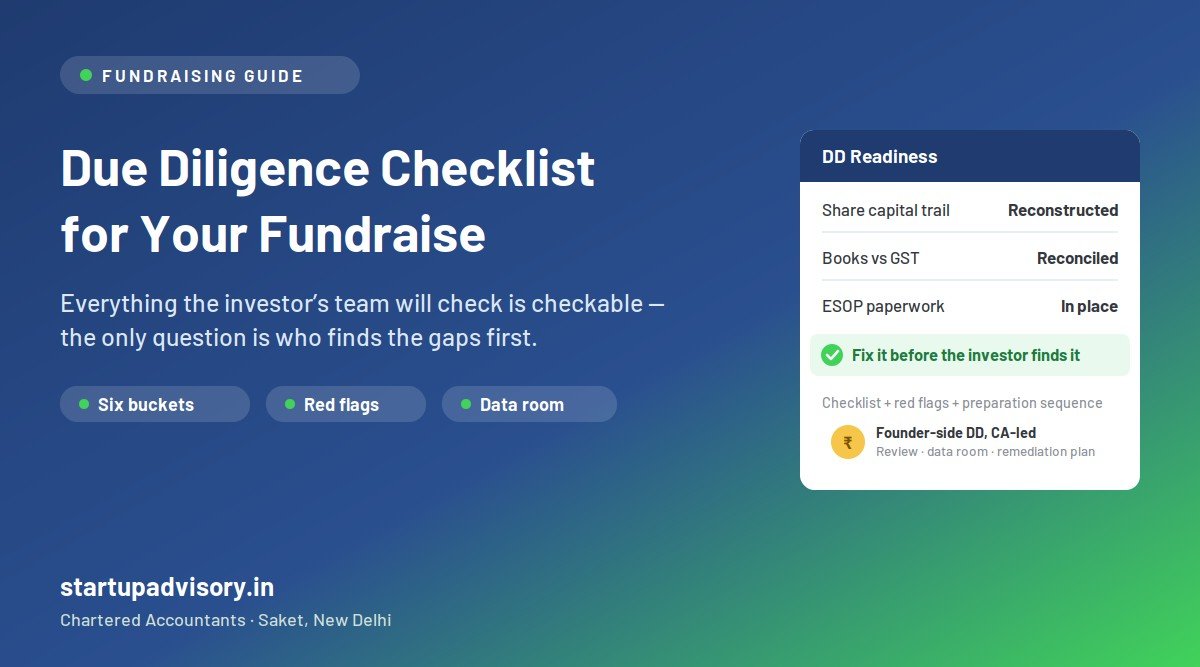
One reframe changes founder behaviour more than any checklist: everything DD checks is checkable — from ROC records, GST portals, bank statements and your own files. There are no secrets, only sequencing. Either you find the gaps first and fix them quietly, or their team finds them and prices them.
The checklist, bucket by bucket
1. Corporate & secretarial
Certificate of incorporation, MoA/AoA as amended; statutory registers (members, directors, charges); board and general meeting minutes — existing, signed, and consistent with what actually happened; all ROC filings with proof of filing; registered office documentation. The test the reviewers apply: does the paper trail reconstruct the company’s decisions without gaps?
2. Capital structure — the bucket that breaks most often
The current cap table; every allotment and transfer since incorporation with its resolutions, return filings and consideration proof in the bank statements; convertible instruments and their terms; the ESOP scheme, pool and every grant letter; any shareholder agreements. A single undocumented allotment from three years ago can hold a closing hostage — this trail is the first thing we reconstruct in sell-side DD.
3. Financial
Audited financial statements for all completed years; current-year MIS and management accounts; bank statements for all accounts; revenue detail by customer/stream with contracts behind the top accounts; receivables ageing; loans given and taken — especially founder and related-party balances — with agreements and approvals; fixed asset registers. The killer test: does the MIS quoted in the deck bridge to the audited books? If not, build the bridge before anyone asks.
4. Tax
Income-tax returns and computations; GST registrations, returns and reconciliation of turnover to the books; TDS returns and challans; PF/ESI where applicable; and — the part founders forget — open notices, assessments and litigation at any stage, each with its current status and exposure estimate. An undisclosed notice discovered by the investor’s team damages credibility far beyond its tax value.
5. Contracts & IP
Customer and vendor agreements (top accounts especially); employment agreements for key people; founder agreements; IP assignments — confirming the company (not a founder personally, not a freelancer) owns the code, brand and content it runs on; licences the business model depends on. Trademark status for the brand. IP sitting in a founder’s personal name is a classic, fixable, and routinely-missed finding.
6. HR, ESOP & licences
Payroll records and statutory deposit proof; offer letters vs what was actually promised — especially options mentioned in offers that no scheme backs; POSH compliance where applicable; sector-specific licences and registrations current and in the right entity’s name.
The red flags that actually delay or kill deals
| Red flag | Why it hurts | Fixable? |
|---|---|---|
| Broken share capital trail | Taints the very shares being sold; closing waits for regularisation | Yes — regularise filings, reconstruct registers, evidence consideration |
| Founder loans / RPTs without paperwork | Reads as governance risk; invites deeper digging everywhere else | Yes — document, approve, disclose |
| Books–GST mismatch | Reads as sloppiness or worse; neither prices well | Yes — reconcile and explain, before they ask |
| ESOPs promised, not papered | Contingent liability sitting with your best employees | Yes — scheme, pool, grants, board approval |
| Deck MIS the audit can’t support | Credibility damage — the one category that kills rather than delays | Only before they find it — build the MIS-to-audit bridge now |
The preparation sequence (founder-side DD)
Weeks 1–2: run the checklist on yourself — or commission a sell-side DD — and grade every finding by deal impact. Weeks 2–3: remediate what is fixable: regularise filings, execute missing agreements, reconcile books to GST, paper the ESOPs, build the MIS-to-audit bridge. Week 3–4: build the indexed data room in the six buckets above, with a disclosure log stating known issues and their explanations — volunteered context always beats discovered surprise. Ongoing: keep it live; a data room maintained monthly makes every future round cheaper. The findings then feed the Registered Valuer valuation and the allotment paperwork — on our desk, the same team runs all three, so the investor hears one consistent story.