Build a full computation of income across all five heads for FY 2025-26 (AY 2026-27), claim your deductions, and see your tax under the old and new regimes side by side. Get the computation emailed to you as a PDF.
A standard deduction of 30% is auto-applied to let-out rent. Self-occupied interest is allowed under the old regime only.
Enter the gain (sale minus cost), not the sale value. Indexation choice, pre-2018 grandfathering and Sec 54/54F/54EC exemptions are not handled here — talk to our CA for those.
Old regime only
Allowed under both regimes
| Particulars | Old regime | New regime |
|---|
This computation gives you a clear, head-wise view of your total income and the tax under each regime for AY 2026-27. If you only want a quick old-vs-new check on salary income, use our income tax calculator; for gains alone, see the capital gains calculator. To understand the choice better, read new vs old tax regime in 2026 and our ITR filing guide for AY 2026-27.
When you are ready to file, our Saket team handles it end to end — see ITR filing & tax advisory or book a free consultation.
A computation of income is a working that totals your income under the five heads — salary, house property, capital gains, other sources and business or profession — reduces eligible deductions to arrive at total income, and then calculates the tax. This tool produces that working for FY 2025-26 (AY 2026-27) and compares the old and new regimes.
No. For FY 2025-26, capital gains taxed at special rates under Sections 111A, 112 and 112A are excluded from the Section 87A rebate, even if your total income is below ₹12 lakh. This tool taxes those gains separately — 20% on STCG from equity (Sec 111A) and 12.5% on LTCG (Sec 112/112A), with the first ₹1.25 lakh of equity LTCG exempt.
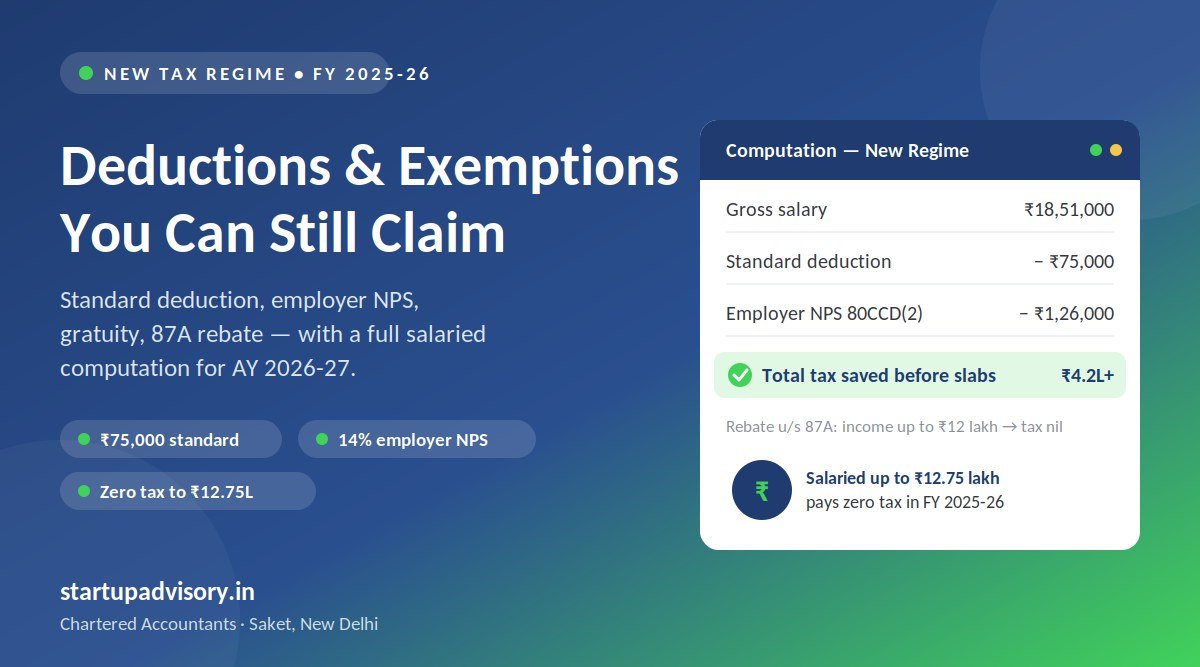
Under the new regime, taxable income up to ₹12 lakh is tax-free because of the ₹60,000 rebate under Section 87A; for salaried taxpayers the ₹75,000 standard deduction lifts the effective tax-free salary to about ₹12.75 lakh. Under the old regime, the Section 87A rebate makes income up to ₹5 lakh tax-free. Capital gains taxed at special rates are outside this limit.
Yes. The new regime is the default for AY 2026-27. Salaried individuals can choose between the two regimes every year while filing their return. If you have business or professional income, switching is restricted and is exercised through Form 10-IEA.
It covers common cases across all five heads. It does not handle every situation, such as indexation choice or grandfathering on property capital gains, Sections 54/54F/54EC exemptions, loss set-off and carry-forward, or relief under Sections 89/90. For those, our Chartered Accountants in Saket can prepare and file your return. This is a guide, not a substitute for professional advice.
These tools give you a quick estimate. For precise figures, regime selection, filing and compliance, our Chartered Accountants in Saket, New Delhi will help. Share your details and we’ll call you back.
Call now: 9311972982Quick, accurate tools for FY 2025-26 — built by our CA team.

Vishal Singh


Ajay Philip

Pranshu Gaur

Ravish Mehta

Mohit Aggarwal

Sanjeev Sharma

Realtoadvisors

Sakshi Gupta
Rudranath Trip
Yash Rohilla
Sandro Cottus

Azan Hosein Photography
Neetu Yadav



























Fresh guides on tax, GST and startup compliance from our CA team.
Share your details — our experts call you back.