Startup Advisory runs financial due diligence (revenue quality, working capital, related-party transactions), statutory & secretarial due diligence (share capital history, ROC filings, minutes, registers — where early-stage deals actually stumble) and tax compliance review — delivered as an investor-ready DD report with an indexed data room and a remediation plan. Founder-side preparation before the round, or investor-side DD on a target — never both sides of one deal.
 Financial DD: revenue recognition, margins, working capital, debt, RPTs, MIS-to-audit bridge.Statutory DD: incorporation & share capital trail, board/shareholder minutes, ROC filings, registers, ESOP paperwork, licences.Tax DD: GST, TDS and income tax positions, open notices and assessments.Deliverables: investor-ready DD report + indexed data room + red-flag remediation plan.Timeline: typically 2–4 weeks for review and report; start before the term sheet.Provider: Startup Advisory, CA firm in Saket, New Delhi 110030. Call 9311972982.
Reviewed by CA Neeraj Rohilla, FCA — Chartered Accountant, Startup Advisory, Saket, New Delhi.
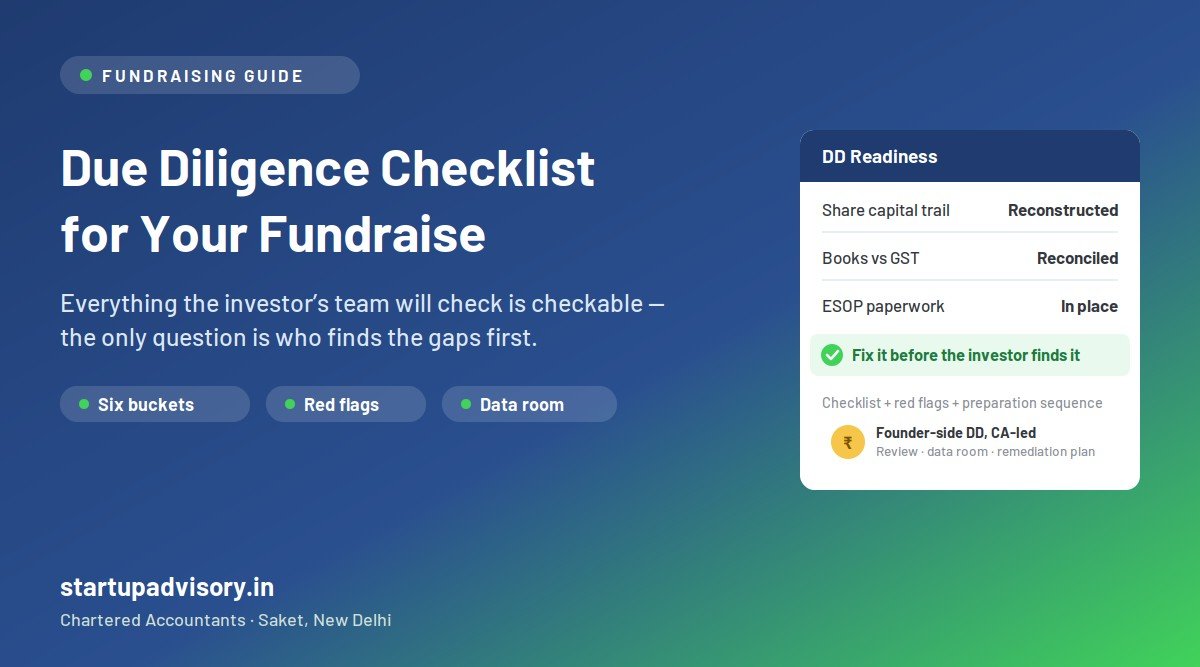
Every funding round ends in the same room: the investor’s diligence team, your documents, and questions. The founders who close fast are not the ones with perfect histories — they are the ones who ran the same checks on themselves months earlier, fixed what could be fixed, and disclosed the rest on their own terms. That is what our investor-ready due diligence engagement does: financial, statutory and tax review by one CA-led desk in Saket, an indexed data room mapped to a standard investor checklist, and a remediation plan for the red flags.
Financial due diligence: revenue quality and recognition, gross-margin integrity, working capital cycles, debt and contingent liabilities, related-party transactions, and the bridge from your MIS to the audited financials investors will actually read.Statutory & secretarial due diligence: the paper trail early-stage deals stumble on — share capital and allotment history, PAS filings, board and shareholder minutes, statutory registers, ESOP scheme adoption and grants, share certificates and stamping, founder and IP-assignment agreements, business licences.Tax compliance review: GST and TDS filing history and reconciliations, income tax positions, and open notices or assessments — disclosed and quantified before they surface as deductions from your valuation.Investor-ready DD report — structured findings, quantified exposures, and management responses drafted with you.Indexed data room mapped to a standard investor checklist, with a disclosure log.Remediation plan — late filings regularised, registers reconstructed, agreements executed, before the investor’s counsel arrives.DD findings feed straight into the Registered Valuer valuation for the allotment and into post-round reporting under Virtual CFO — one team, one consistent story to the investor. We also take investor-side (buy-side) DD mandates on targets; never both sides of the same transaction.
Step 1 — Scoping call: stage, investor type and timeline decide the depth — a seed bridge and a Series A get different treatments, and we say which you need rather than selling the bigger one.Step 2 — Data room build: a structured index (corporate, financial, tax, secretarial, contracts, HR/ESOP) populated from your records — the skeleton investors expect to see.Step 3 — Review: the three tracks run in parallel — financial, statutory & secretarial, tax — each producing findings graded by deal impact.Step 4 — Red-flag report & remediation plan: what will surface, how bad it is, what is fixable before the investor sees it, and what must simply be disclosed with a clean explanation.Step 5 — Deal support: when the investor’s DD team arrives, we sit on your side of the table for the queries.Not just the P&L. The share capital trail from incorporation to today (every allotment, transfer and form filed), whether revenue recognised matches GST returns and bank credits, related-party transactions and their approvals, ESOP grants against a valid scheme and pool, statutory dues (TDS, GST, PF/ESI) deposited on time, open notices and litigation, and whether the MIS the deck quoted reconciles to the audited books. Every one of these is checkable from public and internal records — which means every gap is findable. The only question is who finds it first: you, or their team.
Broken share capital trail: allotments without corresponding filings or consideration proof — the single most common reason closing gets delayed by weeks.Founder loans and RPTs without paperwork: money moved between founder and company with no agreements, board approvals or interest treatment.Books-to-GST mismatch: turnover in the financials that does not reconcile to GST returns — investors read this as either sloppiness or something worse, and neither prices well.ESOPs promised, not papered: offer letters mentioning options with no scheme, no pool, no grants — a liability sitting in your best employees’ inboxes.MIS that outruns the books: a deck claiming numbers the audited statements cannot support — fixable with an MIS-to-audit bridge, fatal without one.
Vishal Singh


Ajay Philip

Pranshu Gaur

Ravish Mehta

Mohit Aggarwal

Sanjeev Sharma

Realtoadvisors

Sakshi Gupta
Rudranath Trip
Yash Rohilla
Sandro Cottus

Azan Hosein Photography
Neetu Yadav
Fresh guides on tax, GST and startup compliance from our CA team.
Share your details — our experts call you back. We use these details only to respond to you. See our Privacy Policy.