
Company & MCA
Company Name vs Brand Name Registration in India: Which One Do You Actually Need?
In short
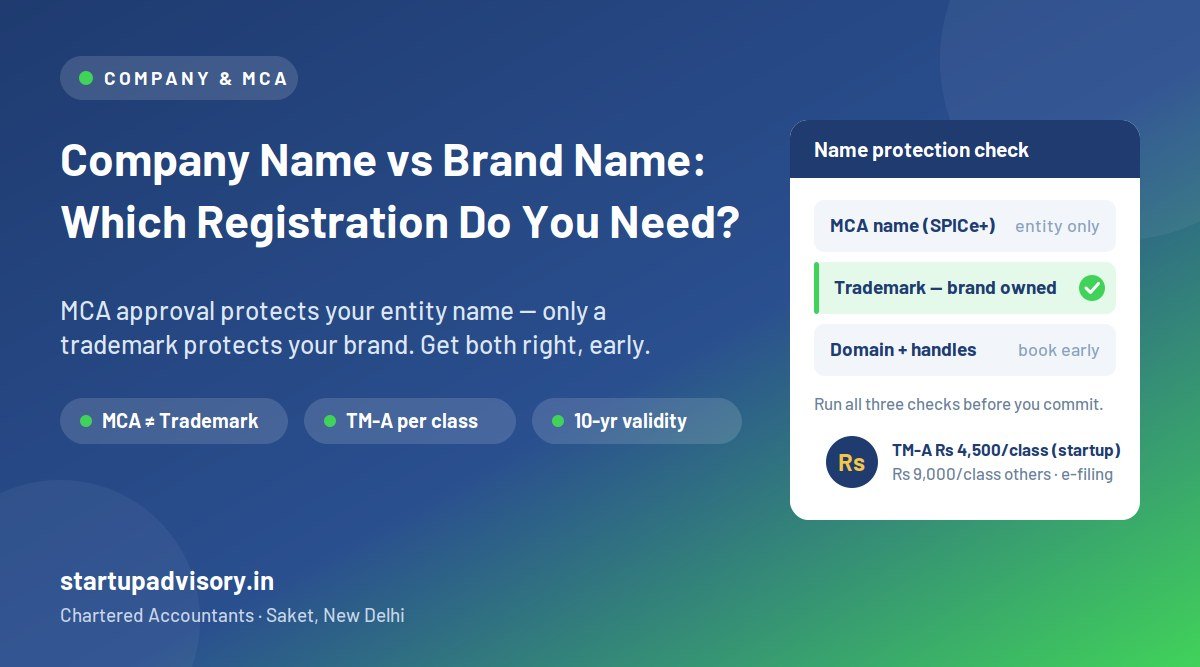
"Registering a name" in India means two completely different things, and confusing them is one of the most expensive mistakes new founders make. Company name registration is reserving your legal entity's name with the MCA when you incorporate (SPICe+ Part A) — it stops another company from taking an identical name, and that's roughly all it does. Brand name registration is a trademark under the Trade Marks Act, 1999 — it gives you exclusive, enforceable rights to the name your customers know. MCA approval does not protect your brand; a competitor can still trademark "your" name and restrain you from using it. The safe sequence: run all three checks (MCA, trademark database, domain) before committing, then incorporate and file the trademark early.
A founder walks in with a Certificate of Incorporation, delighted that the MCA approved their company name — and asks whether their brand is now "registered." The honest answer surprises most people: a company name and a brand name are protected by entirely different laws, in different registries, giving entirely different rights. If you searched for "register a name", "name registration" or "brand name registration", this is the distinction you need before spending a rupee.
The two registrations, side by side
| Company name (MCA) | Brand name (Trademark) | |
|---|---|---|
| What it is | The legal name of your entity, reserved at incorporation | Exclusive rights over a name/logo used for goods or services |
| Governing law | Companies Act, 2013 / LLP Act, 2008 | Trade Marks Act, 1999 |
| Registered with | MCA (Registrar of Companies) | Trade Marks Registry (IP India) |
| How you apply | SPICe+ Part A / RUN | Form TM-A, per class |
| What it stops | Another company/LLP registering an identical or deceptively similar entity name | Anyone using an identical or confusingly similar mark for similar goods/services |
| What it does NOT stop | Someone using the name as a brand, shop name, product or domain | — (this is the real protection) |
| Validity | As long as the company exists | 10 years, renewable indefinitely |
Why MCA name approval protects less than you think
When the MCA approves a name through SPICe+ Part A, it checks the name against its own register of companies and LLPs (and, to an extent, existing trademarks). Approval means no other registered entity can carry an identical or too-similar name. That's a narrow shield:
- A sole proprietor can open a shop under the same name tomorrow — proprietorships aren't on the MCA register at all.
- A competitor can sell a product under that name.
- Someone can register the trademark for that name in your business class — and if they do, they may be able to restrain you from using your own company's name as a brand.
That last point is the trap that catches founders. The MCA register and the trademark register are separate systems that don't reserve rights in each other. Your Certificate of Incorporation is proof of a legal entity, not proof of a brand.
What a trademark actually gives you
A registered trademark under the Trade Marks Act, 1999 gives you the exclusive right to use the mark for the goods or services it's registered in, and the right to sue for infringement — with remedies including injunctions and damages. Registration lasts 10 years and renews indefinitely, making it the only perpetual, enforceable ownership of a name Indian law offers. You can trademark a word, a logo, a tagline, even a combination — and you don't need a company to own one: individuals, proprietors, firms, LLPs and companies can all be applicants.
The process and the cost, briefly
- Search first: check the public trademark database on the IP India portal for identical or similar marks in your classes. A conflict found now costs nothing; found later, it costs the rebrand.
- Pick your classes: trademarks are registered per class under the Nice Classification (45 classes — e.g., Class 35 for retail/advertising, Class 42 for software services). You pay per class.
- File Form TM-A online: the government e-filing fee is ₹4,500 per class for individuals, startups and small enterprises, and ₹9,000 per class for other entities — DPIIT-recognised startups effectively get the concessional rate. Professional drafting fees are extra.
- Use ™ immediately, ® only after registration: the ™ symbol can accompany a pending mark from day one; using ® before registration is an offence.
- Timeline: filing takes days; examination, journal publication and registration typically run several months to over a year — but your rights, once granted, relate back to the filing date.
The right order for a new business
Before you fall in love with a name, run all three checks in one sitting: MCA name availability, a trademark search, and domain availability. If all three are clear, move fast — reserve the company name, book the domain, and file the trademark application as early as you can, because trademark rights broadly favour whoever files and uses first. Founders who incorporate first and think about the trademark "later" are gambling their brand on nobody else noticing a good name.
The bottom line
Company name registration makes your business legal. Brand name registration makes it yours. They live in different registries, under different laws, and neither substitutes for the other. If you're incorporating this year, treat the trademark search as part of the incorporation checklist — not an afterthought for when you're "bigger."
This is general information, not legal advice. Trademark availability and strategy depend on your exact mark, classes and market — take professional advice before filing.
How Startup Advisory Can Help
Startup Advisory is a CA-led firm in Saket, New Delhi that incorporates companies and LLPs for founders across Delhi NCR — and makes sure the name you incorporate under is a name you can actually own:
- Name strategy at incorporation: we run the MCA + trademark + domain checks together before you commit.
- End-to-end company registration and LLP registration, 100% online at fixed fees.
- Guidance on trademark classes, timing and the DPIIT concessional route as part of your Startup India registration.
Call 9311972982 or book a free consultation before you lock in your name.