
Company Compliance / Non-Profit
Annual Compliances for a Section 8 Company (2026): The Complete Companies Act & Income Tax Checklist
In short
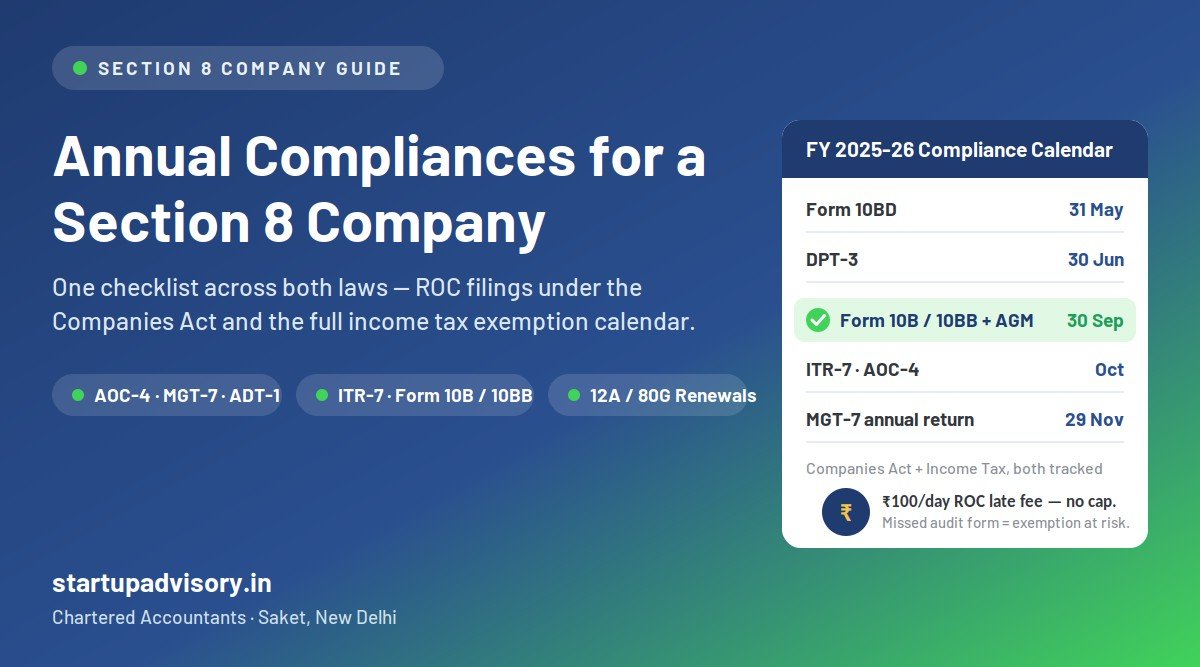
A Section 8 company is a full company first and a non-profit second — it carries the complete annual compliance load of the Companies Act, 2013 (board meetings, AGM, statutory audit, AOC-4 within 30 days and MGT-7 within 60 days of the AGM, ADT-1, DIR-3 KYC, DPT-3, MSME-1) plus a second calendar under the income tax law if it claims exemption: audit report in Form 10B/10BB by 30 September, ITR-7 by 31 October, Form 10BD by 31 May, the 85% application rule, and five-yearly 12A/80G renewals. The Section 8 relaxations are real but narrow: one board meeting per half-year, 14-day AGM notice, no CARO, no secretarial standards. The traps are just as real: no small-company status (so full MGT-7 and a cash flow statement), and a wrong or late audit form can cost the entire year's exemption. From FY 2026-27, the Income Tax Act, 2025 moves exempt Section 8 companies into the new Registered Non-Profit Organisation (RNPO) framework (Sections 332–355) — existing 12A/80G registrations transition automatically. Both calendars, all forms and every due date below.
Founders often incorporate a Section 8 company believing that “non-profit” means “less compliance.” The opposite is closer to the truth. A Section 8 company answers to two regulators every single year — the Registrar of Companies under the Companies Act, 2013, and the Income Tax Department under the exemption regime — and a slip on either side has consequences a trust or society never faces: ROC late fees of ₹100 per day per form with no upper cap, and, on the tax side, the possible loss of a full year's exemption. This guide lays out both calendars for FY 2025-26, what is genuinely relaxed for Section 8 companies, what is genuinely stricter, and what changes when the Income Tax Act, 2025 takes over from FY 2026-27.
First, the two identities of a Section 8 company
Everything in this article follows from one structural fact. A Section 8 company is:
- A company incorporated under the Companies Act, 2013 — so the ROC compliance machinery applies in full, subject only to the specific exemptions notified for Section 8 companies (Notification G.S.R. 466(E) dated 5 June 2015);
- A non-profit that may — but does not automatically — enjoy income tax exemption. Exemption comes only from registration under Section 12A/12AB of the Income-tax Act, 1961 (and, for donors' benefit, approval under Section 80G). Without that registration, a Section 8 company is taxed like any other company.
So the annual calendar has two halves. Miss the corporate half and you accumulate per-day late fees and director-level exposure. Miss the tax half and the exemption itself is at stake.
Part 1 — Annual compliances under the Companies Act, 2013
1. Board meetings — the genuine Section 8 relaxation
A normal company must hold at least four board meetings a year with a maximum gap of 120 days. A Section 8 company, under the 2015 exemption notification, needs to hold at least one board meeting within every six calendar months — effectively two a year. Minutes must still be recorded, and directors must still disclose their interests in Form MBP-1 and their non-disqualification in Form DIR-8 at the first board meeting of the financial year. Note also that the Secretarial Standards (SS-1 and SS-2) do not apply to Section 8 companies — a meaningful procedural relief.
2. Annual General Meeting
The AGM must be held within six months of the financial year end — by 30 September 2026 for FY 2025-26 (the first AGM gets nine months from the close of the first financial year). Section 8 companies may call the AGM with 14 days' notice instead of 21 — another notified exemption. The AGM adopts the audited financial statements, appoints or ratifies auditors, and anchors the AOC-4 and MGT-7 deadlines that follow.
3. Financial statements and statutory audit — no escape on either
Two points here that catch Section 8 founders off guard:
- No small-company status. The definition of “small company” in Section 2(85) expressly excludes Section 8 companies. Consequences: the company files the full MGT-7 (never the abridged MGT-7A), and its financial statements must include a cash flow statement — the small-company exemption from preparing one is unavailable.
- Audit is mandatory regardless of size. Every company must have its accounts audited by a chartered accountant; there is no turnover threshold. The one genuine relief: CARO 2020 does not apply to Section 8 companies, so the auditor's report is significantly lighter.
4. The three core ROC filings
| Form | What it is | Due date | For FY 2025-26 (AGM on 30 Sep 2026) |
|---|---|---|---|
| ADT-1 | Auditor appointment (5-year term) | Within 15 days of the AGM appointing the auditor | By 15 October 2026 (if appointed this year) |
| AOC-4 | Financial statements (with cash flow) | Within 30 days of the AGM | By 30 October 2026 |
| MGT-7 | Annual return (full form, not MGT-7A) | Within 60 days of the AGM | By 29 November 2026 |
Late filing of AOC-4 or MGT-7 costs ₹100 per day per form with no ceiling — a Section 8 company that ignores both for a year is looking at roughly ₹73,000 in additional fees alone, before any penalty proceedings. For the wider ROC calendar in context, see our ROC annual compliance calendar.
5. Recurring and event-based filings that still apply
- DIR-3 KYC — every director holding a DIN as on 31 March must complete KYC by 30 September; failure deactivates the DIN and reactivation costs ₹5,000.
- DPT-3 — the annual return of deposits and exempted borrowings, due 30 June each year. Section 8 companies frequently carry interest-free loans from directors or members; those go into DPT-3.
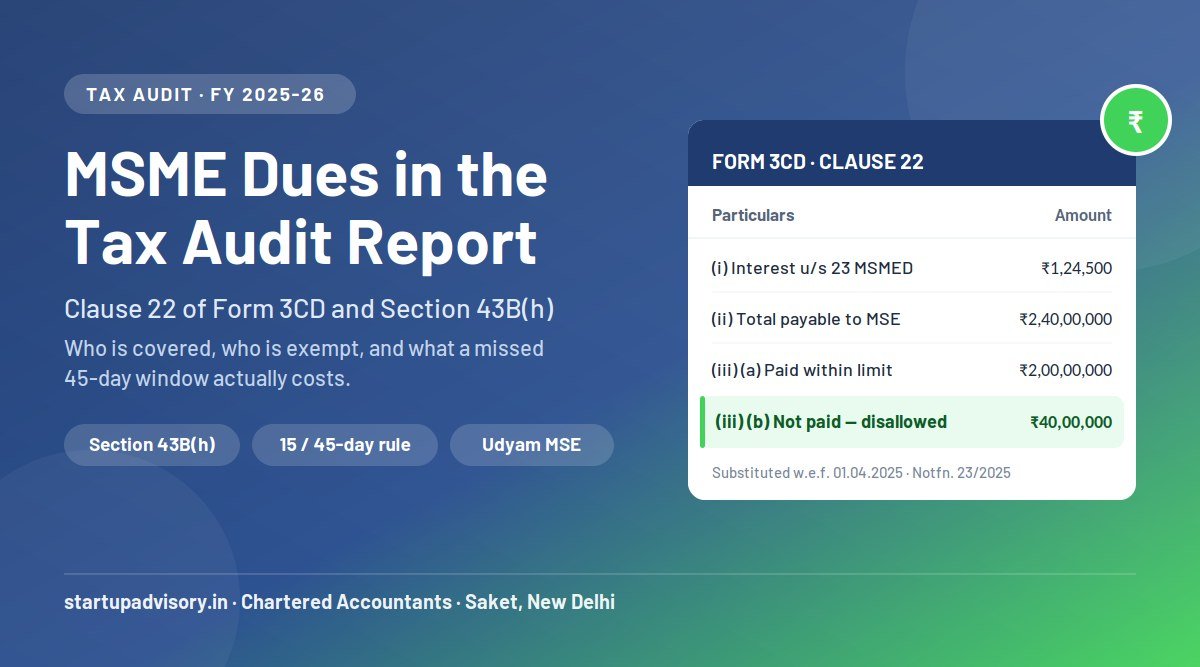
- MSME-1 — half-yearly return of outstanding dues to MSME suppliers beyond 45 days, due 30 April (Oct–Mar half) and 31 October (Apr–Sep half). Applies to Section 8 companies exactly as to any other company.
- Statutory registers and minutes — register of members, directors, charges, related-party contracts; board and general meeting minutes. No exemption here.
- BEN-2 / significant beneficial ownership — event-based, but worth an annual check where the membership structure has layers.
6. CSR — both sides of the table
Section 135 applies to every company that crosses any threshold in the immediately preceding financial year — net worth ₹500 crore, turnover ₹1,000 crore, or net profit ₹5 crore — and a Section 8 company is not excluded. A large grant-funded Section 8 company with a ₹5 crore+ surplus can genuinely trip the net-profit test, triggering the CSR committee, the 2% spend and the Form CSR-2 filing. Most Section 8 companies, though, meet CSR from the other side: as implementing agencies receiving CSR money from corporates — which requires registration in Form CSR-1 and, since the funding companies must report utilisation, disciplined project-wise books.
7. Conditions that never expire
Beyond forms, the Section 8 licence itself imposes standing conditions: no dividend to members, profits applied only to the stated objects, and no alteration of the memorandum's object clauses without Central Government (Regional Director) approval. Breach can lead to revocation of the licence under Section 8(6) — with the company then compelled to convert or wind up — and penalties on the company and every defaulting officer. Annual compliance is the evidence trail that these conditions are being honoured.
Part 2 — Annual compliances under the income tax law
The fork in the road: registered or not
Everything on the tax side depends on one question — does the company hold registration under Section 12A/12AB?
- Not registered: the company is taxed as a normal company at corporate rates, files ITR-6 by 31 October (audit cases), and none of the exemption machinery below applies. “Section 8” status by itself gives zero income tax exemption — the single most common misconception we correct.
- Registered under 12A/12AB: income applied to charitable objects is exempt under Sections 11 and 12, and the full compliance calendar below applies.
1. The 85% application rule — the engine of the exemption
To keep regular income fully exempt, the company must apply at least 85% of its income to its charitable objects during the year; up to 15% may be accumulated indefinitely. Where the 85% cannot be applied in-year, two rescue routes exist — each with its own form and deadline:
- Form 9A — deemed application, where income could not be applied because it was not received or for other specified reasons;
- Form 10 — formal accumulation under Section 11(2) for a specified purpose, for up to five years.
Both must be e-filed at least two months before the ITR due date — i.e. by 31 August 2026 for FY 2025-26. Miss them and the shortfall below 85% becomes taxable income.
2. Audit report: Form 10B or Form 10BB — by 30 September, and the form choice is a trap
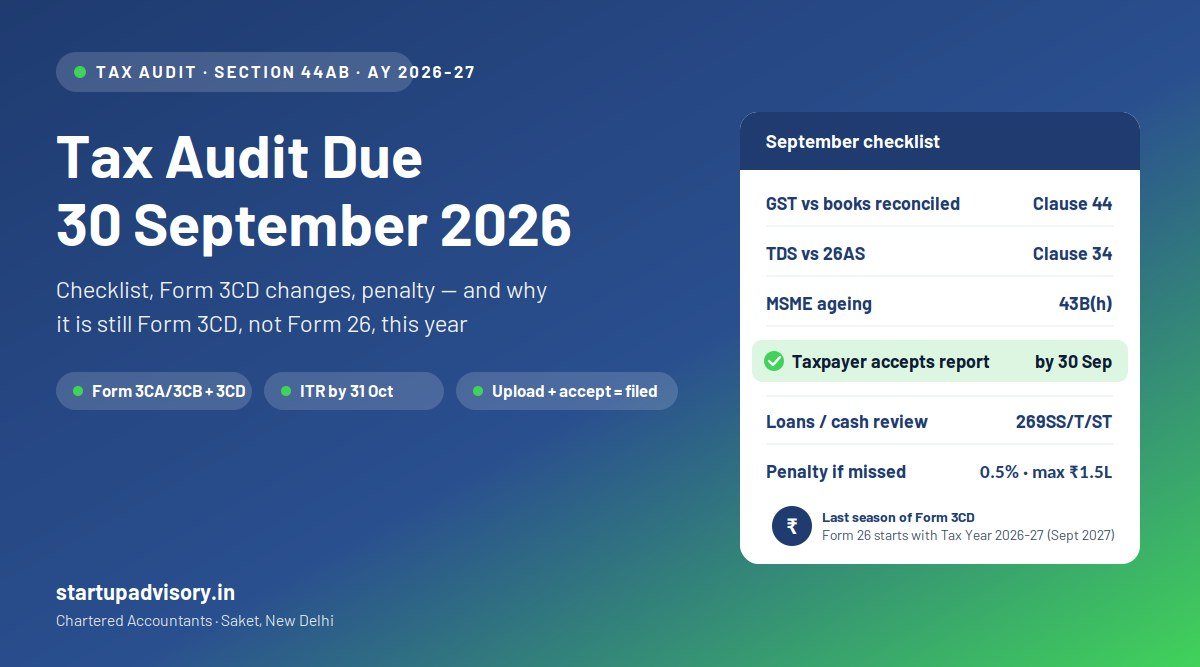
Every 12A/12AB-registered entity whose income (before exemption) exceeds the basic exemption limit needs an audit report e-filed by the CA and accepted by the company one month before the ITR due date — 30 September 2026 for FY 2025-26. Which form:
| Form | When it applies |
|---|---|
| Form 10B | Any one trigger: total income (before exemption) exceeds ₹5 crore; the company received foreign contribution; or it applied income outside India |
| Form 10BB | All other cases — the residual form |
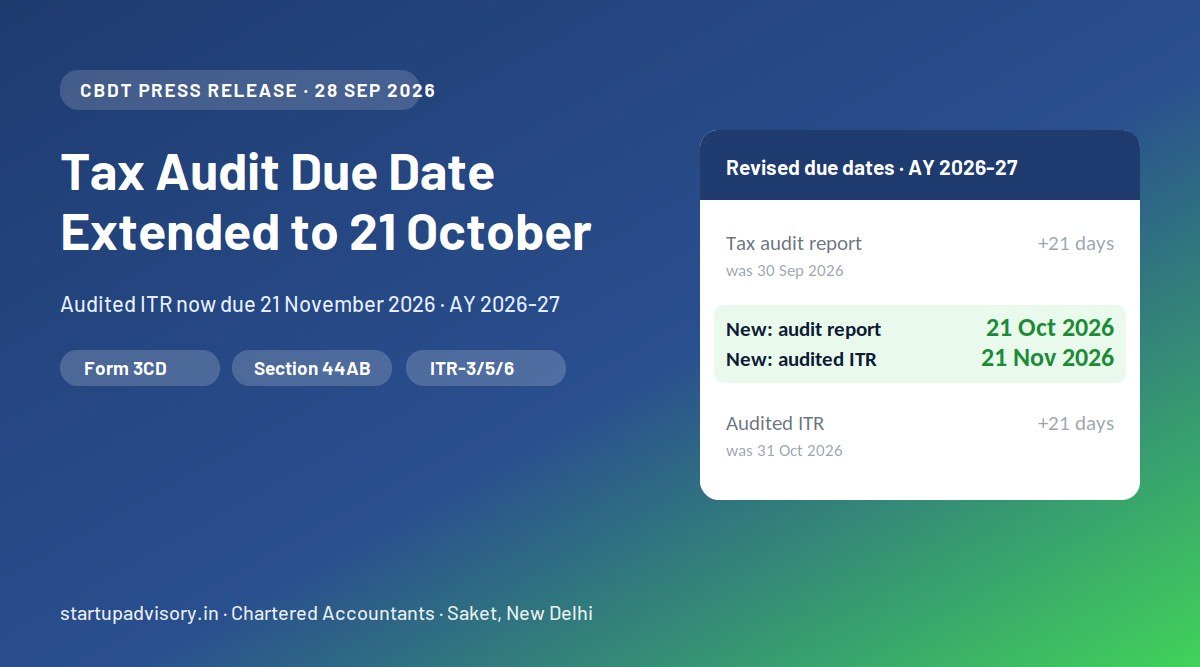
Filing the wrong form is treated as not filing the audit report at all, and a missing audit report can cost the entire year's exemption under Sections 11 and 12. CBDT condonation circulars exist for genuine delay, but condonation is an application, not a right. Sequence discipline matters: books finalised → audit → Form 10B/10BB filed and accepted → only then ITR-7.
3. ITR-7 — by 31 October
The registered Section 8 company files ITR-7 (under Section 139(4A)/(4C)), due 31 October 2026 for FY 2025-26. ITR-7 pulls the 15% accumulation figures and application numbers straight from the audit report, which is why filing it before the audit report is accepted almost always forces a correction. Late filing attracts the Section 234F fee and interest, and a belated return can complicate the exemption claim itself.
4. Form 10BD and 10BE — the donor-side compliance most NGOs miss
Every institution holding 80G approval must e-file Form 10BD — a donor-wise statement of donations (name, PAN, amount, mode) — by 31 May following the financial year, and then issue a certificate in Form 10BE to each donor. The donor's 80G deduction is now matched against this statement in their AIS; a missing or mismatched 10BD entry means your donor loses their deduction — the fastest way a Section 8 company burns donor trust. Late filing attracts a fee of ₹200 per day under Section 234G plus penalty exposure under Section 271K.
5. Keeping 12A and 80G alive — the five-year clock
Registrations are no longer perpetual. Under the current regime: regular 12AB registration and 80G approval run for five years and must be renewed via Form 10AB at least six months before expiry; provisional registrations (three years) must be converted within six months of commencing activities or of expiry, whichever is earlier. The bulk of registrations renewed in the 2021-22 cycle fall due for renewal around 2026-27 — put the date in the compliance calendar now, because a lapsed registration doesn't just pause the exemption, it can trigger the exit tax on accreted income under Section 115TD at the maximum marginal rate.
6. Other tax-side items on the annual list
- TDS compliance — a Section 8 company deducting tax on salaries, rent, professional fees or contractor payments follows the normal TDS deposit and quarterly return calendar; exemption of its own income does not exempt it from deducting on payments.
- Anonymous donations — taxed at 30% under Section 115BBC beyond the safe harbour (5% of total donations or ₹1 lakh, whichever is higher) — wholly religious institutions excepted. Cash-box collections need documentation discipline.
- Books of account — Rule 17AA prescribes the specific books and records a 12A-registered entity must maintain; this is checked in the Form 10B/10BB audit.
- FCRA — outside the Income-tax Act but inseparable in practice: a Section 8 company receiving foreign contribution files the annual return in Form FC-4 by 31 December, and should track the pending FCRA Amendment Bill, 2026 closely.
What changes from FY 2026-27: the Income Tax Act, 2025 and the RNPO regime
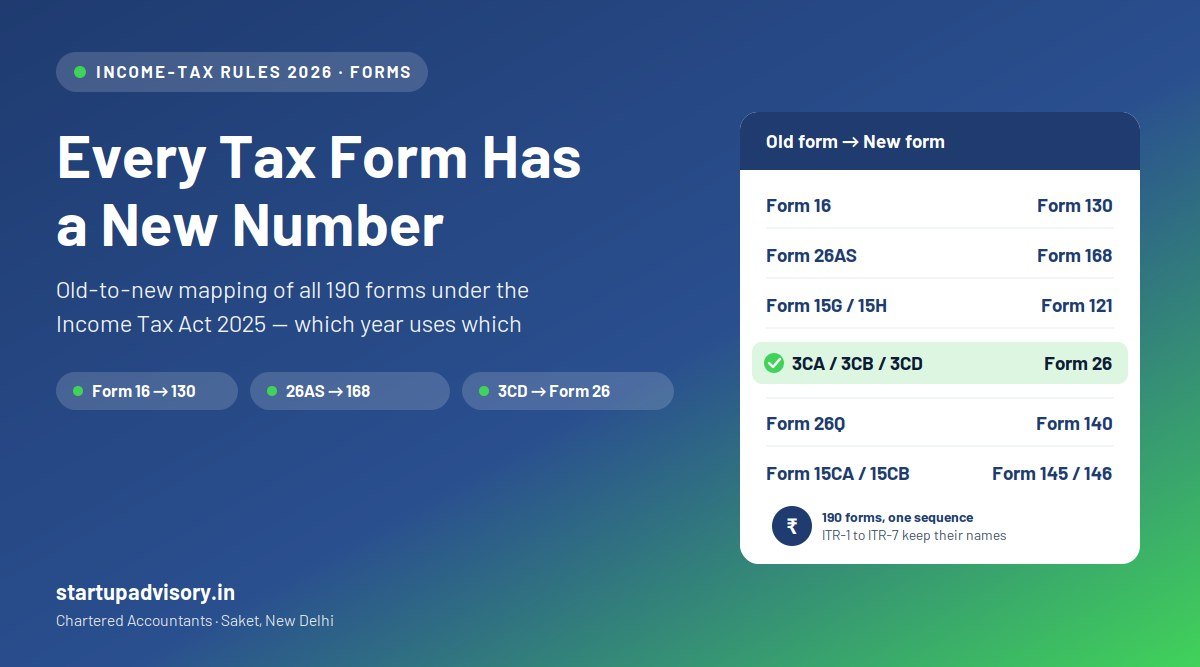
The Income-tax Act, 1961 is replaced by the Income Tax Act, 2025 with effect from 1 April 2026. For FY 2025-26 filings happening through 2026 — everything above — the 1961 Act's sections and forms continue to apply. From financial year 2026-27, the charitable framework changes shape:
- The entire regime — old Sections 11, 12, 12A/12AA/12AB, 10(23C), 80G, 115BBC and 115TD — is consolidated into Part B of Chapter XVII, Sections 332 to 355, as a self-contained code for Registered Non-Profit Organisations (RNPOs).
- Registration moves to Section 332 (replacing 12A/12AB and 10(23C) approvals), with applications and renewals through Form 105 under the Income-tax Rules, 2026. Regular registration runs five years — with a ten-year validity for smaller entities meeting the prescribed income condition.
- Existing valid registrations transition automatically. A Section 8 company holding live 12A/12AB and 80G registrations needs no fresh application on 1 April 2026; the old registration remains effective until its own expiry, and renewal then happens under the new Act.
- The core mechanics survive: the 85% application rule, corpus and accumulation treatment, and the restrictions on private benefit carry into the new chapter — reorganised, not rewritten.
Practical takeaway: nothing to file today because of the new Act, but every renewal falling after 1 April 2026 lands in the Section 332 / Form 105 world, and next year's article on this page will carry the new section numbers. For the broader picture of the new Act, see our guide to the Income Tax Act 2025 section mapping.
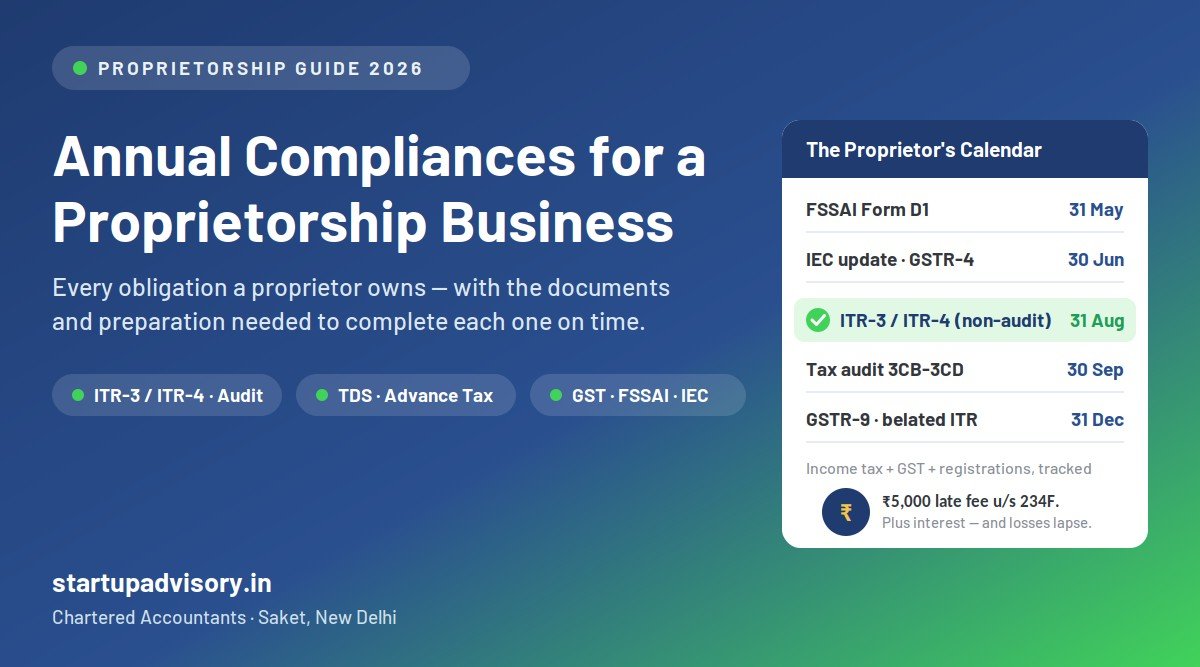
The consolidated FY 2025-26 compliance calendar
| Due date | Compliance | Law |
|---|---|---|
| 30 Apr 2026 | MSME-1 (Oct 2025–Mar 2026 half) | Companies Act |
| 31 May 2026 | Form 10BD donation statement + Form 10BE certificates to donors | Income tax |
| 30 Jun 2026 | DPT-3 return of deposits / exempted borrowings | Companies Act |
| 31 Aug 2026 | Form 9A / Form 10 (deemed application / accumulation), where needed | Income tax |
| 30 Sep 2026 | AGM (latest date) · DIR-3 KYC for all directors · Form 10B/10BB audit report | Both |
| 15 Oct 2026 | ADT-1 (if auditor appointed at this AGM) | Companies Act |
| 30 Oct 2026 | AOC-4 financial statements | Companies Act |
| 31 Oct 2026 | ITR-7 (or ITR-6 if unregistered) | Income tax |
| 31 Oct 2026 | MSME-1 (Apr–Sep 2026 half) | Companies Act |
| 29 Nov 2026 | MGT-7 annual return | Companies Act |
| 31 Dec 2026 | FCRA Form FC-4 (if foreign contribution) · Form CSR-2 (where CSR applies, per the MCA's notified timeline) | FCRA / Companies Act |
Dates assume an AGM held on 30 September 2026; AOC-4, MGT-7 and ADT-1 count from your actual AGM date. Where the CBDT or MCA extends a due date by circular, the extended date governs.
The five mistakes we actually see
- Treating Section 8 status as a tax exemption. Without 12A/12AB, the company pays corporate tax on its surplus — and several founders discover this in an intimation, not a planning meeting.
- Filing MGT-7A or skipping the cash flow statement because “we're small.” A Section 8 company is never a small company in law, whatever its size in fact.
- Filing the wrong audit form. A 10BB filed where 10B was triggered (a single foreign contribution is enough) is a non-filing — and the exemption for the whole year is what's at risk.
- Forgetting Form 10BD until a donor calls. By then the donor's deduction has already been questioned, and the ₹200/day meter has been running since 31 May.
- Letting the five-year 12A/80G clock run silently. The renewal window opens six months before expiry; a lapse invites Section 115TD exit-tax exposure, not just a paperwork gap.
This article reflects the position as we understand it in August 2026 for FY 2025-26 compliances under the Companies Act, 2013 and the Income-tax Act, 1961, with the transition to the Income Tax Act, 2025 (effective 1 April 2026) noted where relevant. Statutory due dates can be extended by CBDT/MCA circulars. This is general information, not legal or tax advice — take professional advice on your company's specific position before acting.
How Startup Advisory Can Help
Startup Advisory is a CA-led firm in Saket, New Delhi working with non-profits and founders across Delhi NCR:
- Section 8 incorporation & registrations — Section 8 company registration with 12A/80G applications, CSR-1 and the full first-year setup.
- Annual compliance retainers — both calendars managed end to end: board/AGM documentation, AOC-4, MGT-7, ADT-1, DPT-3, MSME-1, Form 10B/10BB, ITR-7 and Form 10BD.
- Books & reporting — bookkeeping built for grant and donor reporting, with a Virtual CFO layer for larger programmes and CSR-funded projects.
Run a Section 8 company or planning one? Call 9311972982 or book a consultation for a compliance health-check against both calendars.