
Tax & ITR
ITR-U Updated Return in 2026: The 48-Month Window, What Each Year of Delay Costs, and the Budget 2026 Changes
Reviewed by CA Kunal Mehta, FCA — Chartered Accountant, Startup Advisory, Saket, New Delhi. Last reviewed: August 2026.
In short
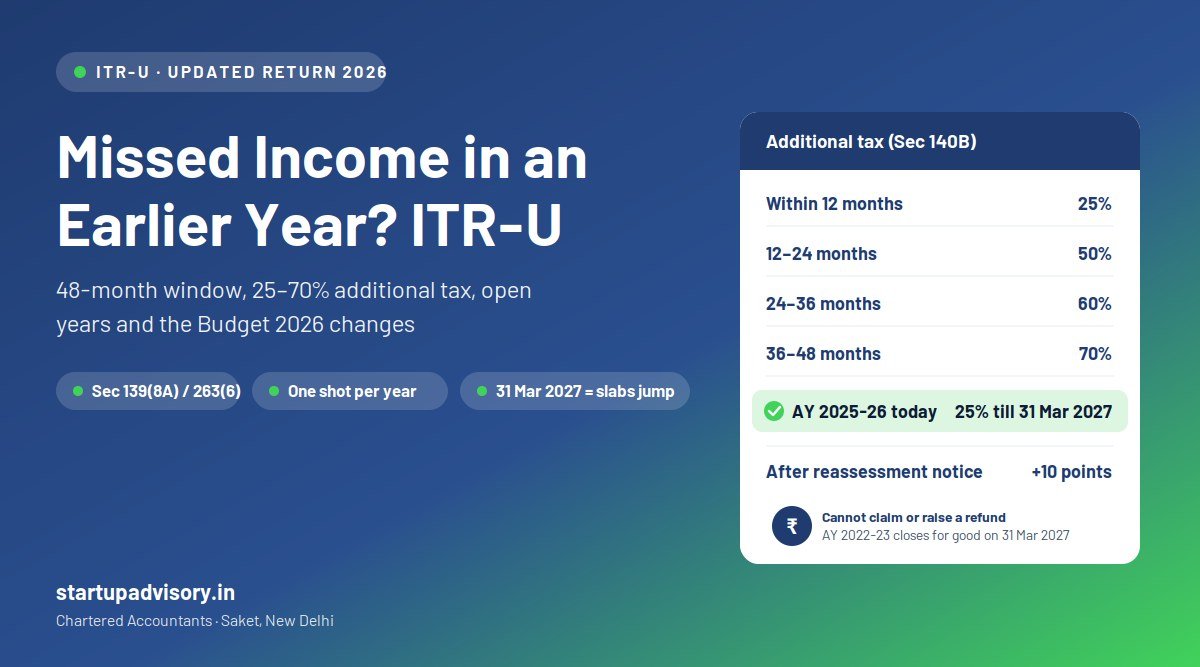
An updated return (ITR-U) lets you declare income you missed — or file a return you never filed — for up to 48 months after the end of the assessment year, on payment of the tax, interest and an additional tax of 25% / 50% / 60% / 70% depending on which 12-month block you file in. It only works one way: it must increase your tax. As of August 2026, AY 2022-23 to AY 2025-26 are open (AY 2022-23 closes 31 March 2027 at 70%; AY 2025-26 is at the cheapest 25% slab until 31 March 2027). Budget 2026 opened two doors that were shut before: ITR-U after a reassessment notice (with a 10-point premium) and ITR-U to reduce a carried-forward loss. From Tax Year 2026-27 the provision becomes Section 263(6) of the Income-tax Act, 2025, with the same slabs. The single most expensive mistake is waiting past 31 March — every year the slab jumps.
The 31 July rush is over, the belated-return window for AY 2026-27 runs to 31 December 2026 — and a lot of people are now discovering something else: interest from FY 2023-24 that never went into the return, a freelance invoice from FY 2022-23, a year they simply never filed. The AIS already shows it. The question is whether you disclose it voluntarily at 25% on top, or wait for a notice and pay a lot more. That is what the updated return is for, and 2026 is the first year it runs on the full 48-month clock with the Budget 2026 changes in force.
What an updated return is — and is not
Section 139(8A) of the Income-tax Act, 1961 (inserted by the Finance Act, 2022) allows any person — resident or non-resident, individual, HUF, firm, company — to file an updated return of income for an assessment year whether or not they filed an original, belated or revised return. The price is set by Section 140B: you pay the tax and interest on the additional income, any Section 234F late fee, and an additional tax computed as a percentage of the aggregate of that tax and interest. From Tax Year 2026-27 the same mechanism sits in Section 263(6) of the Income-tax Act, 2025 (the belated and revised returns are 263(4) and 263(5)); returns for AY 2026-27 and earlier continue to cite 139(8A)/140B under the savings clause.
It is not a general-purpose correction. An updated return cannot:
- claim a refund or increase a refund already claimed;
- reduce the tax liability declared in the earlier return;
- be a loss return (with the Budget 2026 exception below for reducing a loss);
- be filed more than once for the same year, or be revised after filing.
If your error goes the other way — you overpaid — the route is a revised return while that window is open, or a condonation / rectification request, not ITR-U.
The 48-month window and the four slabs
The Finance Act, 2025 doubled the ITR-U window from 24 to 48 months from the end of the relevant assessment year and added two slabs on top of the original two:
| Filed within (from end of AY) | Additional tax (Section 140B) | After a reassessment notice (Budget 2026) |
|---|---|---|
| 0–12 months | 25% of tax + interest | 35% |
| 12–24 months | 50% | 60% |
| 24–36 months | 60% | 70% |
| 36–48 months | 70% | 80% |
| After 48 months | Window closed — only the department can reopen the year | |
The percentage applies to the aggregate of tax and interest on the additional income, not to the income itself — but interest under Sections 234A/234B/234C keeps accruing on the underlying tax every month, so the real cost of delay is higher than the slab jump alone.
Which years are open right now (August 2026)
| Assessment year (FY) | AY ended | Slab now | Slab from 1 Apr 2027 | Window closes |
|---|---|---|---|---|
| AY 2021-22 (FY 2020-21) | 31 Mar 2022 | Closed 31 March 2026 | ||
| AY 2022-23 (FY 2021-22) | 31 Mar 2023 | 70% | — | 31 Mar 2027 |
| AY 2023-24 (FY 2022-23) | 31 Mar 2024 | 60% | 70% | 31 Mar 2028 |
| AY 2024-25 (FY 2023-24) | 31 Mar 2025 | 50% | 60% | 31 Mar 2029 |
| AY 2025-26 (FY 2024-25) | 31 Mar 2026 | 25% | 50% | 31 Mar 2030 |
| AY 2026-27 (FY 2025-26) | 31 Mar 2027 | Belated / revised till 31 Dec 2026; ITR-U opens after that, 25% till 31 Mar 2028 | 31 Mar 2031 | |
What Budget 2026 changed
Two long-standing bars were relaxed with effect from 1 March 2026 / Tax Year 2026-27:
- ITR-U after a reassessment notice. Previously, once a notice under Section 148 (reassessment) was issued the updated-return route was shut. Now an updated return may be filed after the beginning of reassessment proceedings, subject to an additional 10-point premium on the slab (25→35, 50→60, 60→70, 70→80). Once filed, the Assessing Officer proceeds on the basis of the updated return and the disclosed income is not treated as under-reported for penalty.
- ITR-U to reduce a loss. An updated return may now be filed to reduce a carried-forward loss or unabsorbed depreciation (it still cannot create or increase one). This matters for businesses that over-claimed a loss and would otherwise have had no lawful way to correct it.
Separately, the Income-tax Act, 2025 extends the revised-return window from 9 months to 12 months from the end of the tax year (Section 263(5)). For Tax Year 2026-27 that means revisions are possible up to 31 March 2028, and ITR-U for that year opens on 1 April 2028.
Who cannot file ITR-U
- Where a search under Section 132, a survey under Section 133A, or a requisition has been initiated against you (or your books, documents or assets have been seized or called for from another person);
- where the assessment or reassessment for that year is already completed;
- where prosecution proceedings have been initiated for that year;
- where information has been received under PMLA, the Black Money Act, the Benami Act, or under a DTAA exchange-of-information request and communicated to you;
- where an updated return has already been filed for that year;
- where the return would be nil or a loss return, claim or increase a refund, or reduce the tax declared earlier.
Worked example
Priya, salaried, in the 30% bracket, forgot Rs. 3,00,000 of freelance income in AY 2025-26 (FY 2024-25). She files an updated return in October 2026 — within 12 months of 31 March 2026.
| Component | Amount (Rs.) |
|---|---|
| Tax on Rs. 3,00,000 @ 30% | 90,000 |
| Health & education cess @ 4% | 3,600 |
| Interest u/s 234A/B/C (illustrative) | 11,000 |
| Aggregate tax + interest | 1,04,600 |
| Additional tax @ 25% (within 12 months) | 26,150 |
| Section 234F fee (only if no return was filed at all) | 0 / 5,000 |
| Total payable in October 2026 | ~1,30,750 |
| Same disclosure in April 2027 (50% slab, more interest) | ~1,60,000+ |
| Same disclosure in April 2028 (60% slab) | ~1,75,000+ |
Illustrative. Interest depends on the exact dates and any advance tax / TDS already paid; surcharge not considered. Your CA will compute the precise figure and the correct challan split before filing.
Belated vs revised vs updated — which one do you need?
| Belated return | Revised return | Updated return (ITR-U) | |
|---|---|---|---|
| When | After the due date, up to 31 Dec of the AY | After filing, up to 31 Dec of the AY (12 months from end of tax year under the 2025 Act) | After both have closed, up to 48 months from end of AY |
| Can reduce tax / claim refund? | Yes | Yes | No |
| Extra cost | Section 234F fee + interest | None beyond interest | 25–70% additional tax (+10 after reassessment notice) + fee + interest |
| Loss carry-forward | Most losses lost | Preserved if original was on time | Cannot create/increase; may reduce (Budget 2026) |
| How many times | Once | Multiple within window | Once per year, not revisable |
For AY 2026-27 specifically, read our belated return guide first — until 31 December 2026 the belated route is cheaper and more flexible than ITR-U.
How to file
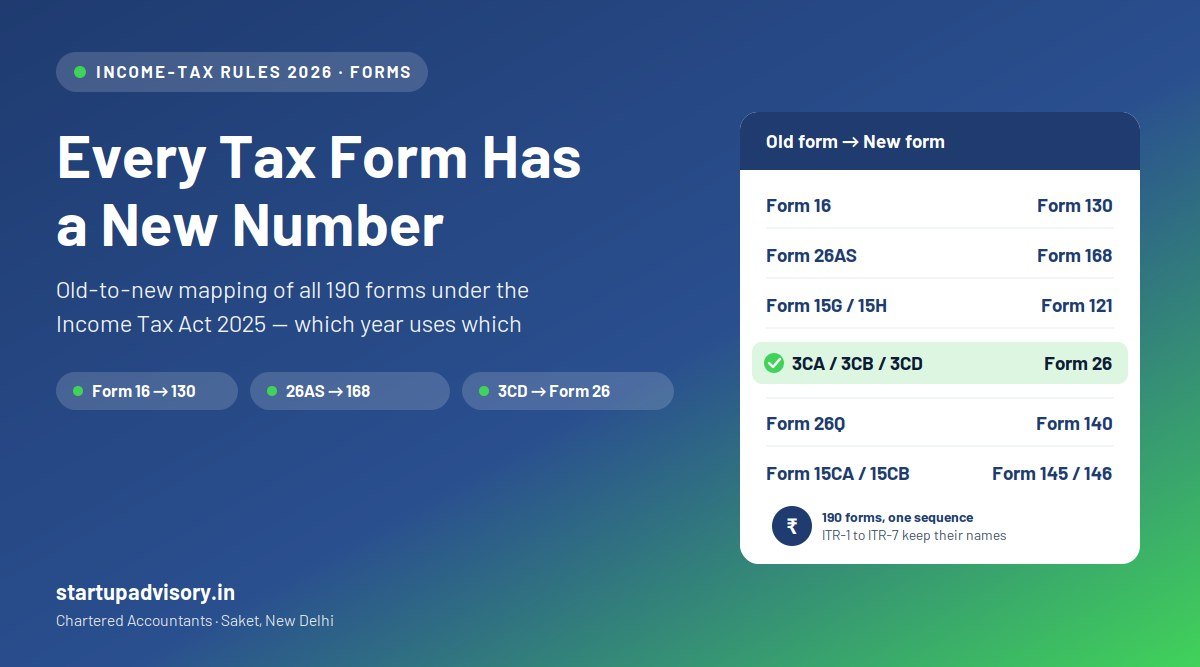
- Reconcile first. Pull the AIS/TIS and Form 26AS (Form 168 under the 2026 Rules) for the year and compare with what was filed. Missed bank interest, dividend, capital gains and TDS-credited receipts are the usual culprits.
- Compute the incremental tax under the regime you originally filed in, plus interest to the filing date, plus any Section 234F fee.
- Apply the slab (25/50/60/70, or +10 after a reassessment notice) to the aggregate of tax and interest.
- Pay the challan — the additional tax under Section 140B is paid before filing, and the challan details go into the ITR-U.
- File ITR-U on the e-filing portal with the applicable ITR form (ITR-1 to ITR-7) attached, selecting the reason for updating, and e-verify. The Income-tax Act, 1961 tab is used for AY 2026-27 and earlier.
This article is general information, not tax advice. ITR-U eligibility, the slab and the interest computation depend on your specific facts and dates; the Budget 2026 changes have their own effective dates and conditions. Confirm with a qualified professional before filing.
How Startup Advisory Can Help
Startup Advisory is a CA-led firm in Saket, New Delhi. For individuals, freelancers and businesses across Delhi NCR with an open year to fix, we:
- Reconcile AIS/TIS and Form 26AS against the filed return and quantify exactly what was missed.
- Compute the incremental tax, interest and Section 140B additional tax for the correct slab — and tell you honestly whether ITR-U, a revised return or a rectification is the right instrument.
- Pay the challan correctly, file the ITR-U with the right ITR form, and e-verify.
- Handle any follow-up from the department, including reassessment-notice responses, through our ITR & tax advisory desk.
Call 9311972982 or book a free consultation — before 31 March 2027 moves every open year up a slab.