
Regulatory / MSME
MSME Amendment Bill 2026: What Actually Changes, the New MSMED Act Rules & Which Businesses Benefit
In short
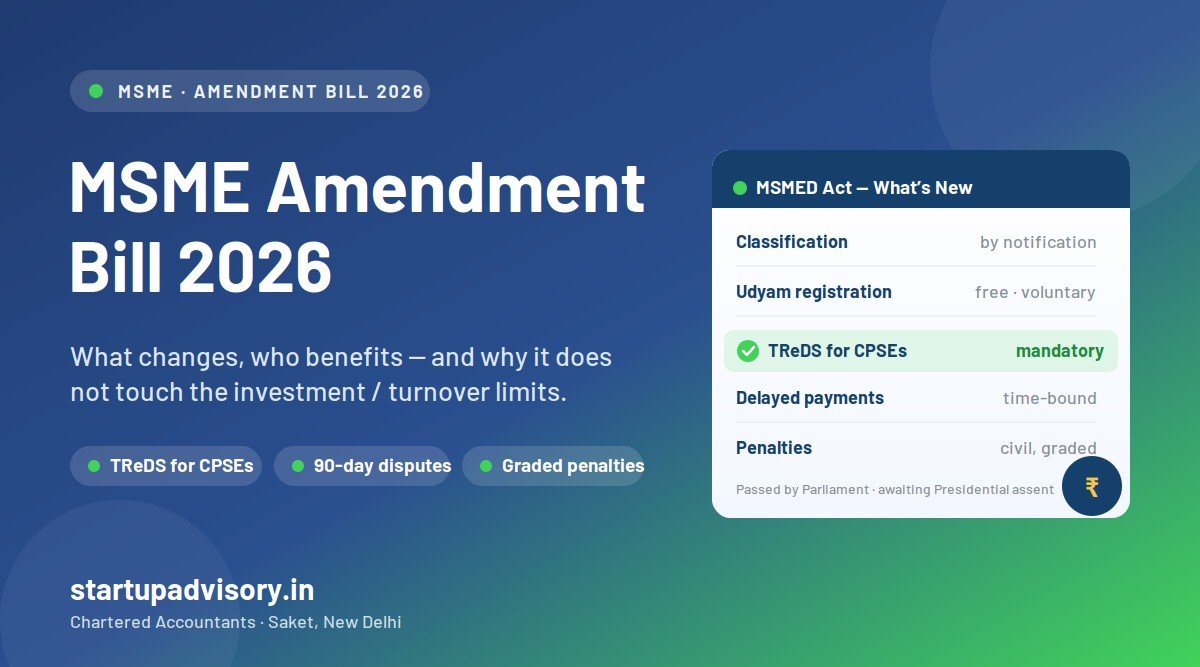
The Micro, Small and Medium Enterprises Development (Amendment) Bill, 2026 was introduced in the Rajya Sabha on 28 July 2026, passed by the Rajya Sabha on 3 August and the Lok Sabha on 7 August 2026, and received Presidential assent on 13 August 2026 — it is now the MSME Development (Amendment) Act, 2026, with provisions taking effect from dates the government notifies. It rebuilds how an MSME registers, gets paid and settles a dispute. The headlines: it removes the fixed investment thresholds from the Act and lets the government set classification limits by notification using investment and turnover; makes Udyam registration free, voluntary and digital for all; requires every Central Public Sector Enterprise to settle MSME invoices on TReDS; puts hard timelines on mediation and arbitration of delayed-payment disputes; lets awards be recovered as arrears of land revenue; and replaces several criminal penalties with a graded civil-penalty framework. One thing it does not do: set new investment or turnover numbers — those come from a separate March 2025 notification. Below: what changes, who gains, and what to do now.
Twenty years after the MSMED Act, 2006 was written, Parliament has rewritten large parts of how a small business in India registers, gets paid, and settles a dispute. If you run or advise a micro, small or medium enterprise — or supply a government undertaking — this Bill changes the rules of the game. This guide sets out exactly what it does, corrects the one point most coverage gets wrong, analyses which businesses benefit most, and gives a practical checklist — all sourced to the Bill text and neutral legislative analysis.
The one thing to get straight first
This Bill does not hand you a fresh set of investment and turnover limits. It does something subtler: it removes the specific thresholds from the Act itself and gives the central government the power to fix them by notification, using both investment and turnover as the statutory basis.
The numbers you have seen quoted — micro up to ₹2.5 crore investment and ₹10 crore turnover, and so on — are not from this Bill. They come from Ministry of MSME Notification S.O. 1364(E) dated 21 March 2025, effective 1 April 2025. Those figures remain the current classification. What the 2026 Bill changes is where the numbers live (statute → notification) and what basis is written into the law (investment + turnover), so that future revisions no longer need an Act of Parliament. Keep the two events separate: the 2025 notification answers “how big can I be and still count as an MSME?”; the 2026 Bill answers “what new rights and obligations do I have as an MSME?”
Current classification limits — the 2025 revision (context, not this Bill)
For readers who arrived looking for the limits, here they are, correctly attributed. These took effect on 1 April 2025 via S.O. 1364(E):
| Category | Investment in plant, machinery or equipment | Annual turnover |
|---|---|---|
| Micro | ₹1 crore → ₹2.5 crore | ₹5 crore → ₹10 crore |
| Small | ₹10 crore → ₹25 crore | ₹50 crore → ₹100 crore |
| Medium | ₹50 crore → ₹125 crore | ₹250 crore → ₹500 crore |
Two rules that trip people up: the classification is a composite criterion — you must satisfy both the investment and the turnover ceiling for a category, and crossing either one moves you up a category; and exports are excluded from the turnover figure, which gives genuine relief to firms that sell abroad. The 2026 Bill does not touch these numbers — it simply makes it easier for the government to move them next time. If you are unsure of your category, our MSME / Udyam registration team can map your live income-tax and GST numbers to the correct band.
What the 2026 Bill actually changes
Drawing on the Bill text and the neutral analysis by PRS Legislative Research, here is the substance of the reform, grouped by what it does for a real business.
1. Classification made flexible — turnover written into the law
The Act hard-coded investment thresholds into the statute. The Bill removes those thresholds and empowers the central government to classify enterprises on the basis of investment in plant and machinery or equipment and turnover, with the actual figures set by notification. Practical effect: the next revision of limits can happen through a Ministry notification rather than a fresh amendment — faster, but also giving the executive more room to move the goalposts.
2. Udyam registration: free, voluntary for all, and made permanent
Under the old Act, a person setting up a medium manufacturing enterprise was required to file a memorandum. The Bill makes filing the memorandum voluntary for all MSMEs, and provides that the central government will notify a digital platform for registration (states may notify their own). In effect this gives the free, digital Udyam registration route a firm statutory footing. Registration stays the gateway to MSME benefits — priority-sector lending, scheme eligibility, and the delayed-payment protections below — so “voluntary” does not mean “skip it.”
3. TReDS made mandatory for Central Public Sector Enterprises
This is the provision with the sharpest cash-flow teeth. The Bill requires every Central Public Sector Enterprise (CPSE) to settle all invoices for procurement of goods or services from MSMEs on the Trade Receivables Discounting System (TReDS) — the RBI-regulated platform where an MSME can discount an approved invoice for cash instead of waiting out a long credit period. The central and state governments may extend the same mandate to other public sector entities. For any MSME that supplies a government undertaking, this converts a slow, uncertain receivable into a financeable one. The scale is real: invoice value discounted through TReDS rose from about ₹40,000 crore in 2022–23 to roughly ₹3.47 lakh crore in 2025–26.
4. Delayed-payment dispute resolution — rebuilt with clocks on it
The old Section 18 machinery before the Micro and Small Enterprises Facilitation Councils (MSEFC) was slow. The Bill puts timelines and enforcement muscle into it:
- Mediation must finish within 90 days of the date fixed for first appearance.
- If mediation fails, the matter must be referred to arbitration within 30 days, and the award must be made within 90 days of completion of pleadings.
- The existing rule that challenging an award needs a 75% pre-deposit is extended to cover mediated settlement agreements too — and, pending disposal, the court can order a reasonable share of the deposit to be released to the supplier.
- If a case has been pending for more than six months, at least 50% of the awarded amount must be paid to the supplier in the meantime.
- Awards and settlements can be recovered as an “arrear of land revenue” through the District Collector — a recovery route that doesn't depend on a fresh civil suit.
- This sits alongside the Online Dispute Resolution (ODR) portal launched in June 2025, giving micro and small enterprises a low-cost digital route for small-value claims.
Taken together, the reform attacks the single biggest killer of small businesses — money owed but not paid — with deadlines and a real enforcement path.
5. Decriminalisation and a graded civil penalty framework
The Bill swaps several criminal-style fines for a warning-first, graded civil-penalty structure:
- Wilfully furnishing false information for registration (and failure to furnish information sought by officers): a warning at first instance, then a penalty of ₹1,000 to ₹50,000 for any subsequent contravention. (Previously: a fine up to ₹1,000 on first conviction and ₹1,000–₹10,000 on subsequent conviction.)
- A buyer failing to report unpaid MSME dues in its annual accounts: a warning first, ₹10,000–₹50,000 for a second contravention, and ₹50,000–₹1,00,000 for subsequent ones. (Previously a flat fine of at least ₹10,000.)
- These penalty floors rise by 10% of the minimum every three years from the commencement of the Amendment Act.
6. A Development Commissioner as adjudicator
The central government will appoint the Development Commissioner as the adjudicating officer, with appeals lying before the MSME Secretary — a cleaner administrative chain than routing everything through the courts.
Comparison: MSMED Act, 2006 vs the Amendment, 2026
This is the honest “existing vs new” comparison for this Bill — provision by provision, not a limits table.
| Area | MSMED Act, 2006 (existing) | Amendment Bill, 2026 (new) |
|---|---|---|
| Classification basis | Investment thresholds fixed in the Act | Thresholds removed from Act; govt classifies by investment + turnover via notification |
| Registration | Memorandum filing mandatory for medium manufacturing; optional for others | Voluntary for all; digital platform (Udyam) given statutory permanence |
| Payments by CPSEs | No TReDS mandate | Every CPSE must settle MSME invoices on TReDS; extendable to other PSEs |
| Mediation timeline | No fixed limit | 90 days from first appearance |
| Arbitration timeline | No fixed limit | Reference within 30 days of mediation failure; award within 90 days of pleadings |
| Challenge to award | 75% pre-deposit to set aside a Council award | Extended to mediated settlements; ≥50% of award paid to supplier if case pending >6 months |
| Recovery of award | Ordinary enforcement | Recoverable as arrear of land revenue via District Collector |
| False info / non-compliance | Fine up to ₹1,000 (first), ₹1,000–₹10,000 (subsequent) | Warning → ₹1,000–₹50,000; graded civil penalties |
| Buyer not reporting MSME dues | Fine of at least ₹10,000 | Warning → ₹10,000–₹50,000 → ₹50,000–₹1,00,000; floors +10% every 3 years |
| Adjudication | Court-led | Development Commissioner as adjudicating officer; appeal to MSME Secretary |
Which businesses benefit the most
A caveat you won't get from most write-ups: the Bill names no industries. Every provision is sector-agnostic. So the analysis below is about which business profiles gain the most from these specific mechanics — not a list drawn from the Bill.
- Suppliers to government and PSU buyers. The TReDS mandate for CPSEs is the most direct, quantifiable win. If you supply a central PSU — defence and railway ancillaries, engineering and fabrication vendors, IT and facilities-management service providers, infrastructure component makers — a payment that used to sit in receivables for 90–180 days can now be discounted for cash on TReDS. This is a working-capital release, not a soft benefit.
- Sectors with long receivable cycles. The delayed-payment overhaul helps most where payment terms are longest and disputes most common: auto components, textiles and apparel, engineering and capital goods, construction and EPC subcontracting, and food processing. These are the industries where a single delayed payment from a large buyer can freeze a small unit's operations; timelines, interim 50% payouts, and land-revenue recovery change the negotiating balance.
- Export-oriented units. The classification framework keeps exports out of the turnover count, letting exporters grow overseas sales without losing MSME status — an advantage the flexible-notification structure makes easier to preserve.
- Micro and small firms that could never afford litigation. The ODR portal plus the MSEFC timelines give the smallest suppliers — who previously wrote off bad receivables because a civil suit cost more than the claim — a low-cost, digital route to recover money.
- Fast-scaling firms near the old ceilings. The 2025 higher limits already let a growing unit stay classified as MSME for longer; the Bill's notification flexibility makes future ceiling revisions likelier, which broadly favours firms scaling through the small-to-medium transition.
Who gains the least: firms that sell only to private buyers who already pay on time, and enterprises that never register on Udyam (voluntary, but you forfeit every protection above).
What you should actually do about it
- Register on Udyam if you haven't. It's free and now firmly voluntary — but every delayed-payment right and scheme benefit is gated behind it.
- Onboard onto TReDS, especially if you supply any government or PSU buyer. The mandate only helps suppliers who are actually on the platform.
- Re-check your classification against the 2025 limits and your live income-tax and GST numbers before a big order or capex decision shifts your investment or turnover.
- Review your buyer payment terms and outstanding dues. The new timelines and interim-payment rules strengthen your hand on genuinely overdue invoices.
What is still pending
Be clear-eyed about the status. The Bill passed both Houses and received Presidential assent on 13 August 2026, but the operative provisions — including the exact classification thresholds and effective dates — come into force only through government notifications. Until those notifications are issued, the 2025 limits and the existing procedures continue to apply. We will update this page as the notifications are published.
This article reflects the position as we understand it in August 2026, drawing on the MSME Development (Amendment) Bill, 2026 as passed by Parliament and neutral legislative analysis. The Bill received Presidential assent on 13 August 2026; statutory figures and effective dates are confirmed by government notification. This is general information, not legal or tax advice — take professional advice on your enterprise's specific position before acting.
How Startup Advisory Can Help
Startup Advisory is a CA-led firm in Saket, New Delhi advising MSMEs and founders across Delhi NCR:
- MSME / Udyam registration & classification — correct category mapping against your live investment and turnover, and the free Udyam registration.
- Working-capital & scheme access — TReDS onboarding guidance and eligibility for MSME schemes and subsidies, CGTMSE-backed credit and more.
- Compliance & Virtual CFO — books, statutory filings and a Virtual CFO to keep receivables, cash flow and MSME reporting in order.
Run an MSME, or supply a government buyer? Call 9311972982 or book a consultation for a classification check and a TReDS/receivables review.