
Incentives & Schemes
Government Schemes & Incentives for MSMEs in 2026: PMEGP, CGTMSE, MUDRA & More
In short
If you run (or are setting up) a micro, small or medium enterprise, 2026 is one of the most generous years on record for government support. PMEGP gives a 15–35% margin-money subsidy on new projects up to ₹50 lakh (manufacturing) / ₹20 lakh (services). CGTMSE now guarantees collateral-free loans up to ₹10 crore (raised from ₹5 crore w.e.f. 1 April 2025). MUDRA covers small-ticket loans up to ₹20 lakh under Tarun Plus. The new MCGS-MSME guarantees machinery term loans up to ₹100 crore. Almost all of them run through one gateway: a valid Udyam Registration and a bankable project report. This guide covers eligibility, amounts, process and the mistakes that get files rejected.
Most MSME owners we meet in Delhi NCR know these schemes exist. Very few know which one fits their situation, whether schemes can be stacked, and why files get stuck at the bank. That is what this guide fixes — scheme by scheme, the way we walk our own clients through it.
First, the gateway: Udyam Registration
Before any scheme, understand one rule: a valid Udyam Registration Number (URN) is the entry ticket to virtually every central MSME benefit — CGTMSE cover, PMEGP appraisal, ZED certification, priority-sector lending classification and public-procurement preference. Registration is free and online, but the investment and turnover figures you declare must match your ITR and GST records, because agencies cross-verify. If your Udyam classification is wrong or stale, fix it before applying anywhere — we handle this as part of MSME/Udyam registration.
The 2026 MSME scheme stack at a glance
| Scheme | What you get | Best for |
|---|---|---|
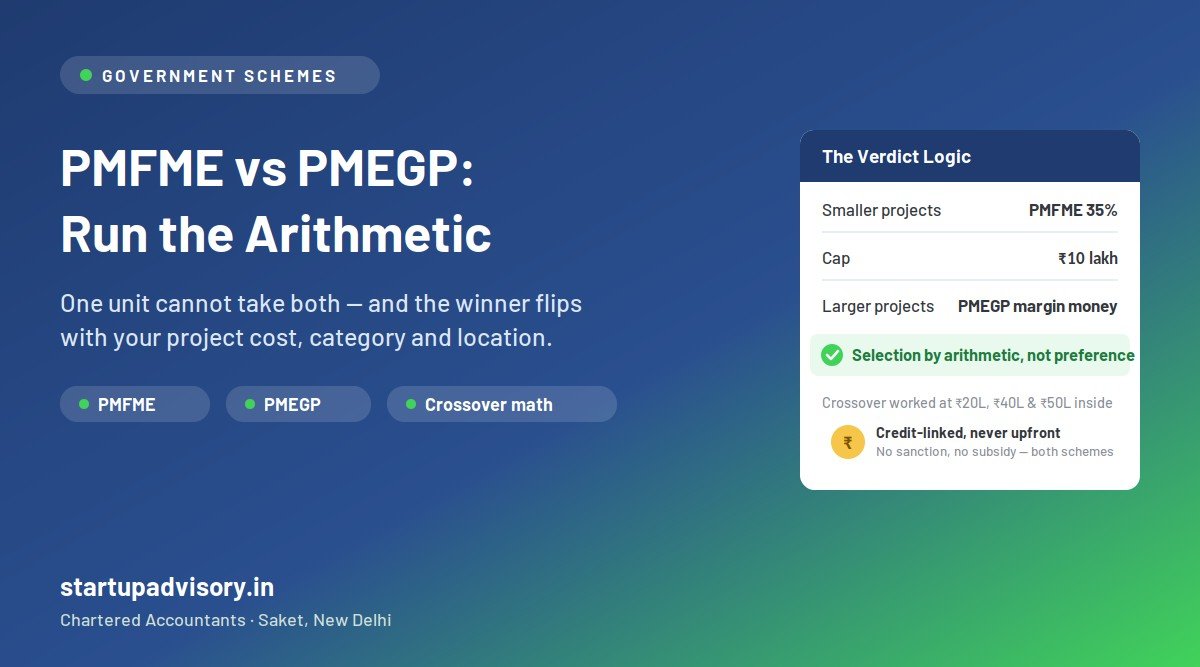
| PMEGP | 15–35% margin-money subsidy on project cost (max ₹50L mfg / ₹20L services) | First-time entrepreneurs setting up a new unit |
| CGTMSE | Collateral-free credit up to ₹10 crore via a government guarantee to your lender | Micro & small enterprises needing term loans / working capital without security |
| MUDRA | Loans up to ₹10 lakh (Tarun); ₹20 lakh under Tarun Plus for repeat borrowers | Micro units and small-ticket needs, no Udyam mandatory |
| MCGS-MSME | Guarantee cover on term loans up to ₹100 crore for plant & machinery purchase | Manufacturers funding capacity expansion |
| ECLGS 5.0 | Collateral-free working-capital top-up (see our full ECLGS 5.0 guide) | Existing borrowers hit by the liquidity squeeze |
| ZED Certification | Subsidised Bronze/Silver/Gold quality certification; 100% support for women-led MSMEs | Manufacturers selling to government or large buyers |
PMEGP: the flagship subsidy for new units
The Prime Minister's Employment Generation Programme, run by the Ministry of MSME through KVIC, KVIBs and District Industries Centres, is the main credit-linked subsidy (not just loan) scheme for new enterprises.
How much you get
- Urban, general category: 15% of project cost as margin-money subsidy
- Rural, general category: 25%
- Special categories (SC/ST/OBC, women, minorities, ex-servicemen, PH, and applicants in aspirational/NER/hill areas): 25% urban / 35% rural
Maximum eligible project cost: ₹50 lakh for manufacturing and ₹20 lakh for service/business activities. Your own contribution is typically 10% (5% for special categories); the balance comes as a bank loan.
Eligibility conditions that trip people up
- New projects only. Existing units, and units that have taken a subsidy under another government scheme, are excluded.
- Applicant must be 18+; for manufacturing projects above ₹10 lakh or service projects above ₹5 lakh, at least Class VIII pass.
- Self-help groups, registered societies, trusts and co-operatives can also apply — not just individuals.
- Beneficiaries of certain earlier credit-linked subsidy schemes are excluded — disclosed and verified at appraisal.
Process
Apply online at the PMEGP e-portal (kviconline.gov.in/pmegpeportal) with your project report; the file is scored, interviewed by the district task force, and forwarded to a bank for sanction. The subsidy is kept as a fixed deposit against your loan account and adjusted after the lock-in, subject to the unit staying operational — which is why realistic projections matter more than optimistic ones.
CGTMSE: collateral-free credit up to ₹10 crore
The Credit Guarantee Fund Trust for Micro and Small Enterprises doesn't lend to you. It guarantees your lender. Because the bank's risk is backstopped by the Trust, it can sanction credit without collateral or third-party guarantee.
- Ceiling raised: with effect from 1 April 2025, the guarantee ceiling went from ₹5 crore to ₹10 crore per borrower.
- Guarantee cover: broadly 75–85% of the facility, with enhanced cover of up to 90% for women-led enterprises and concessional annual guarantee fees for several categories.
- Who qualifies: new and existing micro and small enterprises (medium enterprises are outside CGTMSE) in manufacturing or services — and, after recent revisions, retail and wholesale trade too.
- How to apply: there is no separate CGTMSE application portal. You approach a Member Lending Institution (most banks and many NBFCs) with your Udyam certificate and project/financials; the lender applies for the guarantee.
The annual guarantee fee is borne on the outstanding amount at rates that were rationalised in the April 2025 revision — your lender will quote the exact figure for your slab; treat it as part of your effective borrowing cost when comparing options.
MUDRA: small-ticket loans, now up to ₹20 lakh
For smaller needs, PMMY (MUDRA) remains the fastest route: Shishu up to ₹50,000, Kishor up to ₹5 lakh, Tarun up to ₹10 lakh, and the newer Tarun Plus up to ₹20 lakh for borrowers who have successfully repaid a Tarun loan. Apply at any bank branch or via the Jan Samarth portal. MUDRA needs no DPIIT or heavy paperwork, which makes it the practical first rung for micro units.
MCGS-MSME: the machinery-purchase guarantee
The Mutual Credit Guarantee Scheme for MSMEs is the newest major addition to the stack, aimed squarely at manufacturers. It provides guarantee cover to scheduled banks, all-India financial institutions and NBFCs on term loans up to ₹100 crore sanctioned to Udyam-registered MSMEs for the purchase of plant, machinery and equipment. If your bottleneck is capex rather than working capital, this — not CGTMSE — is the scheme to discuss with your banker, and the project appraisal (machinery quotations, capacity utilisation projections, DSCR) needs to be watertight.
ZED certification: quality as a benefit multiplier
The Zero Defect Zero Effect (ZED) scheme certifies manufacturing MSMEs at Bronze, Silver and Gold levels. The Ministry subsidises certification costs — with 100% financial support for women-led MSMEs — and certified units get preference in government procurement on GeM plus better standing in the credit-guarantee ecosystem. If you sell (or want to sell) to government or large OEM buyers, ZED is low-hanging fruit.
Stacking schemes: a worked example
Take a ₹45 lakh food-packaging unit set up by a woman entrepreneur in rural NCR:
- PMEGP margin-money subsidy at 35% (rural, special category) ≈ ₹15.75 lakh
- Own contribution at 5% ≈ ₹2.25 lakh
- Balance ≈ ₹27 lakh as a bank loan — collateral-free under a CGTMSE guarantee, with enhanced cover for a women-led enterprise
Same project, structured badly — applied as an "existing" unit, or with a DPR whose numbers don't match the GST returns — gets rejected. Structure decides outcomes.
Why applications actually fail
- DPR–reality mismatch: projections that don't reconcile with your ITR, GST turnover or bank statements.
- Wrong or stale Udyam classification — declared investment/turnover out of sync with filings.
- Applying as "new" when the unit already exists (fatal for PMEGP).
- Asking the wrong scheme for the wrong need — e.g., pushing a ₹3 crore machinery loan through MUDRA-era paperwork instead of MCGS/CGTMSE.
- No follow-through: files sit at the bank; nobody chases the DIC, the task-force interview or the sanction conditions.
How Startup Advisory helps you claim these benefits
Our CA-led team in Saket works with MSMEs across Delhi, Gurgaon, Noida, Ghaziabad and Faridabad to convert scheme eligibility into sanctioned money:
- Udyam/MSME registration done right — and reconciled with your GST and ITR data.
- Bankable Detailed Project Reports with defensible projections, prepared by chartered accountants.
- Scheme selection and stacking strategy (PMEGP + CGTMSE, or MCGS for capex) matched to your actual numbers.
- Clean, lender-ready bookkeeping and Virtual CFO support so the bank sees a fundable business.
- End-to-end follow-up with the bank and implementing agency until disbursement.
Call 9311972982 or book a free consultation and we'll tell you — honestly — which schemes your business can realistically get.
This article is general information, not financial or legal advice. Subsidy percentages, ceilings and eligibility are set by scheme guidelines that change from time to time — verify current terms on the official portals (msme.gov.in, cgtmse.in, kviconline.gov.in, mudra.org.in) or with your lender before acting.