
Compliance / Small Business
Annual Compliances for a Proprietorship Business (2026): The Complete Preparation, Documents & Due-Date Guide
In short
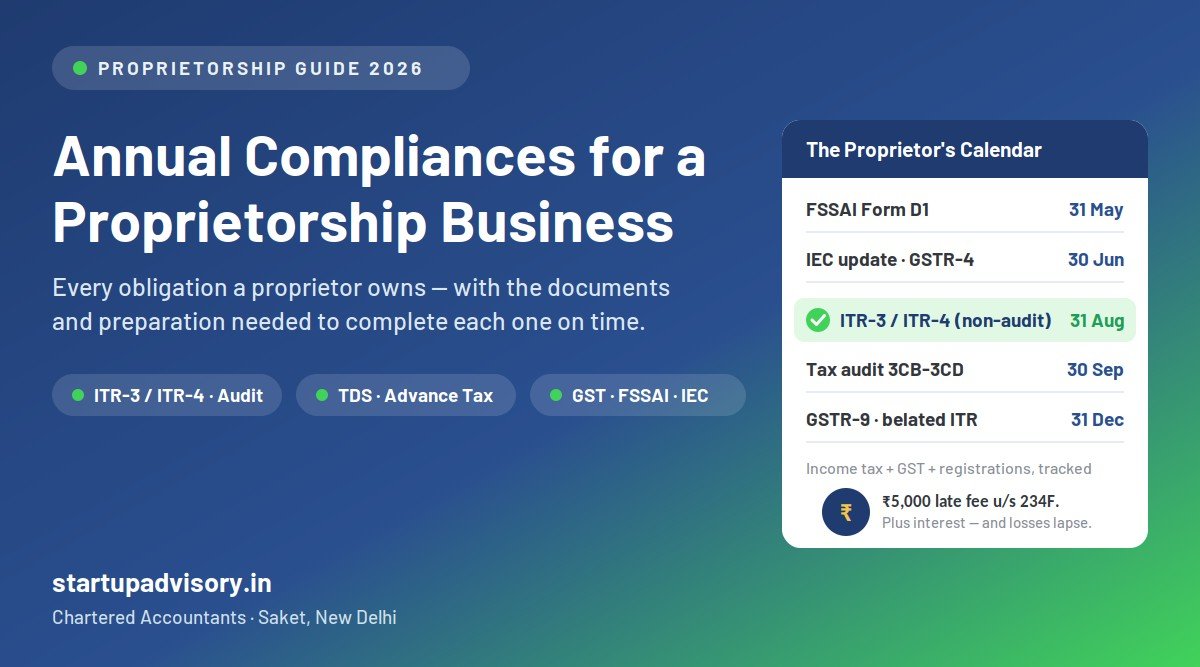
A proprietorship files nothing with the ROC — but the proprietor personally owns a full compliance calendar built from the registrations the business holds. The core is the income tax return: ITR-4 (presumptive under 44AD/44ADA) or ITR-3, due 31 August 2026 for FY 2025-26 in non-audit cases — a month later than the salaried deadline. Around it sit tax audit (turnover above ₹1 crore / receipts above ₹50 lakh; Form 3CB-3CD by 30 September, return by 31 October), advance tax in four instalments, TDS deduction and quarterly returns once last year's turnover crossed ₹1 crore (₹50 lakh for professionals), the full GST cycle including GSTR-9 by 31 December, FSSAI Form D1 by 31 May for licensed food businesses, and the April–June IEC update for exporters. Each section below tells you who it applies to, when it falls due, and exactly which papers to keep ready. The FY 2025-26 return is your last under the 1961 Act — from FY 2026-27 the Income Tax Act, 2025 takes over with renumbered sections.
The proprietorship is India's simplest business structure — no incorporation, no ROC, no separate legal identity. That simplicity misleads people in two directions. Some proprietors assume “no company means no compliance” and discover late fees, interest and disallowances the hard way. Others carry a vague dread of paperwork and over-engineer. The truth is precise: a proprietorship's compliance load is entirely determined by what the business does and which registrations it holds. This guide works through each obligation the way we run it for clients — who it applies to, the due date, and the documents to have ready before the deadline week — so that the whole year becomes a checklist rather than a scramble.
Start here: the compliance map
Because the proprietor and the business are legally the same person, income tax compliance applies to every proprietorship without exception. Everything else switches on with a registration or a threshold:
| If this applies to you… | …you own this compliance |
|---|---|
| Every proprietorship | Annual ITR (ITR-3/ITR-4) · advance tax · books of account per Section 44AA |
| Turnover above the 44AB limits | Tax audit — Form 3CB-3CD by 30 September |
| Last year's turnover > ₹1 crore (business) / ₹50 lakh (profession) | TDS deduction on specified payments + quarterly TDS returns |
| Employees on payroll | TDS on salary (192) · EPF (20+ employees) · ESI (10+ employees) |
| GST registration (regular) | GSTR-1 + GSTR-3B (monthly/QRMP) · GSTR-9 above ₹2 crore · GSTR-9C above ₹5 crore |
| GST composition scheme | CMP-08 quarterly · GSTR-4 annually by 30 June |
| FSSAI licence (State/Central) | Annual return Form D1 by 31 May on FoSCoS |
| Import Export Code (IEC) | Annual online update between April and June — even if nothing changed |
| Udyam registration | No return — but classification auto-updates from your ITR & GST data |
| Trade licence / Shops & Establishment | Renewal per your state or municipal cycle |
Now each row in detail, with its preparation checklist.
1. The income tax return — the compliance every proprietor owns
Which form: ITR-4 or ITR-3
- ITR-4 (Sugam) — if you declare presumptive income: Section 44AD for business (turnover up to ₹2 crore, extended to ₹3 crore where cash receipts are 5% or less; deemed profit 8% of cash turnover, 6% of digital) or Section 44ADA for professionals (gross receipts up to ₹50 lakh, extended to ₹75 lakh with the same 5% cash condition; deemed profit 50%). No books, no audit for that business — the scheme's whole point. Our detailed guide: Section 44AD & 44ADA explained.
- ITR-3 — everyone else with business or professional income: regular books, actual profit, and the form that carries the balance sheet and P&L schedules.
Remember that the return covers the person, not just the shop: salary, rent, capital gains and interest income all go into the same ITR alongside business profit. And the regime choice matters more for proprietors than for anyone else — the new regime under Section 115BAC is the default; opting for the old regime with business income requires Form 10-IEA before the due date, and the switch back is effectively once in a lifetime for business income.
The dates for FY 2025-26 (AY 2026-27)
| Situation | Due date |
|---|---|
| ITR-3 / ITR-4, no audit required | 31 August 2026 |
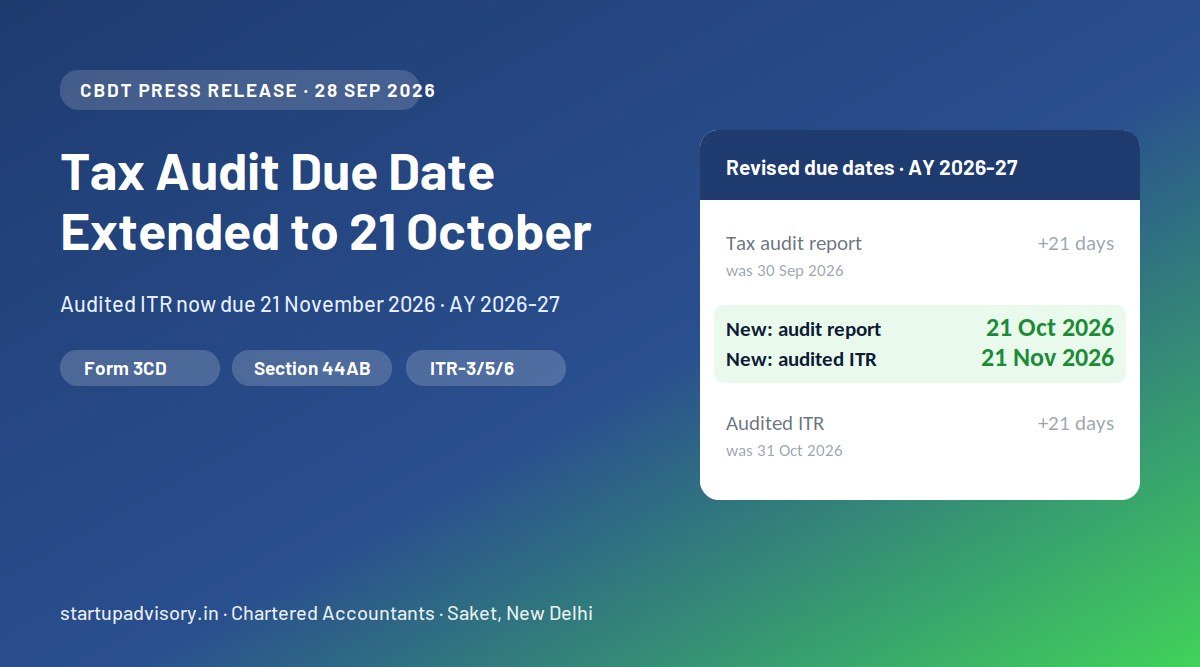
| Tax audit report (Form 3CB-3CD) | 30 September 2026 |
| ITR-3, audit cases | 31 October 2026 |
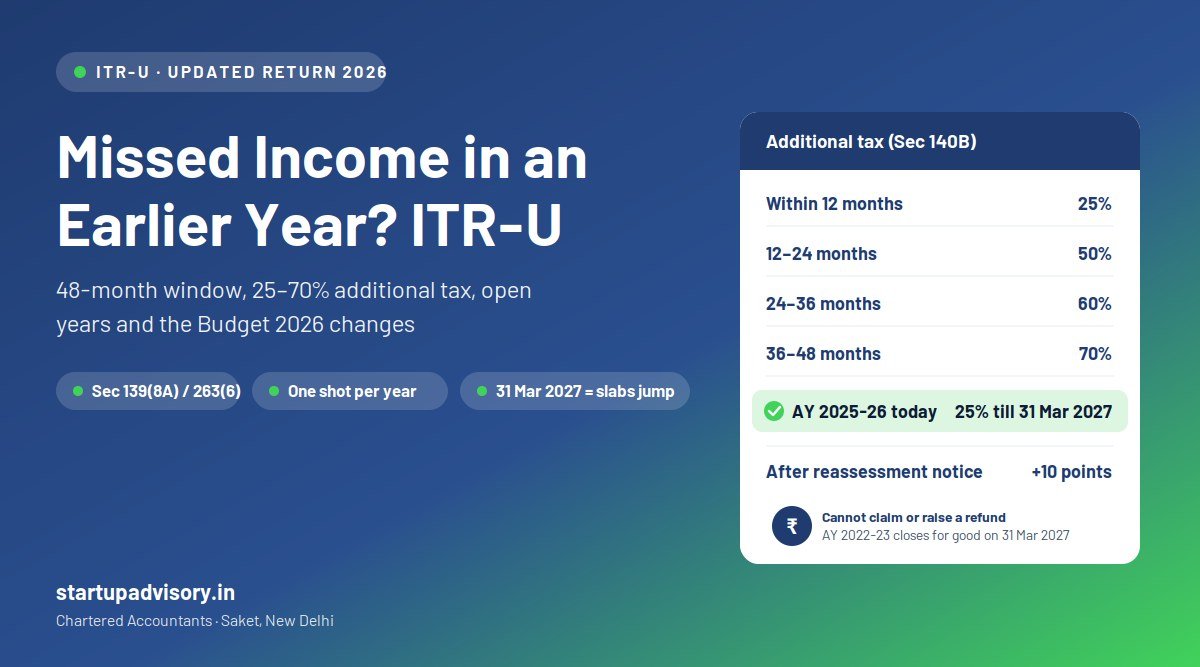
| Belated / revised return | 31 December 2026 (belated) · 31 March 2027 (revised) |
The 31 August date is new from this assessment year — non-audit ITR-3/ITR-4 filers get a month beyond the salaried 31 July deadline. As we publish, that deadline is days away. Miss it and Section 234F levies a fee up to ₹5,000 (₹1,000 where total income is up to ₹5 lakh), Section 234A interest runs at 1% a month on unpaid tax, business losses lose their carry-forward, and the new-regime lock closes the Form 10-IEA window — the full damage list is in our belated return guide.
Preparation checklist — documents for the ITR
- Identity & access: PAN, Aadhaar (linked), e-filing login, and every bank account number with IFSC — all accounts must be reported, including savings accounts that received business payments.
- Income records: sales register or invoice summary for the year; for presumptive filers, the split of cash vs digital receipts (it changes the deemed rate and the eligibility ceiling); professional receipt ledger for 44ADA.
- Expense records (ITR-3): purchase register, expense ledgers with vouchers, rent agreement and rent receipts, salary register, depreciation working with the fixed asset register, loan statements with the interest certificate.
- Tax credits: Form 26AS, AIS and TIS downloaded fresh and reconciled line by line against your books — mismatches between AIS and the return are the single biggest trigger for notices. TDS certificates (Form 16A) from customers who deducted on your invoices; advance tax and self-assessment challans.
- Other-income proofs: interest certificates, capital gains statements from brokers, rent received.
- Last year's return and computation — for brought-forward losses, WDV of assets, and consistency of the regime and scheme choices.
2. Advance tax — four small deadlines that prevent one big one
If the year's estimated tax liability (after TDS) is ₹10,000 or more, advance tax applies: 15% by 15 June, 45% by 15 September, 75% by 15 December, 100% by 15 March. Presumptive filers under 44AD/44ADA get the simplest deal in the Act — one instalment, 100% by 15 March. Shortfalls attract interest under Sections 234B and 234C; it is rarely ruinous, but it is pure waste. Preparation: a quarterly profit estimate — even a one-page one — plus the challan (CRN) generated on the portal before each date. We keep clients on a 10-minute quarterly call for exactly this.
3. Tax audit under Section 44AB — when size switches it on
A proprietorship needs a tax audit when:
- Business: turnover exceeds ₹1 crore — relaxed to ₹10 crore where cash receipts and cash payments are each 5% or less of the totals (the digital-business relaxation most Delhi traders now qualify for);
- Profession: gross receipts exceed ₹50 lakh;
- The 44AD exit trap: leaving the presumptive scheme within the 5-year lock-in, with income above the basic exemption, forces books and audit at any turnover.
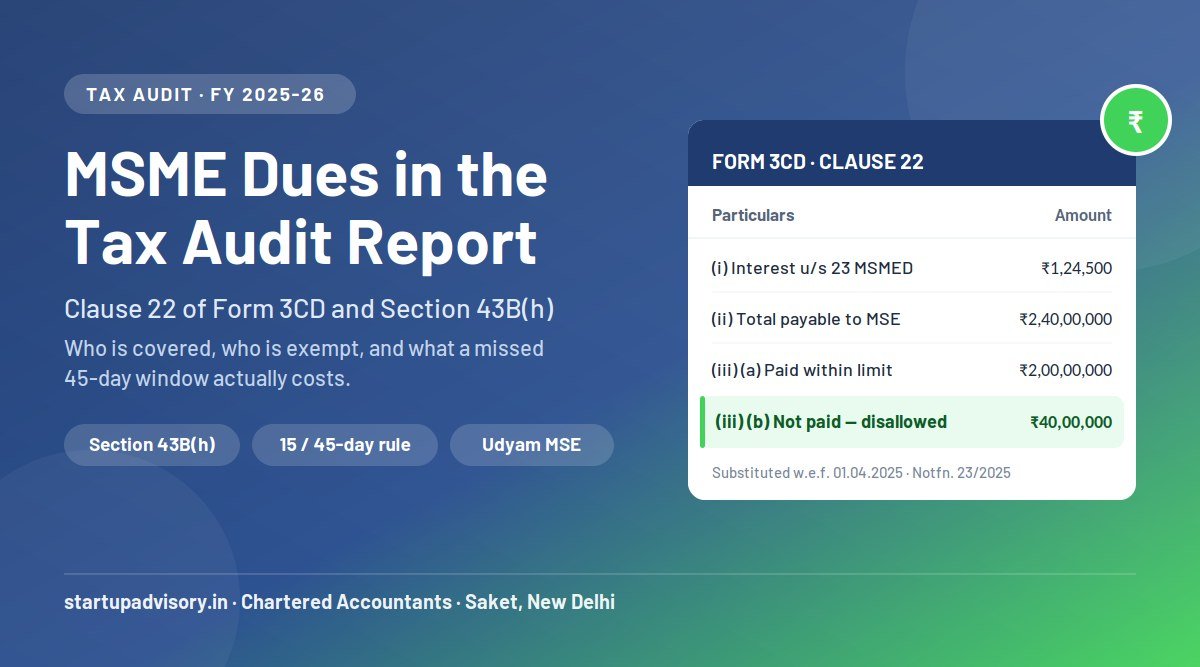
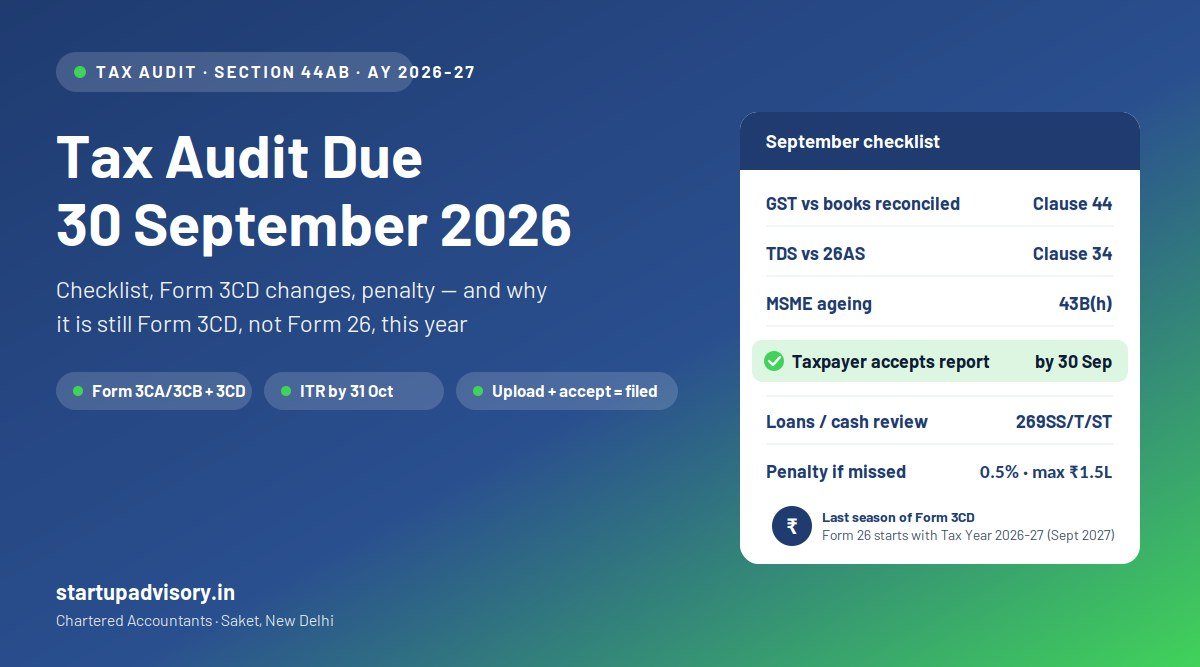
The audit report (Form 3CB-3CD, filed by the CA and accepted by you on the portal) is due 30 September 2026; the return follows by 31 October. Missing the audit costs 0.5% of turnover up to ₹1.5 lakh under Section 271B. Full applicability tests are in our Section 44AB guide. Preparation: everything in the ITR checklist above, plus closing stock valuation with method notes, debtor/creditor lists with confirmations for major balances, cash book with a physical cash count at 31 March, GST returns reconciled to the books turnover, and details the 3CD specifically asks for — loans accepted/repaid in cash (Sections 269SS/269T), TDS compliance status, and payments to relatives.
4. TDS — the obligation proprietors discover one year too late
The trigger is last year's size, not this year's: an individual whose business turnover exceeded ₹1 crore (or professional receipts exceeded ₹50 lakh) in the preceding financial year must deduct TDS on specified payments from 1 April — contractor payments (194C), professional and technical fees (194J), rent (194I), commission (194H) and interest (194A). Salary TDS under Section 192 applies to every employer, whatever the turnover.
The machinery: obtain a TAN; deposit deductions by the 7th of the following month (30 April for March deductions); file quarterly returns — 26Q (non-salary) and 24Q (salary) — by 31 July, 31 October, 31 January and 31 May; issue Form 16/16A certificates. The late-return fee under Section 234E is ₹200 per day, and expense disallowance under Section 40(a)(ia) adds 30% of the un-deducted amount to your taxable income. Preparation: a vendor master with PANs verified before the first payment (no PAN means 20% deduction), a monthly payment register mapped to TDS sections, challan records, and a calendar reminder on the 5th of every month.
5. GST — the year's heaviest recurring cycle
If the proprietorship holds a regular GST registration:
- GSTR-1 (outward supplies) — monthly by the 11th, or quarterly with the Invoice Furnishing Facility under QRMP (turnover up to ₹5 crore);
- GSTR-3B (summary + payment) — monthly by the 20th, or quarterly under QRMP with monthly PMT-06 tax payments;
- GSTR-9 annual return — by 31 December, mandatory where aggregate turnover exceeds ₹2 crore; GSTR-9C self-certified reconciliation adds on above ₹5 crore;
- E-invoicing — mandatory for B2B invoices once aggregate turnover crosses ₹5 crore.
Composition taxpayers run a lighter loop: CMP-08 quarterly by the 18th after each quarter, and the annual GSTR-4 by 30 June following the financial year.
The discipline that decides whether GST is painless or expensive is monthly GSTR-2B reconciliation — your input tax credit exists only to the extent suppliers have reported the invoices. Preparation: sales and purchase registers closed monthly, 2B downloaded and matched before every 3B, RCM self-invoices for imported services and other reverse-charge items, e-way bill records, and a year-end books-vs-returns turnover reconciliation (this is precisely what GSTR-9 tests). Our GST & TDS calendar carries every date.
6. Registration upkeep — the quiet annual duties
- Udyam (MSME): no annual return — but the classification updates itself from your ITR and GST data. Not filing the ITR doesn't just risk tax consequences; it corrupts the Udyam classification your bank limits and scheme eligibility rest on. Keep the profile's activity and bank details current.
- FSSAI: holders of a State or Central licence (manufacturers, importers, repackers — not Basic Registration holders) file the annual return Form D1 on FoSCoS by 31 May; dairy businesses add the half-yearly Form D2. Late filing attracts a per-day fee under the licensing regulations. Preparation: product-wise quantities manufactured/handled, values, and packaging details — pulled painlessly from a maintained stock register, painfully from memory. Licence slabs changed in 2026; see our FSSAI new-rules guide.
- IEC: every Import Export Code must be updated online between April and June each year — even if nothing has changed. Skip it and the IEC is deactivated, which surfaces at the worst possible moment: a shipment at port.
- Trade licence / Shops & Establishment: renewal cycles are state and municipal — check yours. (Delhi proprietors: there is currently no professional tax in Delhi, one genuine local mercy.)
- EPF and ESI: EPF becomes mandatory at 20 employees, ESI at 10 employees (wage ceiling applies); both then run as monthly compliances — contributions and returns by the 15th. Preparation: a clean salary register with UANs and a payroll cut-off discipline.
7. Books of account — the foundation under everything above
Section 44AA requires an individual in business to maintain books where income exceeds ₹2.5 lakh or turnover exceeds ₹25 lakh in any of the three preceding years. Specified professionals (legal, medical, engineering, architecture, accountancy, technical consultancy, interior decoration) follow Rule 6F: cash book, journal, ledger, and copies of bills. Presumptive filers under 44AD/44ADA are exempt for that business — though we still recommend a basic receipts-and-payments record, because the cash-vs-digital split and the eligibility ceilings must be provable. Preserve records for at least six years from the end of the relevant assessment year — longer if any assessment or appeal is open. If bookkeeping is the bottleneck, that is a solvable problem: see our bookkeeping service.
The proprietor's compliance calendar at a glance
| Due date | Compliance | Applies if |
|---|---|---|
| Monthly — 7th | TDS deposit for the previous month | TDS obligation triggered |
| Monthly — 11th / 20th | GSTR-1 / GSTR-3B (monthly filers) | Regular GST registration |
| Monthly — 15th | EPF & ESI contributions | Employee thresholds crossed |
| 15 Jun · 15 Sep · 15 Dec · 15 Mar | Advance tax instalments (15/45/75/100%) | Tax liability ₹10,000+ (presumptive: 15 Mar only) |
| 30 Apr | TDS deposit for March | TDS obligation |
| 31 May | TDS return Q4 · FSSAI Form D1 | TDS obligation / FSSAI licence |
| 30 Jun | GSTR-4 (composition, FY 2025-26) · IEC annual update window closes | Composition scheme / IEC holder |
| 31 Jul | TDS return Q1 | TDS obligation |
| 31 Aug 2026 | ITR-3 / ITR-4 — non-audit cases (FY 2025-26) | Every proprietorship not under audit |
| 30 Sep 2026 | Tax audit report Form 3CB-3CD | 44AB triggered |
| 31 Oct 2026 | ITR-3 (audit cases) · TDS return Q2 | Audit cases / TDS obligation |
| 31 Dec 2026 | GSTR-9 / GSTR-9C (FY 2025-26) · last date for belated ITR | Turnover thresholds / late filers |
| 31 Jan | TDS return Q3 | TDS obligation |
State trade-licence and shops-and-establishment renewals follow their own local cycles. Where a due date is extended by CBDT/GSTN/departmental notification, the extended date governs.
What changes from FY 2026-27: the Income Tax Act, 2025
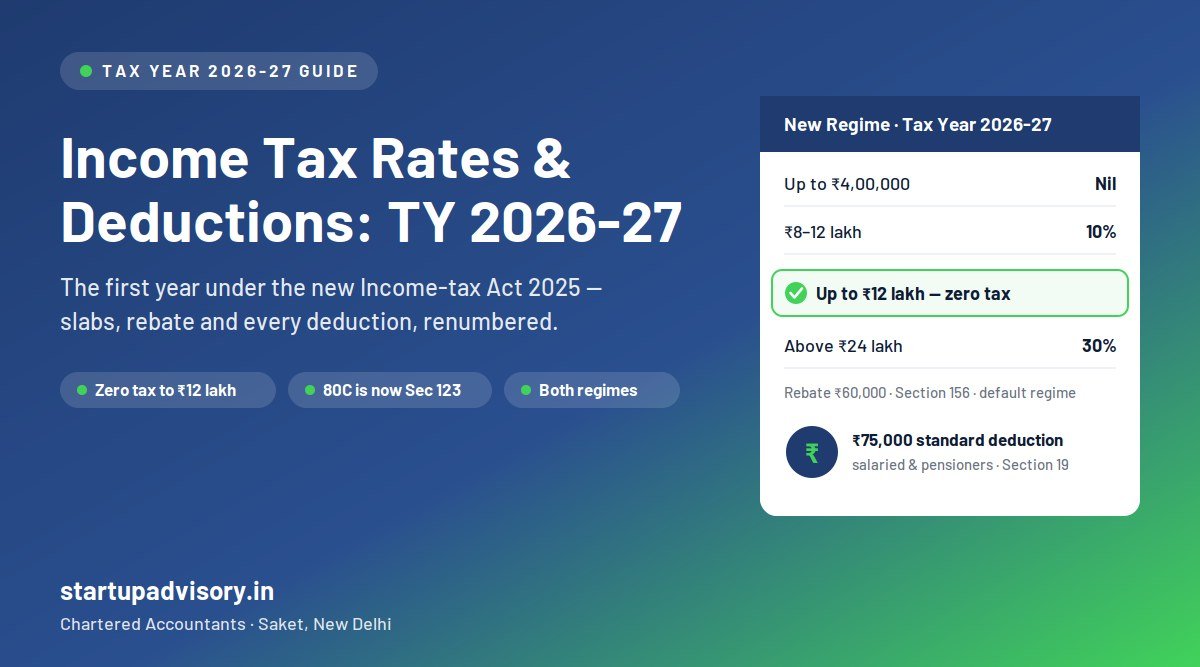
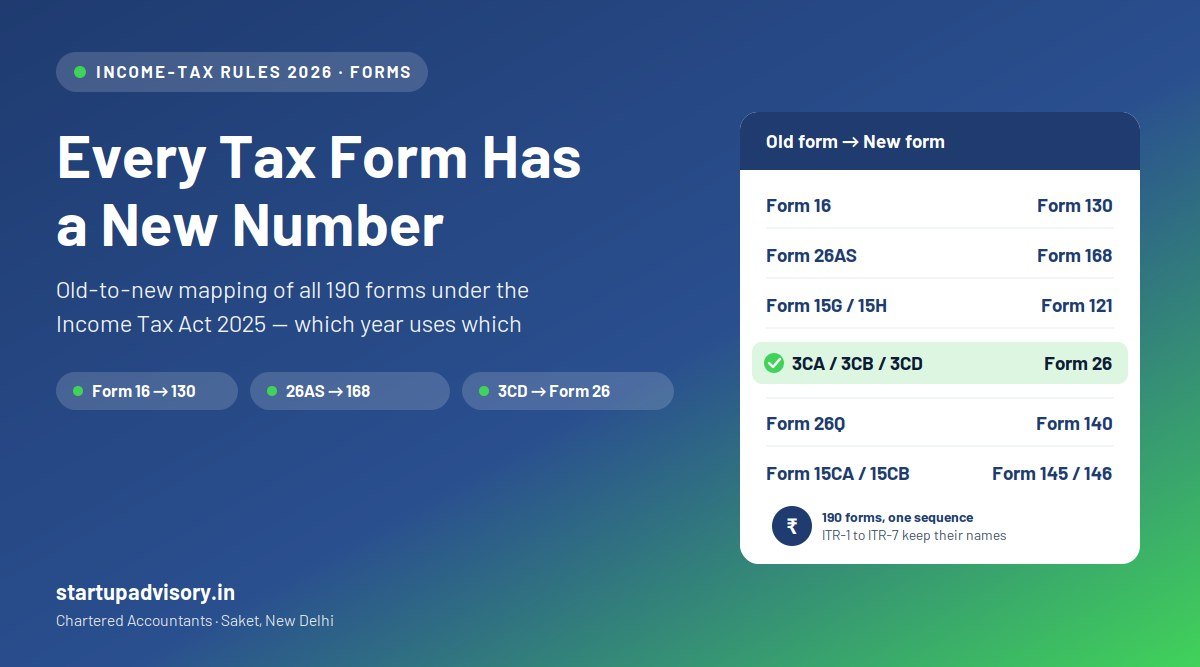
Everything above for FY 2025-26 runs under the Income-tax Act, 1961 — including the return you file this month. From 1 April 2026, income of FY 2026-27 onwards falls under the Income Tax Act, 2025: the assessment year gives way to a single “tax year”, and the familiar section numbers move — the tax audit provision, for instance, shifts from Section 44AB to Section 63. The obligations themselves — return, audit, advance tax, TDS — carry forward in substantially the same shape, and the portal runs both regimes in parallel through the transition. Bookmark our old-vs-new section mapping for the renumbering.
The five mistakes we actually see
- Mixing personal and business banking. Legally one person, yes — but one bank account makes every compliance above harder and every scrutiny worse. A separate current account is the cheapest compliance tool that exists.
- Discovering the TDS obligation in the audit. The trigger is last year's turnover; the deduction duty starts on 1 April. A year of missed deductions means interest, fees and a 30% expense disallowance stacked together.
- Ignoring AIS until the notice. The department already has your card settlements, bank interest and property transactions. Reconcile AIS/26AS to books before filing, not after a mismatch letter.
- Treating the presumptive scheme as “no records at all.” The cash/digital split, the turnover ceiling and the 5-year lock-in all need evidence; and GST-registered presumptive filers still owe the entire GST cycle.
- Letting the quiet renewals lapse. A deactivated IEC, an expired trade licence or a stale Udyam profile costs nothing for months — then blocks a shipment, a tender or a loan on a deadline you don't control.
This article reflects the position as we understand it in August 2026 for FY 2025-26 (AY 2026-27) compliances under the Income-tax Act, 1961 and allied laws, with the Income Tax Act, 2025 (effective 1 April 2026) noted where relevant. Statutory due dates can be extended by notification. This is general information, not legal or tax advice — take professional advice on your specific position before acting.
How Startup Advisory Can Help
Startup Advisory is a CA-led firm in Saket, New Delhi working with proprietors and small businesses across Delhi NCR:
- Setup & registrations — proprietorship setup with GST, MSME/Udyam, FSSAI and IEC registrations done right the first time.
- The annual cycle, managed — ITR-3/ITR-4 with regime and scheme optimisation, advance tax tracking, tax audit where applicable, and TDS returns — on a fixed calendar, not a deadline scramble.
- Books & GST — monthly bookkeeping with GSTR-2B reconciliation and the full GST return cycle through our GST practice.
Running a proprietorship in Delhi NCR? Call 9311972982 or book a consultation for a compliance health-check against this calendar — especially if your ITR is still pending this month.