
Tax & ITR
Applicability of Income Tax Audit: Who Needs a Tax Audit in 2026?
In short
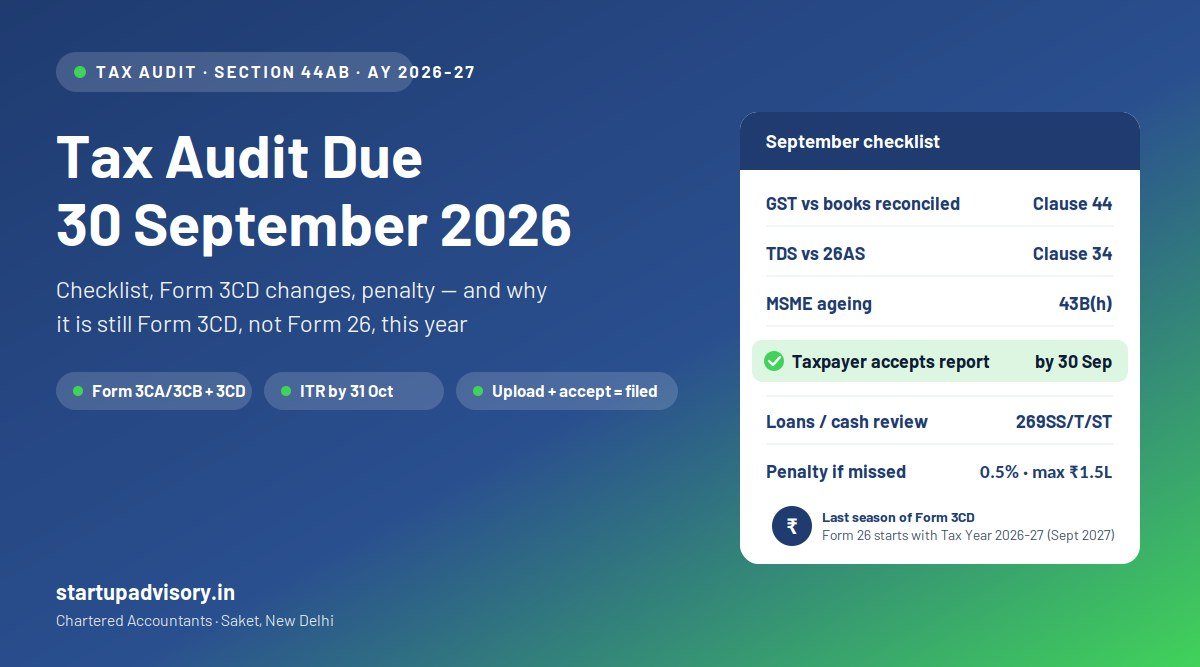
An income tax audit under Section 44AB becomes compulsory mainly on the basis of turnover. For FY 2025-26 (AY 2026-27), a business needs a tax audit if turnover crosses Rs. 1 crore (relaxed to Rs. 10 crore when at least 95% of receipts and payments are digital), and a professional needs one if gross receipts cross Rs. 50 lakh. Presumptive taxpayers who declare income below the prescribed rate can also get pulled in. The audit report (Form 3CB/3CA + 3CD) is due by 30 September 2026, and the penalty for missing it under Section 271B is 0.5% of turnover or Rs. 1.5 lakh, whichever is lower.
"Does my business need a tax audit?" is one of the most common questions founders, freelancers and small-business owners in Delhi NCR ask us at year-end. The answer turns almost entirely on a few numbers and the route you choose to declare income. This guide breaks down the applicability of income tax audit in plain language — who is in, who is out, and the practical edge cases that trip people up.
What is a tax audit under Section 44AB?
A tax audit is an examination of your books of accounts by a practising Chartered Accountant to confirm that your income, deductions and disclosures are computed correctly under the Income Tax Act. It is governed by Section 44AB. The CA verifies records such as the cash book, ledgers, bank statements, stock and sales/purchase invoices, and reports the findings in a prescribed format that is filed alongside (or before) your income tax return.
Importantly, a tax audit is not the same as a statutory audit under the Companies Act, a GST audit, or an investigation by the department. It is a one-time annual compliance that applies only when you cross the thresholds below.
Tax audit limits for FY 2025-26 (AY 2026-27)
| Type of taxpayer | Threshold | Audit applies when… |
|---|---|---|
| Business (standard) | Turnover > Rs. 1 crore | Sales/turnover/gross receipts cross Rs. 1 crore in the year |
| Business (digital) | Turnover > Rs. 10 crore | Limit rises to Rs. 10 crore if both cash receipts and cash payments are ≤ 5% of the total (i.e. ≥ 95% digital) |
| Profession | Gross receipts > Rs. 50 lakh | Receipts of doctors, lawyers, CAs, architects, consultants, etc. cross Rs. 50 lakh |
| Presumptive business (44AD) | Profit below 8% / 6% | Declares profit lower than the deemed rate and total income exceeds the basic exemption limit |
| Presumptive professional (44ADA) | Profit below 50% | Declares less than 50% of gross receipts and total income exceeds the basic exemption limit |
The single most important point: turnover, not profit, is the primary trigger for a business audit. Even a loss-making business with turnover above Rs. 1 crore (and not under a presumptive scheme) generally needs an audit so the loss is verified and can be carried forward.
The Rs. 10 crore "digital turnover" relief — read the fine print
Many founders assume turnover up to Rs. 10 crore is automatically audit-free. It is not. The higher Rs. 10 crore limit applies only if both conditions are met for the full year:
- Cash receipts are 5% or less of total receipts, and
- Cash payments are 5% or less of total payments.
In other words, at least 95% of your money in and money out must move through banking or digital channels. Slip even slightly below that ratio and the business falls straight back under the Rs. 1 crore limit. This is exactly the kind of detail worth tracking through the year rather than discovering in September.
How presumptive taxation interacts with the audit
Presumptive schemes are designed to spare small taxpayers from books and audits — but only if you play within the rules.
- Section 44AD (small business): available up to Rs. 2 crore turnover (Rs. 3 crore if cash receipts are ≤ 5%). You declare deemed profit of 8% (cash) or 6% (digital). Declare less than that while your income is above the exemption limit, and an audit becomes mandatory.
- Section 44ADA (professionals): available up to Rs. 50 lakh gross receipts (Rs. 75 lakh if cash receipts are ≤ 5%). You declare 50% of receipts as income. Declare less, with income above the exemption limit, and you must audit.
- Section 44AE (transporters): for those owning up to 10 goods vehicles, with income computed per vehicle per month.
There is also the well-known 44AD "five-year lock-in": if you opt into 44AD and then opt out in a later year by declaring lower profits, you are barred from the scheme for the next five years — and during that period, if income exceeds the exemption limit, you are required to maintain books and get them audited.
Which forms does the auditor file?
- Form 3CA — where the accounts are already audited under another law (for example, a company audited under the Companies Act).
- Form 3CB — in all other cases (such as a proprietorship or firm not audited elsewhere).
- Form 3CD — the detailed statement of particulars, filed together with 3CA or 3CB.
Due dates for AY 2026-27
| Compliance | Due date |
|---|---|
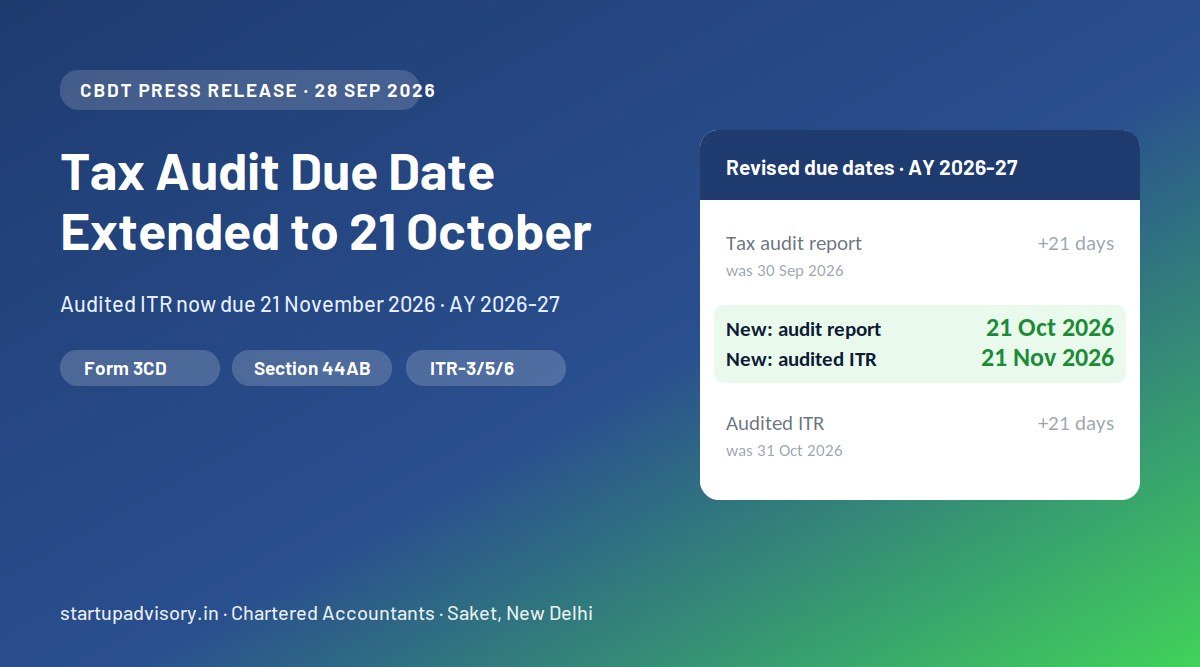
| Tax audit report (Form 3CA/3CB + 3CD) | 30 September 2026 |
| Income tax return — audit cases | 31 October 2026 |
| Transfer-pricing report (Form 3CEB) | 31 October 2026 |
| Income tax return — transfer-pricing cases | 30 November 2026 |
The audit report must be uploaded by the CA and accepted by you on the e-filing portal before the return is filed. Leaving it to the last week is the most common reason people miss the deadline. For the full filing calendar, see our ITR due dates for AY 2026-27 guide.
Penalty for not getting audited
If you are required to get a tax audit and fail to do so (or file the report late), the penalty under Section 271B is the lower of:
- 0.5% of total sales, turnover or gross receipts, or
- Rs. 1,50,000.
The law does allow relief: if you can show a reasonable cause for the failure — for instance, a genuine system failure, a natural calamity or a sudden serious illness — the penalty need not be levied.
Quick scenarios
- A Delhi trader with Rs. 1.4 crore turnover, mostly cash: audit required (above Rs. 1 crore, and the Rs. 10 crore relief needs 95% digital).
- A SaaS startup with Rs. 6 crore turnover, fully digital: no audit on turnover grounds (under Rs. 10 crore with ≥95% digital), assuming it is not otherwise required.
- A freelance consultant earning Rs. 60 lakh: above Rs. 50 lakh, so audit applies unless eligible for and correctly declaring under 44ADA within the Rs. 75 lakh digital limit.
- A small business under 44AD declaring 4% profit with taxable income: audit required, because the declared profit is below the deemed rate.
How Startup Advisory helps
Our CA-led team in Saket, New Delhi first tells you clearly whether an audit even applies — many businesses get scared into audits they do not need, and others miss one they do. Where it applies, we prepare the books, complete the Form 3CD particulars, file 3CA/3CB and the return, and keep you penalty-free. See our ITR & tax advisory and bookkeeping services for businesses across Delhi NCR.
This article is general information, not tax advice. Thresholds, dates and rules can change or be extended by the CBDT, and applicability depends on your specific facts — confirm with a qualified professional before acting.
How Startup Advisory Can Help
Startup Advisory is a CA-led firm in Saket, New Delhi that handles tax audits and audit-applicability questions for businesses and professionals across Delhi NCR. Whether Section 44AB applies to you is rarely as simple as a single turnover figure — we tell you clearly and handle the audit if needed:
- A clear assessment of whether a tax audit applies to you under the latest 44AB limits.
- End-to-end statutory and tax-audit support, plus ITR filing and tax advisory.
- Audit-ready bookkeeping so the audit is smooth, not stressful.
- A named Chartered Accountant who signs off on the work.
Call 9311972982 or book a free consultation to check your audit applicability.
Frequently Asked Questions
Primary sources
The statements of law and figures above are drawn from the official texts below. Each link was checked on 18 September 2026; government portals reorganise their pages from time to time, so tell us if one has moved.