
Company Law & Compliance
ROC Annual Compliance Calendar FY 2025-26: Every Due Date for Pvt Ltd & LLP
In short
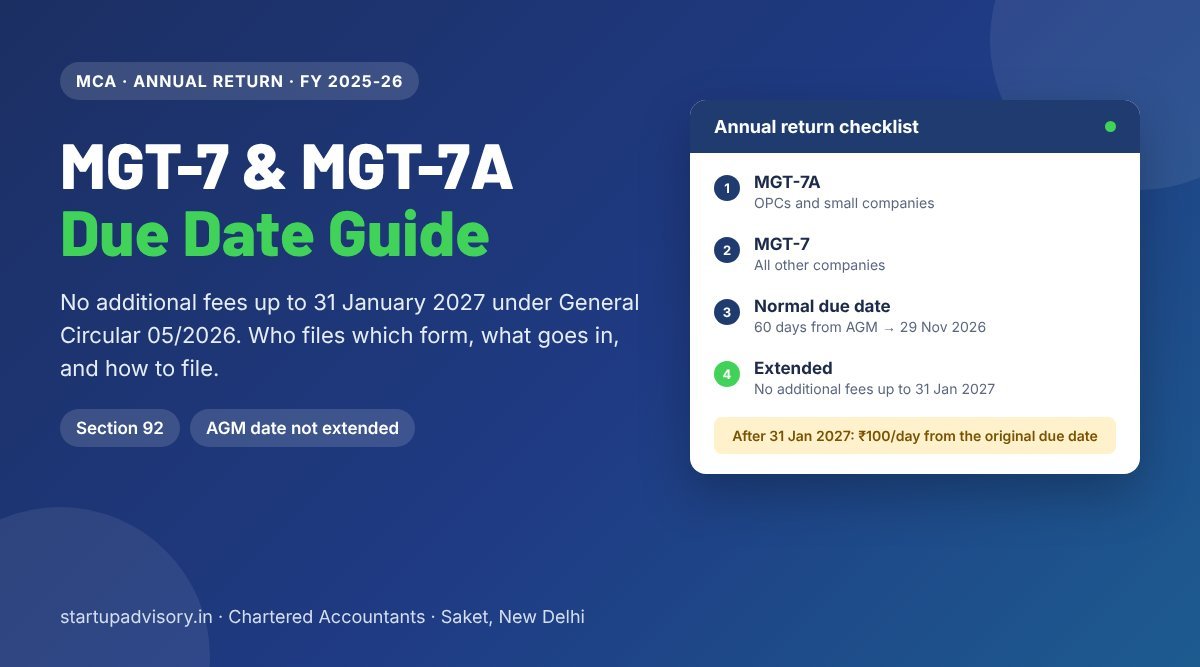
Every company registered under the Companies Act, 2013 must complete its ROC annual filings — whether or not it did any business. For FY 2025-26, hold the AGM by 30 September 2026; file AOC-4 (financial statements) by 31 December 2026 and MGT-7 / MGT-7A (annual return) by 31 January 2027, the dates MCA extended by General Circular 05/2026 (normally 30 and 60 days after the AGM). Also: DPT-3 by 30 June 2026 and MSME-1 half-yearly (30 April and 31 October 2026). DIR-3 KYC is no longer annual — from 31 March 2026 it is filed once every three financial years, by 30 June. LLPs file Form 11 by 30 May 2026 and Form 8 by 30 October 2026. Late filing of AOC-4/MGT-7 costs Rs. 100 per day, per form, with no cap, and missing DIR-3 KYC deactivates the director's DIN.
Update, 24 October 2026: AOC-4 and MGT-7 extended
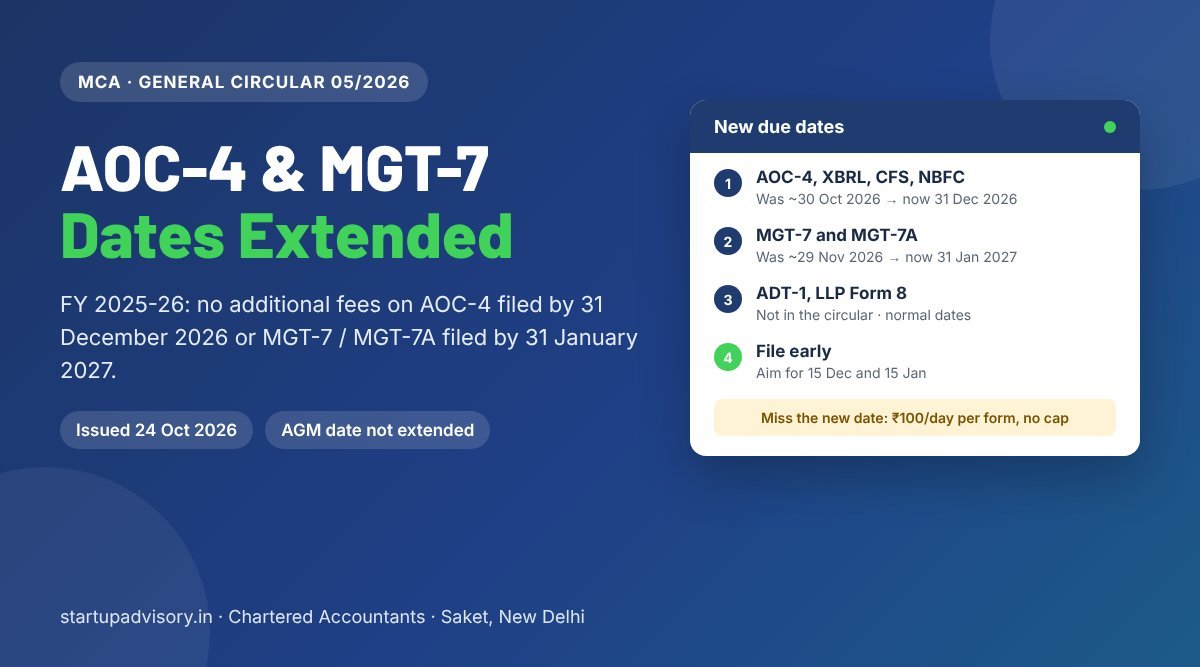
MCA General Circular No. 05/2026 dated 24 October 2026 relaxes additional fees for FY 2025-26: AOC-4, AOC-4 (XBRL), AOC-4 (CFS), AOC-4 CFS NBFC (Ind AS) and AOC-4 NBFC (Ind AS) can be filed up to 31 December 2026, and MGT-7 and MGT-7A up to 31 January 2027, without additional fees. The AGM deadline, ADT-1 and the LLP forms are not covered. Read our full note on the extension.
Most founders we meet in Delhi NCR remember to register their company — and then forget that registration starts an annual obligation that never stops. ROC compliance is not optional, not turnover-dependent, and the penalties run per day, per form with no ceiling. This calendar lays out every filing a private limited company and LLP must make for FY 2025-26, when each is due, and what it costs to miss it.
What is ROC annual compliance?
ROC compliance is the set of mandatory filings every company and LLP must submit to the Registrar of Companies (under the Ministry of Corporate Affairs) each year. The two pillars are AOC-4 (your audited financial statements) and MGT-7 / MGT-7A (your annual return), supported by KYC, deposit, MSME and auditor filings. These obligations exist for every registered company — including a dormant, nil-revenue or loss-making one. Filing keeps your company's status "Active" on the MCA portal; not filing risks penalties, director disqualification and eventual strike-off.
ROC compliance calendar for FY 2025-26
| Due date | Form | What it covers |
|---|---|---|
| 30 April 2026 | MSME-1 | Half-yearly return of dues to micro/small vendors outstanding beyond 45 days (Oct 2025–Mar 2026) |
| 30 May 2026 | LLP Form 11 | Annual return of an LLP |
| 30 June 2026 | DPT-3 | Annual return of deposits and outstanding loans/money received (as on 31 Mar 2026) |
| 30 June (every 3 FYs) | DIR-3 KYC Web | Director KYC — now filed once every three financial years (MCA rule from 31 Mar 2026), not annual. Many directors who filed for FY 2025-26 next file by 30 June 2028 |
| 30 September 2026 | AGM | Last date to hold the Annual General Meeting for FY 2025-26 |
| Within 15 days of AGM | ADT-1 | Intimation of auditor appointment/reappointment (event-based) |
| 30 October 2026 | LLP Form 8 | Statement of accounts and solvency of an LLP |
| 31 October 2026 | MSME-1 | Half-yearly MSME return (Apr 2026–Sep 2026) |
| 31 December 2026 (extended; normally 30 days after AGM) | AOC-4 | Filing of audited financial statements and Board's Report. No additional fees up to 31 Dec 2026 under MCA GC 05/2026 |
| 31 January 2027 (extended; normally 60 days after AGM) | MGT-7 / MGT-7A | Annual return (MGT-7A for OPCs and small companies). No additional fees up to 31 Jan 2027 under MCA GC 05/2026 |
Normally, AOC-4 and MGT-7 deadlines are calculated from your actual AGM date: 30 and 60 days after it, so about 30 October and 29 November 2026 for an AGM on 30 September. For FY 2025-26, MCA General Circular 05/2026 replaces these with fixed dates for filing without additional fees: 31 December 2026 for AOC-4 and 31 January 2027 for MGT-7/MGT-7A, whatever your AGM date. A One Person Company (OPC) has no AGM — it normally files AOC-4 within 180 days of the financial-year end (by 27 September 2026) and MGT-7A within 60 days of that; the circular's relaxation for these forms applies to OPCs as well.
New from 2026: DIR-3 KYC is now a 3-year filing
Under MCA Notification G.S.R. 943(E) dated 31 December 2025 (effective 31 March 2026), Director KYC is no longer an annual chore. Every individual holding a DIN as on 31 March must file Form DIR-3 KYC Web once every three financial years, by 30 June — with the two earlier forms (the e-form and the web form) merged into one. Any change in mobile number, email ID or residential address must still be updated within 30 days. A director who completed KYC for FY 2025-26 generally need not file again until 30 June 2028 — but confirm your own cycle, since it is reckoned from the financial year your DIN was allotted.
The key forms, explained
- AOC-4 — Financial Statements. Your audited balance sheet, profit & loss, and Board's and Auditor's reports. Filed within 30 days of the AGM (for FY 2025-26, extended to 31 December 2026). This is the filing that makes your numbers public record.
- MGT-7 / MGT-7A — Annual Return. A snapshot of shareholding, directors and management as at year-end. Filed within 60 days of the AGM (for FY 2025-26, extended to 31 January 2027). OPCs and small companies use the abridged MGT-7A.
- DIR-3 KYC — Director KYC. From 31 March 2026 (MCA Notification G.S.R. 943(E)), this is filed once every three financial years, by 30 June — not annually — using a single Form DIR-3 KYC Web. Any change in mobile, email or address must still be reported within 30 days. Miss the filing and the DIN is deactivated — which then blocks every other company filing until reactivated for Rs. 5,000.
- DPT-3 — Return of Deposits. Reports loans and money received that are outstanding as on 31 March, even where they are exempt from the deposit rules. Due 30 June.
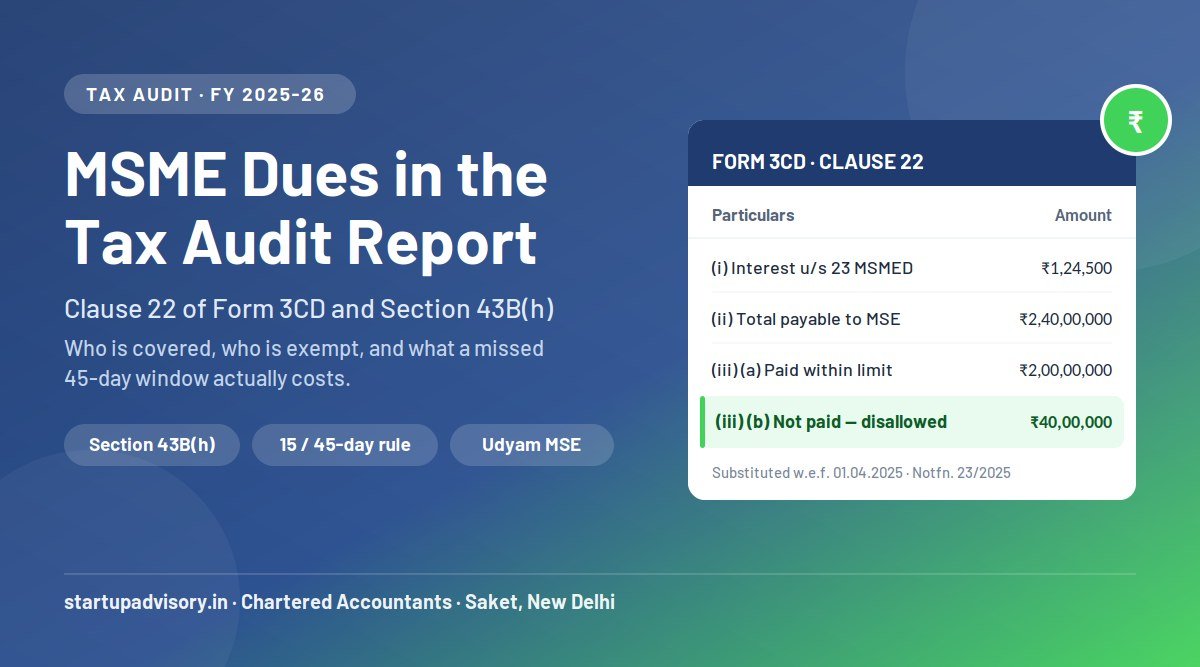
- MSME-1 — MSME Dues. A half-yearly return of amounts owed to micro and small suppliers beyond 45 days. Due 30 April and 31 October.
- ADT-1 — Auditor Appointment. Filed within 15 days of the AGM where an auditor is appointed. As auditors serve a five-year term, this is event-based, not strictly annual.
Penalties for missing ROC deadlines
| Filing | Penalty for delay |
|---|---|
| AOC-4 | Rs. 100 per day, per form — no maximum cap |
| MGT-7 / MGT-7A | Rs. 100 per day, per form — no maximum cap |
| DIR-3 KYC | DIN deactivated; flat Rs. 5,000 to reactivate |
| DPT-3 / MSME-1 | Additional fees and possible penalties on the company and officers |
| LLP Form 11 / Form 8 | Rs. 100 per day of delay |
Because the daily penalty on AOC-4 and MGT-7 has no upper limit, a return filed several months late can cost more than the work itself. Continued default also exposes directors to disqualification under Section 164 and the company to strike-off. The portal also gets congested in the last week before each deadline — file at least a fortnight early.
LLP annual compliance
LLPs have a lighter but equally non-negotiable cycle. For FY 2025-26, file Form 11 (annual return) by 30 May 2026 and Form 8 (statement of accounts and solvency) by 30 October 2026. Designated partners holding a DIN must also keep their DIR-3 KYC current — now once every three financial years, by 30 June. LLPs that miss these dates face an additional fee of Rs. 100 per day, which also compounds without a cap.
Don't forget the tax side
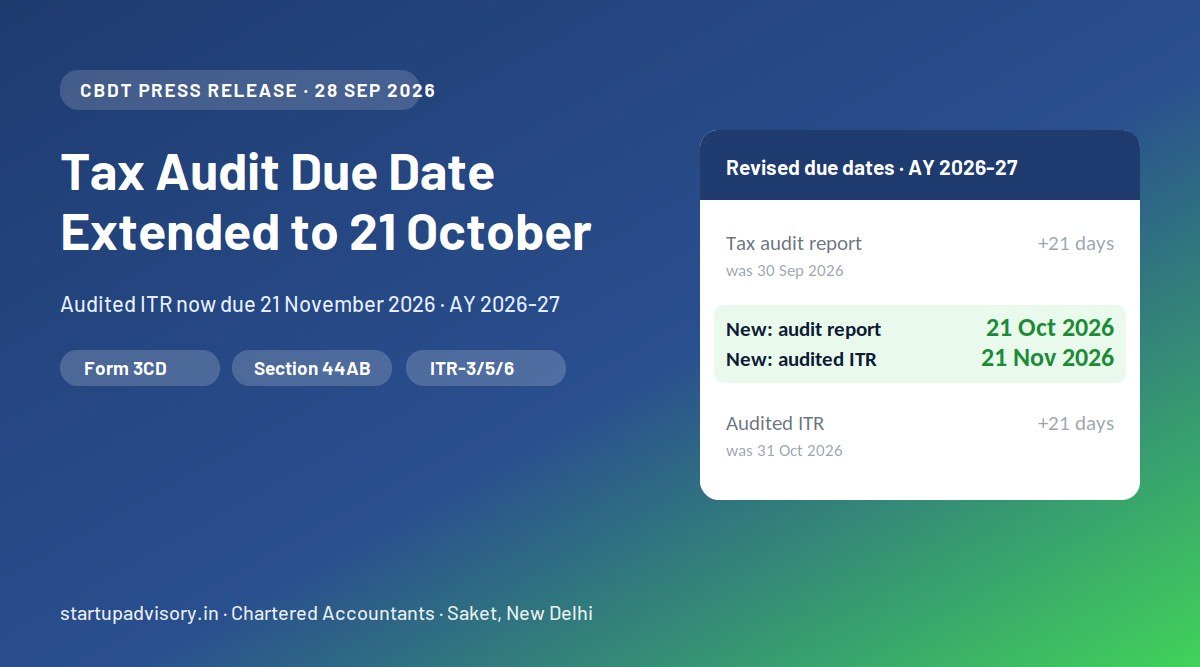
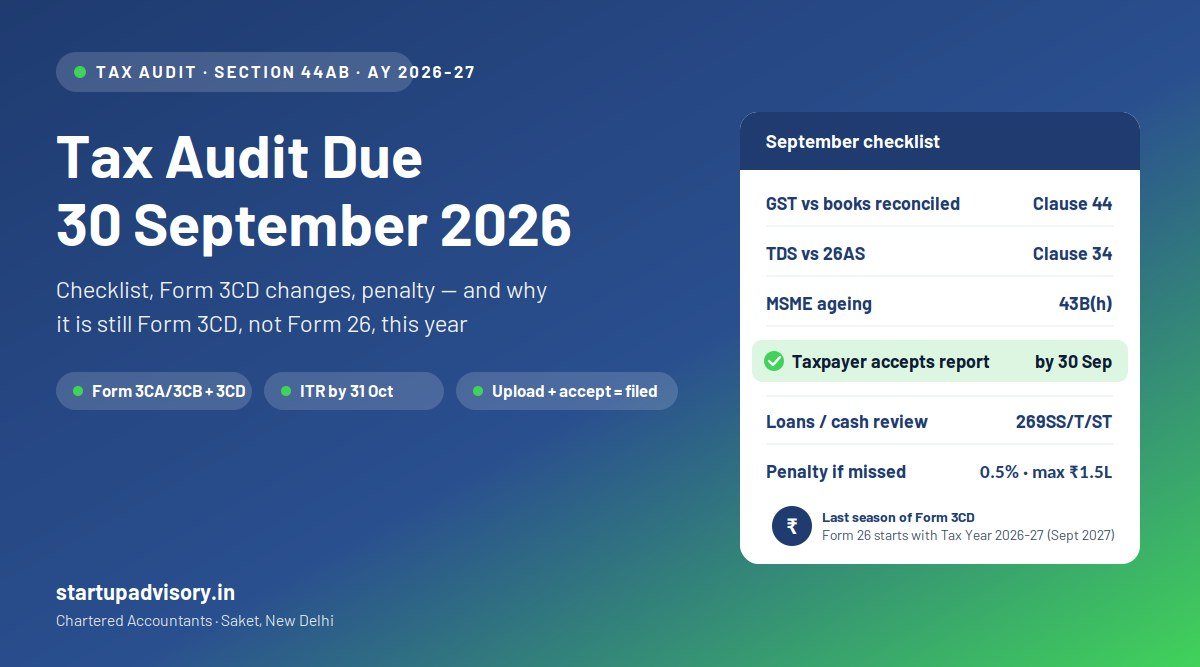
ROC filings sit alongside your income tax obligations. A company is generally required to get a tax audit (Section 44AB) and file its income tax return by 31 October 2026 for audit cases. Keep the two calendars together — AGM approval of accounts has to precede AOC-4, and the audited accounts feed both filings. See our GST & TDS compliance calendar 2026 for the indirect-tax dates that round out the picture.
This article is general information, not professional advice. Due dates can be extended or modified by the MCA, and applicability depends on your company's specific facts — confirm with a qualified professional before acting.
How Startup Advisory Can Help
Startup Advisory is a CA-led firm in Saket, New Delhi that runs the full annual compliance cycle for private limited companies and LLPs across Delhi NCR — so a missed form never quietly turns into a five-figure penalty:
- End-to-end ROC filing: AGM paperwork, AOC-4, MGT-7/7A, DIR-3 KYC, DPT-3, MSME-1 and ADT-1.
- A compliance calendar mapped to your incorporation date, with reminders well before each deadline.
- Bookkeeping and audit coordination so your accounts are AGM-ready on time.
- Combined ROC + income tax handling, with a named Chartered Accountant accountable for the work.
Call 9311972982 or book a free consultation to keep your company Active and penalty-free.