
Income Tax / Retirement
Tax on Retirement Benefits in India (2026): What Is Exempt & What Is Taxable
In short
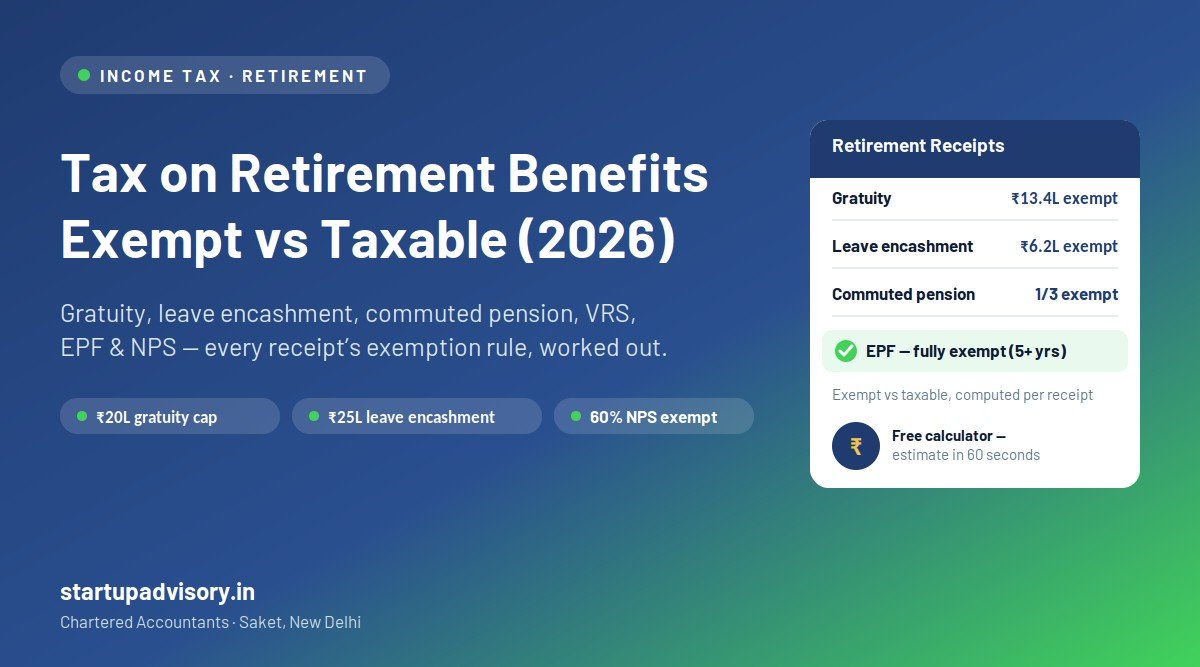
The money you receive on retirement is not one amount for tax purposes — each receipt follows its own rule. Government employees get gratuity, leave encashment and commuted pension fully exempt. For private employees: gratuity is exempt up to the least of the amount received, ₹20 lakh, and a service-based formula; leave encashment up to the least of the amount, ₹25 lakh, 10 months' average salary and the leave-balance value; commuted pension is one-third exempt if you also took gratuity, one-half if you didn't; VRS is exempt up to ₹5 lakh, once in a lifetime; EPF is exempt after 5 years' continuous service; and the NPS lump sum is exempt up to 60% of the corpus. Whatever falls outside these limits is taxed as salary at your slab rate. Run your own numbers on our free Retirement Benefits Tax Calculator.
Retirement usually brings the largest single inflow of money most salaried people will ever see — gratuity, encashed leave, a commuted pension, the EPF corpus, perhaps an NPS lump sum or VRS package, all landing within a few months. And almost every retiree asks us the same question: how much of this is mine, and how much goes to tax? The answer frustrates people at first, because there isn't one answer — there are six, one per receipt. But each rule is mechanical once you see it. This guide works through every retirement receipt the way we compute them for clients: who gets full exemption, the exact formula and cap for everyone else, and what happens to the taxable remainder.
The first fork: government or private?
Before any formula, one classification decides most of the outcome. Employees of the Central or a State Government receive full exemption on gratuity, leave encashment and commuted pension — no caps, no formulas. For everyone else, the exemptions are computed, and for gratuity there is a second fork: whether your employer is covered by the Payment of Gratuity Act (most establishments with 10 or more employees are). Know these two facts about yourself and every rule below resolves cleanly.
1. Gratuity — Section 10(10)
For a private employee covered by the Payment of Gratuity Act, the exempt amount is the least of:
- the gratuity actually received;
- ₹20,00,000; and
- 15/26 × last drawn monthly salary (basic + DA) × years of service — a fraction of a year over six months rounds up to a full year.
If the employer is not covered by the Act, the third limb changes to half the average monthly salary × completed years of service (average of the last 10 months' basic + DA, and no rounding up of part years). The excess over the exempt amount is taxable as salary.
Worked example. A covered private employee retires after 28 years and 7 months, last drawn basic + DA of ₹80,000/month, receiving ₹18,00,000 gratuity. The 7 months round the service up to 29 years. The formula limb is 15/26 × 80,000 × 29 = ₹13,38,462 — the least of the three — so ₹13,38,462 is exempt and ₹4,61,538 is taxable. Estimate your own gratuity first with the Gratuity Calculator, then the tax with the Retirement Tax Calculator.
2. Leave encashment — Section 10(10AA)
For non-government employees, the exemption is the least of four amounts:
- the leave encashment actually received;
- ₹25,00,000;
- 10 months' average salary (basic + DA, averaged over the last 10 months); and
- the cash equivalent of unutilised earned leave, counting a maximum of 30 days of leave per completed year of service.
The fourth limb trips people up: if your employer credited 40 days of leave a year, the tax computation still caps it at 30. An employee with 240 days of accumulated leave and an average salary of ₹78,000 has a leave-value limb of 240/30 × ₹78,000 = ₹6,24,000 — and the exemption is whichever of the four limbs is lowest.
3. Pension — Section 10(10A)
Two different things happen to a pension, and they are taxed differently:
- The uncommuted monthly pension — the regular payment — is taxable as salary for everyone, government and private alike.
- The commuted portion — the lump sum taken in exchange for giving up part of the monthly pension — is fully exempt for government employees. For others, one-third of the full value of the pension is exempt if you also received gratuity, and one-half if you did not.
Note the base: the fraction applies to the full value of the pension, not merely the amount you commuted. If you commuted 40% of your pension for ₹12,00,000, the full pension value is ₹30,00,000 — and, having taken gratuity, one-third of that (₹10,00,000) is exempt, leaving ₹2,00,000 of the lump sum taxable.
4. Voluntary retirement (VRS) — Section 10(10C)
Compensation under a voluntary retirement scheme is exempt up to ₹5,00,000. Two conditions matter in practice: the exemption is available once in a lifetime, and the same amount cannot claim both this exemption and relief under Section 89 — you pick whichever works out better. Everything above ₹5 lakh is taxable as salary.
5. EPF — the five-year rule
An EPF balance withdrawn after 5 years of continuous service is exempt — which covers virtually everyone retiring after a full career. Withdraw before completing five continuous years and the amount becomes taxable, with the treatment splitting by component (employer contributions, employee contributions on which deductions were claimed, and interest each behave differently), so an early withdrawal needs a component-wise computation rather than a single figure.
6. NPS — the 60% rule
The lump sum withdrawn from NPS at retirement is exempt up to 60% of the accumulated corpus. The remaining corpus generally goes into an annuity, and the pension that annuity pays out is taxable as income in the years received — retirement receipts don't end with retirement year.
Every receipt, one table
| Receipt | Government employee | Private employee |
|---|---|---|
| Gratuity — 10(10) | Fully exempt | Least of: received / ₹20L / service formula (15/26 × last salary × years if covered; ½ × avg salary × completed years if not) |
| Leave encashment — 10(10AA) | Fully exempt | Least of: received / ₹25L / 10 months' avg salary / leave value at max 30 days per year |
| Commuted pension — 10(10A) | Fully exempt | 1/3 of full pension value exempt with gratuity; 1/2 without |
| Uncommuted pension | Taxable as salary | Taxable as salary |
| VRS — 10(10C) | Exempt up to ₹5,00,000, once in a lifetime; no double-dip with Section 89 relief | |
| EPF withdrawal | Exempt after 5 years' continuous service; taxable (component-wise) before that | |
| NPS lump sum | Exempt up to 60% of corpus; annuity pension taxable when received | |
What happens to the taxable portion?
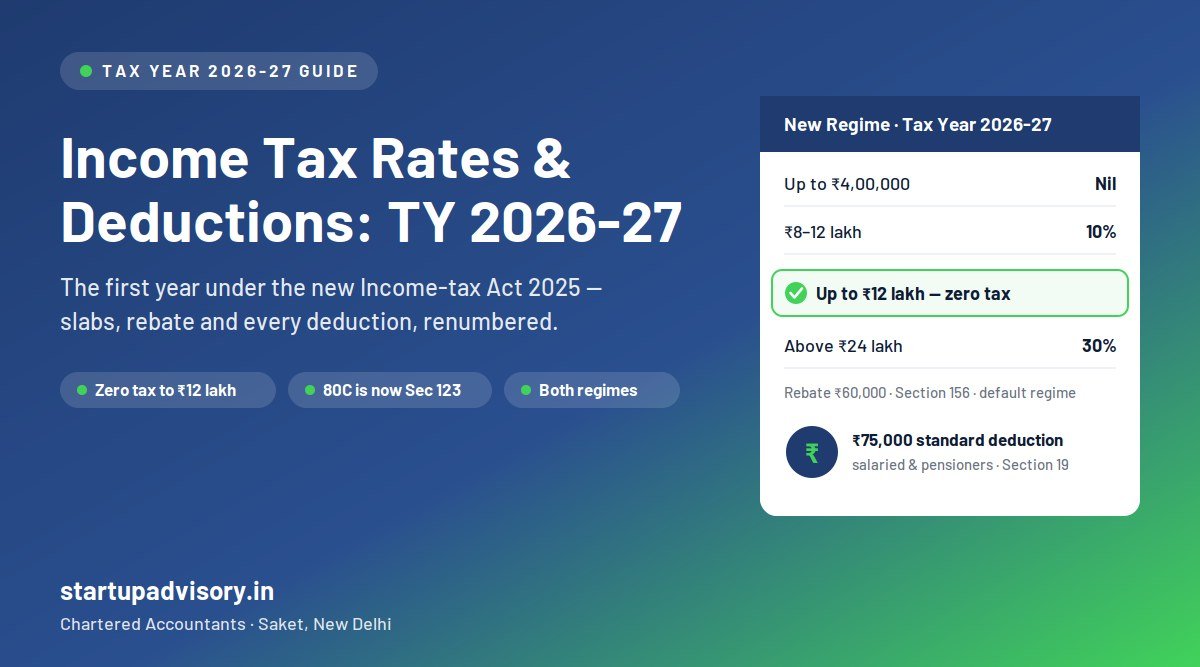
Everything outside the exemptions is added to your other income for the year — the salary earned before retirement, the uncommuted pension, interest — and taxed at slab rates. Under the new regime, salary and pension income get the ₹75,000 standard deduction, the Section 87A rebate (up to ₹60,000) zeroes out tax where total income stays within ₹12 lakh, and surcharge tiers apply above ₹50 lakh — which is exactly where a large taxable retirement receipt can quietly push you. The retirement year is also often your highest-income year ever (a part-year salary plus every lump sum), which is why the sequencing and commutation choices deserve a computation before the money moves, not at filing time. Compare regimes on your full-year picture with the Income Tax Calculator.
A note on section numbers: the references above — 10(10), 10(10AA), 10(10A), 10(10C) — are the familiar citations from the Income-tax Act, 1961. The Income Tax Act, 2025, effective 1 April 2026, renumbers the statute; our old-vs-new section mapping tracks the change. The exemption logic described here is the settled framework these provisions carry.
This article reflects the position as we understand it in August 2026. Monetary limits and conditions can change by amendment or notification, and individual cases turn on specifics — employer coverage, service records, scheme terms. This is general information, not tax advice; take professional advice on your own retirement before acting.
How Startup Advisory Can Help
Startup Advisory is a CA-led firm in Saket, New Delhi advising retirees and families across Delhi NCR:
- Pre-retirement computation — the exempt/taxable split on every receipt, and the commutation and timing choices that change the outcome, worked out before the money lands.
- Retirement-year ITR — the return for your highest-income year, with the exemptions claimed correctly and reconciled to Form 26AS/AIS, through ITR & Tax Advisory.
- Free tools — start with the Retirement Benefits Tax Calculator and the Gratuity Calculator.
Retiring this year or next? Call 9311972982 or book a consultation for a full exempt-vs-taxable computation on your numbers.