
Tax & ITR
Reporting MSME Dues in the Tax Audit Report: Clause 22 of Form 3CD and Section 43B(h)
Four obligations that get conflated — and should not be
Almost every MSME reporting error we see in review starts as a definitional mix-up. There are four distinct requirements, under three different statutes, drawing on one set of vendor data:
| Obligation | Where it lives | What it does | Who it applies to |
|---|---|---|---|
| Section 43B(h) | Income-tax Act, 1961 | Defers the deduction to the year of actual payment | Every assessee with business income on the mercantile basis |
| Clause 22, Form 3CD | Rule 6G(2), Income-tax Rules | Reports the interest, the total payable and the paid/unpaid split | Assessees subject to tax audit |
| Section 22, MSMED Act | MSMED Act, 2006 + Schedule III | Disclosure of principal and interest in the audited accounts | Buyers required to get their accounts audited under any law |
| Form MSME-1 | Companies Act, 2013 (Section 405) | Half-yearly return of MSE dues and delays to the MCA | Specified companies only |
A business can be caught by the first and third and not the fourth (an LLP), or by all four (a private limited company under audit). The tax audit report is where the first two meet, which is why Clause 22 is the clause that attracts scrutiny.
The law, in one page
Section 43B(h) of the Income-tax Act, 1961
Inserted by the Finance Act, 2023 and operative from assessment year 2024‑25, clause (h) brings within Section 43B:
The consequence of falling into Section 43B is that the deduction, though otherwise allowable, is allowed only in the previous year in which the sum is actually paid.
The part that makes clause (h) different
Every other clause of Section 43B has an escape hatch: the first proviso allows the deduction on the accrual basis if the payment is made on or before the due date for furnishing the return under Section 139(1). Clause (h) is carved out of that proviso. This is not a matter of commentary — Form 3CD itself now records it. Clause 26(B) reads:
Section 15 of the MSMED Act, 2006 — the clock
Section 15 obliges a buyer to pay the supplier on or before the date agreed in writing, and where there is no such agreement, before the appointed day. Two hard limits follow:
- No written agreement: the appointed day is the day immediately following the expiry of 15 days from the day of acceptance or deemed acceptance.
- Written agreement: the agreed period governs, but it can in no case exceed 45 days from the day of acceptance or deemed acceptance.
Note what the clock does not run from. It does not run from the invoice date, the GRN posting date, or the date the accounts team booked the entry. It runs from acceptance — the actual delivery of goods or rendering of services — or from deemed acceptance, where the buyer raised a written objection within 15 days of delivery and the clock restarts when that objection is removed.
Clause 22 of Form 3CD as it now reads
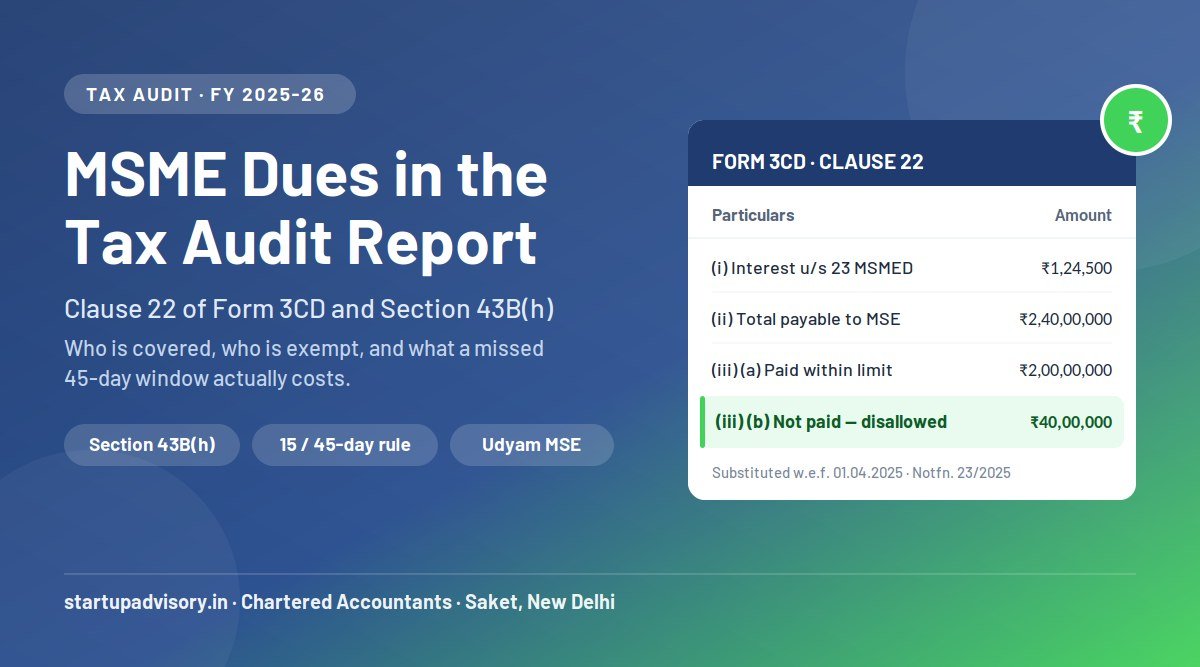
Clause 22 was substituted with effect from 1 April 2025 by the Income-tax (Eighth Amendment) Rules, 2025 (CBDT Notification No. 23/2025 dated 28 March 2025). It now reads:
(ii) Total amount required to be paid to a micro or small enterprise, as referred to in section 15 of the MSMED Act, during the previous year;
(iii) Of amount referred to in (ii) above, amount – (a) paid up to time given under section 15 of the MSMED Act; (b) not paid up to time given under section 15 of the MSMED Act and inadmissible for the previous year.” Clause 22, Form No. 3CD [See rule 6G(2)], Income Tax Department
How it got here
| Period | What Clause 22 asked for |
|---|---|
| Up to AY 2023‑24 | Only the amount of interest inadmissible under Section 23 of the MSMED Act |
| AY 2024‑25 | Interest inadmissible under Section 23 or any other amount not allowable under clause (h) of Section 43B — inserted by Notification No. 27/2024 dated 5 March 2024, corrected by corrigendum G.S.R. 223(E) dated 19 March 2024 |
| From 1 April 2025 (AY 2025‑26 onwards) | The three-part format above — interest, total payable, and the paid/unpaid split |
The direction of travel is unmistakable. The department is no longer content with the disallowance figure; it wants the denominator. Sub-clause (ii) hands the Assessing Officer the entire micro and small enterprise spend for the year, against which the disallowance in (iii)(b) can be sanity-checked.
What goes into each sub-clause
| Sub-clause | What to report | Source in the books |
|---|---|---|
| 22(i) | Interest inadmissible under Section 23 MSMED — interest payable or paid under Section 16 on delayed payments | Interest provision/expense in the P&L; Section 22 MSMED note in the accounts |
| 22(ii) | Total amount required to be paid to micro and small enterprises under Section 15 during the previous year | MSE vendor ledgers — purchases and expenses booked during the year plus opening dues falling due in it |
| 22(iii)(a) | So much of (ii) as was paid within the Section 15 window | Payment dates matched to the computed due date, invoice by invoice |
| 22(iii)(b) | So much of (ii) as was not paid within the window and is inadmissible for the previous year — this is the 43B(h) disallowance | Year-end MSE creditors whose Section 15 window expired on or before 31 March |
A worked example
A manufacturer buys from three Udyam-registered micro suppliers. There is no written payment agreement with any of them, so the 15-day rule applies.
| Invoice | Goods accepted | Amount | Due under s.15 | Paid on | Treatment |
|---|---|---|---|---|---|
| A | 10 Jun 2025 | ₹4,00,000 | 25 Jun 2025 | 20 Jun 2025 | Within window → 22(iii)(a) |
| B | 12 Nov 2025 | ₹6,00,000 | 27 Nov 2025 | 18 Feb 2026 | Late, but paid in the year → deduction survives; s.16 interest accrues |
| C | 20 Mar 2026 | ₹5,00,000 | 4 Apr 2026 | 2 Apr 2026 | Window had not expired at 31 Mar → no disallowance |
| D | 2 Feb 2026 | ₹3,00,000 | 17 Feb 2026 | Unpaid at 31 Mar 2026 | Disallowed → 22(iii)(b) |
Clause 22(ii) is ₹18,00,000. Clause 22(iii)(b) is ₹3,00,000 — invoice D alone. Invoice C is the one people get wrong: a year-end creditor is not automatically a disallowance. If the Section 15 window is still open on 31 March, nothing is inadmissible for that year.
The reconciliation gap in Clause 22 — and how to handle it
Look again at the example. Sub-clause (iii)(a) captures invoice A. Sub-clause (iii)(b) captures invoice D. Invoice B — paid late, but paid within the previous year — fits neither description: it was not “paid up to time given under section 15”, and it is not “inadmissible for the previous year”. Invoice C, paid after the year end but inside the window, is similarly homeless.
The form as drafted therefore does not force (ii) to equal (iii)(a) + (iii)(b), and the e-filing utility does not enforce that arithmetic. Our working position, which we document in every file:
- Report (iii)(a) and (iii)(b) strictly on the words of the clause.
- Maintain a third bucket in the working papers — paid beyond the Section 15 window but within the previous year, or unpaid at year end with the window still open — and reconcile it to sub-clause (ii).
- Where the gap is material, add a remark in Form 3CB (or the Form 3CA annexure) explaining the composition of (ii), rather than forcing the two sub-clauses to add up.
Who is covered on the buyer’s side
Section 43B(h) attaches to the assessee claiming the deduction. That means:
- Every form of entity — company, LLP, partnership firm, proprietorship, AOP, trust or society — computing income under the head profits and gains of business or profession on the mercantile basis.
- Whether or not there is a tax audit. This is widely misunderstood. The disallowance is a charging provision in the Income-tax Act; it applies to a small trader with a ₹40 lakh turnover exactly as it applies to a ₹400 crore company. Tax audit only determines whether the reporting in Clause 22 is triggered.
- Whatever the nature of the purchase — raw material, stores, job work, professional services, freight, repairs — so long as the amount is claimed as a deduction in computing business income.
Who counts as a “micro or small enterprise” supplier
This is where the work actually is. Three tests must all be satisfied on the date of the transaction.
Test 1: The size thresholds — revised from 1 April 2025
The Ministry of MSME revised the classification criteria by notification S.O. 1364(E) dated 21 March 2025, effective 1 April 2025. Both conditions — investment and turnover — must be met:
| Category | Investment in plant, machinery or equipment | Turnover | Within 43B(h)? |
|---|---|---|---|
| Micro | Up to ₹2.5 crore (was ₹1 crore) | Up to ₹10 crore (was ₹5 crore) | Yes |
| Small | Up to ₹25 crore (was ₹10 crore) | Up to ₹100 crore (was ₹50 crore) | Yes |
| Medium | Up to ₹125 crore (was ₹50 crore) | Up to ₹500 crore (was ₹250 crore) | No |
Test 2: Udyam registration
Section 15 casts its obligation in favour of a supplier, and Section 2(n) of the MSMED Act defines a supplier as a micro or small enterprise that has filed a memorandum — in current terms, holds a Udyam registration. The prevailing professional position is therefore that an unregistered enterprise, however small, is not covered. Practically, the auditor looks for the Udyam number on the invoice or obtains a written confirmation from the vendor. An enterprise that obtained Udyam registration mid-year is covered only for transactions on or after the date of registration.
Test 3: Manufacturer or service provider — not a trader
Retail and wholesale trades were allowed onto the Udyam portal in 2021, which has caused a great deal of confusion. The Ministry of MSME’s Office Memorandum dated 2 July 2021 restricts the benefit available to them to priority sector lending only, and expressly excludes other benefits including the delayed payment provisions of the MSMED Act. A trading enterprise holding a Udyam certificate is therefore not a “supplier” for Section 15, and dues to it do not attract Section 43B(h).
Who is outside the net
| Situation | Position | Reason |
|---|---|---|
| Medium enterprise suppliers | Outside | 43B(h) names only micro and small |
| Traders (retail/wholesale) with Udyam | Outside | MSME OM dated 2 July 2021 — priority sector lending only |
| Suppliers without Udyam registration | Outside | Not a “supplier” under s.2(n) MSMED |
| Capital assets and capital work-in-progress | Outside | 43B applies to a “deduction otherwise allowable”; capitalised cost is not claimed as a deduction. Depreciation is not disturbed |
| Assessees under Sections 44AD / 44ADA / 44AE | Outside | Income is computed presumptively; individual expenses are not claimed |
| Books maintained on the cash basis | Outside | Nothing is claimed until paid, so 43B has no work to do |
| Salaries and employee dues | Outside | An employee is not an enterprise under the MSMED Act |
| Amounts not claimed as a business deduction (personal, capital, exempt-income related) | Outside | No deduction to defer |
| Year-end dues whose s.15 window had not expired by 31 March | Outside for that year | Nothing was payable “beyond the time limit” as at the year end |
What failure actually costs
1. The tax on the disallowance
Take a private limited company taxed under Section 115BAA at an effective 25.168% (22% plus 10% surcharge plus 4% cess), with ₹40 lakh of micro and small enterprise dues unpaid beyond the window at 31 March 2026. The disallowance adds ₹40,00,000 to taxable income and roughly ₹10.07 lakh to the tax bill for AY 2026‑27. That money is not lost — it returns as a deduction in the year of payment — but it is paid a year early, out of working capital the business had already deployed elsewhere.
2. Interest under Sections 234B and 234C
Because the disallowance changes assessed income, advance tax instalments were short. Interest under Section 234B and 234C runs at 1% per month on the shortfall. On the illustration above, a company that did not anticipate the disallowance in its advance tax is looking at a further six-figure interest cost. This part is a genuine, unrecoverable loss.
3. MSMED interest at three times the Bank Rate — permanently disallowed
Section 16 of the MSMED Act makes the buyer liable, notwithstanding any agreement to the contrary, to compound interest with monthly rests at three times the Bank Rate notified by the Reserve Bank, from the appointed day or the agreed date. With the Bank Rate at 5.50% (RBI, as on 22 September 2026), that is 16.50% per annum, compounded monthly — an effective annual rate above 17.8%.
Section 23 of the MSMED Act then provides that this interest, whether payable or paid, is not allowed as a deduction in computing income under the Income-tax Act. Unlike the principal, this is a permanent disallowance — it never comes back. It is reported in Clause 22(i).
4. Assessment and penalty exposure
Clause 22 is now a structured, machine-readable field. A Clause 22(iii)(b) figure that does not appear as a disallowance in the computation is an arithmetic mismatch that automated processing under Section 143(1)(a) can pick up without any human reading the file. Where the addition is sustained in assessment and the amount was not disclosed, penalty under Section 270A for under-reporting (50% of the tax on the under-reported income) becomes live.
5. The auditor’s own exposure
Section 271J provides a penalty of ₹10,000 for each report in which an accountant furnishes incorrect information. A Clause 22 reported as “Nil” on nothing more than a client’s verbal assurance, in a business with an obvious micro and small vendor base, is not a defensible position.
What the auditor is actually expected to do
The ICAI’s guidance is clear that identifying which vendors are micro or small enterprises is the auditee’s responsibility, not the auditor’s. That does not reduce the auditor to a post box. A defensible Clause 22 file contains:
- A vendor-wise list from management, flagging MSE status, Udyam number, category (micro/small/medium) and activity (manufacturing/service/trading).
- Verification of Udyam certificates for the significant creditors — not just the numbers, but the classification and activity on the certificate.
- Evidence of the payment terms in writing where the 45-day limit is being relied on. Absent a written agreement, the limit is 15 days, not 45. This is the most common single error in MSME workings.
- An invoice-level computation from the date of acceptance — not the invoice date — to the payment date, for the year-end MSE creditors at minimum.
- A cross-check of Clause 22 against the Section 22 MSMED note in the financial statements and, for companies, against the MSME-1 returns filed for the two half-years. Three numbers from one dataset should agree.
- A specific management representation covering completeness of the MSE vendor list and the payment terms relied on.
- Where the information is unavailable or incomplete, a qualification — in Form 3CB or in the Form 3CA observations — rather than a “Nil”.
The related compliances that should reconcile
Section 22 of the MSMED Act requires a buyer whose accounts are audited under any law to disclose, in the annual statements, the principal and interest due and remaining unpaid at the year end, the interest paid along with payments made beyond the appointed day, the interest due and payable for the period of delay, the interest accrued and remaining unpaid, and the further interest remaining due in succeeding years. Schedule III of the Companies Act carries the same requirement into the notes for companies.
Form MSME-1 is a half-yearly return by specified companies to the MCA, due 31 October for April–September and 30 April for October–March. Following the Specified Companies (Furnishing of information about payment to micro and small enterprise suppliers) Amendment Order, 2024 dated 15 July 2024, the return now captures amounts paid within 45 days, amounts paid after 45 days and amounts outstanding — so a company that cleared its delays before the half-year end must still file. Default attracts penalty under Section 405(4) of the Companies Act, 2013: ₹20,000 on the company and each officer in default, with a continuing penalty of ₹1,000 per day subject to a maximum of ₹3,00,000.
Grey areas that are still unsettled
| Issue | The question | Our working position |
|---|---|---|
| Opening MSE balances | Dues outstanding from years before clause (h) came in | 43B(h) speaks of a sum payable beyond the s.15 limit; dues still outstanding at the year end are evaluated on their own facts. Disclose the basis adopted in the working papers |
| Interest not provided in the books | Is Clause 22(i) “nil” if no provision was made? | Compute and report the s.16 interest, and note whether it was charged to the P&L. Reporting nil merely because the books are silent is weak |
| Disputed invoices | Does the clock run where quality or quantity is in dispute? | Only a written objection within 15 days of delivery resets the clock under the deemed-acceptance rule. An oral dispute or a late one does not |
| Retention money and security deposits | Contractual retentions on MSE bills | Contractual terms cannot extend the 45-day statutory ceiling. Treat the retention as payable within the window unless it is genuinely not yet due under the acceptance test |
| Stock-in-trade unsold at year end | Purchases sitting in closing stock | The purchase is debited and forms part of the trading account; the disallowance operates on the amount claimed. Document the computation |
| What exactly belongs in 22(ii) | All MSE payables, or only those governed by s.15 in the year? | Read it as the amounts falling due under s.15 during the previous year, and disclose the basis. The clause is new and practice is not yet uniform |
On each of these, the defensible answer is not a confident one — it is a documented one. An assessing officer can disagree with a position that is reasoned and disclosed. A position that is neither is much harder to defend three years later.
Your FY 2025-26 checklist
- Extract the creditors ledger for the full year, not just the 31 March balances.
- Obtain or refresh Udyam certificates for every vendor of significance — the 1 April 2025 limits may have reclassified some of them into “small”.
- Strip out medium enterprises, traders and unregistered vendors. Document why each was excluded.
- For the survivors, identify whether a written payment agreement exists. No agreement means 15 days.
- Compute the due date invoice by invoice from the date of acceptance.
- Split into the four buckets: paid in time; paid late within the year; unpaid with window still open; unpaid with window expired. The last bucket is Clause 22(iii)(b) and the 43B(h) disallowance.
- Compute the Section 16 interest on the delays and report it in Clause 22(i).
- Reconcile against the Section 22 MSMED note and both MSME-1 filings.
- Carry the disallowance into the computation — and check that the prior year’s disallowance, if paid this year, has been claimed back through Clause 26(A)(a).
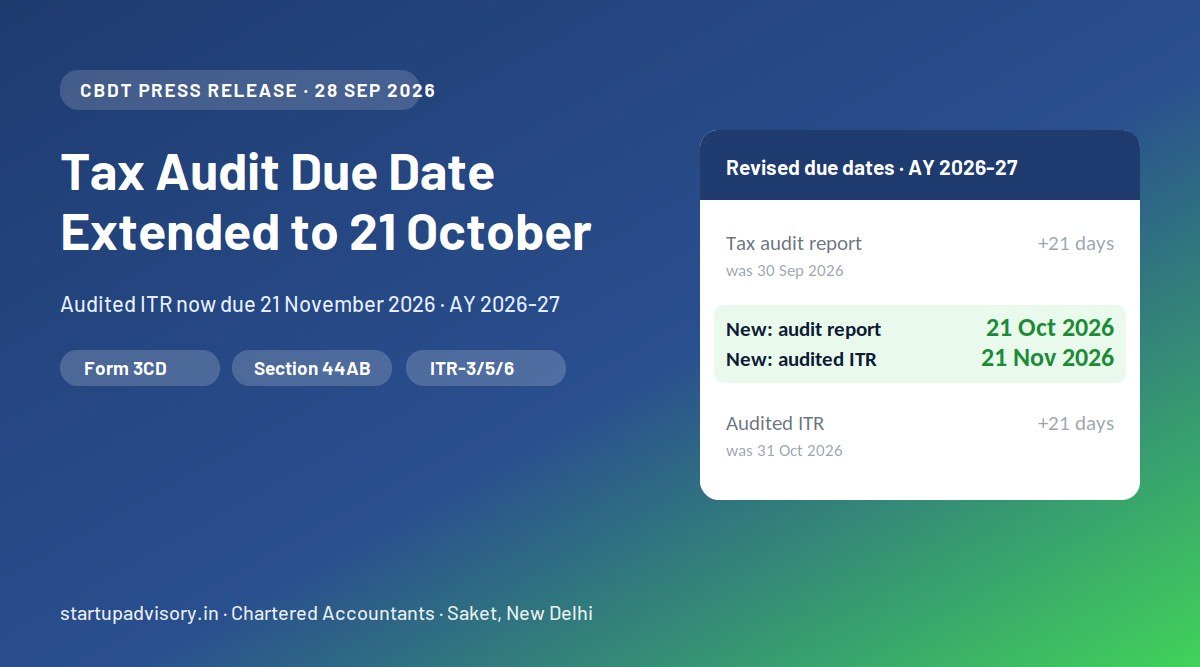
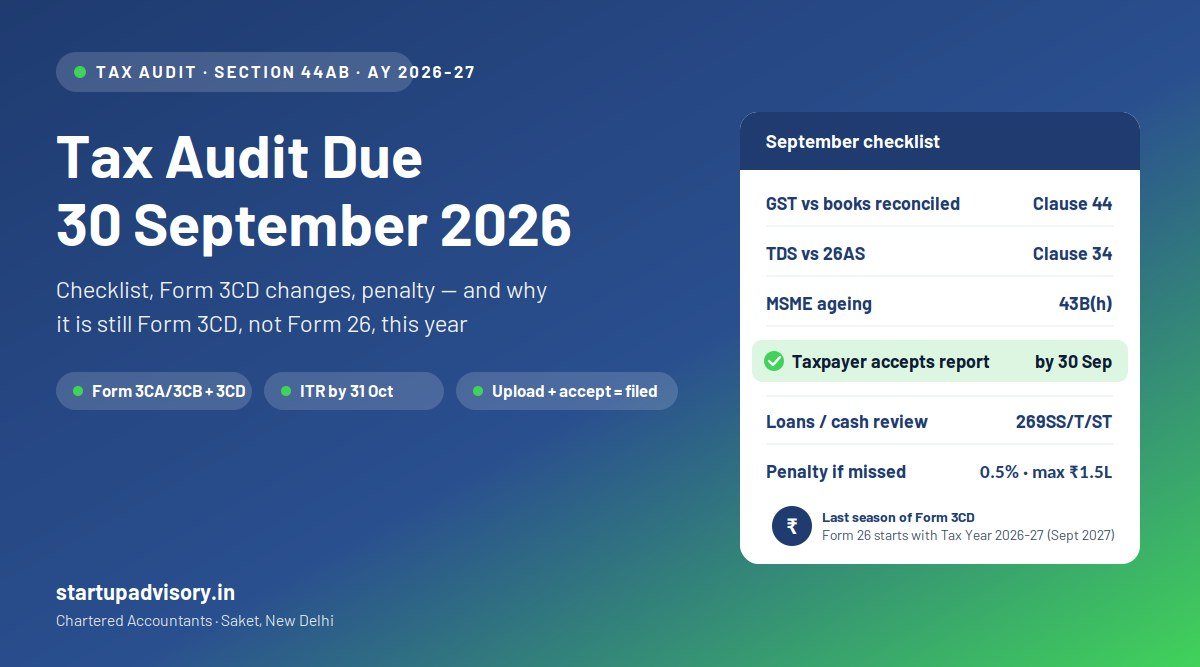
- File Form 3CA/3CB and 3CD by 21 October 2026 (extended from 30 September by CBDT on 28 September 2026).
What changes under the Income-tax Act, 2025
The Income-tax Act, 2025 comes into force on 1 April 2026 and applies from tax year 2026‑27. The audit for FY 2025‑26 (AY 2026‑27) is still governed by the Income-tax Act, 1961 and the Form 3CD discussed above — the Income Tax Department has confirmed that returns for AY 2026‑27 are filed under the old Act’s forms. The substance of the MSME provision carries forward into the new Act; the section numbering does not. Because published mappings of old to new section numbers still conflict on several provisions, we do not quote a new section number here — use the Income Tax Department’s official section mapping utility, and see our note on the old versus new section numbering.
- Form No. 3CD [See rule 6G(2)], Income Tax Department — Clauses 22 and 26
- Section 43B(h), Income-tax Act, 1961 (inserted by the Finance Act, 2023)
- CBDT Notification No. 23/2025 dated 28 March 2025 — Income-tax (Eighth Amendment) Rules, 2025
- CBDT Notification No. 27/2024 dated 5 March 2024 and corrigendum G.S.R. 223(E) dated 19 March 2024
- Sections 2(b), 2(n), 15, 16, 22 and 23, Micro, Small and Medium Enterprises Development Act, 2006
- Ministry of MSME notification S.O. 1364(E) dated 21 March 2025 — revised classification criteria
- Ministry of MSME Office Memorandum dated 2 July 2021 — retail and wholesale trade
- Specified Companies (Furnishing of information about payment to micro and small enterprise suppliers) Amendment Order, 2024 dated 15 July 2024; Section 405, Companies Act, 2013
- Reserve Bank of India — Bank Rate 5.50% as on 22 September 2026