
Incentives & Schemes
CGTMSE Scheme: Eligibility, Conditions, Limits & a Complete Checklist
In short
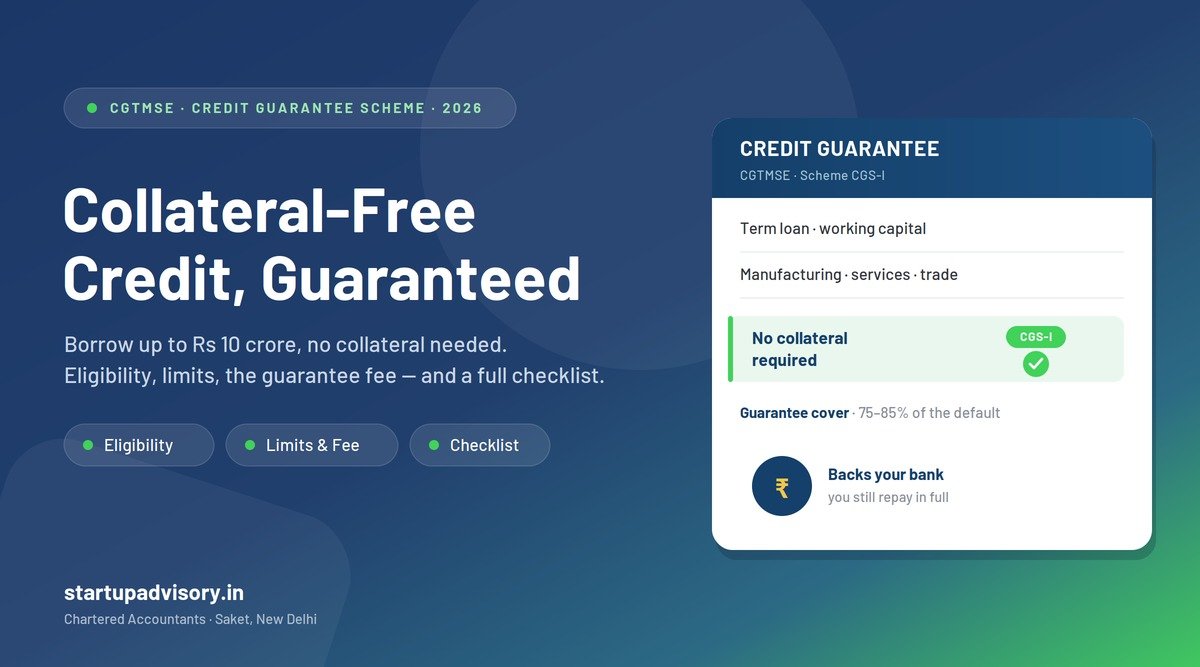
CGTMSE (the Credit Guarantee Fund Trust for Micro and Small Enterprises) lets a micro or small enterprise borrow without pledging collateral or a third-party guarantee. The Trust guarantees a slice of the loan to the lender, so the bank is willing to lend against the business itself. Under the main scheme, cover is available up to Rs 10 crore per borrower (raised from the older Rs 2 crore / Rs 5 crore limits), the guarantee typically covers 75%–85% of the amount in default, and the borrower’s bank pays an Annual Guarantee Fee (revised downward from 1 April 2025). Three things trip people up: a valid Udyam Registration is mandatory; you apply through your bank, never to CGTMSE directly; and the guarantee protects the lender — you still repay the loan in full. The checklist near the end of this guide walks through exactly what to keep ready.
For most first-generation entrepreneurs, the loan conversation stalls at one word: collateral. The business plan is sound and the numbers work, but the bank wants property or a guarantor the founder simply does not have. CGTMSE exists to break that deadlock. It is the Government of India’s flagship mechanism for collateral-free credit to micro and small enterprises, and used correctly it is one of the most useful levers a small business in Delhi NCR has. This guide covers who is eligible, the conditions and exclusions, the limits and fees, and a practical checklist you can work through before you walk into a branch.
What CGTMSE actually is (and is not)
CGTMSE is a Trust, set up jointly by the Ministry of Micro, Small and Medium Enterprises and the Small Industries Development Bank of India (SIDBI), and operational since 2000. When a bank or eligible NBFC — called a Member Lending Institution (MLI) — sanctions a qualifying collateral-free loan to a micro or small enterprise, it can register that loan with CGTMSE. In return for an annual fee, the Trust guarantees a defined percentage of the loan. If the borrower defaults, the Trust pays the lender a large part of the shortfall.
Two clarifications matter before anything else:
- CGTMSE does not lend to you. It guarantees the lender. Your loan still comes from a bank or NBFC, at that lender’s interest rate, on that lender’s appraisal.
- CGTMSE is not a subsidy. It is a risk-cover for the bank. You repay every rupee, with interest. What the guarantee buys you is access — a loan you might not otherwise get without security.
Who is eligible
Eligibility has two layers: the enterprise must qualify, and the lender must still be willing to lend.
- Enterprise type: New and existing Micro and Small Enterprises engaged in manufacturing or services. Retail and wholesale trade is now aligned with other activities and is eligible. Medium enterprises are outside the scheme.
- Udyam Registration: A valid Udyam Registration Number is mandatory — the lender must enter it on the CGTMSE portal to obtain cover. Udyam registration is free at udyam.gov.in; do not pay an intermediary for it.
- A collateral-free facility: The loan must be extended without collateral security or a third-party guarantee (the Hybrid Security route, below, is the one exception).
- Lender appraisal: CGTMSE does not replace credit assessment. The bank still evaluates your business, cash flows and repayment capacity. The guarantee reduces the bank’s risk; it does not make approval automatic.
What is excluded
Some borrowers and facilities cannot be covered, however good the case:
- Agricultural activities, Self-Help Groups (SHGs) and Joint Liability Groups (JLGs).
- Educational and training institutions.
- Any facility already backed by collateral or a third-party guarantee — except the unsecured portion under Hybrid Security.
- An account that has already become an NPA cannot be brought under the guarantee.
- Facilities where the risk is already covered under another scheme of the RBI or the DICGC.
The limits: how much cover you can get
This is the number most people get wrong, because the ceiling has changed several times and old figures still circulate.
| Parameter | Position |
|---|---|
| Maximum guarantee cover (CGS-I) | Up to Rs 10 crore per eligible borrower (raised from the earlier Rs 2 crore and then Rs 5 crore limits) |
| Regional Rural Banks | A lower ceiling applies — confirm the current figure with the RRB |
| DPIIT-recognised startups | Up to Rs 20 crore — but this is under CGSS, a separate scheme, not CGTMSE |
| Extent of guarantee | Generally 75%–85% of the amount in default, with the higher end for micro enterprises and certain categories/regions |
| Facilities covered | Term loans, working capital (fund-based and non-fund-based such as LCs and bank guarantees), and composite loans |
Where credit above the ceiling is extended, the guarantee is simply capped at the ceiling; the excess is on the lender’s own book. And where a lender wants some security, the Hybrid Security product lets it take collateral for part of the facility and cover only the remaining unsecured portion under CGTMSE, up to the scheme ceiling.
The Annual Guarantee Fee (AGF)
The cost of the guarantee is the Annual Guarantee Fee, paid to the Trust to keep the cover live. It was revised downward with effect from 1 April 2025, so that smaller loans now attract the lowest rates. The table below shows the standard slab rates; the actual rate can move with the lender’s risk category (a discount for better portfolios, a premium for higher-risk ones) and is exclusive of GST.
| Credit facility | Standard AGF (p.a.) |
|---|---|
| Up to Rs 10 lakh | 0.37% |
| Above Rs 10 lakh – Rs 50 lakh | 0.55% |
| Above Rs 50 lakh – Rs 1 crore | 0.60% |
| Above Rs 1 crore – Rs 2 crore | 0.85% |
| Above Rs 2 crore – Rs 5 crore | 1.00% |
| Above Rs 5 crore – Rs 8 crore | 1.10% |
| Above Rs 8 crore – Rs 10 crore | 1.20% |
A few practical points on the fee:
- It is separate from the interest rate. Your all-in cost is the bank’s interest plus the AGF (for example, roughly 10% interest plus 0.55% AGF).
- Certain categories — such as women-owned units, SC/ST entrepreneurs, ZED-certified units and enterprises in the North-East and other designated areas — are eligible for a concession on the standard rate.
- The lender decides whether to pass the AGF on to you or absorb it. Many capitalise it into the loan — convenient, but it then also carries interest. Check your sanction letter.
- If the AGF is not paid on time, the guarantee lapses for that period — a real risk worth diarising.
The key conditions to understand before you sign
- You apply through the bank, not to CGTMSE. There is no direct application by the borrower. The MLI files for the guarantee once it sanctions the loan.
- Udyam is non-negotiable. Without a valid Udyam Registration Number, the lender cannot obtain cover.
- The guarantee protects the lender. Default does not vanish; you remain fully liable to repay. If the guarantee is invoked, the Trust pays the bank and recovery efforts against you continue.
- Lock-in before any claim. The lender can invoke the guarantee only after a lock-in period — generally 18 months (shorter, around 9 months, for very small guarantees up to Rs 10 lakh).
- Promoter guarantee is common. No third-party or collateral guarantee is needed, but lenders frequently take the personal guarantee of the promoter(s). That is not the same thing.
- Keep the account regular. Restructured accounts or accounts in serious stress in the recent past may be ineligible, and an NPA cannot be covered.
The CGTMSE checklist — work through this before the branch
Use this as a readiness list. The stronger your file, the faster the sanction — and the guarantee only follows a sanction.
1. Eligibility check
- Is the enterprise a Micro or Small enterprise (not Medium)?
- Is it in manufacturing, services or trade (not agriculture, SHG/JLG, or an education/training institution)?
- Do you have a valid Udyam Registration Number? If not, register free at udyam.gov.in first.
- Is the account standard/regular (not an existing NPA, not recently restructured)?
2. Registration & identity documents
- Udyam Registration certificate (with URN).
- PAN of the business and of the proprietor/partners/directors.
- Aadhaar and KYC of the promoter(s).
- Constitution documents — partnership deed, LLP agreement, or Certificate of Incorporation + MOA/AOA, as applicable.
- GST registration certificate (if registered).
- Business address proof / rent agreement / utility bill.
3. Financial documents
- Last 2–3 years’ financial statements and ITRs (for existing units).
- Bank statements for the last 6–12 months.
- A clear project report / business plan with the loan purpose, costings and projections — this is what the bank actually judges.
- Quotations for machinery/equipment (for a term loan) or a working-capital assessment (for CC/OD).
- Existing loan/EMI details and, ideally, a look at your credit score before you apply.
4. At the bank
- State upfront that you want a collateral-free facility under CGTMSE — not every officer offers it unprompted.
- Confirm the loan is being registered for CGTMSE cover and get it noted in the sanction.
- Ask who bears the AGF — you or the bank — and whether it is being capitalised.
- If some security is unavoidable, ask about the Hybrid Security route so the unsecured part is still covered.
- Check the lock-in and the AGF renewal date, and diarise the fee so cover never lapses.
5. After sanction
- Verify the guarantee is live (it commences once the AGF reaches the Trust).
- Keep the AGF paid on time every year for the life of the loan.
- Keep the account regular — the guarantee is a backstop for the lender, not a licence to default.
CGTMSE vs CGSS vs CGFMU — don’t mix them up
Three guarantee schemes are constantly confused, and applying under the wrong one wastes time:
- CGTMSE — collateral-free loans to micro & small enterprises, up to Rs 10 crore. The subject of this guide.
- CGSS — guarantees loans to DPIIT-recognised startups, up to Rs 20 crore. A different scheme with different eligibility.
- CGFMU — guarantees Mudra and certain micro loans. Different fund, different rules.
The bottom line
CGTMSE turns “we’d lend, but where’s the security?” into a workable loan. It will not lend to you, it will not subsidise you, and it will not excuse a default — but it removes the single biggest barrier a small business faces. The value is in getting the file right, choosing the right facility, and keeping the guarantee live. Get those three things wrong and the cover is worth little; get them right and it can be the difference between staying stuck and getting funded.
This is general information, not financial or legal advice. Scheme parameters — the ceiling, coverage percentages and the Annual Guarantee Fee — are set by the CGTMSE Trust and revised by circular from time to time; the rate and cover applicable to your specific loan should be confirmed with your lender or against the current CGTMSE guidelines before you rely on them.
How Startup Advisory Can Help
Startup Advisory is a CA-led firm in Saket, New Delhi that helps micro and small businesses across Delhi NCR get funded. On CGTMSE specifically, our team:
- Checks your eligibility and gets your Udyam Registration in order first.
- Builds a bankable project report and financial projections — the document that actually decides your sanction.
- Helps you approach the right lender and ask for the loan to be registered under CGTMSE (or Hybrid Security where needed).
- Keeps your books and tax filings clean so your file stands up to appraisal.
Call 9311972982 or book a free consultation to see whether a CGTMSE-backed loan is the right route for your business.