
Regulatory / Foreign Funding
The FCRA Amendment Bill, 2026 (“FCRA 2.0”): What Changes for NGOs, Section 8 Companies & Foreign-Funded Assets
In short
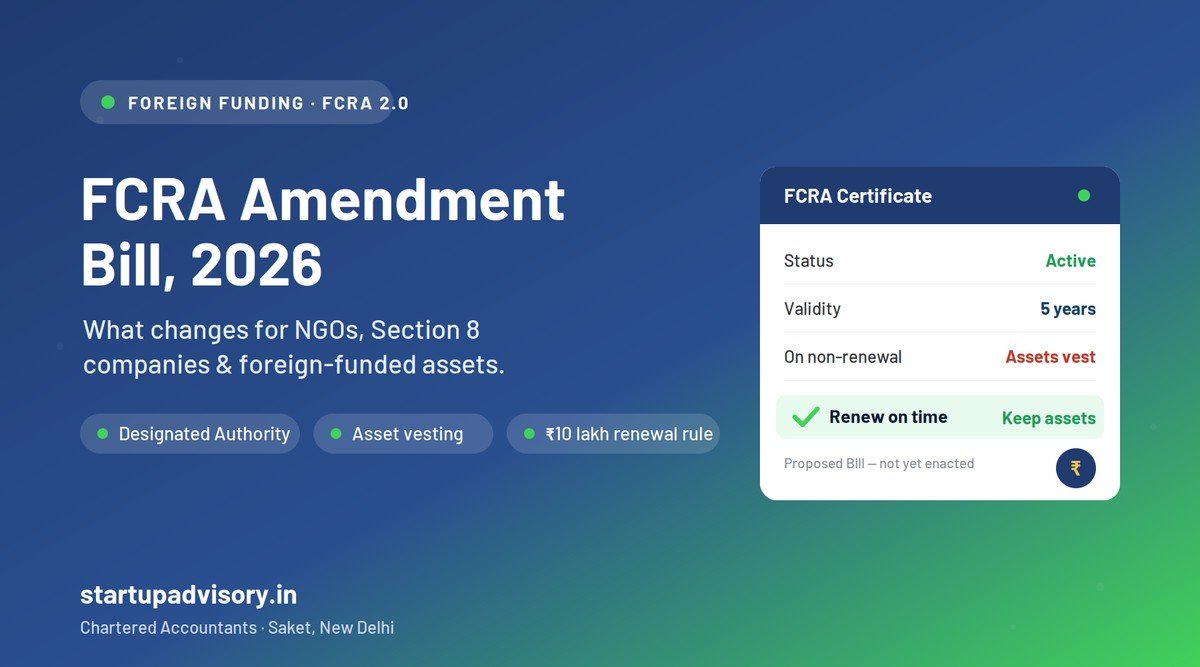
The Foreign Contribution (Regulation) Amendment Bill, 2026 — introduced in the Lok Sabha on 25 March 2026 and referred on 12 August 2026 to a Joint Parliamentary Committee (report due by the first week of the 2026 Winter Session) — not yet law — would make the most significant change to India's foreign-funding regime in years. Its centrepiece is a new Designated Authority in which an organisation's foreign contribution and the assets created from it would vest when its FCRA certificate is cancelled, surrendered or ceases — and crucially, the Bill adds non-renewal as a trigger. It also defines key functionaries who are presumed liable for organisational offences, reduces the maximum jail term from five years to one, and requires prior central-government approval to open an investigation. Separately, the already-notified FCRA Amendment Rules, 2026 add a ₹10 lakh two-year utilisation threshold for renewal. The government says the aim is stronger oversight, transparency and national security without changing FCRA's core objectives; opposition parties, civil society and some observers argue it expands control over NGOs. Below: what actually changes, why, and what FCRA-registered organisations and Section 8 companies should do now.
If your organisation — a Section 8 company, trust or society — receives foreign donations or grants, this Bill deserves your full attention, even though it is not yet law. It changes the consequences of the one thing many organisations treat as routine: the five-yearly FCRA renewal. This guide sets out the current law, exactly what the 2026 Bill proposes, the government's stated intent, the concerns being raised, and a practical checklist — all sourced to the Bill text and neutral legislative analysis rather than commentary.
The law today: how FCRA works before the Bill
The Foreign Contribution (Regulation) Act, 2010 governs how individuals, associations and companies receive and use foreign contribution — grants or donations from foreign sources — and aims to prevent diversion of such funds towards activities detrimental to national interest. Its key features:
- Registration or prior permission: an entity must hold an FCRA certificate to receive foreign contribution, or obtain prior permission for a one-time, source-and-purpose-specific receipt.
- Five-year certificate: the 2010 Act replaced the earlier 1976 Act's open-ended certificate with a five-year renewable registration.
- The 2020 tightening: the FCRA (Amendment) Act, 2020 mandated Aadhaar/passport identification for office-bearers, confined foreign contribution to a single designated SBI account in New Delhi, prohibited sub-granting of foreign funds to other organisations, reduced the administrative-expense cap, and allowed voluntary surrender of a certificate.
Under the existing Act, if a certificate is cancelled or surrendered, the foreign contribution and assets created out of it vest in a prescribed authority. The 2026 Bill rebuilds and expands exactly this vesting machinery.
The scale of the regime is worth noting. Per the Ministry of Home Affairs, 13,520 organisations received about ₹55,741 crore of foreign contribution between 2019 and 2022. As of 15 July 2026, the FCRA portal showed roughly 14,449 active certificates, 22,498 cancelled and 15,212 deemed expired — so far more certificates are now inactive than active, which is precisely the population the Bill's asset provisions would reach.
What the 2026 Bill actually proposes
Drawing on the Bill text and the neutral analysis by PRS Legislative Research, here is what changes.
| Area | What the Bill proposes |
|---|---|
| Cessation of certificate | Adds three new ways a certificate can cease, beyond cancellation and surrender: it is not renewed before expiry, no renewal application is made, or the renewal is denied. |
| Designated Authority & vesting | Creates a Designated Authority in which foreign contribution and assets created from it (including assets created partly from foreign funds) vest on cancellation, surrender or cessation. Vesting is provisional until a fresh/renewed/restored certificate, then the unutilised portion is returned; otherwise it becomes permanent. |
| Use of permanently vested assets | The Authority may use them for public purposes, transfer them to central/state government ministries, departments or agencies, or dispose of them by sale. Proceeds and unutilised foreign contribution are credited to the Consolidated Fund of India. A place of worship must have its religious character maintained. |
| Key functionaries | Defines key functionaries (directors, partners, trustees, the Karta of a HUF, office bearers/governing-body members, and anyone responsible for management) who are presumed liable for an organisational offence unless they prove no knowledge or due diligence. On an organisation becoming defunct, the last key functionaries must notify the government or the foreign contribution vests permanently. |
| Penalties | Reduces the maximum imprisonment from five years to one year, and adds that prior central-government approval is required to initiate an investigation for any offence under the Act. |
| Prior-permission route | Foreign contribution received under prior permission must be received and utilised within a prescribed time period. |
The single most consequential change is the middle two rows read together: non-renewal now triggers vesting, and vesting can be permanent. That converts the five-yearly renewal from an administrative formality into a step an organisation cannot afford to miss if it holds any asset built with foreign funds.
The ₹10 lakh rule: the FCRA Amendment Rules, 2026
Separate from the Bill, the FCRA Amendment Rules, 2026 (gazetted in June 2026) add a concrete test to the existing ground that a certificate can be cancelled if the holder has not undertaken “reasonable activity in its chosen field for two consecutive years.” Under the Rules, an organisation is deemed to have undertaken reasonable activity if it has utilised at least ₹10 lakh of foreign contribution in the last two financial years.
Read with the Bill, the implication analysts have flagged is stark: a small but genuine organisation that receives or spends less than ₹10 lakh of foreign contribution over two years could fail the renewal test, lose its certificate, and see its foreign-funded assets vest in the Designated Authority. A rural library or clinic built with a one-time foreign grant and since run on modest domestic funds is exactly the kind of case this raises. Because the Rules are a distinct instrument from the Bill, confirm their exact text and effective status against the gazette before relying on them.
The government's stated intention
The government's case for the Bill, as set out through the Press Information Bureau and the Ministry of Home Affairs, rests on four stated objectives:
- Stronger oversight and transparency of how foreign contribution is received and used, closing administrative and operational gaps in the 2010 Act.
- Better asset governance — a clear, single mechanism to supervise, manage and dispose of assets of organisations that are cancelled, surrendered or defunct, rather than assets being left in limbo.
- Accountability of those in charge — fixing responsibility on defined key functionaries and setting timelines.
- National security — preventing the diversion or misuse of foreign funds towards activity the government considers detrimental to national interest.
The government's position is that these changes modernise the framework without altering FCRA's core objectives, and without preventing legitimate organisations from receiving overseas funding provided they comply with the statutory requirements.
The concerns being raised
The Bill is contested, and a professional reading has to note both sides. Drawing on the PRS analysis and public commentary, the principal concerns are:
- Non-renewal as a route to losing assets. Because non-renewal now triggers vesting, an organisation effectively cannot exit the FCRA framework, or simply stop renewing, without risking loss of assets built from past foreign funds — even if it now operates entirely on domestic money. Analysts note this sits awkwardly with the Act's own purpose of regulating foreign funding rather than compelling its continuation.
- Retroactive reach. Assets created from foreign funds years ago can be caught, not just new receipts.
- Partly-foreign-funded assets vest entirely. An asset built from a mix of domestic and foreign money vests in full; the organisation must apply to get back a “distinct or ascertainable” domestic portion — often impossible to identify for, say, a jointly funded building.
- No appeal or hearing on non-renewal. The Act allows appeal against cancellation, but the Bill provides no appeal mechanism and no opportunity to be heard where renewal is denied — even though the consequence (loss of assets) is severe.
- Broader political debate. Opposition parties, several civil-society and religious organisations, and some international observers have argued the Bill could expand government control over NGOs. The government rejects that characterisation. We flag the debate for completeness; the compliance implications above are what matter for planning.
What FCRA-registered organisations and Section 8 companies should do now
- Do not let a certificate drift toward lapse. Whatever the final shape of the Bill, treat FCRA renewal as a hard, calendared deadline — not a formality. Map your certificate's five-year expiry now and start renewal well ahead.
- Inventory your foreign-funded assets. Identify every asset created wholly or partly from foreign contribution, and keep the documentary trail that distinguishes domestic from foreign funding — that trail is what you would rely on to reclaim a domestic portion.
- Check the ₹10 lakh utilisation exposure. If your foreign receipts or spend are modest, model whether you clear the two-year ₹10 lakh threshold, and take advice before assuming your renewal is safe.
- Fix key-functionary responsibility internally. Know who your key functionaries are, ensure due-diligence records exist, and build the governance that supports a “without knowledge / due diligence” defence if ever needed.
- Reconsider before surrendering. Surrender already vests assets; under the Bill, so does non-renewal. Take advice before either.
- Watch the Bill's progress. It is not yet law. Track its passage and the final enacted text before making irreversible decisions, and confirm the Rules' current status against the gazette.
This article reflects the position as we understand it in August 2026, drawing on the Bill as introduced and neutral legislative analysis. The Foreign Contribution (Regulation) Amendment Bill, 2026 is before a Joint Parliamentary Committee (referred 12 August 2026) and has not been enacted; its provisions may change or may not become law. This is general information, not legal or tax advice — take professional advice on your organisation's specific FCRA position before acting.
How Startup Advisory Can Help
Startup Advisory is a CA-led firm in Saket, New Delhi advising foreign-funded organisations across Delhi NCR:
- FCRA health-check — certificate expiry mapping, the ₹10 lakh utilisation test, and a foreign-vs-domestic asset inventory before renewal.
- Section 8 & NGO setup — incorporating the right vehicle and layering 12A/80G, CSR-1 and, where eligible, FCRA registration; see our Section 8 company registration service.
- Compliance & governance — annual FCRA returns, books and the key-functionary governance the Bill would make more consequential.
Hold an FCRA certificate, or planning to raise foreign funding? Call 9311972982 or book a consultation for a review before your next renewal.