
Income Tax / Search Cases
Block Assessment After an Income Tax Search (Section 158BC): The Complete 2026 Guide
In short
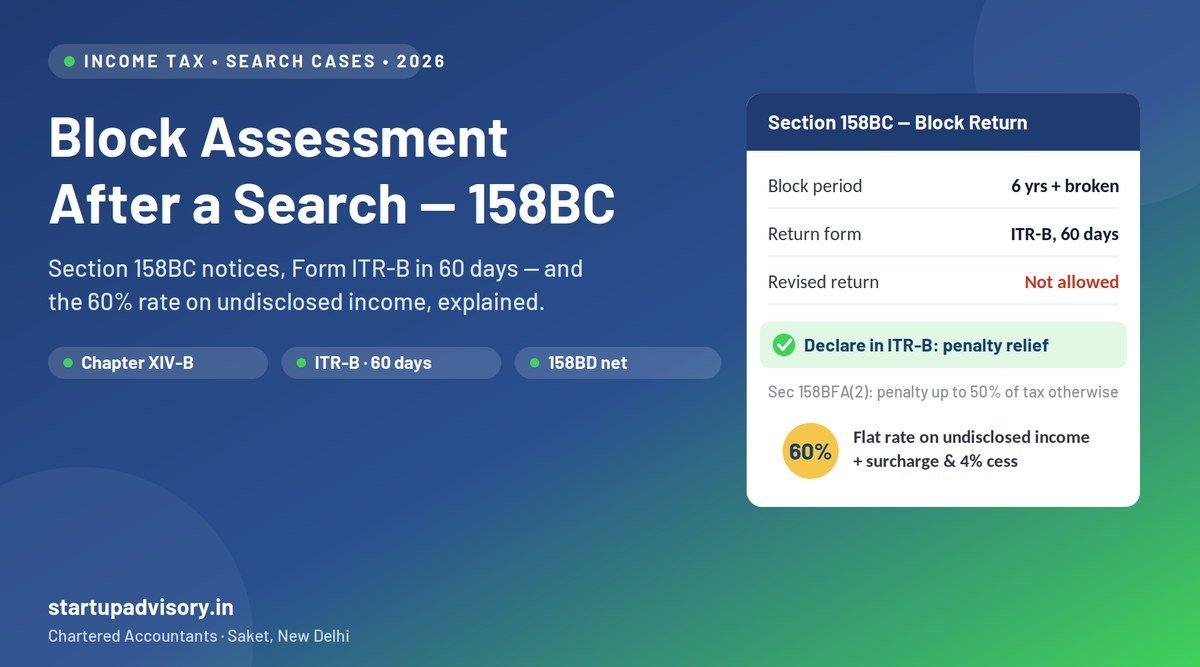
Block assessments are back. For searches under Section 132 (or requisitions under Section 132A) initiated on or after 1 September 2024, Chapter XIV-B (Sections 158B–158BI) replaces year-by-year reopening with one consolidated assessment of a block period: the six previous years plus the broken period up to the last search authorisation. The notice under Section 158BC requires a single return in Form ITR-B within a maximum of 60 days — and no revised return is allowed. Undisclosed income of the block is taxed at a flat 60% (plus surcharge and 4% cess); disclosed income stays at normal rates. Late filing attracts 1.5% per month interest, and penalty under Section 158BFA(2) can reach 50% of the tax — though it is generally not levied on undisclosed income honestly declared in the block return with tax paid. One more thing many people learn the hard way: through Section 158BD, a search on someone else — a consultant, an intermediary, an "arranger" of deductions — can put you in the block-assessment net. We are seeing exactly this pattern in notices landing since July 2026.
Over the past few weeks, our office has been seeing a steady stream of a notice most taxpayers have never encountered: Section 158BC. The trigger is recent search action — including on consultancy and intermediary networks — and the notices are going not only to the persons searched but, via Section 158BD, to people whose names and transactions surfaced in the seized material. If one of these has landed on you or a client, here is what the law actually says, what the deadlines are, and how to respond without making an expensive situation worse.
What changed: the return of Chapter XIV-B
Block assessment is not new law — it ran from 1995 to 2003 before being replaced by the Section 153A/153C regime. The Finance (No. 2) Act, 2024 revived it for all searches initiated on or after 1 September 2024. The stated logic: instead of the department reopening six or more years one by one, with parallel notices and parallel litigation, everything found in a search is assessed once, in one proceeding, in one order.
For the taxpayer this cuts both ways. One proceeding means faster closure and fewer notices — but it also means one 60-day window, one return that cannot be revised, and one very high tax rate on whatever is held to be undisclosed.
The block period
The block covers the six previous years preceding the year of search, plus the part of the search year running from 1 April up to the date the last search authorisation was executed. Example: for a search executed in July 2026, the block runs from FY 2020-21 through FY 2025-26, plus 1 April 2026 to the date of the last authorisation. All of it goes into one return and one assessment order.
Who gets the notice — and why "I wasn't searched" is not an answer
- The searched person (Section 158BC): the person on whom the Section 132 search was conducted receives the notice directly, with prior approval of the Joint/Additional Commissioner.
- Other persons (Section 158BD): where books, documents or assets found in the search point to undisclosed income of someone else, the Assessing Officer can — after recording satisfaction — proceed against that other person under the same block scheme. This is precisely how clients of searched consultants get pulled in: entries in the consultant's records, beneficiary lists, or seized digital data naming clients.
The recorded-satisfaction requirement in 158BD is not a formality. Courts have quashed block assessments where the officer failed to properly record satisfaction before proceeding against the other person. If you have received a notice as a 158BD "other person", the satisfaction trail is one of the first things your representative should examine.
What counts as "undisclosed income"
Section 158B defines it broadly: money, bullion, jewellery or other valuable articles, and income based on entries in books or documents, which has not been or would not have been disclosed for tax purposes. The revived scheme adds a second limb with teeth: expenses, deductions or allowances claimed under the Act which are found to be incorrect. That limb matters enormously in the current wave — where searches centre on arrangements that manufactured deductions or expense claims, the disallowed claim itself can be treated as undisclosed income of the block, taxed at 60%.
What stays out: income already disclosed in returns filed before the search, income already assessed, and income recorded in the books for a year whose filing due date had not yet expired — that continues to be taxed at normal rates in the regular way.
The Form ITR-B return: your one shot
- Form: ITR-B, notified by CBDT Notification No. 30/2025 dated 7 April 2025 (Rule 12AE), covering the entire block in one return.
- Deadline: the time stated in the notice — a maximum of 60 days from service (with a limited extension of up to 30 days in specified audit-related cases).
- No revision: the return is treated as a Section 139 return for limited purposes, but no revised return is permitted. Errors can only be pursued later through rectification or appeal — slow, uncertain routes. Every figure must be finalised before submission.
- Credits: TDS and TCS credit can be claimed against the undisclosed income in ITR-B.
- A late block return is not treated as a valid Section 139 return — and the interest meter below starts running.
The cost: 60% tax, 158BFA interest and penalty
| Item | Provision | Rate / consequence |
|---|---|---|
| Tax on undisclosed income of the block | Sec 113 r.w. 158BA | 60% flat, plus applicable surcharge and 4% cess — regardless of the year the income relates to |
| Disclosed income of the block | Normal provisions | Normal slab/corporate rates — the 60% does not apply to income already in your filed returns |
| Late filing of the block return | Sec 158BFA(1) | Interest at 1.5% per month (or part) of delay |
| Penalty on undisclosed income | Sec 158BFA(2) | Up to 50% of the tax on undisclosed income — generally not leviable on income declared in the block return with tax duly paid, subject to the statutory conditions |
Read that last row again, because it drives the entire response strategy: the scheme is built to reward honest declaration in ITR-B. Income you declare and pay tax on in the block return generally escapes the 50% penalty; income the officer finds and adds does not.
What happens to your pending cases and the department's clock
- Abatement: assessments pending on the date of search for years within the block period abate — they merge into the block proceeding rather than running in parallel.
- The department's deadline: the block assessment must generally be completed within 12 months from the end of the month in which the last search authorisation was executed (for 158BD other-person cases, the clock runs from the relevant notice), with statutory extensions and exclusions in specified situations such as transfer-pricing references. An order passed beyond the limit is invalid.
- Procedure after the return: the AO issues Section 143(2) notices, examines the seized material against your evidence, and passes the block order; Section 143(1) processing and Section 148 do not apply within the block.
Received a notice? The response playbook
- Diarise the deadline the day the notice arrives. Sixty days sounds generous; reconstructing six-plus years of income against seized material is slow work. Start immediately.
- Establish which capacity you are in — searched person (158BC) or other person (158BD). For 158BD, have your representative examine whether satisfaction was properly recorded; it is a genuine jurisdictional defence.
- Get the seized-material picture. Your response must reconcile what the department holds — panchnamas, seized documents, digital data, statements recorded during the search — with your books and filed returns.
- Segregate disclosed from undisclosed, year by year. Everything already in your filed returns and books belongs at normal rates; fight to keep it out of the 60% bucket with documentation.
- Make the declare-or-contest call deliberately. For genuinely undisclosed amounts, declaring in ITR-B with tax paid usually beats a 50% penalty plus litigation. For defensible positions, build the evidence file now — you cannot revise later.
- File ITR-B complete and on time, claiming eligible TDS/TCS credits, and preserve every working paper — the 143(2) stage will test all of it.
- If statements were recorded during the search under pressure, take advice on retraction law early — timing and corroboration matter.
A note on the new Income Tax Act
The notices in the current wave cite the Income-tax Act, 1961 provisions (Sections 158B–158BI), which continue to govern these search proceedings. The Income Tax Act 2025 carries corresponding provisions for later periods — for section mapping, use the official ITD utility rather than relying on informal cross-reference tables. See our old-vs-new section guide.
This article reflects the law as we understand it in August 2026 and is general information, not legal or tax advice. Search assessments are high-stakes, fact-specific proceedings — engage a professional representative before responding to any notice.
How Startup Advisory Can Help
Startup Advisory is a CA-led firm in Saket, New Delhi handling assessment and notice representation across Delhi NCR:
- 158BC / 158BD notice response — capacity analysis, satisfaction-trail review for other-person cases, and a reconciliation of seized material against your books.
- ITR-B preparation — block-period computation, disclosed-vs-undisclosed segregation, TDS/TCS credit claims, and the declare-or-contest analysis on each item.
- Representation through the 143(2) evidence stage to the block order, and appellate strategy where additions are contested.
- Facing a related scrutiny notice or reassessment? We handle those too — see our ITR & tax advisory service.
These notices are time-boxed and unforgiving — call 9311972982 or book a consultation the day the notice arrives, not in week seven.
Frequently Asked Questions
Primary sources
The statements of law and figures above are drawn from the official texts below. Each link was checked on 18 September 2026; government portals reorganise their pages from time to time, so tell us if one has moved.
- Income Tax Department — Section 158B, definitions and the revival of Chapter XIV-B by Act 15 of 2024 w.e.f. 1 September 2024
- Income Tax Department — Section 158BA, assessment of undisclosed income
- Income Tax Department — Section 158BC, procedure for block assessment
- Income Tax Department — Section 158BE, time limit for block assessment
- Gazette of India — Finance (No. 2) Act, 2024 (Act 15 of 2024) (PDF)