
Company Registration / LLP
LLP Registration Cost in India (2026): Government Fees, Stamp Duty & Full Breakdown
In short
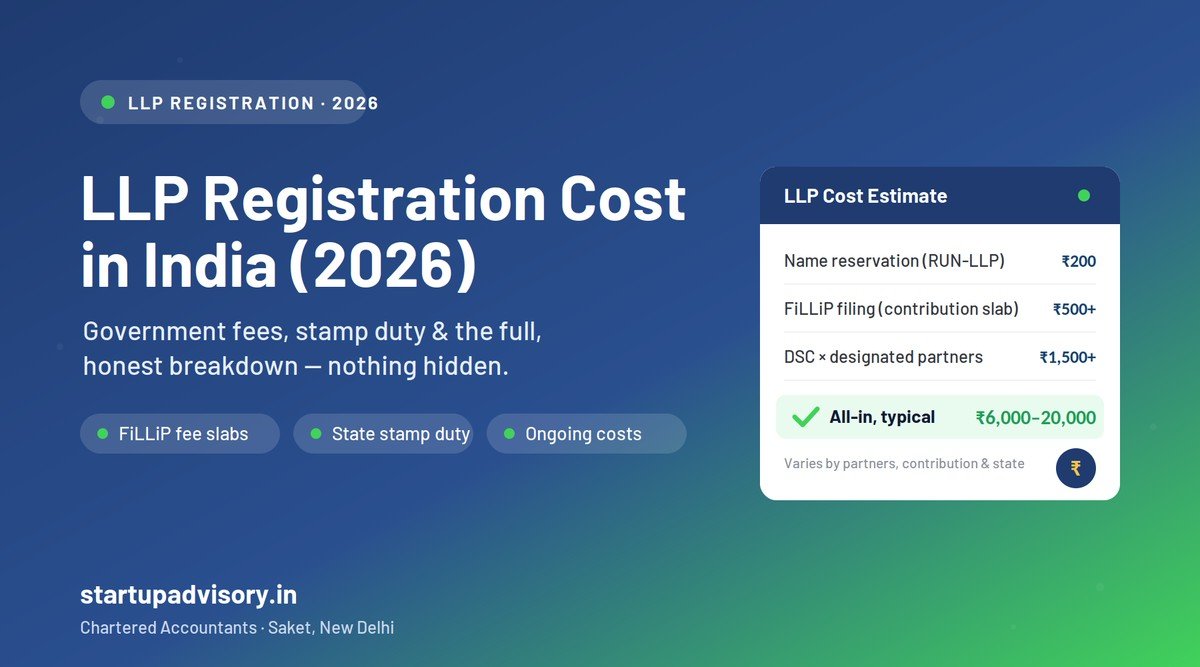
An all-inclusive LLP registration in India typically costs ₹6,000–₹20,000, and where you land in that band depends on exactly three things: the number of designated partners (each needs a Digital Signature Certificate), the capital contribution (which sets the MCA's FiLLiP fee slab), and the state of your registered office (which sets the stamp duty on the LLP agreement). The core MCA fees are modest — ₹200 for name reservation and a FiLLiP fee starting at ₹500 for contribution up to ₹1 lakh — so for small LLPs the real variables are DSCs, stamp duty and the professional fee. In Delhi NCR, a standard 2-partner LLP usually lands between ₹6,000 and ₹15,000. And budget for the costs that come after registration: Form 11 and Form 8 every year, with a ₹100-per-day late fee per form if you miss them.
"How much does an LLP cost?" sounds like it should have a one-number answer. It doesn't — and any portal quoting a single flat price is either padding the quote for the smallest case or hiding statutory costs that surface later. This guide breaks the cost of LLP registration into its actual components, so you can compute your own number before anyone quotes you.
The three drivers of your LLP registration cost
- Number of designated partners. Every designated partner needs a Class 3 DSC to sign MCA filings. Two partners means two DSCs; four means four. This scales your cost linearly before anything else is counted.
- Capital contribution. The MCA's FiLLiP incorporation fee is slab-based on the total contribution all partners commit. Declare ₹1 lakh and the fee is ₹500; declare ₹8 lakh and it's ₹4,000. Stamp duty in most states also scales with contribution.
- State of the registered office. Stamp duty on the LLP agreement is state law, not MCA law — the same LLP can cost meaningfully different amounts in two different states. This is the biggest source of variation in the ₹6,000–₹20,000 band.
Component-by-component: what you actually pay
| Component | Typical Amount (2026) | Notes |
|---|---|---|
| Digital Signature Certificate (DSC) | ₹1,500 – ₹2,500 per designated partner | Class 3 DSC from a licensed Certifying Authority; usually 2-year validity |
| Name reservation (RUN-LLP) | ₹200 per application | Two name choices per application; a fresh application needs a fresh fee |
| Incorporation filing (FiLLiP) | ₹500 – ₹5,000+ | Slab-based on contribution: ₹500 up to ₹1 lakh; ₹2,000 for ₹1–5 lakh; ₹4,000 for ₹5–10 lakh; ₹5,000 onwards for higher slabs |
| LLP Agreement filing (Form 3) | Nominal, slab-based | Must be filed within 30 days of incorporation — missing it costs ₹100/day |
| Stamp duty on LLP Agreement | Varies by state & contribution | From a few hundred rupees to several thousand; the main state-wise variable |
| Professional fee | As per package | Drafting the LLP agreement well is where professional input earns its fee |
Add it up for the most common case — two designated partners, ₹1 lakh contribution: two DSCs (₹3,000–₹5,000), RUN-LLP (₹200), FiLLiP (₹500), Form 3 (nominal), stamp duty (state-dependent), plus the professional fee. That is how the ₹6,000–₹15,000 Delhi NCR band, and the wider ₹6,000–₹20,000 all-India band, are built.
Where the money is not: the myth of expensive MCA fees
Notice that for a small LLP the pure government incorporation fees are under ₹1,000. Founders often assume the government charge is the big-ticket item; it isn't. The cost centres are DSCs, state stamp duty and professional drafting — and of those three, the LLP agreement is the one worth paying for. It is the constitution of your firm: profit sharing, capital, exit, dispute resolution. A template agreement saves a little now and costs a lot at the first partner disagreement.
LLP vs Pvt Ltd: which is cheaper to register?
Here is the honest comparison most portals skip. The SPICe+ government filing fee for a Private Limited Company is nil for authorised capital up to ₹15 lakh — while the LLP's FiLLiP fee is never nil. So on pure government incorporation fees, the company can actually be cheaper. The LLP claws it back on stamp duty in many states and on professional fees, and then wins decisively on ongoing costs: no mandatory statutory audit below ₹40 lakh turnover / ₹25 lakh contribution, lighter annual filings, and lower penalties for Small LLPs. If you're choosing a structure on cost, compare the five-year cost, not the day-one cost — our Pvt Ltd vs LLP vs OPC guide does exactly that.
The costs that come after registration
- Form 11 (Annual Return) by 30 May and Form 8 (Statement of Account & Solvency) by 30 October — every year, even with zero business.
- Income tax return of the LLP, and DIR-3 KYC for each designated partner.
- Late fee of ₹100 per day, per form, with no upper limit for delayed Form 8 / Form 11 — a missed year can cost multiples of the original registration.
- Audit only if turnover exceeds ₹40 lakh or contribution exceeds ₹25 lakh.
See the full year-round picture in our ROC compliance calendar for Pvt Ltd & LLP.
Four legitimate ways to keep the cost down
- Declare a sensible contribution, not a vanity number. The FiLLiP fee and most states' stamp duty scale with contribution. You can increase contribution later as the business actually needs it.
- Get both name choices right in one RUN-LLP application. Check MCA name availability and trademark conflicts before filing, so you don't pay for repeat applications.
- File Form 3 within 30 days. The filing fee is trivial; the ₹100/day late fee is not.
- Don't pay for what's free. PAN and TAN come through the incorporation process; Udyam (MSME) registration afterwards is free on the government portal.
Government fee slabs and stamp duty rates stated here reflect the position as we understand it in August 2026 and can change by notification; state stamp duty in particular varies. Treat the figures as indicative and confirm the exact payable amounts for your case before filing. This article is general information, not professional advice.
How Startup Advisory Can Help
Startup Advisory is a CA-led firm in Saket, New Delhi registering LLPs for founders across Delhi NCR and India:
- Fixed-fee LLP registration — DSCs, name reservation, FiLLiP filing and a properly drafted LLP agreement, quoted upfront with no surprise add-ons.
- Structure advice before you file — whether an LLP, OPC or Pvt Ltd actually fits your funding and compliance plans.
- Post-registration compliance — Form 3, Form 11, Form 8, DIR-3 KYC and the LLP's tax filings, so the ₹100/day meter never starts.
Want an exact, fixed quote for your LLP? Call 9311972982 or book a free consultation — we'll compute your number in one call.
Frequently Asked Questions
Primary sources
The statements of law and figures above are drawn from the official texts below. Each link was checked on 18 September 2026; government portals reorganise their pages from time to time, so tell us if one has moved.