
GST / Compliance
GST Registration in South Delhi (2026): Process, Documents, Cost — and Why Applications Get Rejected
In short
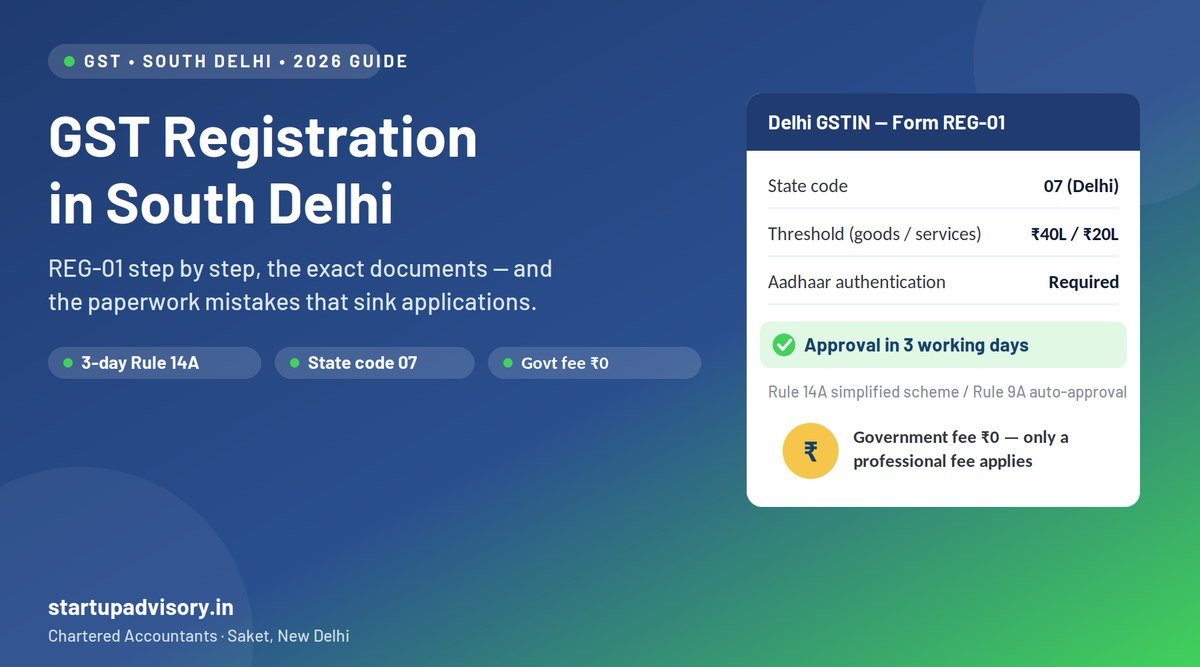
A business operating from South Delhi — Saket, Hauz Khas, Lajpat Nagar, Nehru Place, Okhla and nearby — registers for GST under Delhi (state code 07), entirely online through Form REG-01. Registration is mandatory above ₹40 lakh turnover for goods / ₹20 lakh for services, and regardless of turnover for e-commerce sellers and inter-state suppliers. Since 1 November 2025, the simplified scheme (Rule 14A) and auto-approval (Rule 9A) mean a clean, low-risk application can be approved in 3 working days after Aadhaar authentication; a normal case takes about 7. The government fee is nil. Most rejections aren't eligibility failures — they're paperwork failures: mismatched address proof, missing NOCs, PAN-Aadhaar name mismatches and skipped Aadhaar authentication. Here is the full process, the exact document set, and how to avoid each trap. For done-for-you filing, see our GST registration in South Delhi service.
South Delhi crams remarkable business diversity into a few pin codes: market traders in Lajpat Nagar and GK, IT and hardware firms around Nehru Place, exporters in the Okhla phases, D2C brands, doctors, designers and a small army of freelancers in co-working spaces. Nearly all of them hit the same first compliance milestone — getting a GSTIN. This guide walks through the 2026 process end to end, based on what we see filing these applications every week from our office in Saket.
Step 0: Do you actually need to register?
- Mandatory by turnover: aggregate turnover above ₹40 lakh (goods) or ₹20 lakh (services) — Delhi is a normal category state.
- Mandatory regardless of turnover: selling through e-commerce operators (Amazon, Flipkart, Meesho), making inter-state supplies, and certain other categories.
- Voluntary but smart: consultants and agencies below ₹20 lakh often register anyway — corporate clients prefer GST-registered vendors, and registration unlocks input tax credit on your own expenses.
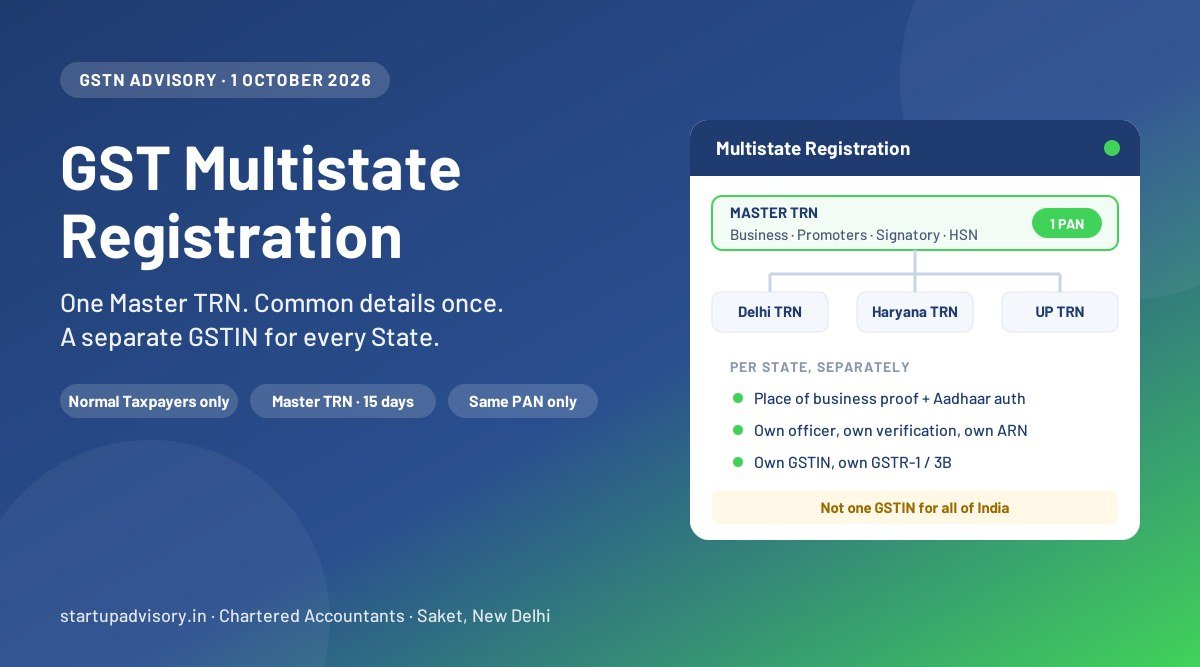
One point that surprises founders: GST is state-wise. A South Delhi place of business gets a Delhi GSTIN beginning with 07. If you also operate from Gurgaon, that location needs its own Haryana GSTIN under the same PAN — see our Gurgaon GST guide.
The documents (get these right and the rest is easy)
| Category | What you need |
|---|---|
| Identity | PAN of the business/proprietor; Aadhaar & photo of proprietor/partners/directors |
| Constitution | Partnership deed / Certificate of Incorporation / registration certificate |
| Authority | Authorisation letter or board resolution for the authorised signatory |
| Premises (owned) | Electricity bill or property-tax receipt |
| Premises (rented / co-working / virtual office) | Rent or service agreement + NOC from the owner/provider + a recent electricity bill or property-tax receipt for the premises |
| Bank | Cancelled cheque / statement / passbook |
| Signature | DSC for companies & LLPs; Aadhaar OTP / EVC otherwise |
The 2025 reforms cleaned this list up — officers now follow a strict, limited document list, and a simple electricity bill is accepted as premises proof. The flip side: what is asked for must match perfectly.
The REG-01 process, step by step
- Part A: PAN, mobile and email go in, Delhi is selected as the state, and a Temporary Reference Number (TRN) is generated after OTP verification.
- Part B: business details, HSN/SAC codes for what you sell, promoter details, bank details, and the premises proof are uploaded.
- Aadhaar authentication: the authorised signatory and a promoter authenticate via Aadhaar OTP (or biometric verification at a GST Suvidha Kendra if the system flags it). This step is now central — the ARN is generated only after successful authentication.
- ARN & processing: the application is processed by the Delhi state / central GST system or officer. Low-risk cases can be auto-approved electronically (Rule 9A).
- GSTIN & certificate: on approval, the Delhi GSTIN is allotted and the REG-06 certificate is available to download.
Timelines in 2026: 3 working days under the Rule 14A simplified scheme (available where monthly B2B output tax is ₹2.5 lakh or less) or for low-risk auto-approved cases; about 7 working days normally; up to 30 working days where physical verification is triggered.
Why applications get rejected or stuck (the part nobody tells you)
In our experience the eligibility rules almost never sink a South Delhi application — the paperwork does. The recurring failure modes:
- Address proof mismatch. The rent agreement names a different unit than the application, the agreement has expired, or the electricity bill is in a name with no visible link to the landlord in the chain of documents. The fix: make the premises story consistent across every document before filing.
- Missing NOC. Co-working seats and virtual offices are fully valid places of business — but only with the service agreement plus the provider's NOC plus a utility bill. Filing with the agreement alone invites a query.
- PAN–Aadhaar name mismatch. Even small spelling differences between PAN and Aadhaar records can fail validation. Fix the records first; don't file and hope.
- Skipped or failed Aadhaar authentication. Without successful authentication, the application routes to physical verification — adding weeks. If OTP fails, biometric verification at a Suvidha Kendra is the recovery path.
- Wrong state or jurisdiction selection. A Delhi business filed under the wrong state, or a careless ward/jurisdiction choice, creates avoidable friction.
- Poor scans. Cropped, blurry or partial uploads are a classic query trigger. Full-page, legible scans only.
A query (notice in REG-03) isn't a rejection — you get a window to reply in REG-04 — but every round trip costs one to two weeks. A clean first filing is the entire game.
What it costs
The government fee is ₹0 — anyone charging a "government fee" for GST registration is padding the bill. What you actually pay: a professional fee, typically ₹1,000–₹3,000 for CA-led preparation and filing, plus ₹1,500–₹2,500 for a Digital Signature if you're a company or LLP. Ongoing GST return filing is a separate package.
After the GSTIN: your first-month checklist
- Display the registration certificate at the premises and print the GSTIN on invoices and the name board.
- Set up compliant invoicing with the correct HSN/SAC codes and tax rates.
- Know your return cycle: GSTR-1 (outward supplies) and GSTR-3B (summary + payment) — monthly, or quarterly under QRMP if aggregate turnover is up to ₹5 crore. Our GST & TDS compliance calendar has every date.
- Exporters (common in Okhla): file a Letter of Undertaking (LUT) so zero-rated exports run without IGST outflow.
- Get the books in order from day one — ITC claims live or die on clean purchase records. See our bookkeeping service.
This article reflects the GST registration rules and portal behaviour as we understand them in August 2026 and is general information, not professional advice. Rules and portal workflows change; take advice on your specific facts before filing.
How Startup Advisory Can Help
Startup Advisory is a CA firm physically based in Saket, South Delhi — not just a website. For GST registration we:
- Prepare a clean first filing — correct jurisdiction, HSN/SAC codes and a premises document set that won't draw a query.
- Handle co-working and virtual-office cases weekly, including the NOC and agreement structuring that trips most DIY filers.
- Guide you through Aadhaar authentication and draft REG-04 replies if a query does land.
- Take over from there: returns and ITC reconciliation, LUTs for exporters, and bookkeeping.
Walk into our Saket office or do it all remotely — start on the GST Registration in South Delhi page, call 9311972982, or book a free consultation.