
Startup India / DPIIT
Section 80-IAC Explained: How Delhi Startups Get a 100% Tax Holiday (Extended to 2030)

In short
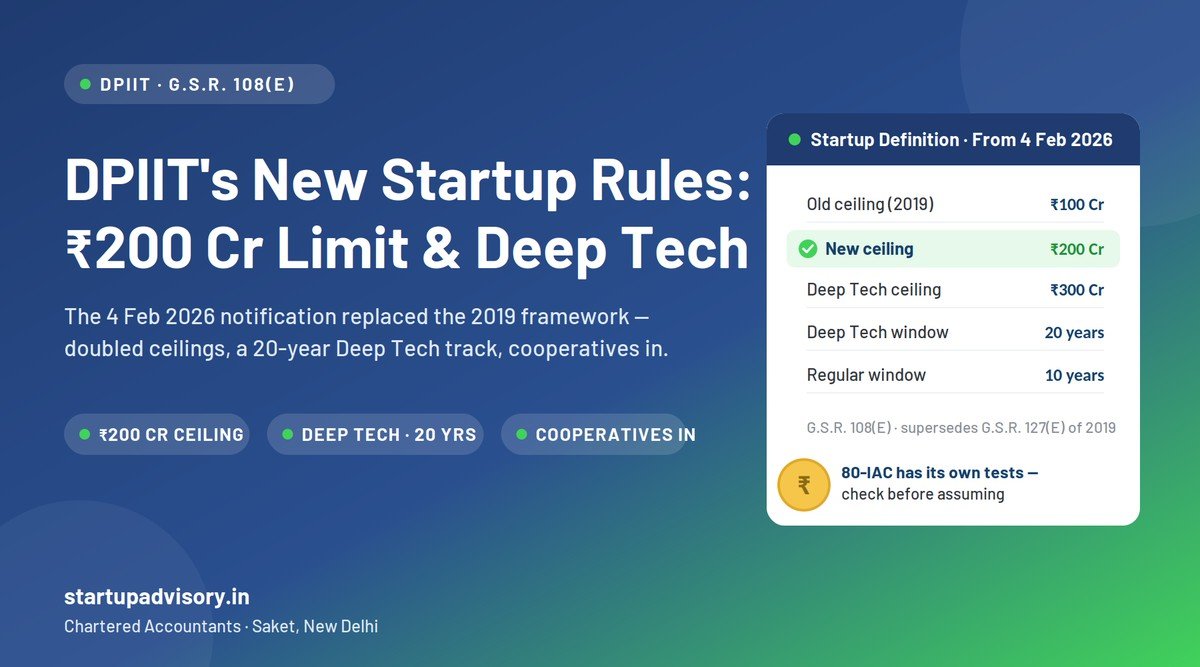
Section 80-IAC gives eligible DPIIT-recognised startups a 100% income-tax deduction on profits for any 3 consecutive years within their first 10 years — effectively a tax holiday. In Budget 2025-26 the government extended eligibility to startups incorporated before 1 April 2030, and applications are now reviewed within 120 days. From 1 April 2026 the deduction continues as Section 140 of the Income-tax Act, 2025, and the Finance Act, 2026 raised the turnover limit to Rs. 300 crore from Tax Year 2026-27 (Rs. 100 crore for earlier years). To qualify you must be a DPIIT-recognised Pvt Ltd or LLP within that limit. It's one of the biggest financial incentives available to Delhi NCR startups.
For a profitable early-stage company, paying zero income tax for three years is transformational — that's exactly what Section 80-IAC offers eligible startups. Here's how it works in 2026 and how Delhi founders can claim it.
What Section 80-IAC actually does
It allows an eligible startup a 100% deduction on profits and gains from its business for any three consecutive financial years chosen out of the first ten years since incorporation. Because you pick the years, most startups apply the deduction to their most profitable years, maximising the saving and freeing up capital to reinvest in growth.
The 2025 extension — why it matters now
The Union Budget 2025-26 extended the eligibility window: startups incorporated before 1 April 2030 can now apply. The review process was also streamlined, with complete applications assessed within a 120-day timeline. For Delhi founders incorporating today, this means the door to the tax holiday is firmly open.
Eligibility checklist
- DPIIT-recognised — you must first hold DPIIT recognition (see our DPIIT recognition guide)
- Structure: Private Limited Company or LLP
- Incorporation date: on or after 1 April 2016 and before 1 April 2030
- Turnover: not exceeding Rs. 300 crore in the tax year of the claim from Tax Year 2026-27 (Section 140, as amended by the Finance Act, 2026); Rs. 100 crore for earlier years under Section 80-IAC
- Genuine business: not formed by splitting up or reconstructing an existing business
How to claim it
Get DPIIT recognition
This is the prerequisite. Without it, you can't apply for 80-IAC.
Apply for the exemption
Submit the 80-IAC application with your business plan and financials; it's reviewed by the Inter-Ministerial Board (IMB).
Get IMB approval
Complete applications are reviewed within 120 days. On approval, you can claim the deduction in your chosen years.
Claim in your ITR
Apply the 100% deduction across the three consecutive years you select, supported by clean accounts.
A simple illustration
Say your startup turns profitable in years 4, 5 and 6 after incorporation. By electing those three consecutive years for the 80-IAC deduction, the profits of those years can be fully exempt — capital that stays in the business instead of going to tax. (Other taxes such as MAT/AMT and conditions can apply, so plan the timing with an advisor.)
What a strong application needs
- A clear demonstration of innovation, scalability and growth potential
- A credible business plan and financial statements
- Clean, well-maintained books — see our bookkeeping service
The IMB rejects vague or weak applications, so the write-up matters as much as the numbers. Our Saket team helps Delhi NCR startups secure both DPIIT recognition and the 80-IAC exemption.
This article is general information, not tax advice. Eligibility and conditions are governed by the Income Tax Act and DPIIT notifications and can change.
How Startup Advisory Can Help
Startup Advisory is a CA-led firm in Saket, New Delhi that helps DPIIT-recognised startups across Delhi NCR actually secure the Section 80-IAC tax holiday. The exemption is valuable but the application is where most startups get rejected — we get it approved:
- Startup India (DPIIT) recognition plus the full Section 80-IAC exemption application to the inter-ministerial board.
- A strong innovation and scalability write-up — the single biggest reason applications succeed or fail.
- ITR and tax advisory to choose the right three years and claim the holiday correctly.
- A named CA who manages the whole approval, end to end.
Call 9311972982 or book a free consultation to check your 80-IAC eligibility.