
Startup India / DPIIT
DPIIT Startup Recognition in 2026: Eligibility, Process & Benefits (Post-February 2026 Rules)

In short
DPIIT recognition is a free government certification under the Startup India scheme that marks your business as an eligible startup. Since 4 February 2026 (G.S.R. 108(E)), you qualify if you are a Pvt Ltd, LLP, registered partnership or cooperative society, under 10 years old, with turnover under Rs. 200 crore in every year since incorporation (20 years and Rs. 300 crore for Deep Tech), working on something innovative or scalable. You apply online through the National Single Window System (NSWS) — no government fee — and recognition usually comes through in a few working days to two weeks. It unlocks the 80-IAC tax holiday (separate application, with its own turnover test), IPR rebates, self-certification, public-procurement access and funding schemes. Most rejections are caused by a weak innovation write-up, not ineligibility.
DPIIT recognition is one of the most valuable — and underused — things a Delhi startup can do after incorporation. It's free, fast, and opens the door to tax and compliance benefits worth far more than the effort. The rules changed materially in February 2026, and most guides online still describe the old Rs. 100 crore regime. Here is the current picture.
What changed on 4 February 2026
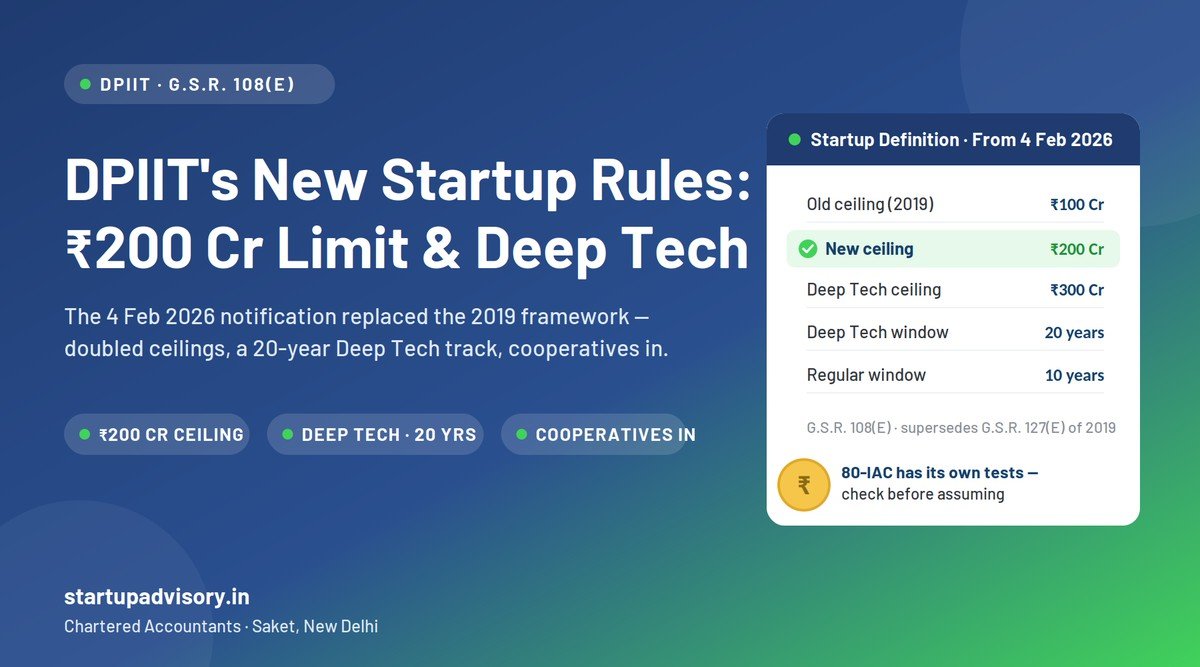
DPIIT's notification G.S.R. 108(E) superseded the 2019 framework (G.S.R. 127(E)). Three things moved:
| Criterion | Before (2019 rules) | Now (G.S.R. 108(E), from 4 Feb 2026) |
|---|---|---|
| Turnover ceiling | Rs. 100 crore | Rs. 200 crore (Rs. 300 crore for Deep Tech) |
| Recognition window | 10 years from incorporation | 10 years; 20 years for Deep Tech |
| Eligible entities | Pvt Ltd, LLP, registered partnership | Pvt Ltd, LLP, registered partnership, state / multi-state cooperative society |
| Deep Tech category | None | New — novel science/engineering, heavy R&D, novel IP, long commercialisation |
| Use of funds | — | Negative list through the recognition period: no residential real estate, luxury assets, speculative investments or unrelated loans |
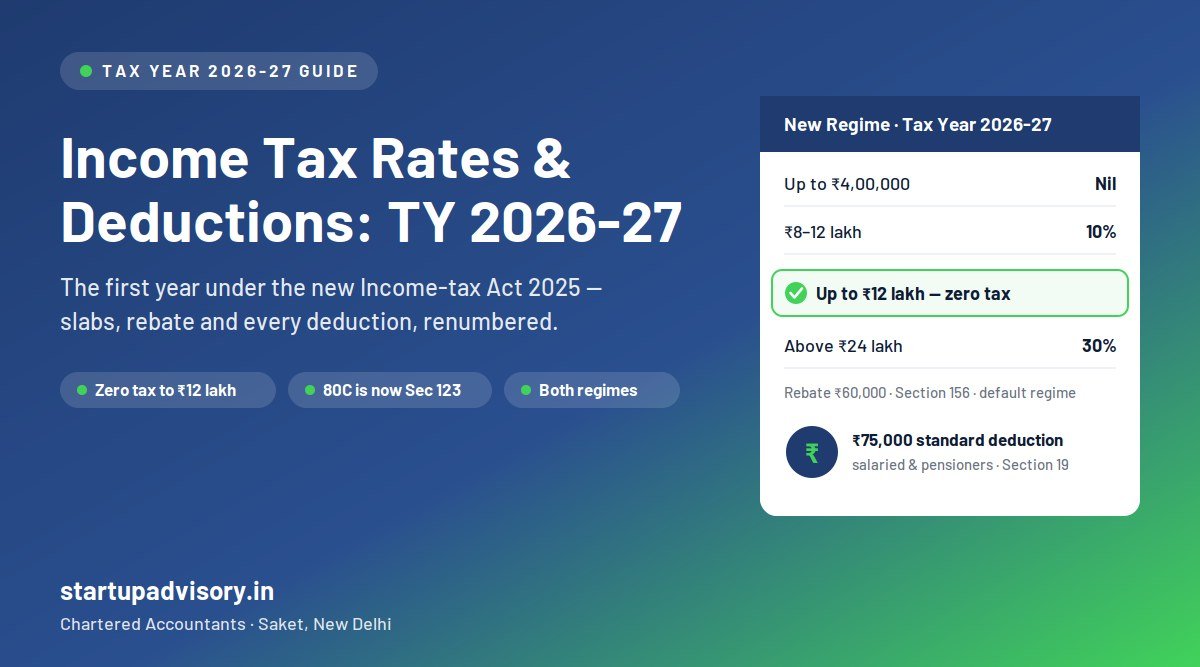
Already-recognised startups did not have to re-apply; they should download the updated certificate from the Startup India portal. One caveat that matters: the Section 80-IAC tax holiday has its own turnover condition in the income-tax law — the Rs. 200 crore recognition ceiling does not automatically extend the tax holiday. (From Tax Year 2026-27 the deduction is Section 140 of the Income-tax Act, 2025, and the Finance Act, 2026 set its turnover limit at Rs. 300 crore.) For the definition changes in depth see our G.S.R. 108(E) explainer.
What is DPIIT recognition?
DPIIT stands for the Department for Promotion of Industry and Internal Trade. Under the Startup India initiative, it grants recognition to eligible businesses, formally classifying them as "startups." This recognition is what makes you eligible for the scheme's benefits — it is not the same as registering your company (that's a separate, earlier step).
Eligibility criteria (2026)
- Entity type: Private Limited Company (including OPC), LLP, registered partnership firm, or a state / multi-state cooperative society
- Age: up to 10 years from the date of incorporation (20 years if recognised as Deep Tech)
- Turnover: under Rs. 200 crore in every financial year since incorporation (Rs. 300 crore for Deep Tech)
- Nature: working towards innovation, development or improvement of products/services, or a scalable model with potential for employment or wealth creation
- Originality: not formed by splitting up or reconstructing an existing business
Sole proprietorships, HUFs and unregistered partnerships are not eligible.
The application process
Incorporate first
You need a registered Pvt Ltd, LLP, partnership or cooperative before applying. See our Company Registration service.
Register on NSWS / Startup India
Create an account on the National Single Window System (nsws.gov.in), which hosts the DPIIT recognition form, and link your Startup India profile.
Fill in business details
Enter entity details, directors/partners, sector, and a clear description of what makes your business innovative or scalable. If you are building deep technology, say so and substantiate it — that is what triggers the 20-year / Rs. 300 crore category.
Upload documents
Incorporation certificate, and a short write-up or proof of your product/innovation.
Receive your recognition certificate
Once approved, you get a DPIIT recognition number and certificate — usually within a few working days to two weeks. There is no statutory timeline.
Documents you'll need
- Certificate of Incorporation / registration
- Details of directors / partners
- A brief description of your business and what makes it innovative or scalable
- Website, pitch deck or product details (helpful for a strong application)
What recognition unlocks
- 80-IAC tax holiday — 100% income-tax deduction for 3 consecutive years out of 10 (separate IMB application; own turnover test; see our 80-IAC guide and why 80-IAC applications get rejected)
- IPR benefits — fast-tracked patents and big rebates on patent/trademark fees
- Self-certification under select labour and environmental laws
- Public procurement — relaxed eligibility for government tenders and GeM access
- Funding access — eligibility for Fund of Funds (including the Rs. 10,000 crore Fund of Funds 2.0), the Credit Guarantee Scheme for Startups and state schemes (the Seed Fund closed to new applications in May 2026)
For the full list, read Startup India benefits beyond tax and what funding is actually open in 2026.
Common reasons applications get sent back
- A vague description that doesn't show innovation or scalability — by far the largest cause; the reviewer needs the problem, the solution and why it is new, not a marketing paragraph
- Missing or mismatched incorporation details between MCA / LLP / cooperative records and the form
- Applying with a structure that isn't eligible (e.g. sole proprietorship)
- An entity formed by splitting or reconstructing an existing business
- Claiming Deep Tech without evidence of R&D, IP or a credible technology roadmap
A well-written application is the difference between fast approval and a rejection. Our Saket team handles DPIIT recognition end to end for Delhi NCR founders.
How Startup Advisory Can Help
Startup Advisory is a CA-led firm in Saket, New Delhi that handles DPIIT recognition end to end for startups across Delhi NCR. Most rejections come down to a weak innovation write-up — that is exactly where our team adds value:
- Full Startup India (DPIIT) registration — eligibility check, application and follow-up.
- A compelling innovation and scalability note that stands up to DPIIT scrutiny.
- Section 80-IAC tax-exemption filing once you are recognised.
- Company registration first if you are not yet incorporated.
Call 9311972982 or book a free consultation to get DPIIT-recognised.