A tax audit is a CA’s audit of a taxpayer’s books for income-tax purposes, reported in prescribed forms before the return is filed. For FY 2025-26 (AY 2026-27) it is governed by Section 44AB of the Income-tax Act, 1961; from Tax Year 2026-27 it moves to Section 63 of the Income-tax Act, 2025, with the same core limits. Startup Advisory handles tax audits for proprietors, firms, LLPs and companies.
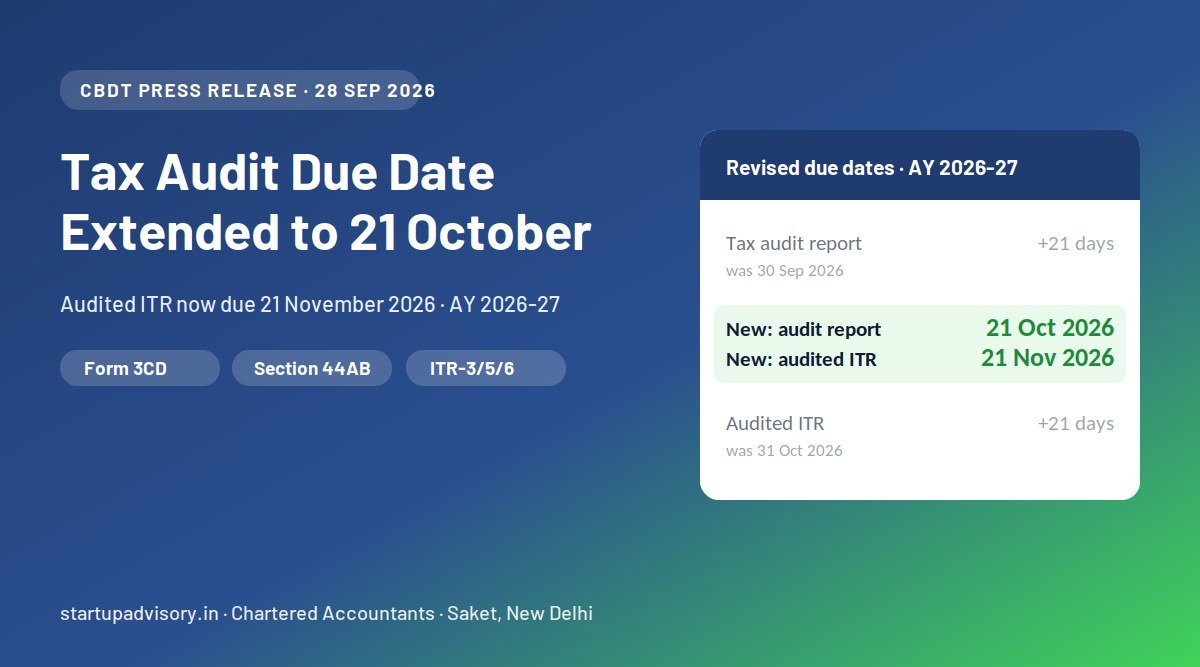
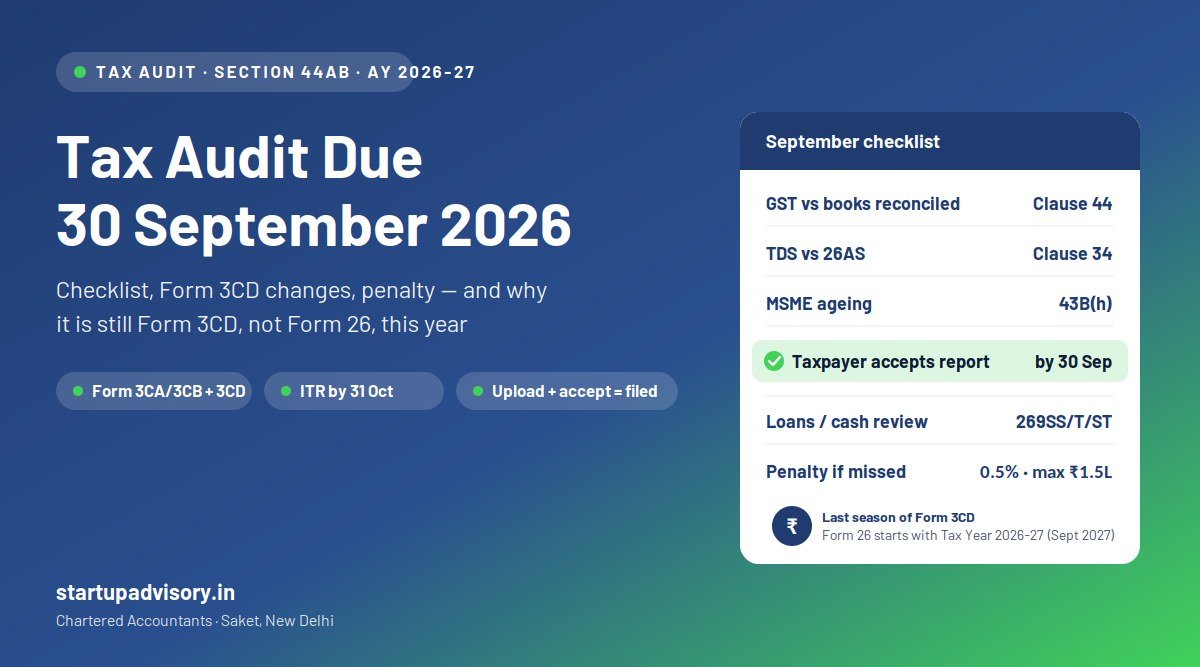
 Business: turnover above ₹1 crore — or above ₹10 crore if cash receipts and cash payments are each within 5% of the totals.Profession: gross receipts above ₹50 lakh.Presumptive cases: declaring profit below the presumptive rate (44AD/44ADA; Sections 58/61 of the 2025 Act) when income exceeds the basic exemption limit.Forms: Form 3CA or 3CB with Form 3CD under the 1961 Act; a single Form 26 for Tax Year 2026-27 audits.Due date: one month before the ITR due date — 30 September normally; for AY 2026-27 CBDT extended it to 21 October 2026.Penalty: for years under the 1961 Act, Section 271B — 0.5% of turnover or receipts, capped at ₹1.5 lakh, unless reasonable cause is shown.
Reviewed by CA Neeraj Rohilla, FCA — Chartered Accountant, Startup Advisory, Saket, New Delhi.
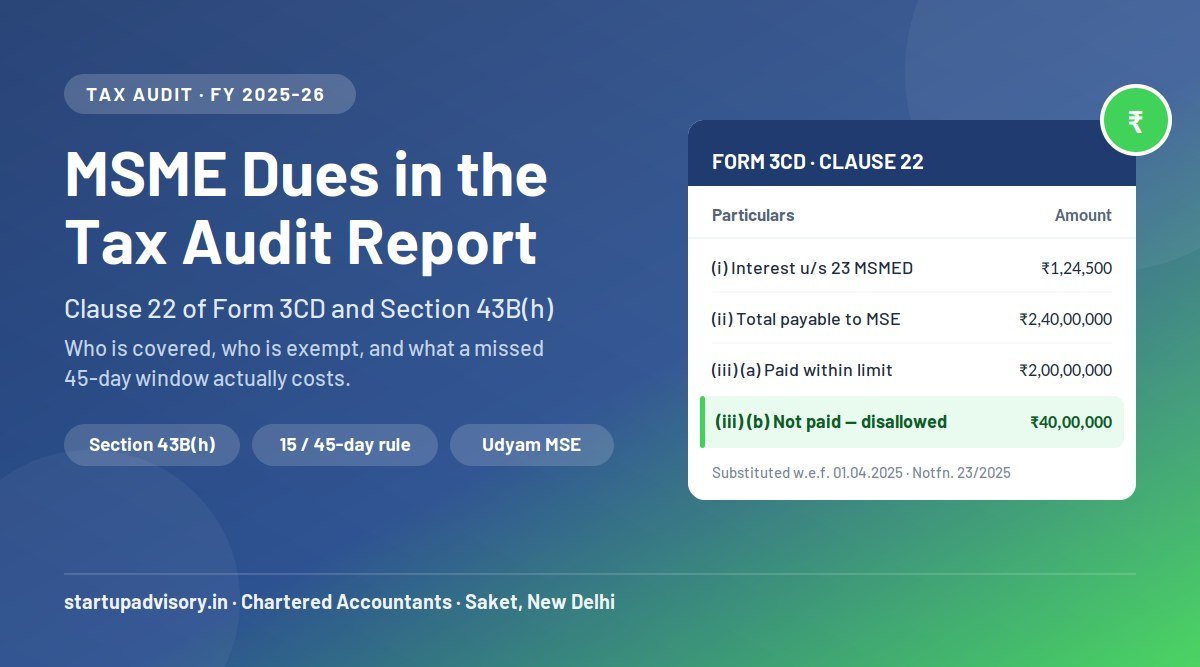
A tax audit report is more than a signature on accounts. Form 3CD (and from Tax Year 2026-27, Form 26) asks the auditor to report dozens of specific particulars — payments to related parties, TDS defaults, cash transactions above limits, MSME dues paid late, deemed income, and more — and the department uses those disclosures to select cases for scrutiny. Getting it right protects you; getting it wrong hands the assessing officer a ready-made list.
| Taxpayer | Audit required when | Notes |
|---|---|---|
| Business (default) | Turnover, sales or gross receipts exceed ₹1 crore | Applies even if the business made a loss |
| Business with low cash | Turnover exceeds ₹10 crore | Only if cash receipts and cash payments are each 5% or less of the totals; a non-account-payee cheque or draft counts as cash |
| Profession | Gross receipts exceed ₹50 lakh | Doctors, lawyers, architects, consultants, IT professionals and other notified professions |
| Presumptive business (44AD / Section 58) | Profit declared below the presumptive rate and income above the basic exemption limit | Also where a business opts out of the scheme within the lock-in period |
| Presumptive profession (44ADA / Section 61) | Profit declared below 50% of receipts and income above the basic exemption limit | — |
The limits are the same under Section 63 of the Income-tax Act, 2025: ₹1 crore for business, ₹10 crore with the 5% cash conditions, and ₹50 lakh for professions, with presumptive cases covered where declared profit is lower than the deemed profit. Our tax audit applicability guide works through the edge cases.
| Year | Law | Section | Forms | Due date |
|---|---|---|---|---|
| FY 2025-26 (AY 2026-27) | Income-tax Act, 1961 | 44AB | Form 3CA or 3CB, with Form 3CD | 21 October 2026 (extended from 30 September 2026) |
| Tax Year 2026-27 onwards | Income-tax Act, 2025 | 63 | Form 26 | One month before the return due date — 30 September 2027 for Tax Year 2026-27 |
Form 3CA is used where the accounts are already audited under another law, such as a company under the Companies Act; Form 3CB is used for everyone else. Under Section 63(4) of the 2025 Act, as under the old law, an audit under another law suffices if it is completed and reported by the specified date along with the tax audit report.
Applicability check: turnover computation, cash-ratio test, presumptive options and whether an audit is required at all.Pre-audit clean-up: GST turnover reconciled to books, TDS defaults identified, Section 43B and MSME payment timelines tested, related-party schedule prepared.Audit and reporting: verification of books and the particulars, Form 3CD or Form 26 prepared clause by clause, UDIN generated and report uploaded.Taxpayer acceptance: the report counts only once you accept it from your own e-filing login — we track it to acceptance.Return filing: audited ITR filed by the due date, with the computation consistent with the audit report.For deadline news, see our post on the AY 2026-27 tax audit extension. Companies that also need a statutory audit can have both planned together.

Vishal Singh


Ajay Philip

Pranshu Gaur

Ravish Mehta

Mohit Aggarwal

Sanjeev Sharma

Realtoadvisors

Sakshi Gupta
Rudranath Trip
Yash Rohilla
Sandro Cottus

Azan Hosein Photography
Neetu Yadav
Fresh guides on tax, GST and startup compliance from our CA team.
Share your details — our experts call you back. We use these details only to respond to you. See our Privacy Policy.