
FEMA / RBI Compliance
ODI Compliance for Indian Residents: Buying Shares in a Foreign Company or Setting Up a Company Abroad
Reviewed by CA Neeraj Rohilla, FCA — Chartered Accountant, Startup Advisory, Saket, New Delhi.
1. The law in 2026
Three instruments, all in force since 22 August 2022, govern every investment an Indian resident makes outside India:
| Instrument | Issued by | What it covers |
|---|---|---|
| Foreign Exchange Management (Overseas Investment) Rules, 2022 (G.S.R. 646(E)) | Central Government (Ministry of Finance) | Definitions of ODI, OPI and control; who may invest; limits; prohibited sectors and structures; pricing; transfer and holding period. Schedule I covers Indian entities, Schedule III resident individuals. |
| Foreign Exchange Management (Overseas Investment) Regulations, 2022 (FEMA 400/2022-RB) | Reserve Bank of India | Debt and guarantees to foreign entities, deferred payment, mode of payment, UIN and designated AD bank, evidence of investment, reporting (Regulation 10), delay and late fee (Regulations 11 and 12). |
| Master Direction – Overseas Investment (FED Master Direction No. 15/2024-25) | Reserve Bank of India | Operational instructions for AD banks and investors, the forms and the Late Submission Fee matrix. Current version: updated as on 1 April 2026. |
The 2022 framework replaced the older ODI regulations of 2004 and moved most investments to the automatic route: you do not need RBI’s permission, but the AD bank checks compliance and you carry the reporting burden. The Rules themselves state the starting point plainly:
Investment in Pakistan, or any other country the Central Government notifies, needs prior approval of the Central Government, and so do certain strategic-sector cases.
2. ODI or OPI: which one is yours?
Every overseas investment is either Overseas Direct Investment (ODI) or Overseas Portfolio Investment (OPI). The label decides the paperwork, so get it right first.
| Your investment | Classification | Why |
|---|---|---|
| Subscribing to shares of a new company you set up in Delaware, Singapore, the UAE or the UK | ODI | Subscription to the memorandum of association of a foreign entity is always ODI. |
| Buying shares in an unlisted foreign startup or private company, any percentage | ODI | Any acquisition of unlisted equity capital is ODI. |
| Buying 10% or more of a listed foreign company | ODI | 10% of paid-up equity is the ODI line for listed companies. |
| Buying less than 10% of a listed company but getting board seats or veto rights | ODI | Investment with control is ODI even below 10%. |
| Buying Apple, Nvidia or other listed shares through an LRS investing app | OPI | Listed, below 10%, no control. |
| ESOPs, sweat equity or qualification shares from a foreign parent, below 10% without control | OPI | Specifically treated as OPI under Schedule III. |
| Foreign mutual funds, ETFs, listed debt | OPI | Portfolio securities, not equity control. |
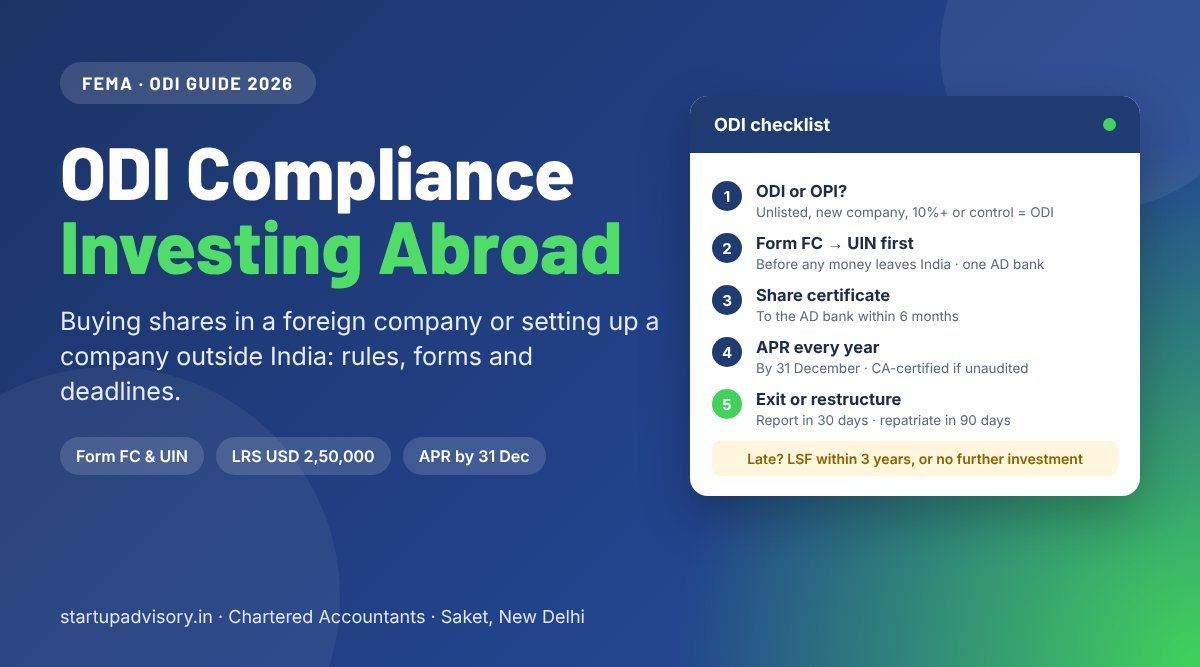
Two rules catch people out. First, “control” is defined widely: the right to appoint a majority of directors or to control management or policy decisions, including through shareholders’ or voting agreements that give 10% or more of voting rights. Second, once ODI, always ODI: an investment that was ODI stays ODI even if later dilution takes you below 10% or you lose control.
OPI cannot be made in unlisted debt instruments, in derivatives unless permitted, or in commodities including Bullion Depository Receipts.
3. Who can invest, and how much
| Point | Resident individual | Indian entity (company, LLP, registered partnership firm) |
|---|---|---|
| Limit | Within the Liberalised Remittance Scheme: USD 2,50,000 per financial year (April–March), shared with all other LRS remittances such as education, travel and gifts | Total financial commitment up to 400% of net worth as per the last audited balance sheet (Schedule I); above USD 1 billion in a financial year needs prior RBI approval |
| What it can invest in | Equity capital only (ODI or OPI) | Equity, plus loans, debt instruments, guarantees and pledges to a foreign entity it controls |
| Type of foreign entity | An operating entity, not in financial services, with no subsidiary or step-down subsidiary where the individual has control | Any foreign entity in bona fide business, including holding structures and step-down subsidiaries, subject to Rule 19 |
| Foreign startups | Only from the individual’s own funds | Only from internal accruals of the Indian entity or its group, not borrowed funds |
| Who files | The individual, through the AD bank (plus Form A2 under LRS) | The Indian entity, through its AD bank |
The individual’s limit is the important practical constraint. LRS is one bucket of USD 2,50,000 a year, so a founder who has already paid a child’s foreign tuition from LRS has that much less room for an overseas company. Shares received by gift from a resident relative or by inheritance are allowed without limit and do not use up the LRS limit.
A person who is a wilful defaulter, whose account is an NPA, or who is under investigation by a financial service regulator or by an investigative agency in India must get a no-objection certificate from the lender, regulator or agency before making a financial commitment or disinvesting (Rule 10). The NOC is deemed granted if not received within 60 days.
4. Buying shares in a foreign company
Listed shares (OPI). A resident individual buying foreign listed shares through an LRS investing platform or a bank’s overseas brokerage needs no Form FC and no UIN. The remittance goes under LRS with Form A2, PAN is mandatory, and money parked abroad and not invested must be brought back within 180 days. Individuals do not file Form OPI; that half-yearly return is for Indian entities and other non-individual investors.
Unlisted shares (ODI). Investing in a friend’s US startup, buying a stake in a Dubai trading company, or joining a foreign angel round is ODI from the first rupee. The full procedure in section 7 applies: designated AD bank, Form FC, UIN before remittance, valuation at arm’s length, share certificate within six months, APR every year.
ESOPs from a foreign parent. Employees and directors of an Indian subsidiary, branch or office of a foreign company can acquire ESOPs, sweat equity or employee-benefit-scheme shares of that foreign company without limit, provided the scheme is offered globally on a uniform basis. Below 10% without control this is OPI and is reported by the Indian employer in Form OPI; the employee still pays for exercise through LRS. See our note on how foreign dividends are taxed once the shares start paying out.
Rights and bonus shares, mergers. Shares received in a rights issue, as bonus, or on a swap in a merger, demerger or amalgamation of the foreign company are permitted under Schedule III and keep the original classification.
5. Setting up a company abroad
Incorporating a company outside India and taking its shares is ODI by subscription to the memorandum. The route depends on who will own it:
| Owner | When it fits | Key conditions |
|---|---|---|
| You, as a resident individual | A small operating business abroad: a US LLC or C-corp to sell to US customers, a Singapore or UAE trading company, a UK consultancy | Within the LRS limit; operating company only; not financial services; it cannot have its own subsidiaries that you control; you cannot lend to it or guarantee its loans |
| Your Indian company or LLP | A foreign subsidiary that will need loans, guarantees or its own subsidiaries, or larger capital | Within 400% of net worth; can lend and guarantee; can hold step-down subsidiaries subject to the two-layer rule; startups from internal accruals only |
For most growing businesses the Indian-company-as-parent route is the cleaner one. It allows debt funding and guarantees, it is not capped by LRS, and it keeps the overseas business inside the group’s books where auditors and investors expect to find it.
Practical points when you set up abroad:
- Get the UIN before you pay for the shares. Incorporation agents and registered-agent fees are service payments, but the money that pays for your shares is ODI. Regulation 9(2) requires the UIN before the outward remittance or acquisition, whichever is earlier.
- Do not pay share capital with an international credit card or from a friend’s account abroad. ODI must be paid through banking channels via the designated AD bank.
- Pick a business that is really operating. A shell that only holds investments, or a vehicle for real estate trading or crypto-linked financial services, will not pass as an individual’s ODI.
- Keep the foreign company’s accounts in usable shape from day one. You will need them for the APR every December, certified by a chartered accountant if the company is not audited.
6. What is not allowed
Rule 19 sets restrictions that apply to every investor:
- Prohibited activities: no ODI in a foreign entity engaged in real estate activity (buying and selling real estate or trading in TDRs; building townships, homes, offices, roads or bridges for sale or lease is allowed), gambling in any form, or financial products linked to the Indian rupee without RBI approval.
- Two-layer rule: no financial commitment in a foreign entity that has invested, or later invests, into India, directly or indirectly, “resulting in a structure with more than two layers of subsidiaries” (Rule 19(3)). This is how the Rules police round-tripping.
- Startups: ODI in a foreign startup must come from the Indian entity’s internal accruals or the individual’s own funds, never from borrowed money.
- Pricing: the issue or transfer of foreign equity must be at an arm’s length price, backed by a valuation under an internationally accepted pricing methodology (Rule 16).
- Individuals only: no ODI in a financial-services entity, no subsidiaries under their control, and no loans or guarantees to the foreign entity. Exceptions: shares received by inheritance, as sweat equity, as qualification shares, or under ESOP may be in any foreign entity.
7. Step-by-step procedure for an ODI
Stage A – Before any money moves
- Classify the investment as ODI or OPI (section 2) and confirm the investor is eligible: LRS headroom for an individual, net-worth headroom for an Indian entity.
- Screen the foreign entity: bona fide operating business, not in a prohibited activity, structure within the two-layer rule, and for individuals no subsidiary under their control.
- Get the valuation on an arm’s length basis. For a new company subscribed at face value this is straightforward; for a stake in an existing company, use a valuation report under an internationally accepted method.
- Get board and shareholder approvals (for an Indian company: a board resolution, and a special resolution under Section 186 of the Companies Act where the limits are exceeded).
Stage B – UIN and remittance
- Designate one AD bank for this foreign entity. All transactions for the UIN must go through it; switching later needs a no-objection from the existing bank.
- Submit Form FC with documents (KYC, valuation, approvals, foreign entity documents) to the AD bank. The bank reports it to RBI and a UIN is allotted. Allotment of a UIN is not an RBI approval; compliance remains yours.
- Remit the money through the same AD bank quoting the UIN. Individuals also submit Form A2 under LRS. Each later investment in the same entity is reported in a fresh Form FC at the time of remittance.
Stage C – After the investment
- Submit the share certificate or other evidence of investment to the AD bank within six months of the remittance. If it is not submitted, the money must be repatriated.
- Calendar the APR for 31 December, and (for Indian entities) the FLA return due 15 July.
- Keep an ODI file per UIN: Form FCs, valuation, share certificates, APRs, and bank correspondence. It is the first thing a buyer, auditor or tax officer asks for.
8. Ongoing compliance
| Obligation | Who | What it involves |
|---|---|---|
| Annual Performance Report (APR) | Every ODI investor (where several Indian investors hold the same entity, the one with the highest stake) | One APR per foreign entity every year by 31 December, based on its accounts; reports step-down subsidiaries set up, acquired, wound up or transferred. Certified by a CA where statutory audit does not apply, including for resident individuals. Not needed below 10% without control with only equity, or if the entity is under liquidation. |
| Further investment, loans, guarantees | Investor | Fresh Form FC at the time of each remittance or commitment. |
| Disinvestment | Investor | Report within 30 days of receiving the proceeds. Allowed only after one year of holding (Rule 17), with no dues outstanding from the foreign entity on a full exit. |
| Restructuring | Investor | Report within 30 days of the restructuring (merger, demerger, change in shareholding pattern of the foreign entity). |
| Repatriation of dues | Investor | Dividends, interest, fees and sale or liquidation proceeds due from the foreign entity must be realised and brought to India within 90 days of falling due. |
| FLA return | Indian entities with ODI | Annual return on foreign liabilities and assets on RBI’s FLAIR portal by 15 July. See our FLA return guide. |
| Form OPI | Indian entities and other non-individual investors with OPI | Half-yearly, within 60 days of the end of September and March. Not filed by resident individuals. |
9. Key timelines at a glance
| Event | Time limit | Source |
|---|---|---|
| Obtain UIN for the foreign entity | Before the first remittance or acquisition, whichever is earlier | Regulation 9(2) |
| Report financial commitment (Form FC) | At the time of remittance or commitment, whichever is earlier | Regulation 10(2) |
| Submit share certificate / evidence of investment | 6 months from remittance | Regulation 9(1) |
| Annual Performance Report | 31 December every year | Regulation 10(4) |
| Report disinvestment | 30 days from receipt of proceeds | Regulation 10(2) |
| Report restructuring | 30 days from restructuring | Regulation 10(2) |
| Repatriate dues and sale proceeds | 90 days | Regulation 9(4) |
| Minimum holding before disinvestment | 1 year | Rule 17(4) |
| Form OPI (non-individuals) | 60 days from end of September / March half-year | Regulation 10(3) |
| Regularise a delayed filing with LSF | Within 3 years of the due date | Regulation 11 |
10. Missed a filing? The Late Submission Fee
Delays are common, especially with APRs for small foreign companies whose accounts arrive late. The 2022 framework lets you regularise a delay by paying a Late Submission Fee (LSF), set by RBI’s A.P. (DIR Series) Circular No. 16 dated 30 September 2022 and carried into the Master Direction:
| Return | LSF per return |
|---|---|
| APR, evidence of investment, Form OPI and other periodic returns that do not capture flows | ₹7,500 flat |
| Form FC and other returns that capture a flow of money | ₹7,500 + (0.025% × A × n), where A is the amount involved and n is the years of delay (rounded up to the nearest month) |
Example: a resident individual remitted USD 50,000 (about ₹42 lakh) to a new Singapore company without filing Form FC, and regularises it 18 months later. LSF = ₹7,500 + 0.025% × ₹42,00,000 × 1.5 = ₹7,500 + ₹1,575 = about ₹9,100 (rounded up to the nearest hundred). The fee is capped at 100% of the amount involved.
11. The tax side
- TCS on the remittance: banks collect TCS on LRS remittances once your total in a financial year crosses ₹10 lakh; for investment purposes the rate is 20% on the excess. From 1 April 2026 this sits in Section 394 of the Income-tax Act, 2025 (formerly Section 206C(1G)). TCS is credited to your PAN and adjusted against tax or refunded in the return. Remittances by an Indian company for its ODI are not LRS remittances.
- Disclosure in the ITR: foreign shares held at any time in the year must be reported in Schedule FA by a resident and ordinarily resident individual, even if no income arose. Non-disclosure attracts penalties under the Black Money Act.
- Income from the investment: foreign dividends are taxed at slab rates for individuals, with credit for foreign tax withheld (claim it with Form 67 before the return). Gains on sale of unlisted foreign shares are capital gains in India.
- Transfer pricing: an Indian company dealing with its foreign subsidiary (services, loans, guarantees, cost recharges) has associated-enterprise transactions that need arm’s length pricing and, above the thresholds, a transfer pricing report.
12. Mistakes to avoid
- Remitting first and filing later. The UIN must come before the money moves. Most ODI defaults we see start with an online incorporation service and a card payment.
- Treating a small stake in an unlisted company as portfolio investment. Unlisted equity is ODI at any percentage.
- A resident individual setting up subsidiaries under the foreign company. Not allowed if the individual has control. Use an Indian company as the investor instead.
- Funding the foreign company through personal loans to it. Individuals can invest only in equity.
- Forgetting the share certificate. Many Delaware and Singapore companies issue electronic share records; get a certified extract and submit it within six months.
- Missing the APR because the foreign company is small or dormant. The APR is due every year until you exit or the company is under liquidation.
- Exiting within a year, or without reporting. Sale before one year is not permitted except in specified restructurings, and every disinvestment needs a report within 30 days.
- Using up the LRS limit elsewhere. Education, travel and gifts abroad share the same USD 2,50,000.
What we recommend
- Decide the investor before you incorporate. If the foreign business will need loans, guarantees or its own subsidiaries, invest through an Indian company, not personally.
- File Form FC and get the UIN before paying for any shares.
- Diarise six months for the share certificate and 31 December for the APR the day you remit.
- If you have past gaps, regularise them now with the LSF while they are inside the three-year window.
- Disclose the holding in Schedule FA every year and keep the TCS credit in view when planning large remittances.
- Foreign Exchange Management (Overseas Investment) Rules, 2022, Ministry of Finance Notification G.S.R. 646(E) dated 22 August 2022: Rules 2, 9, 10, 16, 17, 19 and Schedules I and III (RBI-hosted text, rbi.org.in/scripts/bs_viewcontent.aspx?Id=5087)
- Foreign Exchange Management (Overseas Investment) Regulations, 2022, RBI Notification No. FEMA 400/2022-RB dated 22 August 2022: Regulations 3, 7, 9, 10, 11 and 12 (rbi.org.in/Scripts/NotificationUser.aspx?Id=12380)
- RBI, Master Direction – Overseas Investment, FED Master Direction No. 15/2024-25 dated 24 July 2024, updated as on 1 April 2026 (rbi.org.in/Scripts/BS_ViewMasDirections.aspx?id=12710)
- RBI, A.P. (DIR Series) Circular No. 16 dated 30 September 2022, Late Submission Fee for reporting delays under FEMA (rbi.org.in/Scripts/NotificationUser.aspx?Id=12393)
- RBI, Master Direction – Liberalised Remittance Scheme (LRS), paragraphs 1, 6, 16 and 17 (rbi.org.in/Scripts/BS_ViewMasDirections.aspx?id=10192)
- Section 394(1), Income-tax Act, 2025 (TCS on LRS remittances, in force from 1 April 2026)
Checked against the RBI-hosted texts as of 23 October 2026. We will update this guide if the Rules, Regulations or Master Direction change.
This article is general information, not legal or tax advice. Overseas investment structures turn on their facts; confirm your own position with a qualified professional and your AD bank before remitting.
How Startup Advisory Can Help
Startup Advisory is a CA-led firm in Saket, New Delhi. We handle overseas investment compliance for founders, families and growing companies across Delhi NCR:
- ODI vs OPI classification and the choice between investing personally or through your Indian company.
- Form FC, UIN and AD bank documentation, valuation coordination, and board resolutions.
- Annual Performance Reports with CA certification, FLA returns and disinvestment reporting.
- Regularising past ODI gaps with the Late Submission Fee before the three-year window closes.
- Schedule FA, foreign tax credit and TCS planning in your income-tax return.
Call 9311972982 or book a free consultation.